
Table of Contents
Table of Contents
Teams usually search for kafka upgrade test gates after the easy part is done. The test cluster starts. Producers send records. Consumers read them. The harder question is whether a production upgrade, migration, or Kafka-compatible platform change will preserve offset continuity, transactional behavior, client compatibility, recovery paths, and cost controls.
A production gate is not a longer smoke test. It is a release decision with evidence attached. For Kafka, that evidence has to cover the application contract, broker operating model, storage architecture, and rollback plan. If one area is missing, an upgrade may pass a functional test while creating a failure mode that appears only under load, broker loss, or copied-offset recovery.
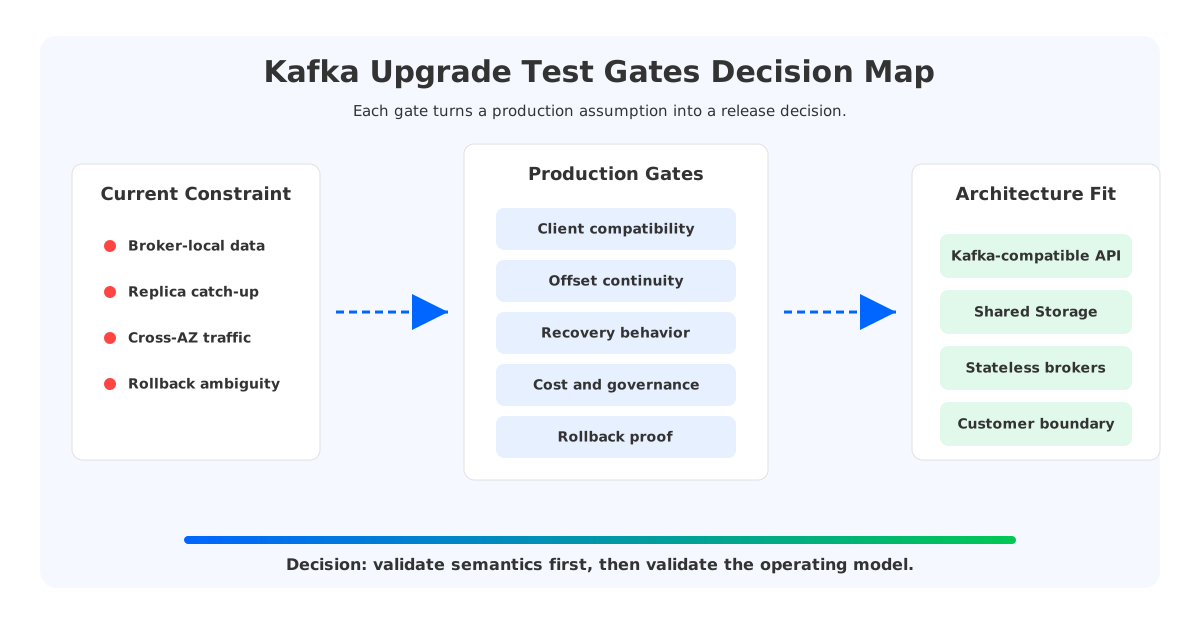
The useful way to approach kafka upgrade test gates is to treat them as risk reductions. Each gate answers one release question, produces one measurable signal, and defines one stop condition. The team is no longer asking, "Did the target cluster work in staging?" It is asking, "Which production assumptions have we validated?"
1Why teams search for kafka upgrade test gates
Kafka upgrades carry pressure because Kafka sits between systems with different owners. Application teams care about serialization, retries, ordering, idempotent producers, consumer lag, and downtime windows. Platform teams care about broker versions, controller state, partition placement, disk pressure, network paths, observability, and incident rollback. Security teams care about encryption, IAM boundaries, audit logs, and where data flows during migration.
Those concerns collide at production validation. A basic upgrade plan may verify that brokers roll one at a time and clients reconnect. A stronger plan tests whether the business can tolerate target-platform behavior: Consumer group movement, offset commits, transactional writes, Kafka Connect task recovery, KRaft metadata stability, and cold-read behavior after retention or tiering changes.
The gap is usually not technical ignorance. Kafka operators know that clients, topics, partitions, offsets, and Consumer groups matter. The gap is that upgrade checklists often mix three different decisions into one pass/fail bucket:
- Compatibility: Existing clients, protocols, ACLs, serializers, transactions, and connectors behave as expected.
- Operability: The platform can scale, rebalance, recover, observe, and roll back under production-like conditions.
- Economics and governance: The target architecture does not create hidden capacity, storage, network, or ownership problems.
Separating those decisions makes the gate useful. A team can pass client compatibility while failing rollback readiness, or pass broker restart while failing cost control. The point is not paperwork; it is making those differences visible before the change window.
2The production constraint behind the problem
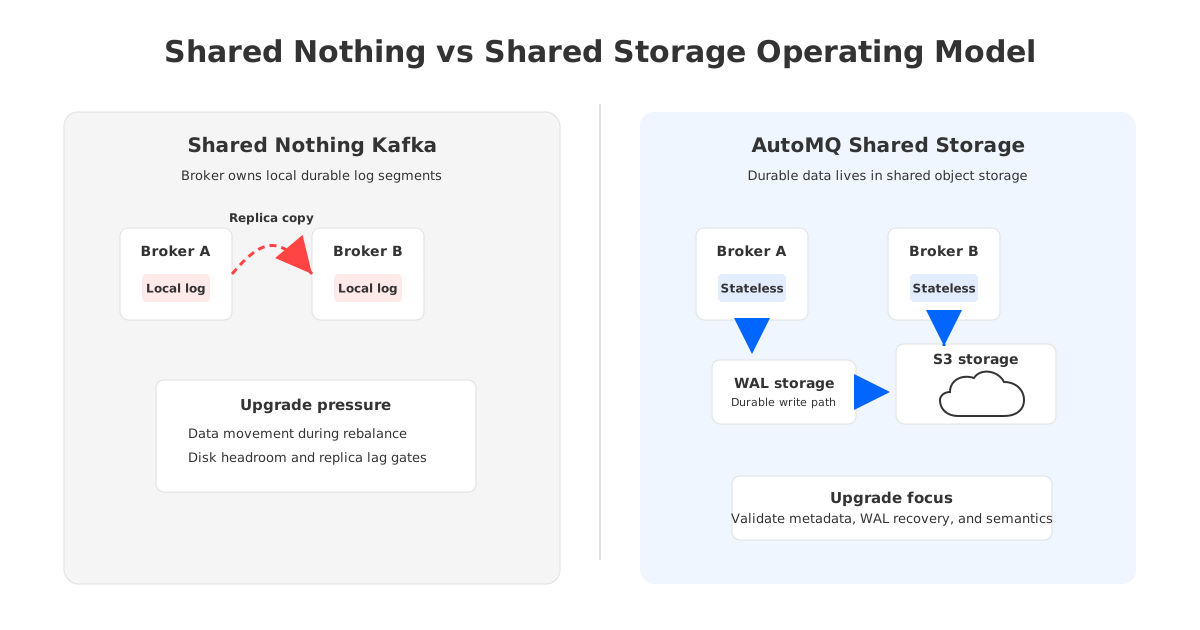
Traditional Kafka is a Shared Nothing architecture. Each Broker owns local log segments, and durability is achieved through replication between leader and follower replicas. That design is mature, but it makes production upgrades sensitive to local storage, broker placement, and data movement. When a cluster is resized, rebalanced, or recovered, the platform often moves partition data between Brokers or waits for replicas to catch up.
That behavior matters because the test is not only about software versions. It is about cluster behavior under production conditions. Broker-local storage turns several operational questions into capacity questions: spare disk, replica movement speed, cross-Availability Zone traffic, and whether rollback requires another round of data movement.
The common mistake is validating the steady state but not the transition state. A Kafka cluster may look healthy after an upgrade, while the risky hour was when partitions moved, clients reconnected, and consumers caught up. The gate should capture that transition.
Tiered Storage changes part of this picture by moving older log data to remote storage. It can reduce local disk pressure for historical data, and it is an important Apache Kafka feature. It does not, by itself, make Brokers stateless. Recent data, leader placement, replica state, and recovery still need local-storage validation.
That distinction is important for upgrade planning. If your gate assumes that remote storage removes all data movement, the test will miss the difference between offloading old segments and changing the primary storage model. A strong gate names the architecture being validated: Shared Nothing, Tiered Storage, or Shared Storage architecture.
3Architecture options and trade-offs
Platform teams do not need a vendor-first checklist. They need a neutral way to evaluate whether the target operating model matches the risk they are trying to remove. For Kafka-compatible streaming platforms, the architecture options usually fall into four patterns.
| Option | What to validate | Typical risk |
|---|---|---|
| In-place Kafka upgrade | Client compatibility, broker rolling restart, KRaft or metadata behavior, and disk headroom | Existing storage and network constraints remain in place |
| New Kafka cluster migration | Replication lag, offset translation, dual-write avoidance, DNS or bootstrap cutover, and rollback | Cutover state can diverge from source state |
| Kafka with Tiered Storage | Local hot data behavior, cold-read performance, retention rules, and remote log recovery | Operators may overestimate how stateless the cluster becomes |
| Kafka-compatible Shared Storage platform | Protocol compatibility, object-storage durability path, WAL behavior, scaling, and governance boundary | Architecture changes require different validation signals |
The table is not a ranking. In-place upgrades often fit small version changes with stable workloads. A target cluster migration can isolate old operational debt. Tiered Storage helps when retention and local disk pressure dominate. Shared Storage becomes more interesting when the upgrade is really a platform change: fewer broker-local storage dependencies, faster scale changes, and less data movement during recovery.
That last point should not be accepted as a slogan. If a platform claims Kafka compatibility, the gate still has to test Kafka semantics. Producers should validate retries, idempotence, transactions if used, and ordering. Consumers should validate committed offsets, group rebalances, lag recovery, and auto.offset.reset edge cases. Connectors should validate task restart, offset storage, and sink/source consistency.
The best gate design starts from application-facing semantics and works downward into operations. Start with what clients observe. Then test what operators must control. Only then decide whether the architecture improves the upgrade path.
4Evaluation checklist for platform teams
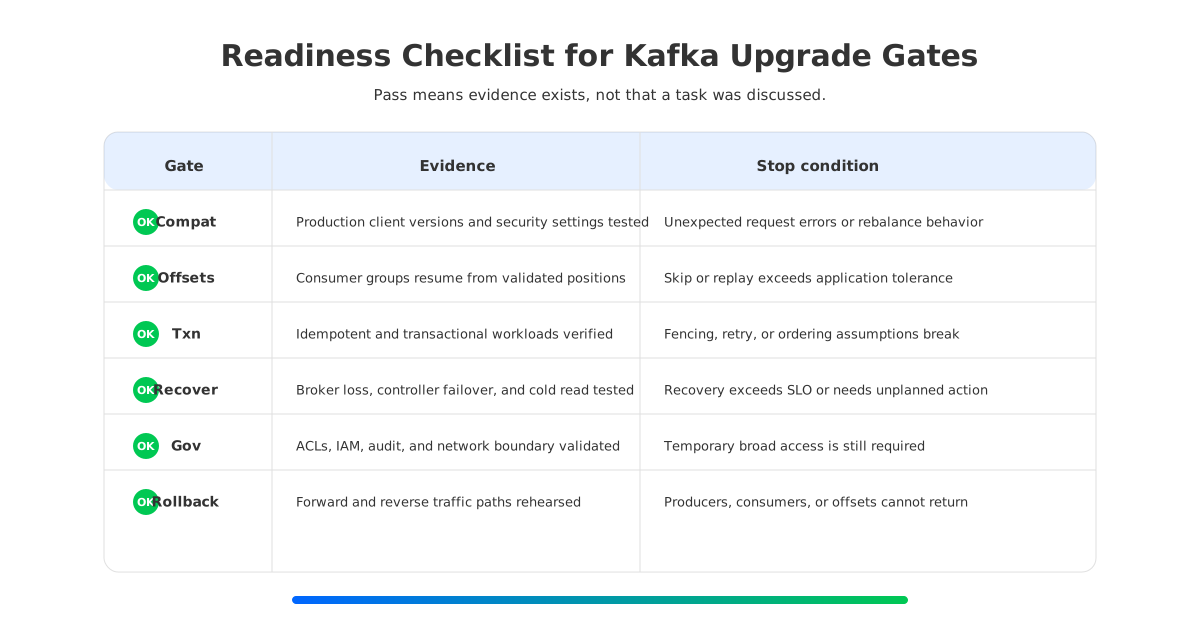
A useful production validation plan has a small number of gates with sharp failure criteria. If the gate cannot fail, it is a note, not a gate. These seven gates cover most Kafka upgrade and migration risk.
-
Client compatibility gate. Run representative producers and consumers with production client versions, security settings, serializers, compression, batch sizes, and retry policies. Pass only when request errors, rebalance behavior, and latency distributions stay inside the release SLO.
-
Offset and Consumer group gate. Validate committed offsets for each critical Consumer group before and after the upgrade. Prove that consumers resume from the expected position without skipping records or replaying beyond application tolerance. For migrations, test forward cutover and rollback.
-
Transaction and idempotence gate. If applications use idempotent producers or transactions, test them explicitly. A produce-consume test does not prove transactional fencing, producer epoch handling, or exactly-once assumptions.
-
Storage and recovery gate. Inject broker loss, controller failover, rolling restart, and cold-read scenarios. The pass condition should include recovery time, lag behavior, unavailable partitions, and manual reassignment needs.
-
Capacity and cost gate. Measure peak write throughput, read fanout, storage growth, broker utilization, and network traffic during the transition. In cloud environments, include cross-Availability Zone traffic and PrivateLink or inter-region paths when relevant.
-
Governance and security gate. Validate ACLs, authentication, encryption, audit visibility, network boundaries, and automation access. A migration that depends on a temporary broad credential has not passed production governance.
-
Rollback gate. Define the conditions that stop the upgrade and the steps that return traffic to the previous state. Include producers, consumers, offsets, DNS or bootstrap configuration, connector tasks, and dashboards.
The scorecard below is a practical way to keep those gates from becoming a wall of equal-looking tasks.
5How AutoMQ changes the operating model
After the neutral gates are defined, the architecture question becomes easier. AutoMQ is a Kafka-compatible cloud-native streaming platform that keeps the Kafka protocol and client ecosystem while replacing broker-local persistent log storage with a Shared Storage architecture backed by S3-compatible object storage. Brokers become stateless for durable data ownership, while WAL storage supports durable writes and failure recovery before data is uploaded to object storage.
That architecture changes what an upgrade gate should observe. In a broker-local model, partition movement and recovery are tightly coupled to data movement. In AutoMQ, durable data lives in shared object storage, while Brokers handle Kafka protocol processing, leadership, caching, and scheduling. The gate still tests Kafka semantics, but operational signals shift toward metadata ownership, WAL recovery, cache behavior, object storage access, and controller scheduling.
Migration design changes too. AutoMQ Kafka Linking supports migration from Apache Kafka or Kafka distributions to AutoMQ, with byte-to-byte topic synchronization and Consumer group offset synchronization documented by AutoMQ. For an upgrade gate, that matters because offset continuity and rollback are release criteria. If an application depends on Flink checkpoints, Consumer group offsets, or strict resume positions, prove those positions before traffic moves.
AutoMQ BYOC and AutoMQ Software also matter for governance gates. In AutoMQ BYOC, the control plane and data plane run in the customer's cloud account or VPC, and message data remains in the customer environment. That boundary still requires IAM, network routing, audit, and object storage policy validation.
The practical result is not that upgrade validation disappears. It becomes more focused. A Shared Storage architecture reduces the need to prove that large volumes of partition data can be copied between Brokers during every operational change. The team can spend more of the gate budget on application semantics, rollback, object storage access, observability, and whether stateless Brokers make scaling and recovery fit the production window.
6A release-ready gate model
The final gate should read like an engineering decision. For each domain, write one sentence that can be true or false:
- Critical producers and consumers pass compatibility tests with production client versions and security settings.
- Consumer groups resume at validated offsets after forward cutover and rollback.
- Transactional and idempotent workloads preserve their expected behavior under broker restart and client retry.
- Broker or node failure recovers within the release SLO without unplanned data movement.
- Storage, network, and compute costs during migration stay inside the approved budget.
- Governance controls match production policy without temporary broad access.
- Dashboards and alerts show the signals operators need during the change window.
If any sentence cannot be tested, the gate is not ready. If any sentence can fail without stopping the release, it is not a gate. That discipline matters because many Kafka failures are recoverable but still damaging. Duplicate consumption may be acceptable for one service and unacceptable for another. The gate must encode those differences before the incident bridge is open.
The strongest Kafka upgrade plans do not try to prove that nothing can go wrong. They prove that the team understands which failures matter, how to detect them, and how to reverse the change before those failures spread. That is the point of kafka upgrade test gates: not ceremony, but production control.
If you are evaluating whether a Kafka-compatible Shared Storage architecture can reduce the operational burden in your next upgrade or migration, review AutoMQ's architecture and deployment model, then test it against the gates above. For a hands-on evaluation in your own environment, start from the AutoMQ console: try AutoMQ BYOC.
7FAQ
7.1What are kafka upgrade test gates?
Kafka upgrade test gates are production release checks that validate whether a Kafka upgrade, migration, or platform change can safely proceed. They should cover client compatibility, Consumer group offsets, transactional behavior, storage recovery, capacity, governance, observability, and rollback.
7.2Is a staging smoke test enough for a Kafka upgrade?
No. A smoke test proves that a basic produce-consume path works. It does not prove production client compatibility, offset continuity, transactional behavior, broker recovery, cold-read behavior, or rollback readiness under realistic load.
7.3How should teams test Consumer group offsets during a migration?
Record committed offsets for critical Consumer groups, move or synchronize them through the planned migration path, and verify that consumers resume from the expected position on the target platform. Also test rollback, because source offsets may not advance automatically after a forward cutover.
7.4Does Shared Storage remove the need for upgrade validation?
No. Shared Storage changes the operating model by reducing broker-local durable data ownership and data movement, but teams still need to validate Kafka semantics, object storage access, WAL recovery, governance controls, and rollback behavior.
7.5Where should AutoMQ appear in an upgrade evaluation?
AutoMQ should be evaluated after the team defines neutral Kafka upgrade gates. That sequence keeps the decision grounded in compatibility, operability, governance, and migration risk rather than product claims.


