
Table of Contents
Table of Contents
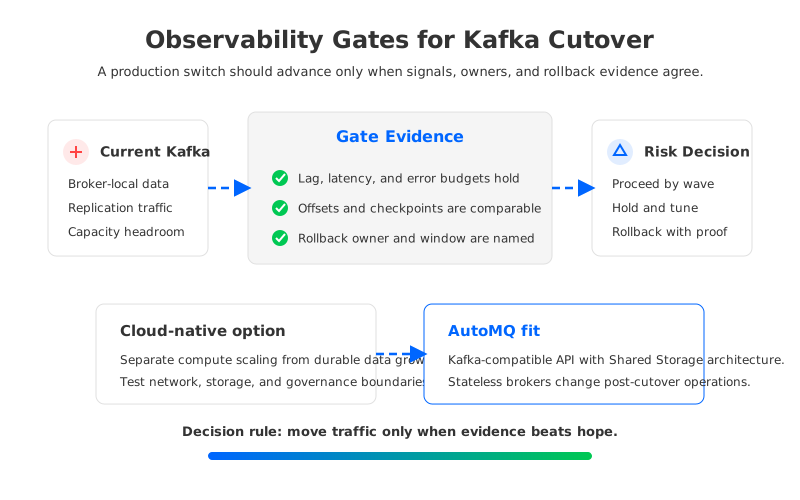
When a platform team searches for observability gates cutover kafka, the migration is usually past the whiteboard stage. Someone has already proven that records can move. A target cluster exists. A replication or linking path is running. The remaining question is harder: what evidence says production traffic is allowed to move, and what evidence says the team should stop?
That question is operational, not cosmetic. A Kafka cutover can look healthy from one dashboard while a consumer group is about to resume from the wrong offset, a connector is retrying quietly, or a private network path is adding latency only one application owner can see. The gate is the mechanism that prevents "the data copied" from being mistaken for "the system is ready." It turns the cutover from a calendar event into a sequence of measured decisions.
The healthiest teams make those decisions before the cutover window opens. They define the signals, thresholds, owners, and rollback actions while the source cluster is still authoritative and everyone can think clearly. If the team cannot say which metric will stop the next wave, the next wave is not ready.
1Why Teams Search for observability gates cutover kafka
Kafka migrations are uncomfortable because the platform is shared. One topic may feed fraud decisions, billing, search indexing, audit logs, and downstream lakehouse jobs. Producers and consumers also move at different speeds. A platform team can switch a bootstrap endpoint in one service, but another service may carry offset assumptions, schema dependencies, or a Kafka Streams state store that needs a separate rehearsal.
The phrase "observability gate" appears when teams realize that monitoring after cutover is too late. They need signals that can decide whether to proceed, pause, or roll back while both paths still exist. That signal set is broader than broker health. It has to cover producers, consumers, connectors, network reachability, storage behavior, authorization failures, and the business-level freshness expectations attached to each workload.
A useful gate has four parts:
- A live signal. The team can inspect it during the cutover window, not after an offline report is assembled.
- A threshold. The metric has a known pass, warning, and stop condition.
- An owner. One named team can interpret the signal and approve the next action.
- A rollback action. The team knows what command, config change, or traffic route reverses the wave.
Without those four parts, a dashboard is only a picture. It may help investigation, but it cannot control production risk.
2The Production Constraint Behind the Problem
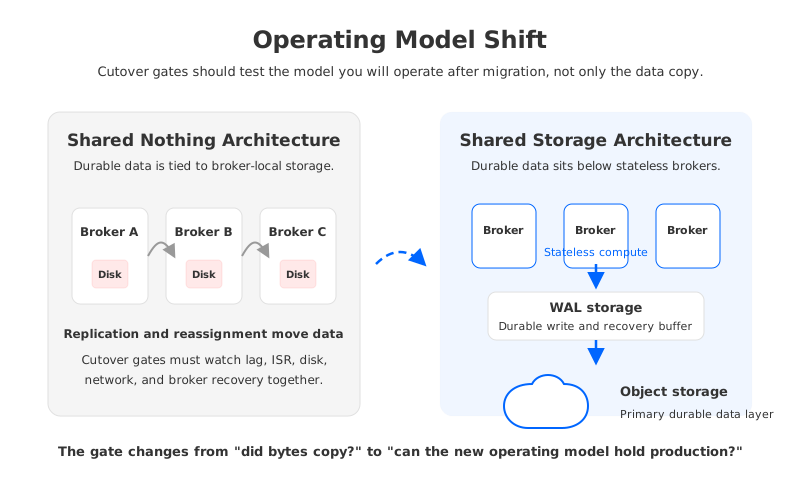
Traditional Kafka was designed around a Shared Nothing architecture. Each broker owns local log storage, and durability comes from replica placement and in-sync replication across brokers. That model is well understood, battle-tested, and still a strong fit for many environments. The operational tension appears when a cloud deployment asks the same broker to be compute capacity, durable storage owner, replication participant, failure domain, and scaling unit at the same time.
That coupling affects cutover validation. If the source cluster is under pressure, the symptoms may show up as broker disk saturation, slow partition reassignment, ISR shrinkage, controller churn, increased produce latency, or consumer lag. If the target cluster is also based on broker-local durable storage, the target needs enough spare capacity to absorb the migration surge and enough recovery headroom to survive a node failure during the same window. The cutover gate therefore has to test the infrastructure model, not only the application behavior.
The most common mistake is to validate only the replication path. Replication lag matters, but it is not the whole production contract. A migration can have low replication lag and still fail if consumers resume from an unsafe offset, if ACLs differ, if a connector task restarts with a different source-system position, or if a producer retry policy creates duplicates after a transient authorization error. Kafka exposes a durable log, but the application estate around that log defines the real cutover surface.
The constraint becomes sharper when teams are moving to a Kafka-compatible platform. Compatibility reduces application rewrite pressure, which is valuable, but it does not remove the need to validate the behaviors your estate uses. Consumer groups, offsets, idempotent producers, transactions, log compaction, Kafka Connect internal topics, and stream-processing checkpoints are all part of the contract if your applications depend on them.
3Architecture Options and Trade-Offs
Before building gates, separate the migration mechanism from the target operating model. The mechanism answers how data and traffic move. The operating model answers what the platform will feel like after the cutover. Those two questions are often mixed, and that is where observability plans become vague.
| Option | What the gate must prove | Hidden risk |
|---|---|---|
| Broker-local Kafka to broker-local Kafka | Replication, capacity, broker health, disk, and reassignment behavior remain inside limits. | The target may inherit the same scaling and data-movement constraints as the source. |
| Managed Kafka service | Application contracts, network paths, quota behavior, and support boundaries match production needs. | The service boundary may hide some signals the team used in self-managed operations. |
| Kafka-compatible shared storage | Kafka-facing behavior stays compatible while durable data no longer depends on broker-local disks. | The team must test the new storage, WAL, cache, and recovery behavior with real workload patterns. |
This is where gate design becomes practical. A broker-local target needs strong gates around disk, ISR, partition reassignment, and storage growth. A managed service needs gates around quotas, private connectivity, operational visibility, and escalation paths. A shared-storage target needs gates around write durability, object-storage behavior, cache hit patterns, cold reads, and stateless broker recovery.
None of those models is universally right. The point is to avoid using one generic "Kafka is healthy" dashboard for all of them. The architecture determines which failure modes deserve first-class gates.
4Evaluation Checklist for Platform Teams
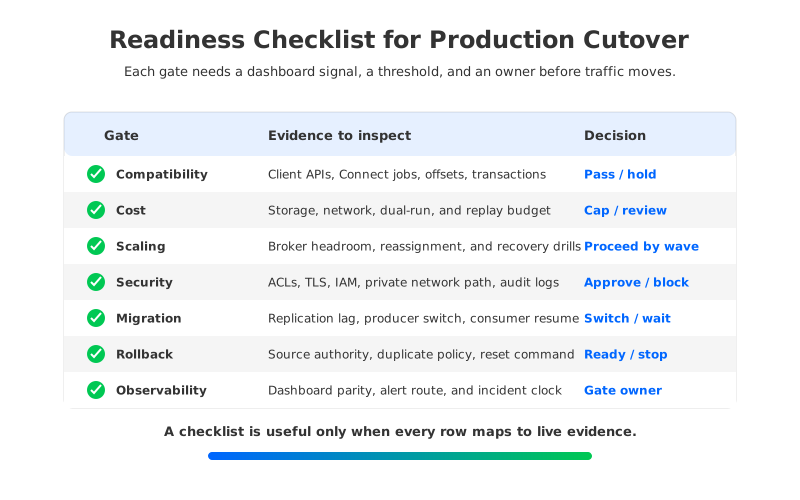
The strongest cutover gates are boring. They do not rely on a war-room hero interpreting 30 graphs. They reduce the migration into a small set of decisions that can be made under pressure. Each row below should map to a dashboard, a runbook step, and a named approver.
| Gate | Production question | Evidence that should exist before cutover |
|---|---|---|
| Compatibility | Can standard clients and ecosystem components behave as expected on the target? | Producer and consumer tests, admin API checks, Connect task tests, transaction or idempotency tests where used, and schema lookup tests. |
| Offset continuity | Can consumers resume without skipping records or replaying beyond tolerance? | Source and target offset comparison, consumer group mapping, checkpoint notes for stream processors, and duplicate-handling policy. |
| Lag and freshness | Is the target close enough to the source for the next wave? | Replication lag, end-to-end latency, consumer lag, connector lag, and workload-specific freshness thresholds. |
| Error budget | Are failures inside the application team's tolerance? | Produce error rate, consume error rate, authorization failures, retry rate, timeout rate, and dead-letter queue growth. |
| Network path | Are clients reaching the intended endpoint through the approved boundary? | DNS, private connectivity, TLS, firewall, route table, and cross-zone or cross-region traffic checks. |
| Rollback | Can the team return to the previous path without guessing? | Source authority definition, producer switchback procedure, consumer offset reset plan, duplicate policy, and rollback window. |
The table is intentionally strict. If a row has no owner, the migration is not ready. If the evidence is a verbal answer, the migration is not ready. If rollback depends on "we will decide then," the gate is not a gate.
The order of gates also matters. Start with compatibility and offset behavior before testing bulk traffic movement. Then validate lag, errors, and network path under a representative load. Only after those pass should the team rehearse rollback, because rollback without known offsets and known authority is mostly theater.
5How AutoMQ Changes the Operating Model
Once the neutral evaluation is in place, a cloud-native Kafka-compatible target becomes easier to judge. AutoMQ is a Kafka-compatible streaming platform that keeps the Kafka protocol and ecosystem expectations while replacing broker-local durable log storage with a Shared Storage architecture. The important cutover point is not that the migration disappears. It is that the system being validated after migration has a different failure and scaling model.
In AutoMQ, brokers are stateless from the perspective of durable stream data. S3Stream replaces Kafka's local log storage layer, using WAL (Write-Ahead Log) storage for durable writes and recovery buffering, with S3-compatible object storage as the primary data layer. That changes what platform teams should test after a successful cutover. Broker replacement, partition reassignment, scaling events, and retention growth no longer mean the same thing they mean in a broker-local storage model.
The migration gate still needs Kafka discipline. Producers must switch in controlled waves. Consumers must resume from validated offsets. Kafka Connect jobs and stream processors still need their own tests. AutoMQ Linking, available for AutoMQ commercial editions, is designed for Kafka-compatible migration paths where message synchronization and offset consistency matter. AutoMQ Open Source recommends MirrorMaker2 for cluster migration, which has different consistency characteristics and should be tested accordingly.
The more interesting gate is the post-cutover operating proof. A team evaluating AutoMQ should include these tests in addition to the usual migration checklist:
- Broker replacement drill. Remove or restart a broker and watch leader movement, client errors, recovery time, and whether durable data movement appears in the operational path.
- Scale event drill. Add and remove broker capacity under load, then inspect throughput, latency, partition ownership, and Self-Balancing behavior.
- Storage-path drill. Track WAL health, object-storage request behavior, cache behavior, and Catch-up Read performance for consumers that replay history.
- Boundary drill. Confirm that the control plane, data plane, object storage, IAM, and network path match the organization's governance model.
These tests are not product ceremony. They are how a team proves that the reason for migration survives contact with production. If the original pain was slow scaling, test scaling. If the pain was cross-AZ traffic, test the traffic path. If the pain was operational recovery, test recovery while application owners are watching.
6A Practical Gate Sequence
A production cutover should be staged as a sequence of narrow approvals, not as one large "go" decision. The exact steps depend on the organization, but the following sequence works well for Kafka estates with shared platform ownership.
- Freeze the contract. Capture topic list, partition counts, retention, compaction settings, ACLs, schemas, client versions, connector jobs, and consumer groups. Do not treat this as documentation cleanup. It defines what the gates must protect.
- Run shadow validation. Keep the source authoritative while the target receives mirrored or linked data. Compare offsets, lag, message counts where practical, and application read behavior without moving write ownership.
- Move low-risk consumers. Start with consumers that can replay safely and have clear owners. Watch lag, error rate, and downstream side effects.
- Move producers by domain. Switch producers for one workload domain at a time. Keep the source path and rollback steps ready until the gate window closes.
- Promote authority. Only promote the target when all required producers and consumers have moved, lag is inside threshold, rollback implications are understood, and the owner accepts the remaining risk.
- Keep the gate alive after cutover. The first quiet hour is useful, but the first normal business cycle is better. Keep alert thresholds tight until the platform has passed real traffic patterns.
The uncomfortable part is that a gate may say no. That is its job. A stopped migration is frustrating, but it costs less than discovering during an incident that no one knows which cluster owns the truth.
7FAQ
7.1What are observability gates for Kafka cutover?
Observability gates are predefined production checks that decide whether a Kafka migration wave can proceed, pause, or roll back. They combine live metrics, thresholds, owners, and runbook actions instead of relying on dashboard inspection after traffic has already moved.
7.2Which Kafka metrics matter most during cutover?
Start with producer error rate, producer latency, consumer lag, replication or linking lag, authorization failures, connector task failures, request timeout rate, broker health, storage-path health, and end-to-end freshness for the workload. The exact list should match the application contract, not a generic Kafka dashboard.
7.3Is low replication lag enough to approve a Kafka cutover?
No. Low replication lag shows that the data movement path is close to the source, but it does not prove offset safety, client compatibility, ACL parity, connector behavior, rollback readiness, or target operating health.
7.4How does shared storage affect cutover validation?
Shared storage does not remove migration validation. It changes what teams should validate after the migration. For a Kafka-compatible shared-storage platform, gates should include stateless broker recovery, WAL health, object-storage behavior, cache behavior, scaling, and governance boundaries.
7.5When should AutoMQ be evaluated in a Kafka migration?
Evaluate AutoMQ when the team wants to keep Kafka-compatible APIs while changing the long-term operating model around broker-local storage, scaling, recovery, retention, and cloud cost structure. Use the same gates you would use for any production migration, then add tests for Shared Storage architecture and stateless broker behavior.
If your team is building a production cutover plan, start with one workload domain and turn the checklist above into gates with owners, dashboards, and rollback commands. When you are ready to test a Kafka-compatible Shared Storage architecture against that plan, evaluate AutoMQ with your migration runbook.


