
Table of Contents
Table of Contents
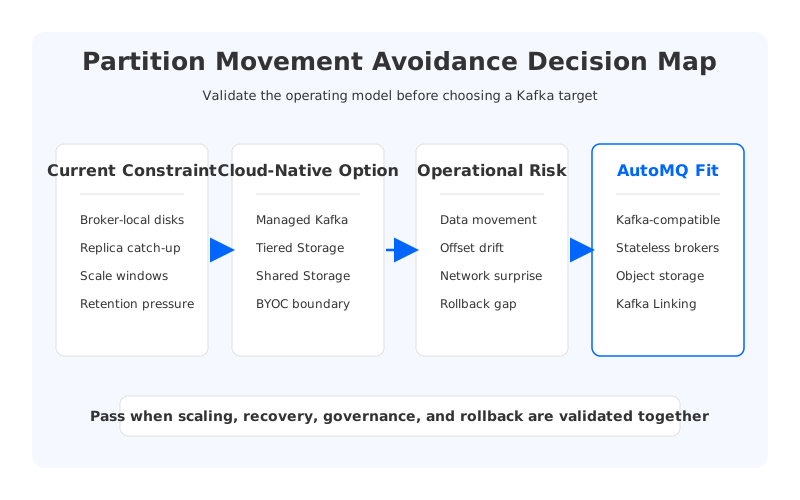
Teams search for partition movement avoidance kafka when Kafka has stopped being a steady background service and has become part of the production change calendar. A broker replacement needs a maintenance window. A retention increase creates disk pressure. A scale-out plan starts with a reassignment proposal instead of a capacity target. The question is not whether Kafka partitions can move; Apache Kafka documents reassignment, consumer groups, offsets, transactions, Kafka Connect, KRaft, and Tiered Storage as real operating surfaces. The harder question is whether a platform team can keep business traffic stable while avoiding unnecessary data movement in the first place.
That distinction changes the validation process. A team that only tests steady-state throughput will miss the part of Kafka that hurts during incidents: replica catch-up, leader movement, broker-local disk pressure, cross-Availability Zone (AZ) replication paths, consumer lag during rebalancing, and rollback after a failed migration step. Production validation should therefore measure the architecture under change, not only under load. The useful thesis is direct: partition movement avoidance is not a single Kafka setting; it is an operating-model goal that has to be validated across compatibility, storage ownership, scaling, governance, and migration control.
1Why Teams Search for partition movement avoidance kafka
The search phrase usually appears after the team has already tried normal Kafka hygiene. They have tuned replication throttles, reviewed partition counts, checked broker skew, and improved runbooks. Those steps matter, but they do not remove the underlying coupling in a traditional Kafka deployment: partitions are durable log shards, brokers own local or attached storage, and moving ownership can imply moving data or rebuilding replicas.
The problem becomes visible in ordinary production moments. A broker fleet needs a hardware refresh. A topic that once retained hours of data needs days for audit or replay. A consumer group falls behind after a downstream outage, turning historical fetch into a recovery workload. A cloud cost review asks why the cluster keeps idle disk and compute online for peaks that last a short time. Each scenario has a Kafka-level explanation, but the shared pattern is architectural: the platform is paying an operational tax whenever capacity, placement, or recovery changes.
Partition movement avoidance starts by naming which movement is actually harmful. Leadership changes and metadata updates are normal. Planned rebalancing can be healthy. The expensive category is movement that copies or reconstructs retained data while production traffic is still active. That is where validation should focus: how much data is tied to broker identity, how long a scale event consumes shared resources, and whether the team has to reserve extra capacity because moving partitions during a live incident feels too risky.
2The Production Constraint Behind the Problem
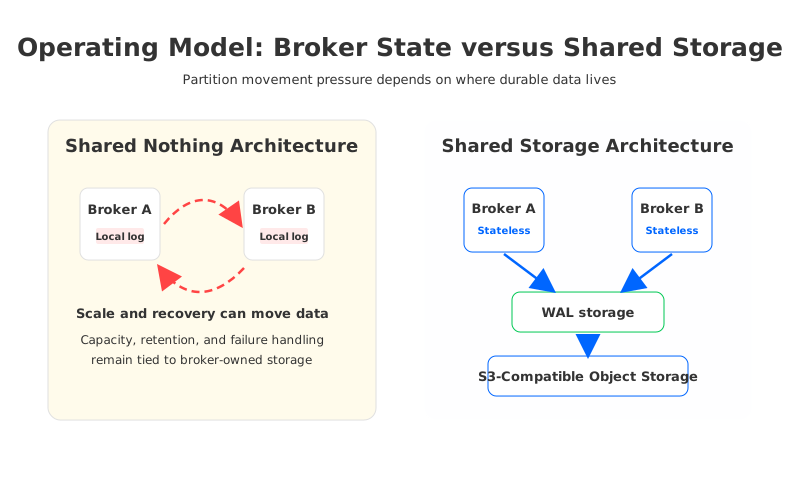
Traditional Kafka is built on a Shared Nothing architecture. Each broker stores log segments for the partitions assigned to it, and replication through ISR (In-Sync Replicas) protects durability and availability. This model is proven and familiar. It also makes brokers stateful infrastructure: the machine or volume behind the broker is part of the durability story, not merely a compute worker.
That statefulness turns small operational changes into multi-layer events. Adding brokers can require partition reassignment to use the added capacity. Removing brokers requires leadership and replica placement work. Replacing a broker requires careful recovery because local or attached storage is part of the cluster's state. Increasing retention expands the amount of data that might later participate in recovery or reassignment. In multi-AZ cloud deployments, replication and recovery paths may also cross fault-domain boundaries, so the operational plan becomes a network and cost plan.
Tiered Storage can reduce pressure from older log segments by placing historical data in remote storage, and it is worth evaluating where the main pain is long retention. It does not automatically make the active broker fleet stateless. The hot write path, local storage, broker ownership, and reassignment behavior still deserve direct tests. A team that treats Tiered Storage as complete partition movement avoidance may discover that the most painful movement involves active partitions and recent data, not old segments.
3Architecture Options and Trade-offs
The first option is to keep the current Kafka architecture and improve operational discipline. This is reasonable when traffic is predictable, retention is bounded, and the team has strong tooling around reassignment, throttling, capacity alerts, and failure drills. The trade-off is that the team is optimizing around the broker-local storage model rather than changing it.
The second option is a managed Kafka service. Managed operations can reduce the burden of infrastructure lifecycle, upgrades, and some day-to-day maintenance. The team still needs to validate the service boundary: supported Kafka APIs, client versions, authentication modes, network placement, pricing meters, region support, and what happens during scaling or broker replacement. A managed surface can simplify ownership, but it does not guarantee that the underlying storage model has stopped making partition movement expensive.
The third option is a Kafka-compatible Shared Storage architecture. In this pattern, the Kafka API remains familiar while durable stream data moves into shared object storage and brokers behave more like replaceable compute nodes. The evaluation shifts from broker disk sizing to WAL (Write-Ahead Log) behavior, object storage durability, cache design, metadata coordination, and how quickly ownership can move without copying retained partition history.
Use the same decision criteria for all three paths:
| Evaluation area | Question to answer | Evidence that matters |
|---|---|---|
| Kafka compatibility | Do producers, consumers, offsets, transactions, Connect, Streams, and admin tools keep expected behavior? | Client inventory, staging tests, protocol and API compatibility notes |
| Data movement | Does scaling or broker replacement copy retained partition data? | Failure drills, reassignment logs, recovery timelines, storage metrics |
| Cost boundary | Are compute, storage, network, and operational labor visible as separate drivers? | Cloud bill mapping, capacity model, retention forecast |
| Governance | Does the deployment boundary match VPC, identity, audit, and data residency requirements? | Security review, IAM model, private networking, observability plan |
| Migration control | Can the team cut over by workload and roll back with offsets and consumer progress intact? | Migration rehearsal, abort criteria, rollback owner |
The table is intentionally neutral. Some teams should stay with a well-run Kafka estate. Some should use a managed service because the service boundary is the value. Others should change the storage architecture because the recurring pain is not Kafka's API; it is the amount of durable state attached to brokers.
4Evaluation Checklist for Platform Teams
A production validation plan should start with compatibility, not architecture diagrams. List every client family, language library, producer setting, Consumer group, transactional producer, Kafka Connect worker, Kafka Streams job, schema workflow, ACL automation, quota rule, and observability integration. The purpose is to protect the application contract before debating the infrastructure target. Kafka compatibility is valuable only when the exact behaviors your estate relies on are tested.
The second validation layer is change behavior. Run broker replacement, scale-out, scale-in, partition reassignment, retention expansion, and consumer catch-up tests under representative traffic. Record not only whether the operation succeeds, but what it consumes: network bandwidth, disk I/O, object storage operations, broker CPU, controller activity, and operator attention. A result that passes functionally but starves production traffic is not a pass for partition movement avoidance.
The third layer is rollback. Many platform plans over-describe the happy path and under-specify the stop condition. A useful rollback plan names who can call the abort, which workloads are allowed to remain on the target, how offsets and consumer progress are verified, and what happens to writes accepted during the test window. This is especially important for migrations because application correctness depends on more than byte movement. It depends on ordering, offsets, idempotence, transactions, and consumer state.
Score each workload before it moves:
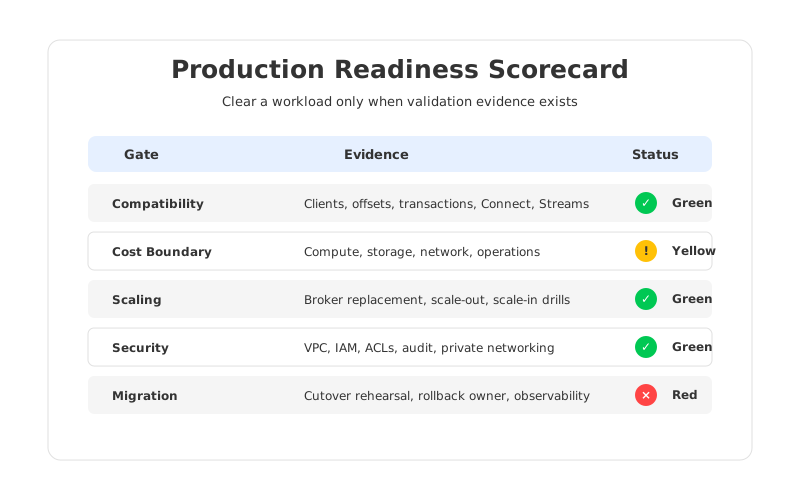
- Green: The workload has tested client compatibility, known ownership, bounded retention behavior, clear offset validation, and a rollback plan that has been rehearsed.
- Yellow: The workload is technically understood but has one unresolved edge, such as an old client, a stateful stream processor, or a connector restart dependency.
- Red: The workload cannot explain its source of truth, consumer progress, security model, or recovery owner. It should not be used as an early migration candidate.
This scoring method keeps the review practical. It prevents the platform team from treating all topics as equal and gives application owners a concrete reason to fix ambiguous dependencies before the infrastructure window arrives.
5How AutoMQ Changes the Operating Model
This is the right point to introduce AutoMQ. The evaluation framework has already isolated the real requirement: keep Kafka compatibility while reducing the amount of broker-local durable state that turns scaling and recovery into data movement projects. AutoMQ is a Kafka-compatible, cloud-native streaming platform built around Shared Storage architecture, S3Stream, WAL storage, and stateless brokers.
In AutoMQ, brokers still speak Kafka protocol and handle request processing, leadership, caching, and scheduling. The storage layer changes. Data is written through WAL storage and then organized in S3-compatible object storage through S3Stream. Because durable data is not owned by a broker's local disk as the long-term home of the log, broker replacement and partition reassignment are less tied to copying retained history between machines. The operational attention moves from "how do we move all this broker-owned data?" to "is the shared storage path, WAL choice, cache behavior, and metadata coordination healthy under this workload?"
That shift also affects migration planning. AutoMQ Kafka Linking is designed for Kafka-compatible migration paths that preserve byte-level data synchronization, offset consistency, synchronized consumer progress, and controlled producer cutover. Those capabilities map directly to the validation gates platform teams care about: application continuity, workload-by-workload cutover, and rollback clarity. The migration still needs capacity planning, network validation, security review, observability, and rehearsals. Architecture changes reduce the wrong kind of movement; they do not remove the need for disciplined production change management.
Deployment boundaries matter as much as mechanics. AutoMQ BYOC runs in the customer's cloud account and VPC, while AutoMQ Software targets private environments. For teams with strict governance requirements, that means the decision is not limited to "self-managed versus managed." It becomes a more precise question: can the platform keep Kafka semantics, place durable stream data in customer-controlled storage, and make brokers replaceable enough that scaling and recovery stop being dominated by partition data movement?
6A Production Validation Sequence
The cleanest validation sequence is incremental. Start by building an inventory that ties every workload to owners, client versions, authentication, retention, consumer groups, stateful processors, connectors, and dashboards. Then create a staging test that mirrors the failure domains and network paths of production. Synthetic benchmarks are useful, but they should be paired with workload-shaped tests: a lagging consumer, a rolling broker replacement, a retention increase, a connector restart, and a scale-in attempt after traffic falls.
After that, compare options through observed behavior rather than vendor claims. For existing Kafka, measure reassignment and recovery pressure. For a managed service, measure the service's scaling and migration boundaries. For a Shared Storage architecture, measure WAL durability, object storage behavior, cache hit patterns, broker replacement, and compatibility. The point is not to crown a universal winner. The point is to identify which operating model removes the constraint your team actually has.
End with a decision record that is short enough to use. It should name the accepted architecture, the workloads cleared for the first wave, the unresolved risks, the rollback owner, and the metrics that will decide whether the migration proceeds. Partition movement avoidance becomes real only when the team can point to evidence that production change no longer depends on large broker-local data movement.
7FAQ
7.1Is partition movement avoidance the same as disabling partition reassignment?
No. Reassignment and leadership movement can be healthy operational tools. The goal is to avoid unnecessary movement of retained data during scaling, recovery, or migration. A platform should still support controlled balancing; it should not make every capacity change depend on copying large broker-local logs.
7.2Does Tiered Storage solve partition movement avoidance in Kafka?
Tiered Storage can reduce local disk pressure for historical segments, but it does not automatically make brokers stateless. Platform teams should still test active partition behavior, hot data, local storage, recovery, and reassignment under their own workload.
7.3What should be validated before migrating to a Kafka-compatible platform?
Validate client compatibility, offsets, Consumer groups, transactions, Kafka Connect, Kafka Streams, ACLs, quotas, observability, network placement, cutover sequencing, and rollback. Compatibility claims are useful starting points, but production readiness comes from testing the exact behaviors your estate uses.
7.4When should AutoMQ be evaluated?
Evaluate AutoMQ when Kafka compatibility is required but broker-local storage, partition movement, retention growth, cross-AZ traffic, or slow broker replacement is the recurring operational constraint. It is most relevant when the team wants a customer-controlled deployment boundary and a storage model built around Shared Storage architecture.
If your validation work shows that partition movement is really a symptom of broker-local durable state, test a different operating model before the next scaling window becomes urgent. You can start with the AutoMQ trial console and map its Kafka-compatible migration path against your own readiness gates.
8References
- Apache Kafka documentation
- Apache Kafka documentation: consumer groups
- Apache Kafka documentation: transactions
- Apache Kafka documentation: Kafka Connect
- Apache Kafka documentation: KRaft
- AutoMQ documentation: architecture overview
- AutoMQ documentation: WAL storage
- AutoMQ documentation: partition reassignment in seconds
- AutoMQ documentation: migration overview


