
Table of Contents
Table of Contents
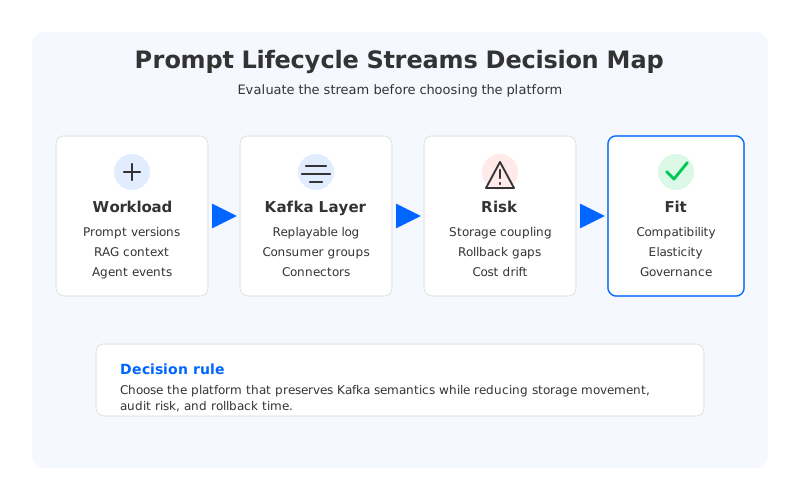
AI teams do not usually start by asking for another Kafka topic. They start with a release that went wrong: a prompt template changed, an agent called the wrong tool, a retrieval policy pulled stale context, or an evaluation set no longer explains why model output drifted. The search for prompt lifecycle streams kafka appears when those incidents stop looking like application bugs and start looking like a missing infrastructure layer.
Prompts behave more like production configuration than copy. A prompt version has authors, approvals, feature flags, dependencies, evaluation results, runtime traces, and rollback requirements. A database table may be enough for one model in one application. Multiple agents, RAG pipelines, customer-specific variants, and continuous evaluation turn the prompt lifecycle into an event stream.
That shift changes the platform question. The first decision is whether the team needs a durable, replayable, ordered history of prompt decisions that can be consumed by deployment tools, evaluation jobs, audit systems, observability pipelines, and rollback controllers.
1Why Teams Search for prompt lifecycle streams kafka
Prompt lifecycle work becomes hard when the same artifact has to satisfy two clocks. Product teams want releases to move quickly because model behavior is part of the user experience. Governance teams want every change to be attributable, reviewable, and recoverable because model behavior affects compliance, customer trust, and incident response. A prompt lifecycle stream records each meaningful change as an event and lets downstream systems react at their own pace.
That stream carries more than prompt text: semantic version, template variables, model references, retrieval policy IDs, safety policy references, evaluation summaries, rollout percentage, approval status, and rollback pointer. Runtime events can be separate topics keyed by prompt version, so evaluation and incident analysis can join what was deployed with how it behaved.
Kafka fits this pattern because its core abstraction is an append-only log with consumer groups and offsets. Apache Kafka documents consumer groups as a mechanism for distributing records among consumers while preserving each group’s progress independently, and that is exactly what prompt lifecycle systems need. The release controller, evaluation runner, audit warehouse, and observability sink should not block each other or share one fragile cursor.
The anti-pattern is to treat prompt lifecycle as a row-update problem. A database row tells you the current prompt, but incidents ask a harder question: which version was active, what made it eligible for rollout, which evaluation dataset was attached, and which consumers had processed the rollback signal?
2The Freshness and Governance Problem Behind AI Event Streams
Freshness matters because prompts are not isolated. A prompt may depend on a retrieval index, a tool schema, a model endpoint, a safety policy, and a customer-specific template. If one dependency changes while another remains pinned, the model can produce behavior that nobody explicitly released. The lifecycle stream records what combination was intended, when it became active, and which systems acknowledged it.
Governance matters because the prompt is also an operational artifact. A platform team needs to answer basic questions without reconstructing history from scattered application logs:
- Who proposed, approved, and deployed this prompt version?
- Which model, retrieval policy, and tool schema were part of the release envelope?
- Which evaluation suite passed before rollout, and what was the rollback condition?
- Which downstream systems consumed the release event and committed progress?
- Can the team replay the decision stream into a clean environment and reproduce the same state?
These are the same questions mature engineering teams ask about container images, database migrations, feature flags, and access policies. AI teams often grow into them after the application is live, so the stream has to integrate with existing services.
Kafka-compatible infrastructure is useful here because it provides a common contract for producers, consumers, connectors, and stream processors. Kafka Connect can move records between Kafka and external systems, while producer and consumer APIs keep lifecycle publishing close to the release workflow. Transactions and idempotent producers can matter when a release event must be coordinated with related metadata writes, though teams should test the exact semantics their clients and platform support.
3Architecture Options for Durable, Replayable AI Context
The architecture choice usually starts with a pipeline: prompt registry emits lifecycle events, deployment service consumes approved versions, evaluation consumes candidates, observability joins runtime traces with prompt metadata, and audit stores a long-term copy. That sketch is useful, but it hides the operating model underneath the stream. The hard part is keeping the log durable, recoverable, cost-visible, and elastic.
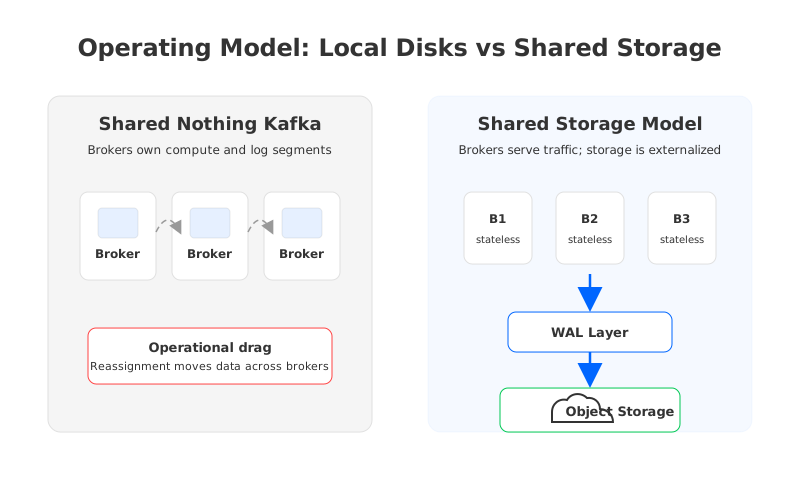
Traditional Kafka deployments use a shared-nothing model: each broker owns compute and local log storage. This design has served the ecosystem well because it keeps the broker self-contained and makes the replication protocol explicit. It also ties storage placement to broker placement. When teams add brokers, remove brokers, rebalance partitions, or recover from failures, data movement becomes part of the operational path.
That coupling becomes visible in prompt lifecycle systems because the write rate can be modest while the read fanout is wide. Evaluation jobs, governance jobs, release tools, offline analytics, and incident-response scripts may all read the same history differently. The cluster may not be constrained by ingest throughput, yet it still needs long retention, reliable catch-up reads, and predictable recovery.
Tiered storage changes part of the equation by moving older log segments to remote storage while brokers still coordinate hot reads and local state. That can help retention economics, but it does not fully remove the broker's storage responsibility. Platform teams should distinguish tiered storage from a shared-storage architecture where brokers are stateless with respect to durable log storage.
The evaluation should be concrete. A prompt lifecycle stream can be small enough that a weak architecture survives for months, then fails during the incident where replay speed, rollback confidence, and audit completeness matter most. The platform review should focus on operational failure modes.
| Decision area | What to verify | Why it matters for prompt lifecycle streams |
|---|---|---|
| Kafka compatibility | Client APIs, consumer groups, offsets, ACLs, connectors, and observability integrations | AI teams should not rewrite release tooling to adopt a different streaming backend |
| Retention economics | Long-lived prompt history, runtime traces, evaluation records, and replay windows | Audit and rollback windows often outlive hot operational data |
| Elastic scaling | Broker add/remove behavior, partition movement, and catch-up read impact | AI traffic can be bursty while governance workloads run in batches |
| Recovery model | Broker failure, zone failure, metadata recovery, and replay into a clean environment | A rollback plan depends on reproducible stream state |
| Governance boundary | Encryption, IAM, network isolation, tenant boundaries, and deployment ownership | Prompt data can include customer context and regulated workflow metadata |
| Migration risk | Mirror topics, offset handling, client compatibility, and rollback to the old cluster | The lifecycle stream should be safer after migration, not temporarily less auditable |
4Evaluation Checklist for Platform Teams
The strongest prompt lifecycle designs treat rollback as a streaming workflow, not as a button in the prompt registry. A rollback event should identify the target version, reason, scope, initiator, and systems expected to act on it. Consumers process that event using their own group offsets, which lets the platform team inspect who has caught up.
That model depends on operational visibility. Consumer lag is evidence that a deployment controller or audit pipeline has not processed a critical lifecycle event. Topic retention defines the replay horizon for incident reconstruction. ACLs decide who can publish a prompt release versus who can only observe one.
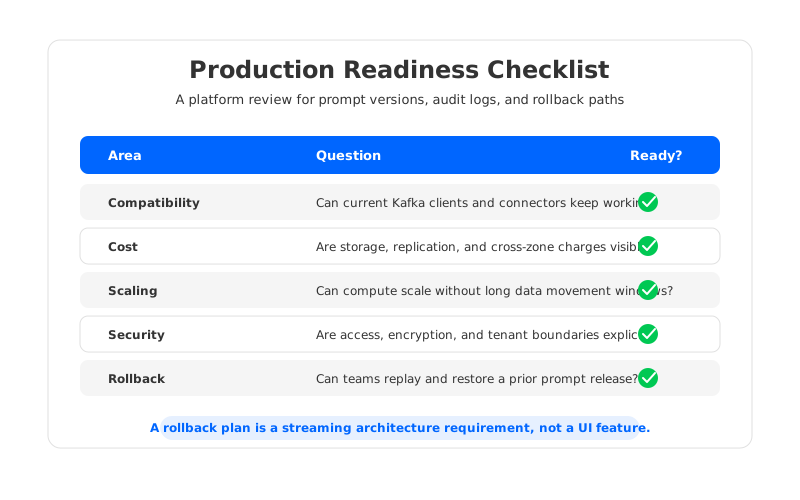
For production review, ask the following questions in order:
- Can every prompt release be reconstructed from immutable events, including approvals, dependencies, and evaluation evidence?
- Can a fresh consumer rebuild state from the relevant retention window without manual database exports?
- Can release, audit, evaluation, and observability consumers progress independently using consumer group offsets?
- Can the platform show which consumers processed a rollback event and which have not?
- Can the cluster scale read and retention capacity without turning every expansion into a long data movement project?
- Can the team migrate the stream platform while preserving topic data, client behavior, and consumption progress?
If the answer to the first four questions is no, the team does not yet have a prompt lifecycle stream; it has prompt change notifications. That distinction matters. Notifications are useful for integration. Streams are useful for recovery.
5How AutoMQ Changes the Operating Model
Once the evaluation reaches storage coupling, elasticity, and migration risk, AutoMQ becomes relevant as an architectural option rather than a product detour. AutoMQ is a Kafka-compatible, cloud-native streaming platform that keeps the Kafka protocol and common client ecosystem while moving durable stream storage into a shared-storage architecture backed by object storage and a WAL layer.
The design goal is straightforward: brokers should serve Kafka traffic without being the long-term owners of the data they serve. In a shared-nothing Kafka cluster, broker replacement or partition movement often implies data movement because durable log segments are tied to broker-local disks. In AutoMQ's model, brokers are stateless with respect to durable storage, while S3Stream and the WAL layer handle the storage path. Scaling compute and retaining history are no longer the same decision.
For AI teams, the value is not that prompt events are unusually large or high throughput. Many are not. The value is that prompt lifecycle streams combine long retention, many independent readers, strict rollback expectations, and governance boundaries. Reducing broker-local storage pressure gives architects more room to design for auditability instead of designing around disk placement.
AutoMQ's documentation describes native compatibility with Apache Kafka, shared storage through S3Stream, WAL storage options, migration from Apache Kafka, and approaches for reducing inter-zone traffic. Those details matter because prompt lifecycle systems usually sit beside existing Kafka clients, observability tools, and data integration jobs. Compatibility comes first; storage architecture only helps if the surrounding ecosystem keeps working.
Teams still need topic naming conventions, schema discipline, retention policy, access controls, evaluation metadata design, rollback automation, and replay runbooks. A shared-storage Kafka-compatible platform does not design the prompt lifecycle for you. It changes the infrastructure constraints so those design decisions are not dominated by broker disk sizing and partition reassignment.
6Migration and Rollback Design
Migration deserves its own plan because the prompt lifecycle stream may become the system of record for AI releases. If the existing prompt registry stores state in a database, begin by emitting immutable lifecycle events alongside it. Once consumers can rebuild from the stream, the registry can become a producer and materialized view.
A pragmatic migration path has four phases: define the event envelope, publish lifecycle events from the current release workflow, attach read-only consumers for audit and evaluation, then move release automation and rollback controllers onto the stream once consumer lag, retention, and access controls are observable.
The rollback path should be tested before the first production incident. Pick a real prompt family, deploy version N, deploy version N+1, emit a rollback event to N, and verify which systems changed state. Release control, audit, evaluation, and observability should all show the rollback.
Kafka's offset model is useful here. Each consumer group can be inspected independently, so a delayed audit consumer does not block serving rollback, and a delayed release controller is visible as lag rather than hidden inside an application queue.
7Cost, Security, and Operations
Cost analysis is easy to underestimate because prompt event volume often looks small. The expensive part can be retention, replay, replication, and cross-zone movement, especially when runtime traces are joined with prompt versions for evaluation. Cloud object storage pricing, durability, network transfer, and private connectivity should be checked against the target region and account model.
Security analysis should assume prompt metadata is sensitive. Prompt text may expose business logic, retrieval context may point to customer data, and runtime traces may include user interactions. Teams should define permissions, encryption, network boundaries, and audit export controls. Operationally, dashboards and runbooks should prove which rollback event was processed, by which consumer, and at what offset.
8A Practical Readiness Scorecard
Use this scorecard before turning prompt lifecycle events into a production dependency. Score each item from 0 to 2: not designed, partially designed, or tested.
| Readiness item | Score |
|---|---|
| Event schema is versioned and immutable | 0-2 |
| Release, audit, evaluation, and observability use independent consumer groups | 0-2 |
| Retention supports incident reconstruction and compliance review | 0-2 |
| Rollback flow has been tested with real consumers | 0-2 |
| Lag alerts distinguish safety-critical and analytical consumers | 0-2 |
| Access controls separate release publishers from read-only consumers | 0-2 |
| Migration plan preserves topic data, client behavior, and consumption progress | 0-2 |
The score forces a decision: is this stream a notification bus, an audit trail, or a release control plane? Those are different reliability promises.
For teams evaluating Kafka-compatible infrastructure for this pattern, the next step is to compare the operating model against replay and rollback requirements. AutoMQ's shared-storage architecture overview is a useful starting point: read the AutoMQ architecture documentation.
9References
- Apache Kafka Documentation: https://kafka.apache.org/documentation/
- Apache Kafka Consumer Configuration: https://kafka.apache.org/documentation/#consumerconfigs_group.id
- Apache Kafka Connect Documentation: https://kafka.apache.org/documentation/#connect
- Apache Kafka Transactions Documentation: https://kafka.apache.org/documentation/#transactions
- Apache Kafka Tiered Storage Documentation: https://kafka.apache.org/documentation/#tiered_storage
- AutoMQ Shared Storage Architecture: https://docs.automq.com/automq/architecture/overview.md
- AutoMQ S3Stream Shared Streaming Storage: https://docs.automq.com/automq/architecture/s3stream-shared-streaming-storage/overview.md
- AutoMQ Kafka Compatibility: https://docs.automq.com/automq/architecture/technical-advantage/native-compatible-with-apache-kafka.md
- AutoMQ Difference with Tiered Storage: https://docs.automq.com/automq/what-is-automq/difference-with-tiered-storage.md
- AutoMQ Migration from Apache Kafka: https://docs.automq.com/automq/migration/migrating-from-apache-kafka-to-automq.md
- AutoMQ Inter-Zone Traffic Overview: https://docs.automq.com/automq/eliminate-inter-zone-traffics/overview.md
- Amazon S3 Pricing: https://aws.amazon.com/s3/pricing/
- Amazon S3 Data Durability: https://docs.aws.amazon.com/AmazonS3/latest/userguide/DataDurability.html
10FAQ
10.1Do prompt lifecycle streams need Kafka, or is a database enough?
A database can be enough where one service owns all reads and writes. Kafka becomes useful when deployment automation, evaluation, audit, observability, and incident response need the same ordered history. The key requirement is independent replay, not raw throughput.
10.2What should be included in a prompt lifecycle event?
At minimum, include prompt ID, version, actor, timestamp, approval state, dependency references, evaluation summary, rollout scope, and rollback pointer.
10.3How long should prompt lifecycle topics be retained?
Retention should match the longest period needed for incident reconstruction, compliance review, and model behavior analysis. Some teams keep compacted metadata topics for current state and longer-retention event topics for audit.
10.4How is rollback different from publishing an older prompt again?
Publishing an older prompt again changes serving state, but it may not explain why the change happened or which downstream systems processed it. A rollback event should be explicit, attributable, scoped, and observable.
10.5Where does AutoMQ fit in a prompt lifecycle architecture?
AutoMQ fits when teams want Kafka-compatible APIs plus a shared-storage operating model with stateless brokers and object-storage-backed durability. It changes the infrastructure constraints behind prompt registry design, schema governance, and rollback automation.


