
Table of Contents
Table of Contents
Teams usually search for protect pii kafka after Kafka has already become the nervous system for customer activity, payment events, product telemetry, support cases, and operational logs. The platform is doing its job: it moves events quickly, keeps producers and consumers decoupled, and gives downstream systems a durable stream of business facts. The security problem starts when nobody can say with confidence which topics contain personally identifiable information, which fields are safe to replay, and which consumers are allowed to see raw values.
That ambiguity is expensive because Kafka records do not stay in one place. A single event may be retained in a topic, processed by a stream application, mirrored to another cluster, exported by Kafka Connect, queried by a data product, and replayed during incident recovery. If the PII rule lives only in a wiki page or one producer library, the rule will drift from the pipeline.
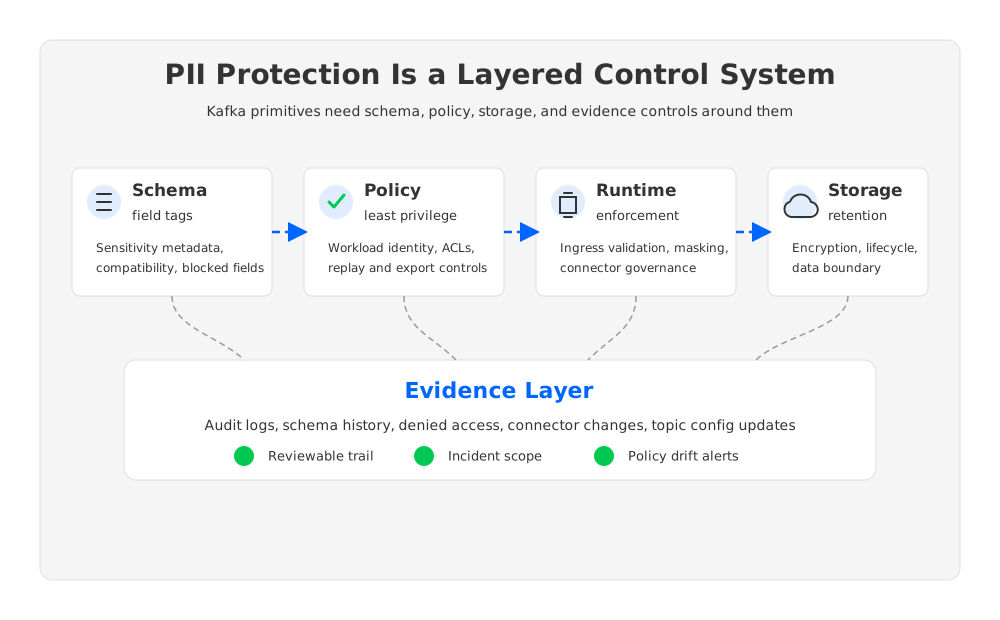
The right starting point is not "encrypt Kafka" or "add a masking library." Those controls matter, but they answer only part of the question. Protecting PII in Kafka requires a layered design:
- Shape: schemas define which fields may exist, which fields are sensitive, and which changes are allowed.
- Path: policies define who can produce, consume, transform, mirror, export, and replay each topic.
- Storage: retention, encryption, isolation, and ownership boundaries define how long sensitive events remain recoverable.
- Evidence: audit trails, lineage, and incident workflows prove the controls are working when compliance teams ask.
1Why PII Spreads Differently in Kafka
Traditional databases tend to have visible table ownership, query logs, and user-facing access paths. Kafka is different. Its value comes from fan-out: one producer can feed many consumers, and consumers can replay historical data without asking the producer to resend it. Apache Kafka describes an event as a record with a key, value, timestamp, and optional headers; that flexibility is why sensitive fields can hide in multiple places.
PII also changes risk based on context. A user ID may be harmless in one isolated service but sensitive when joined with location, device, support notes, or purchase history. NIST SP 800-122 frames PII protection around inappropriate access, use, and disclosure, which maps well to event streaming. Kafka does not make that distinction for you, so the platform team has to turn topics, partitions, offsets, headers, ACLs, and retention into policy.
2Schema Controls Are the Contract Layer
Schema controls make PII visible before it enters the shared stream. A schema does more than keep Avro, Protobuf, JSON, or custom payloads parseable. It can express field ownership, sensitivity labels, compatibility rules, and allowed transformations.
A practical schema program usually needs three layers:
- Structural schema: field names, types, optionality, defaults, and compatibility mode. This prevents accidental breaking changes and makes downstream processing predictable.
- Sensitivity metadata: tags such as
pii.direct,pii.quasi_identifier,secret, orregulatedattached to fields, headers, or nested objects. These tags should be machine-readable, not comments in a ticket. - Release workflow: CI checks that reject unsafe additions, require owner approval for sensitive fields, and generate a changelog for data governance and incident response.
Kafka headers are useful for routing, tracing, and lightweight metadata, but they should not become a second ungoverned payload. If a header contains an email, token, phone number, or customer ID, it needs the same classification, retention, and access treatment as the value.
Schemas also need negative controls. Payment card numbers, passwords, session tokens, private keys, and raw government identifiers should usually be blocked at ingress rather than masked later. If a workflow truly needs them in an event stream, the exception should be explicit, reviewed, time-bound, and isolated.
3Policy Controls Are the Runtime Boundary
Schemas define what the data is; policies define who may do what with it. Kafka provides security primitives such as SSL/TLS encryption, SASL authentication, and ACL-based authorization. Those primitives are necessary, but PII protection requires policy design above the primitive level: can this principal read raw PII, replay old PII, export it, transform it, or mirror it elsewhere?
The policy model should be built around workload identity. A fraud-scoring service, billing sink, CRM export connector, and experimentation platform should have separate principals even if the same team owns them. That separation lets the platform grant narrow permissions and investigate misuse.
| Control area | Kafka-level mechanism | PII-specific decision |
|---|---|---|
| Authentication | SASL or mTLS client identity | Is every producer, consumer, connector, and processor using a distinct principal? |
| Authorization | ACLs on topics, groups, transactional IDs, and cluster resources | Can the principal read raw PII, masked PII, or only derived signals? |
| Transport security | TLS-enabled listeners | Are sensitive pipelines restricted to encrypted paths end to end? |
| Retention | Topic retention and compaction settings | Does the topic keep raw PII longer than the business purpose requires? |
| Replay | Consumer group offsets and reset behavior | Who can reset offsets and reprocess historical sensitive events? |
| Export | Kafka Connect and sink credentials | Which systems are allowed to receive PII, and under what field-level rules? |
The table matters because Kafka access is not one-dimensional. A connector that reads one topic may still copy PII into a data store with weaker controls. A developer with permission to reset offsets may trigger a large replay of historical sensitive data. For PII, administrative permissions are data permissions.
4Ingress Validation Beats Downstream Cleanup
The lowest-friction point to protect PII is before the record is written. Once a sensitive record lands in a Kafka topic, the platform must assume it can be retained, consumed, mirrored, exported, and replayed according to topic settings.
Ingress validation should combine deterministic checks and governance workflow. Deterministic checks catch blocked field names, invalid schema tags, raw secrets, unexpected payload size, or serialization failures. Governance workflow handles harder cases: a quasi-identifier, a field allowed only for a specific purpose, or a topic whose retention needs privacy review.
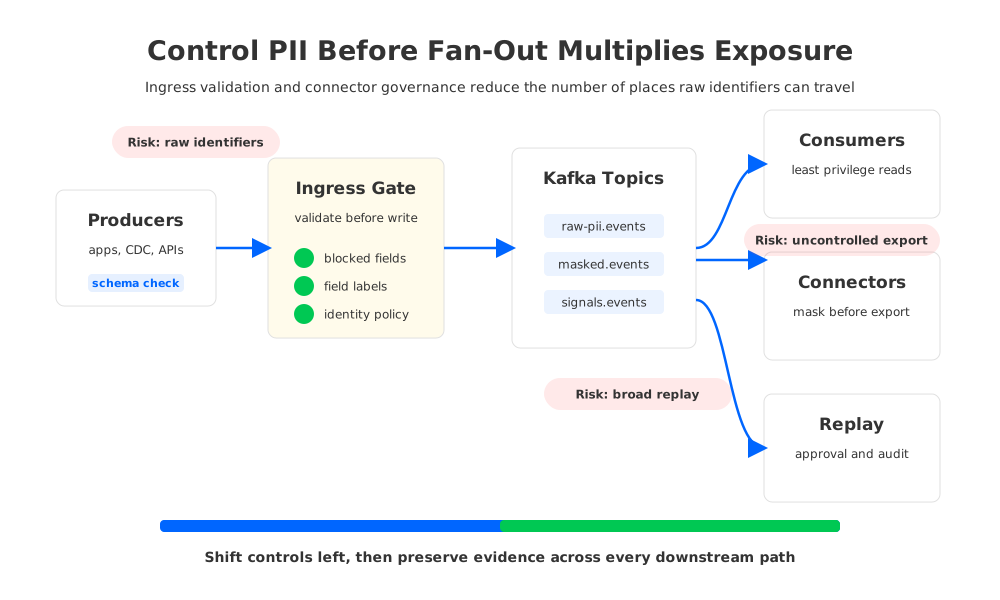
There are three useful enforcement patterns:
- Producer-side enforcement: shared libraries and CI templates stop bad schemas and payloads early, but they should be paired with platform checks.
- Ingress proxy or gateway enforcement: a controlled entry point validates schemas, headers, identities, and topic policies before writes reach brokers.
- Broker-adjacent policy checks: platform-level controls inspect authorization, topic configuration, and client identity close to the Kafka boundary.
No single pattern wins everywhere. High-throughput telemetry may rely on schema CI and topic isolation, while regulated customer events may require a stricter ingress gateway.
5Retention, Replay, and Deletion Are Governance Controls
Kafka retention is often treated as an operational setting: keep enough history for consumers to recover, but not so much that storage costs rise. With PII, retention becomes a governance control. Longer retention expands the window for inappropriate access and increases the blast radius of a credential leak.
Compaction needs similar care. A compacted topic may retain the latest value for each key for a long time, which is useful for state distribution but risky if the value contains direct identifiers. If a privacy request requires suppressing an identifier, the team needs to understand how that request propagates through compacted topics, derived topics, sink systems, caches, and backups.
Replay is the control many teams miss. Kafka's ability to reset a consumer group and reprocess old data is a feature. For PII topics, it is also a privileged operation. A replay can resend historical records to systems with different policies, schemas, or owners.
6When Architecture Changes the Governance Burden
PII controls are shaped by the streaming platform's storage and deployment model. In a traditional Shared Nothing architecture, Kafka brokers manage local storage and replicate partition data across brokers for durability. That model tightly couples storage capacity, broker replacement, partition reassignment, and retention design.
A cloud-native Kafka-compatible platform changes some of those operating constraints without changing the Kafka API surface that applications depend on. AutoMQ is one example: it keeps Kafka protocol and ecosystem compatibility while replacing broker-local persistent storage with a Shared Storage architecture backed by S3-compatible object storage and WAL (Write-Ahead Log) storage. In this model, AutoMQ Brokers are stateless, and persistent stream data is not tied to a single broker's local disk.
That does not classify PII or write your policies. It does change the platform questions security teams can ask. If the deployment model is AutoMQ BYOC, both the control plane and data plane run inside the customer's own cloud account and VPC. That boundary helps the organization align network controls, key management, object storage policies, audit collection, and Kafka-compatible operations within its own environment.
The architecture also affects operational pressure. When brokers are lighter and persistent data lives in shared storage, scaling and balancing become less tied to large partition data movement. That gives platform teams more room to isolate sensitive workloads, tune compute capacity, and recover from node issues without turning every operation into a data relocation project.
7A Production Checklist for Protecting PII in Kafka
The strongest PII program is routine: every sensitive topic has an owner, a schema, a policy, a retention decision, and an audit trail. A checklist turns privacy from a quarterly review into a release gate.
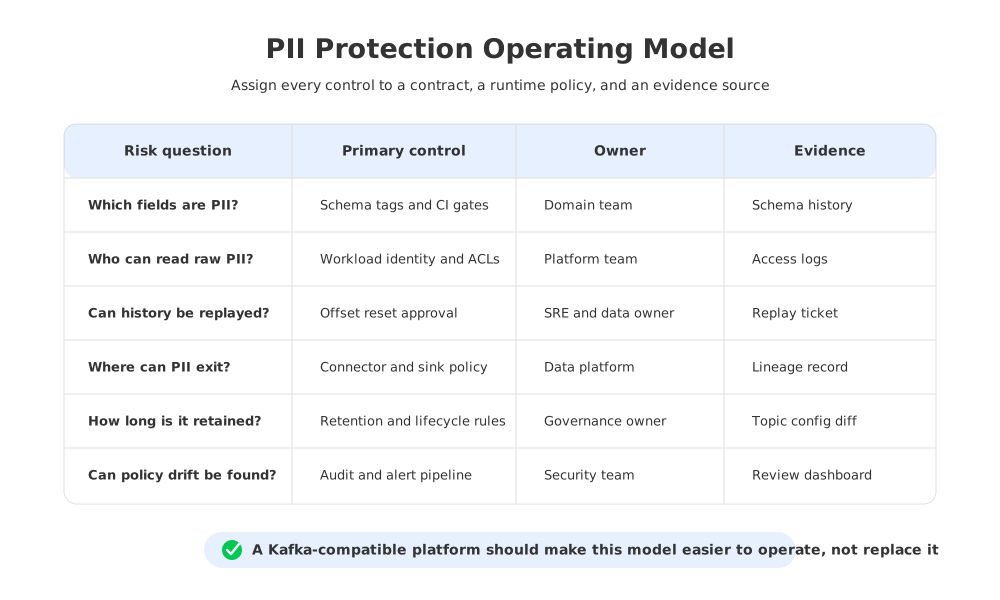
Use this checklist when reviewing a Kafka pipeline that may carry PII:
- Topic inventory: every topic has an owner, purpose, sensitivity label, retention policy, and downstream system list.
- Schema enforcement: every producer uses an approved schema workflow, and sensitive fields are tagged in a machine-readable way.
- Field minimization: direct identifiers and secrets are blocked unless a documented exception exists.
- Access boundaries: producers, consumers, connectors, and processors use distinct workload identities with least-privilege ACLs.
- Replay governance: offset reset, backfill, and historical replay require approval and are logged as sensitive operations.
- Export control: sink connectors and lake ingestion jobs preserve field classifications and apply masking or tokenization rules where needed.
- Encryption and keys: sensitive paths use encrypted transport and approved encryption-at-rest controls for broker storage, object storage, and sink systems.
- Monitoring evidence: audit logs, schema changes, denied requests, connector changes, and topic config updates feed a reviewable evidence trail.
This checklist also exposes a common maturity gap. Many teams can describe encryption and authentication, but fewer can explain who may replay sensitive history or which connector copied a field into a warehouse.
8Decision Table: Control First, Platform Second
Platform selection should come after the governance model is clear. A managed service, a self-managed Kafka deployment, or a Kafka-compatible shared-storage architecture can all be secure or insecure depending on implementation.
| If your main risk is... | Prioritize... | What to validate |
|---|---|---|
| Unknown sensitive fields | Schema metadata and CI enforcement | Field tagging, blocked fields, compatibility checks, owner approval |
| Overbroad consumers | Workload identity and ACL design | Distinct principals, group permissions, denied-access evidence |
| Uncontrolled exports | Connector policy and sink governance | Connector credentials, masking, lineage, destination security |
| Excessive retention | Topic lifecycle governance | Retention by data class, compaction behavior, deletion workflows |
| Operational drift | Platform automation | Policy-as-code, audit feeds, reproducible topic and ACL provisioning |
| Data boundary concerns | Deployment model and storage ownership | VPC boundary, key control, object storage policy, observability scope |
For teams that want Kafka compatibility and a cloud-native operating model, AutoMQ is worth evaluating after the control model is defined. Its Shared Storage architecture and BYOC deployment boundary do not replace privacy engineering, but they can reduce operational friction around elasticity, broker replacement, and customer-controlled data placement.
Protecting PII in Kafka starts with an uncomfortable question: can the platform explain where sensitive fields are, who can touch them, and what happens when they are replayed? If the answer depends on tribal memory, the risk is already larger than it looks. Start with schema contracts and policy controls, then choose the Kafka-compatible architecture that keeps those controls enforceable under production change. To explore how AutoMQ approaches Kafka compatibility, Shared Storage architecture, and customer-controlled deployment, review the AutoMQ architecture and security documentation linked below.
9References
- Apache Kafka Documentation: Introduction
- Apache Kafka Documentation: Security
- Apache Kafka Documentation: Authentication using SASL
- NIST SP 800-122: Guide to Protecting the Confidentiality of PII
- AutoMQ Documentation: Architecture Overview
- AutoMQ Documentation: Compatibility with Apache Kafka
- AutoMQ Documentation: Manage Security
10FAQ
10.1What is the first step to protect PII in Kafka?
Start with a topic and schema inventory. Identify which topics may contain PII, who owns them, which fields are sensitive, which consumers read them, and how long the data is retained. Encryption and ACLs are important, but they are hard to apply correctly without this inventory.
10.2Should PII be stored in Kafka headers?
Avoid putting PII in headers unless there is a clear, governed reason. Headers are often used for routing and tracing, so teams may overlook them during data classification. If a header can identify a person, it needs the same schema, policy, retention, and audit treatment as the record value.
10.3Can Kafka ACLs enforce field-level PII policies?
Kafka ACLs control access to resources such as topics, consumer groups, transactional IDs, and cluster operations. They do not provide field-level masking by themselves. Field-level protection usually requires schema metadata, producer validation, stream processing controls, masking or tokenization services, and connector governance.
10.4How does retention affect PII risk?
Longer retention increases the amount of sensitive history that can be replayed, copied, or exposed after a credential or policy mistake. Retention should be tied to business purpose, recovery needs, legal requirements, and deletion workflows, not only to storage cost.
10.5Where does AutoMQ fit in a PII protection architecture?
AutoMQ fits after the organization has defined schemas, policies, and audit requirements. It provides a Kafka-compatible platform with Shared Storage architecture, stateless brokers, and BYOC deployment options, which can help teams keep data placement and operations inside customer-controlled infrastructure while preserving Kafka ecosystem compatibility.


