
Table of Contents
Table of Contents
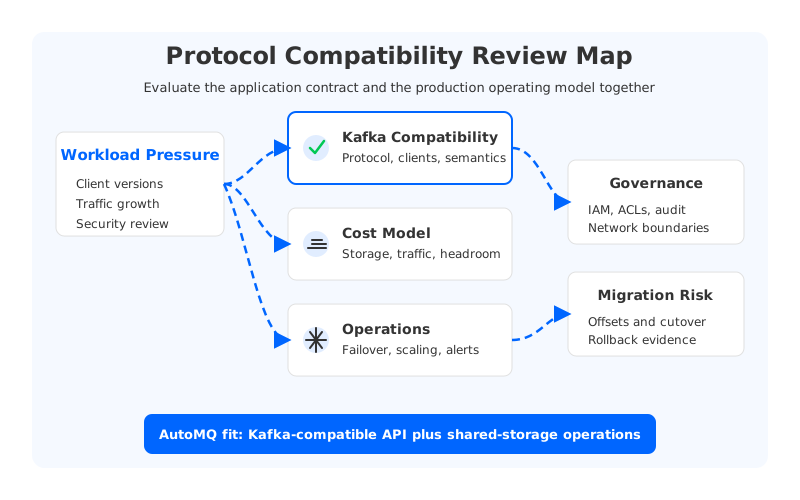
A protocol compatibility review kafka search usually starts when the team has already outgrown a simple question. The issue is no longer whether an application can call produce() and consume() against another endpoint. The issue is whether a Kafka-compatible platform can preserve the application contract, the operational contract, and the recovery contract after it enters production. That distinction matters because Kafka compatibility is visible in the first integration test, but incompatibility often appears later: during a rebalance, a transactional workload, a connector rollout, a security audit, a broker failure, or a regional incident.
The uncomfortable part is that most platform evaluations compress this review into a client smoke test. A producer writes a record. A consumer reads it. A dashboard shows throughput. The result looks reassuring, yet it does not answer the harder question: what exactly must remain Kafka-compatible for your organization to treat the platform as production infrastructure? For an SRE team, the answer includes offset management, failure behavior, observability, and rollback. For an application team, it includes client libraries, serializers, consumer group behavior, delivery semantics, and error handling. For a CTO or procurement reviewer, it includes cost predictability, deployment boundaries, governance, and vendor exit options.
1Why Teams Search for protocol compatibility review kafka
Kafka became an infrastructure standard because it created a stable contract between producers, consumers, stream processors, connectors, and operators. That contract is broader than the wire protocol. It includes topic and partition semantics, offset commits, consumer group coordination, producer acknowledgements, transactional guarantees, ACLs, quotas, metadata behavior, admin APIs, and the operational assumptions teams build around all of those pieces. A platform can be Kafka-compatible in the narrow client sense while still changing enough behavior to require application or runbook changes.
That is why a serious review should start with the workload, not the vendor. A payments system using idempotent producers and transactions has a different compatibility risk profile from an observability pipeline that can tolerate duplicates. A CDC estate built on Kafka Connect has a different migration burden from a small group of custom consumers. A regulated organization that treats Kafka ACLs and audit logs as control evidence has a different bar from a product analytics team focused mainly on throughput. The review has to expose those differences before the team signs off on the platform.
There are four practical reasons teams run this review:
- They want to change infrastructure without rewriting applications. The platform must accept common Kafka clients, preserve expected protocol behavior, and support the operational APIs the team already uses.
- They want a cloud operating model that does not inherit every storage and scaling constraint of broker-local disks. Compatibility matters, but it should not block architecture improvement.
- They need to quantify migration risk. A compatible endpoint is useful, but migration also depends on offset movement, topic configuration, connector behavior, rollback paths, and observability.
- They need a governance answer. Security teams care about identity integration, encryption, auditability, network boundaries, and customer control over where data runs.
The search term looks narrow. The actual decision is architectural.
2The Production Constraint Behind the Problem
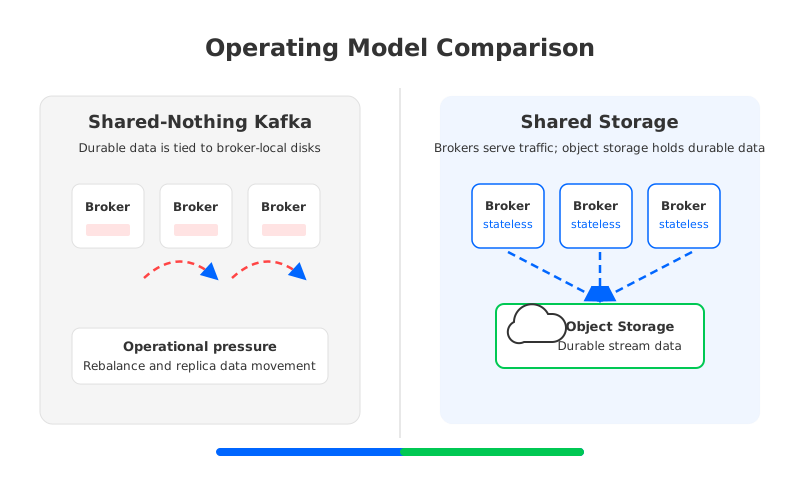
Traditional Apache Kafka is a shared-nothing system: each broker owns local partitions on its attached storage, and replication copies partition data across brokers for durability and availability. This model has served Kafka well, but it couples compute, storage, and network movement in ways that become expensive and operationally heavy in cloud environments. When a broker fills disk, loses a node, or needs rebalancing, the platform has to move data. When the cluster spans availability zones, replication and follower reads can create cross-zone traffic. When capacity grows unevenly, operators often choose between over-provisioning and noisy rebalancing.
Protocol compatibility does not remove those constraints. It can hide them for application developers, which is valuable, but platform teams still own the infrastructure physics underneath. A Kafka-compatible platform that keeps broker-local storage may preserve client behavior while retaining familiar capacity planning problems. A platform that separates compute from storage may change the operating model, but the team must then verify that the Kafka contract still holds for the workloads that matter.
This is the first review trap: teams test compatibility and architecture as if they were the same thing. They are related, but they answer different questions. Compatibility asks whether existing clients, APIs, and semantics keep working. Architecture asks what happens when load changes, a node fails, a region has an incident, a security policy changes, or a team needs to restore service under pressure. A production review needs both.
The second trap is treating Kafka as one interface. Kafka is a family of interfaces and expectations. A producer path depends on batching, compression, acknowledgements, idempotence, and retries. A consumer path depends on fetch behavior, group membership, offset commits, lag visibility, and rebalance behavior. An admin path depends on topic configuration, ACLs, quotas, metadata, partition changes, and operational tooling. A data integration path depends on Kafka Connect, schema handling, connector offsets, and task recovery. The review should name each path, because one successful path does not validate the rest.
3Architecture Options and Trade-Offs
Kafka-compatible platforms usually fall into three operating models. The first model is self-managed Kafka on virtual machines or Kubernetes. It gives teams high control over version, configuration, plugins, and network design, but it also leaves them responsible for broker storage, upgrades, rebalancing, incident response, and cost controls. The second model is managed Kafka. It reduces parts of the operational burden, but the underlying shared-nothing design can still shape storage scaling, network cost, and partition movement. The third model is cloud-native Kafka-compatible streaming, where the platform keeps the Kafka protocol surface while redesigning the storage and scaling layer.
The right question is not which model is universally preferable. The right question is which risk you are trying to remove. If your main risk is a small operations team that cannot patch brokers on schedule, managed Kafka may be enough. If your main risk is cloud cost from replication, over-provisioned disks, and scaling headroom, a platform that changes the storage model deserves closer inspection. If your main risk is strict application semantics, then the compatibility review must go deeper than the architecture diagram.
| Review Dimension | What to Validate | Why It Matters |
|---|---|---|
| Client protocol | Producer, consumer, admin, and transactional paths with real client versions | Client compatibility is the minimum entry point, not the full decision |
| Data semantics | Ordering, offset commits, idempotence, transactions, retention, and compaction | Small semantic differences can become application correctness bugs |
| Operations | Rebalance behavior, failover, upgrades, scaling, observability, and rollback | Production reliability depends on runbooks as much as APIs |
| Cost model | Storage growth, replication traffic, cross-AZ traffic, endpoint charges, and headroom | A compatible platform can still create an unpredictable cloud bill |
| Governance | IAM, ACLs, encryption, audit logs, network isolation, and data residency | Security sign-off often gates production migration |
| Migration | Topic sync, offset migration, connector continuity, dual-write, and cutback | The review should prove reversibility before cutover |
The table is intentionally plain. Compatibility reviews fail when they become vendor checklists full of feature names. A useful review turns each feature into a falsifiable question. Does this client version work? Does the consumer group rebalance the same way under a rolling restart? Does the platform expose the metrics your alert rules use? Can the team prove where data is stored? Can the migration be rolled back without losing consumer position?
4Evaluation Checklist for Platform Teams
Start with the application contract. List the client libraries, versions, serializers, compression codecs, delivery settings, authentication methods, and admin operations used in production. Include the boring details, because compatibility failures often live there. A consumer that uses cooperative rebalancing, a producer that depends on idempotence, or a framework that performs topic creation through the Admin API can reveal more than a throughput benchmark.
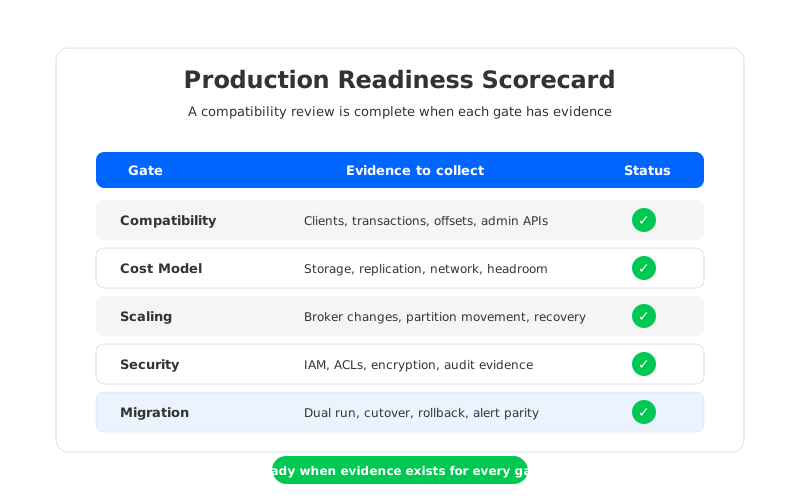
Then test the operational contract. A review environment should include realistic topic counts, partition counts, message sizes, retention settings, and consumer group patterns. It should also include failure injection. Restart brokers, rotate credentials, scale capacity, change topic configuration, interrupt a connector task, and observe what happens to lag, offsets, and alerts. The goal is not to create chaos for its own sake; it is to prove that your existing operational assumptions still hold, and the scorecard below keeps that proof concrete.
The cost review deserves the same rigor as the API review. Kafka costs are rarely limited to broker instance hours. Storage, replication, cross-zone traffic, connector infrastructure, private connectivity, monitoring, and over-provisioned capacity can all matter. The exact numbers depend on region, provider, traffic pattern, and deployment model, so do not accept any static cost claim without rebuilding the estimate from current cloud pricing pages and measured workload data. The review should state its assumptions: write throughput, read fanout, retention, replication factor, availability zones, compression ratio, and expected growth.
Security and governance should not wait until the end. A Kafka-compatible platform may pass application tests and still fail a security review because of identity mapping, audit coverage, encryption boundaries, private connectivity, or data residency requirements. Platform teams should ask where the control plane runs, where the data plane runs, who can access metadata, how credentials are rotated, and how logs are retained. For BYOC and self-managed models, the review also needs to clarify which responsibilities stay with the customer and which are handled by the vendor.
The final checkpoint is reversibility. A migration plan that has no rollback path is not a compatibility review; it is a bet. Before cutover, prove that topics can be synchronized, offsets can be mapped or reset according to application policy, connectors can be paused and resumed, and consumers can move without ambiguous ownership. Some applications can tolerate a controlled replay. Others need exact offset continuity. The review should make that distinction explicit.
5How AutoMQ Changes the Operating Model
Once the review has separated protocol behavior from infrastructure behavior, AutoMQ becomes relevant as an architecture option rather than a slogan. AutoMQ is a Kafka-compatible cloud-native streaming platform that keeps the Kafka API surface while moving durable log storage to shared object storage. Brokers become stateless in the operational sense: they serve protocol traffic and cache hot data, while the durable stream state is no longer tied to a broker's local disk.
That change targets the production constraints that a compatibility review often uncovers. If storage is bound to brokers, scaling storage capacity usually means scaling broker resources or moving partitions. If durable data lives in shared storage, compute and storage can scale more independently. If broker replacement does not require copying a large local log from one node to another, recovery and elasticity become less data-movement-heavy. The Kafka contract still needs to be tested, but the operating model is different.
AutoMQ's architecture also changes how teams think about cloud cost. Traditional replication copies data between brokers, and in multi-AZ deployments that traffic can interact with provider-specific network billing. AutoMQ's shared-storage design is built to reduce broker-to-broker replication movement and supports a zero cross-AZ traffic architecture documented by AutoMQ. That does not mean every bill disappears; object storage, compute, private networking, and operational services still have costs. It means the cost model should be evaluated from a different set of primitives: object storage durability, write-ahead log design, stateless broker capacity, and read fanout behavior.
The most important review point is still compatibility. AutoMQ should be tested with the same client paths, topic settings, transaction patterns, connector workflows, security controls, and runbooks you would test against any Kafka-compatible platform. The difference is what you test after the protocol tests pass. With AutoMQ, the next questions shift toward storage separation, WAL choice, object storage behavior, deployment boundary, and how stateless brokers affect scaling and recovery. That is a better conversation than asking whether a producer can write one message.
For teams evaluating cloud-native Kafka, the practical path is a two-layer review. Layer one proves Kafka compatibility for the workloads that matter. Layer two proves the operating model under failure, scale, cost, and governance pressure. AutoMQ is strongest when the second layer is the real pain: elastic capacity, cloud cost control, reduced broker-local data movement, and customer-controlled deployment boundaries.
If your team is already running this kind of review, use a small workload that resembles production rather than a synthetic demo. Bring the client versions, topic configurations, security model, alert rules, and cost assumptions you already own. To see how AutoMQ fits that process, start with the hands-on guide for experiencing AutoMQ Cloud, then extend it with your own compatibility checklist.
6References
- Apache Kafka Protocol Guide: https://kafka.apache.org/protocol/
- Apache Kafka Documentation: https://kafka.apache.org/documentation/
- Apache Kafka Connect Documentation: https://kafka.apache.org/documentation/#connect
- Apache Kafka KRaft Documentation: https://kafka.apache.org/documentation/#kraft
- Apache Kafka Tiered Storage Documentation: https://kafka.apache.org/documentation/#tiered_storage
- AutoMQ Architecture Overview: https://docs.automq.com/automq/architecture/overview?utm_source=blog&utm_medium=reference&utm_campaign=protocol-compatibility-review-kafka
- AutoMQ WAL Storage: https://docs.automq.com/automq/architecture/s3stream-shared-streaming-storage/wal-storage?utm_source=blog&utm_medium=reference&utm_campaign=protocol-compatibility-review-kafka
- AutoMQ Difference with Tiered Storage: https://docs.automq.com/automq/what-is-automq/difference-with-tiered-storage?utm_source=blog&utm_medium=reference&utm_campaign=protocol-compatibility-review-kafka
- AWS Global Network FAQs: https://aws.amazon.com/about-aws/global-infrastructure/global-network/faqs/
- AWS PrivateLink Pricing: https://aws.amazon.com/privatelink/pricing/
7FAQ
7.1What does Kafka protocol compatibility mean?
Kafka protocol compatibility means a platform can speak the Kafka client protocol and support the producer, consumer, admin, and metadata interactions that applications expect. For production decisions, the review should go beyond the wire protocol and test delivery semantics, offset behavior, transactions, security, observability, and operational runbooks.
7.2Is a successful producer and consumer smoke test enough?
No. A smoke test proves a narrow path through the system. A production compatibility review should also test consumer group rebalances, retry behavior, idempotent producers, transactions if used, topic administration, ACLs, connector workloads, monitoring, failure recovery, and rollback.
7.3How should teams compare shared-nothing Kafka and shared-storage Kafka-compatible platforms?
Compare them on both compatibility and operating model. Shared-nothing Kafka ties durable partition data to broker-local storage, so scaling and recovery often involve data movement. Shared-storage platforms separate durable storage from broker compute, which can reduce broker-local recovery work and change the cost model. The Kafka application contract still needs direct validation.
7.4Where does AutoMQ fit in a protocol compatibility review?
AutoMQ fits after the neutral compatibility checklist is defined. Test it like any Kafka-compatible platform for client behavior, semantics, security, and operational tooling. Then evaluate the architecture-specific questions: shared object storage, stateless brokers, WAL design, independent compute and storage scaling, deployment boundary, and zero cross-AZ traffic architecture.
7.5What should be in a migration readiness checklist?
A practical checklist should include client inventory, topic and partition inventory, security mapping, connector behavior, offset strategy, dual-run plan, rollback path, alert parity, cost assumptions, and ownership boundaries. The migration is ready when each item has evidence, not when a vendor feature list looks complete.


