
Table of Contents
Table of Contents
Searching for MSK Cost usually means the first spreadsheet has already failed. The AWS pricing page can tell you the hourly rate for a broker class, the storage price per GB-month, and the optional line items that may apply. What it cannot know is whether your cluster is about to become storage-bound, network-bound, replay-bound, or operationally bound. Those four conditions create very different bills even when the broker count looks identical.
Amazon MSK is a strong managed service for teams that want Apache Kafka on AWS without running every control-plane operation themselves. The hard part is not whether MSK has a price. The hard part is that provisioned Kafka cost is a moving target: brokers carry compute and hot storage together, storage can grow in ways that are difficult to reverse, and production traffic rarely follows the clean average rate used in early estimates.
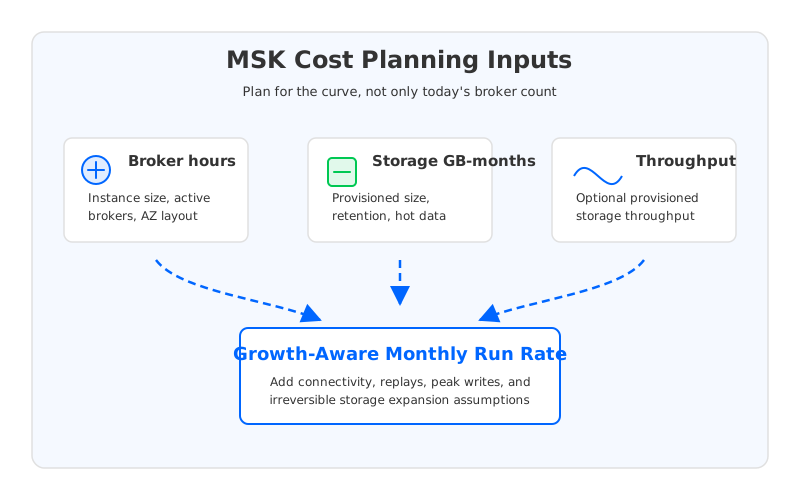
The useful question is not "How much does MSK cost?" It is "Which workload inputs make the MSK bill grow, and which architecture choices keep that growth reversible?" Once the problem is framed that way, cost planning becomes an engineering exercise rather than a procurement exercise.
1Start with the billable units, then add the growth behavior
For MSK Provisioned Standard brokers, AWS describes the core bill as broker instance usage plus provisioned storage. Storage is calculated as GB-months, and optional provisioned storage throughput is charged separately when enabled. AWS also notes that standard data transfer charges apply for traffic transferred in and out of MSK clusters, and that PrivateLink-based private connectivity has its own hourly and per-GB processing charges.
That gives FinOps a starting table, but Kafka platform owners need a second table beside it: how each input changes under growth. Broker hours grow when CPU, network, partition density, or operational isolation requires more brokers. Provisioned storage grows when retention, backlog, or topic count increases. Throughput charges may appear when EBS throughput becomes the constraint. Connectivity charges show up when clients cross VPC, account, Region, or service boundaries.
| Cost input | What buyers often model | What production planning should add |
|---|---|---|
| Broker hours | Number and size of brokers | Peak write/read load, partition density, failure headroom, rolling maintenance |
| Provisioned storage | Retention multiplied by ingest | Replication factor, hot data window, growth bursts, inability to shrink volumes |
| Storage throughput | Average write throughput | Flush/replay behavior, compaction, catch-up consumers, peak-hour write amplification |
| Data transfer and connectivity | Normal producer and consumer traffic | Cross-VPC access, multi-account clients, PrivateLink, cross-Region replication |
| Operations | Managed service assumption | Capacity reviews, quota planning, storage expansion runbooks, migration paths |
The storage line deserves special attention because it behaves differently from compute. AWS MSK documentation states that automatic storage scaling can expand broker storage based on utilization, but a storage scaling action can occur only once every six hours. The same documentation also states that MSK does not reduce cluster storage when usage falls. Manual expansion has the same directionality: you can increase storage, but the service does not let you decrease the existing volume size.
That one-way behavior changes the cost model. If a retention spike pushes storage upward, the extra GB-months can remain in the run rate after the spike is gone. For a team with strict chargeback, this matters as much as the unit price because it changes who pays for temporary demand.
2The hidden variable is coupling
Traditional Kafka made a sensible trade-off for the environment where it was born. Brokers own compute, network serving, and local log storage. Replication across brokers gives durability and availability. When demand grows in a data center, adding brokers and disks is a natural way to add more aggregate capacity.
Cloud pricing changes the shape of that trade-off. Compute, block storage, object storage, and network transfer are separate products with separate billing models. A Kafka cluster that binds compute scaling to storage placement can therefore overpay in either direction. If the workload needs more retention but not more CPU, the team may still carry more broker-attached storage. If the workload needs more network or CPU but not more retained data, the team may add brokers and then rebalance partitions across those brokers.
The cleanest MSK cost plans separate three questions that are too often merged:
- How much compute do producers, consumers, controllers, and background broker work require during peak hours?
- How much durable storage does the workload require over its full retention and replay window?
- How much data must cross AZ, VPC, account, or Region boundaries to satisfy availability and client access?
When these are separate questions, teams can reason about trade-offs directly. A broker-heavy architecture may be appropriate when workload growth is predictable and operational simplicity matters more than independent scaling. Tiered storage may be attractive when long retention is the main pressure and old data is rarely read. A shared-storage Kafka-compatible architecture becomes relevant when the team wants brokers to behave more like stateless compute while durable data lives in cloud storage.
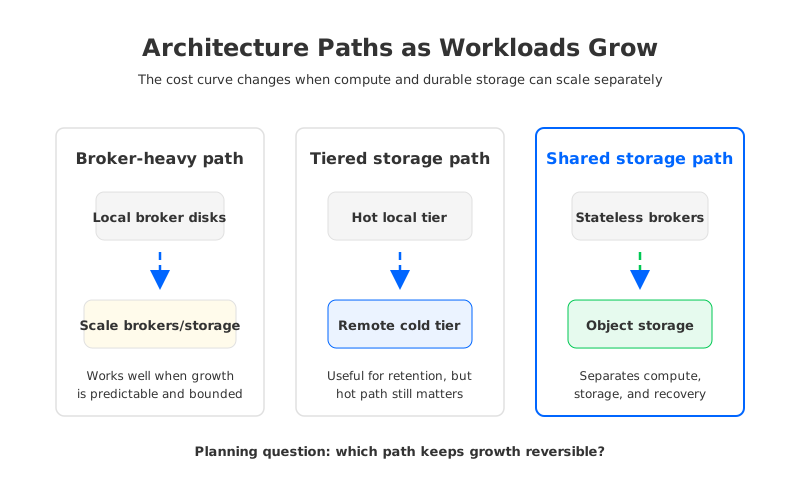
None of these paths is universally correct. The point is to put the cost discussion at the same level as the architecture decision. If the architecture forces a cost line to move whenever an unrelated workload dimension changes, the spreadsheet should expose that coupling.
3Build the model around workload events, not averages
Average throughput is useful for a first estimate and dangerous as a final estimate. Kafka clusters are paid for capacity that must survive spikes, maintenance, and recovery. A 50 MiB/s average workload with smooth producers is different from a 50 MiB/s average workload that has hourly bursts, many compacted topics, long consumer catch-ups, and periodic backfills.
The practical approach is to model events. Pick the workload moments that force the platform to behave differently, then calculate how each billable unit responds. A few examples usually reveal more than another decimal place in the monthly estimate:
- Retention expansion: A business team increases retention from a few days to a few weeks for replay, audit, or model training. Broker-attached storage and tiered storage behave differently here, especially if old data is read back frequently.
- Consumer replay: A downstream incident requires a full topic replay. Storage retrieval, broker egress, and cross-boundary client access can matter more than the normal write path.
- Partition growth: A topic count or partition count increase raises metadata, open file, recovery, and balancing pressure. The cost effect may be more brokers, more operational work, or both.
- Multi-account access: Producers and consumers move into different VPCs or accounts. Private connectivity can be the right design, but it should be modeled as both fixed hourly cost and per-GB processing.
- Failure recovery: A broker failure or AZ event tests whether the cluster has enough headroom to recover without extending outage risk or causing an emergency capacity change.
This event-based model is also a good way to avoid false precision. Teams do not need to predict every byte. They need to identify which growth event changes the slope of the bill and which mitigation is available before that event happens.
4Tiered storage helps retention, but it is not the same as decoupling
Apache Kafka tiered storage separates Kafka storage into local and remote tiers. The local tier continues to use broker disks for active log segments, while remote storage such as S3 can hold completed log segments. That is a meaningful improvement for retention-heavy workloads because older data no longer has to remain entirely on broker-local storage.
But tiered storage should not be confused with fully decoupled compute and storage. The hot path still depends on brokers. The team still needs to configure remote storage behavior, local retention, topic-level enablement, and failure procedures. The Kafka documentation also calls out limitations that matter in production planning, including limitations around compacted topics and remote fetch behavior. These are not reasons to avoid tiered storage; they are reasons to model it as an architectural feature with operating constraints.
For MSK cost planning, the distinction is simple. Tiered storage can change the retention economics of older data. It does not automatically make brokers stateless, remove the need for hot storage planning, or make capacity shrink when demand falls. If a buyer is comparing MSK Standard brokers, MSK Express brokers, tiered storage, and Kafka-compatible alternatives, the comparison should separate "where old data lives" from "how broker compute and durable storage scale."
5Where AutoMQ fits the evaluation
Once the evaluation reaches independent compute and storage scaling, AutoMQ enters naturally as a Kafka-compatible, cloud-native streaming option rather than as a direct line-item tweak. AutoMQ keeps Kafka protocol compatibility while redesigning the storage layer around shared object storage. Its S3Stream architecture uses object storage as the primary durable layer and uses a WAL design to absorb low-latency writes before data is organized for shared storage.
That architecture matters to MSK cost planning because it attacks the coupling problem rather than only optimizing a unit price. Stateless brokers can be scaled for compute and serving pressure without treating each broker as the long-term owner of local durable data. Object-storage-backed durability changes the recovery model because data is not stranded on a failed broker's local disk. AutoMQ documentation also describes a cross-AZ traffic optimization model that avoids server-side replica replication traffic and producer cross-AZ write traffic in its S3-based shared storage architecture.
This does not remove the need for workload design. Teams still need to test client compatibility, latency requirements, quota policies, observability, and migration runbooks. It does, however, give buyers a different axis for comparison: instead of asking whether one managed Kafka bill is lower than another under today's assumptions, they can ask which architecture reduces the number of assumptions that become permanent cost.
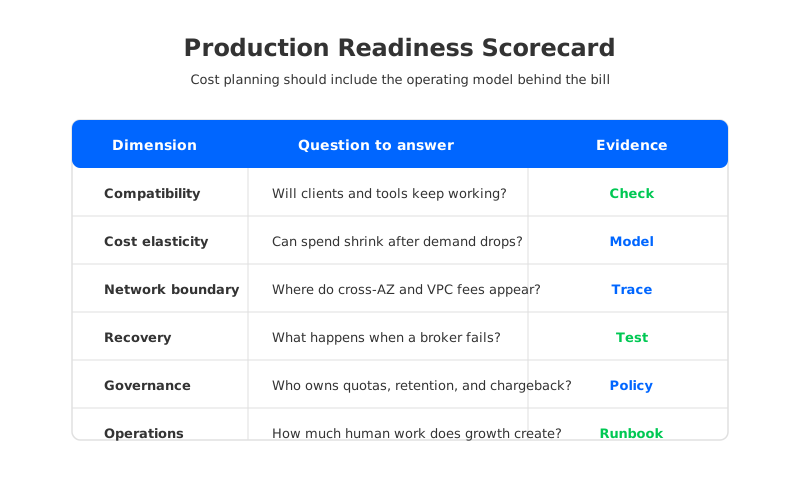
The evaluation should be sober. If a team wants the narrowest AWS-native managed Kafka path and has predictable growth, MSK may be the right answer. If the workload's cost pressure comes from broker/storage coupling, cross-AZ replication traffic, or repeated capacity operations, a shared-storage Kafka-compatible design deserves a proof of concept beside the MSK estimate.
6A buyer-ready worksheet
A useful MSK cost worksheet fits on one page. It should not begin with a vendor comparison table. It should begin with the workload contract: ingest rate, read fanout, retention, partition count, compression ratio, availability target, client network topology, and replay expectations. After that, each architecture can be priced and risk-scored against the same contract.
Use these questions to pressure-test the estimate before it becomes a budget line:
- What is the peak-to-average ratio for writes and reads, and which hour of the week sets the capacity floor?
- Which topics are retention-heavy, replay-heavy, or compaction-heavy, and should they share the same cluster?
- What is the largest expected replay, and will it read from hot broker storage, remote storage, or object storage?
- Which clients cross VPC, account, AZ, or Region boundaries, and who owns those network charges?
- What storage expansion event would permanently raise the run rate, and how would the team reverse it?
- What failure or maintenance event requires spare capacity, and is that spare capacity always paid for?
- What would migration require for ACLs, client configs, schema tooling, connectors, observability, and rollback?
The answers should produce a cost range, not a single number. A single number hides uncertainty; a range shows which assumptions dominate. More importantly, it lets architects and finance teams discuss the same system. Finance can see which line items are variable, sticky, or event-driven. Engineers can see which architecture choices create those line items.
7The practical conclusion
MSK cost planning is not a hunt for a magic calculator. It is a way to expose how Kafka's operating model maps to cloud billing. Broker hours, provisioned storage, storage throughput, and connectivity fees are visible line items, but the most important driver is the architecture underneath them. The bill grows when compute, storage, recovery, and network boundaries are coupled in ways the workload can trigger.
Return to the first spreadsheet and add one column: "Can this cost go down after the event ends?" That column will change the conversation. It turns MSK cost from a static estimate into an architectural decision about reversibility, failure recovery, and operational control.
If you are comparing provisioned MSK with Kafka-compatible shared storage, start with the same workload contract and test the operational assumptions directly. AutoMQ's documentation on saving cross-AZ traffic costs with its shared-storage architecture is a practical next step when network and broker/storage coupling are part of the cost problem.
8References
- Amazon MSK pricing
- Automatic scaling for Amazon MSK clusters
- Auto-scaling policy details for Amazon MSK
- Manual scaling for Amazon MSK Standard brokers
- Apache Kafka tiered storage documentation
- AutoMQ architecture overview
- AutoMQ compatibility with Apache Kafka
- AutoMQ WAL storage documentation
9FAQ
9.1What is the biggest MSK cost planning mistake?
The biggest mistake is pricing only the current broker count and retention setting. Production Kafka costs are shaped by growth events: retention expansion, consumer replay, partition growth, private connectivity, and recovery headroom. A good estimate shows which events raise the monthly run rate and whether that increase can be reversed.
9.2Does MSK storage auto scaling reduce cost when usage drops?
No. AWS documentation states that MSK can automatically expand cluster storage based on utilization, but it does not reduce cluster storage when usage falls. If you need smaller storage after expansion, the practical path is migration to a cluster with smaller storage.
9.3Is Kafka tiered storage enough to solve MSK storage cost?
Tiered storage can improve the economics of longer retention by moving completed log segments to remote storage, but it does not make the whole broker architecture stateless. The hot tier, broker operations, topic configuration, and remote-read behavior still need production planning.
9.4When should teams evaluate an MSK alternative?
Evaluate alternatives when the cost pressure is architectural rather than a one-time tuning issue. Common triggers include sticky storage growth, high cross-boundary traffic, frequent rebalancing work, difficult broker recovery planning, or a need to scale compute and durable storage independently.
9.5How should AutoMQ be compared with MSK?
Compare them against the same workload contract: throughput, read fanout, retention, partitions, latency, network topology, recovery target, and migration constraints. AutoMQ is most relevant when Kafka compatibility is required but broker/storage coupling is the main cost or operations concern.


