
Table of Contents
Table of Contents
Choosing between Pub/Sub and Kafka on Google Cloud starts with a contract, not a service comparison page. Pub/Sub gives applications a managed messaging API built around topics and subscriptions. Kafka gives them a protocol, partitions, offsets, consumer groups, and an ecosystem that expects those concepts. Both can move events through a GCP architecture, but they ask the application and platform teams to make different promises.
The decision becomes clearer when the team writes down what a producer, consumer, and operator must be able to do. Can an existing Kafka client connect without an adapter? Does a replay start from a timestamp, a subscription position, or a partition offset? Who owns the broker, the retention boundary, and the failure drill? Those answers identify the right service faster than a checklist of features.
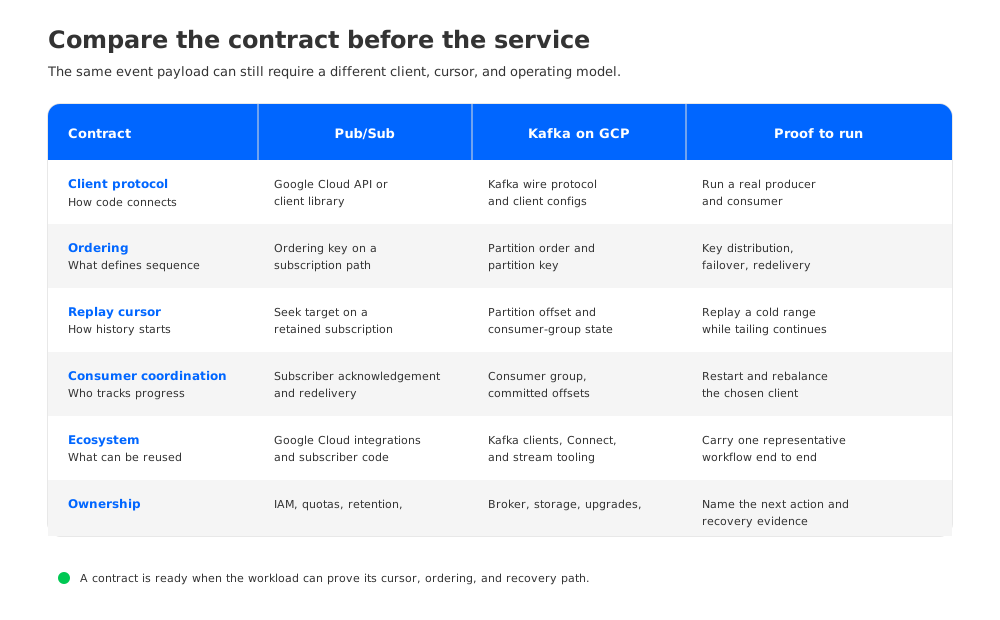
1Start with the application contract
Pub/Sub and Kafka meet an application at different interfaces. Pub/Sub clients publish to a topic and consume through a subscription using Google Cloud APIs or client libraries. The service manages the messaging infrastructure behind that interface. Kafka clients speak the Kafka protocol and address topics and partitions directly, whether the brokers run on Compute Engine, GKE, or a managed Kafka service on Google Cloud.
That distinction matters during an adoption review. A service that can carry the same business event is not automatically a drop-in replacement for a Kafka workload. Producers may depend on Kafka headers, partition keys, idempotent delivery behavior, transactions, or client configuration. Consumers may depend on committed offsets, consumer-group rebalancing, or a Kafka Streams topology. Each dependency is part of the contract even when the payload is JSON.
Write the contract in terms of actions instead of product names:
- Publish: Which client library or wire protocol does the producer use, and which acknowledgement tells it that the record is accepted?
- Route: Does a key select a Kafka partition, a Pub/Sub ordering key, or an application-level route that your code owns?
- Consume: Does a worker pull through a subscription, join a Kafka consumer group, or use another coordination mechanism?
- Replay: Which cursor identifies the starting point, and can a replay run while tail consumers continue?
- Operate: Which team owns IAM, quotas, retention settings, network paths, upgrades, and recovery evidence?
Once those answers are explicit, the comparison stops being a debate about labels. It becomes a check that each platform can honor the same business requirement.
2Delivery and ordering are different promises
Pub/Sub's delivery model centers on a subscription and acknowledgement. A subscriber receives messages from that subscription and acknowledges work after processing. Pub/Sub also supports ordering keys when an application needs ordered delivery for related messages. The ordering key is an application choice, so the team must test the key distribution and the behavior when a subscriber fails or falls behind. Google documents the feature and its constraints in the Pub/Sub ordering guide.
Kafka puts order inside a partition. A producer's partitioning decision determines which records share that ordered log, and a consumer reads by offset. Ordering is therefore coupled to partition layout and consumer progress. A workload that uses partition keys, offset commits, or partition-aware stream processing should preserve that contract unless the team is prepared to redesign the application.
Neither description is a universal quality ranking. It explains where the proof must live. For Pub/Sub, test the ordering key, acknowledgement, redelivery, and subscription behavior that your code relies on. For Kafka, test partition assignment, offset commits, rebalance behavior, and the recovery path for the brokers and storage underneath them.
3Replay is where the models diverge
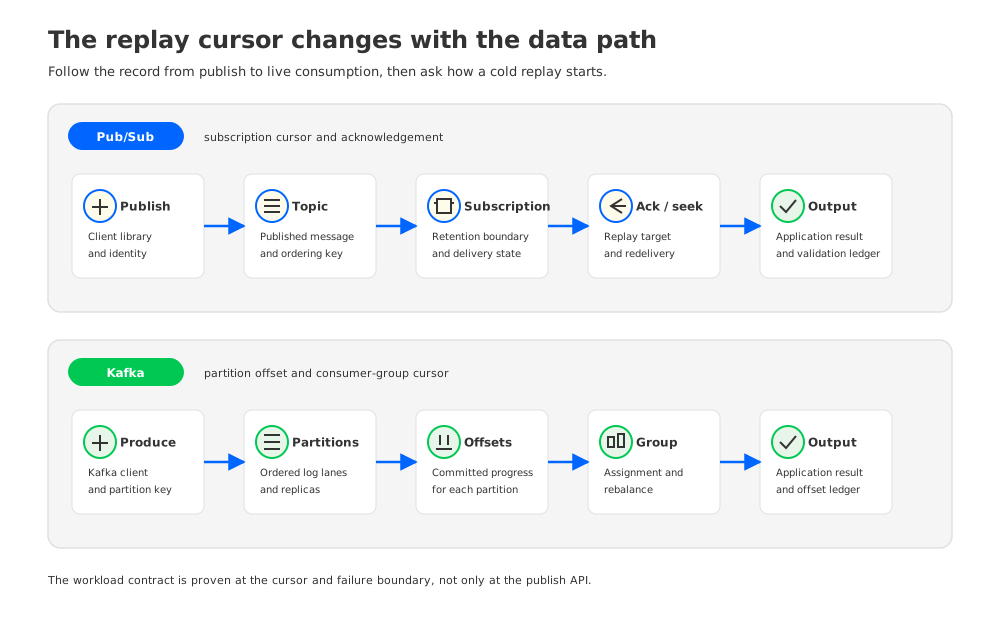
Replay sounds like a shared requirement, but the cursor is different. Pub/Sub can retain messages on a subscription and supports seek operations to replay a range when the required retention and configuration are in place. The replay documentation describes the supported workflow. A replay design still needs an identity, permission, output sink, and a way to compare the replayed result with the original business record set.
Kafka replay starts from offsets in a partition log. That makes it natural for a consumer group to pause, reset, or create a separate group for backfills. It also means the replay depends on Kafka retention, partition availability, and the storage path that serves the chosen offsets. A team cannot infer replay readiness from a successful tailing test.
Use the same evidence worksheet for both systems:
| Replay question | Pub/Sub | Kafka on GCP |
|---|---|---|
| Starting cursor | Subscription seek target or retained message position | Partition offset and consumer-group state |
| Isolation from live readers | Separate subscription or controlled seek workflow | Separate consumer group or assigned partitions |
| Ordering proof | Ordering keys and acknowledgement behavior | Partition order and offset progression |
| Failure proof | Subscriber restart, redelivery, and permission handling | Broker, partition, storage, and consumer recovery |
| Output check | Compare message IDs or application keys | Compare keys, offsets, and application output |
The matrix forces a useful question: if the historical data is needed after an incident, which team can reproduce the cursor and prove that no records were skipped? That answer should be written into the runbook before a migration or a production launch.
4Ecosystem fit is a change-budget decision
Kafka brings an ecosystem contract with it. Existing Kafka producers, consumers, Connect connectors, schema tooling, and stream processors often share configuration and operational knowledge. Keeping that contract can shorten a migration when the application already speaks Kafka and its teams have Kafka runbooks.
Pub/Sub reduces the amount of broker infrastructure a platform team operates, but an application that moves from Kafka still has to change its client surface and coordination model. A connector may need a different adapter. Offset-based recovery may become subscription-based replay. A Kafka Streams topology may need a different processing runtime. None of those changes is automatically wrong, but each one consumes engineering and test capacity.
The right comparison is the cost of change against the value of the target contract. A greenfield service with simple publish and subscribe behavior may prefer the managed API and a small operational surface. A platform with shared Kafka libraries, partition-aware consumers, and existing replay tooling may value protocol continuity even when the brokers move to a managed service.
Avoid a migration plan that treats payload compatibility as application compatibility. Carry a representative producer, consumer, schema, connector, and replay job through the proof. If one of those components cannot preserve its contract, name the redesign rather than hiding it behind a successful smoke test.
5Operations still have an owner
Pub/Sub delegates the messaging infrastructure, but the application team still owns IAM, topic and subscription policy, quotas, subscriber capacity, dead-letter handling, and the evidence that a replay works. The platform team also owns the network and identity path from workloads to the service. The Pub/Sub pricing page is useful for identifying billing dimensions, but a price page cannot estimate the application's retry or replay behavior.
Kafka on GCP has a wider ownership range because the phrase can describe self-managed Kafka or Google Cloud's managed Kafka service. Self-managed deployments add broker, storage, upgrade, and recovery responsibilities. Google Cloud's Managed Service for Apache Kafka overview defines a provider-operated service boundary, while the pricing page describes its billing model. In either case, the application team still owns clients, schemas, retention policy, and consumer behavior.
Ask the owner to show the artifacts, not the architecture slide alone:
- a client and identity inventory;
- a retention and replay runbook with a tested cursor;
- ordering and redelivery evidence for the chosen workload;
- a failure drill that names the person or team taking the next action; and
- a cost worksheet that separates message volume, storage, requests, compute, and network effects.
If those artifacts do not exist, the platform choice is still an assumption. That is a useful finding before procurement, because it points to the missing experiment rather than to another product demo.
6A neutral decision path
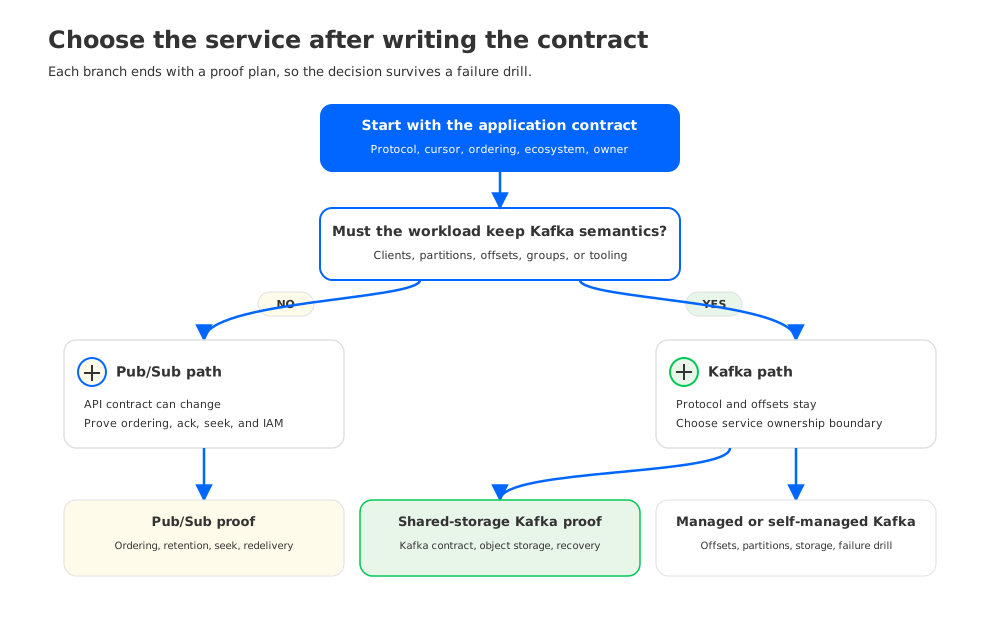
Start with the existing client contract. If the application must keep Kafka protocol behavior, partition offsets, and Kafka ecosystem tooling, evaluate Kafka on GCP first. Choose between self-managed and managed Kafka by the operations your team is prepared to own, then test storage, recovery, and network boundaries.
If the application can adopt a cloud messaging API and its replay model maps cleanly to subscriptions and seek operations, evaluate Pub/Sub with the same workload and failure evidence. Pay attention to ordering-key distribution, acknowledgement behavior, subscription retention, and the IAM path used by every subscriber.
There is a third outcome: keep the Kafka contract while changing the storage architecture underneath it. That option is relevant when the team needs Kafka clients and ecosystem behavior but wants brokers to carry less broker-local durable state.
7Where AutoMQ fits
When protocol continuity is a requirement and broker-local storage is the constraint, AutoMQ is a Kafka-compatible cloud-native streaming platform built on a Shared Storage architecture. It keeps the Kafka client and partition model in the application-facing layer while moving durable stream data into object storage, with WAL storage and Data caching serving the active path according to the selected deployment.
That architecture changes the proof, not the need for one. The evaluation should still run the real producer and consumer clients, verify offset and ordering behavior, exercise broker replacement, and measure the object-storage and network paths that the chosen GCP deployment uses. The AutoMQ architecture overview and GKE deployment guide identify the layers and deployment choices to verify.
AutoMQ is therefore a fit for a specific contract: Kafka protocol and ecosystem continuity with a shared-storage design that your team can test on GCP. It is not a reason to force Kafka onto a workload whose application contract already matches Pub/Sub. Let the cursor, client, ownership, and recovery evidence decide.
8FAQ
8.1Is Pub/Sub a drop-in Kafka replacement?
No. Pub/Sub and Kafka expose different client and delivery contracts. A migration can be appropriate, but it needs a client, coordination, ordering, replay, and connector plan.
8.2When is Kafka on GCP the safer choice?
Kafka is the safer starting point when the workload already depends on Kafka clients, partitions, offsets, consumer groups, or Kafka ecosystem tools. Confirm that the chosen GCP deployment can meet the storage, recovery, and ownership requirements before committing.
8.3Does Pub/Sub remove replay work?
No. Pub/Sub provides documented retention and seek workflows, but the team still has to define the replay identity, permissions, output validation, and failure behavior for its application.
8.4Does a managed Kafka service remove application operations?
No. It delegates a provider-defined infrastructure boundary. Application teams still own client configuration, schemas, retention decisions, consumer lag, and the recovery evidence that matters to their business.
The first question in a GCP Kafka versus Pub/Sub review is not which logo is on the diagram. It is which contract the application must keep when a record is published, replayed, reordered, or recovered. Write that contract, run it through the failure path, and let the evidence choose the service. If the answer is Kafka continuity with a different storage boundary, start an AutoMQ evaluation with your client matrix and replay runbook ready.


