
Table of Contents
Table of Contents
Microservice teams rarely ask for messaging infrastructure in the abstract. They ask for safer service decoupling, fewer cascading failures, independent deploys, durable event history, and a way to recover when a downstream service ships a bad release. Google Pub/Sub and Apache Kafka can both move events between services, but they encode different assumptions about what an event system should be.
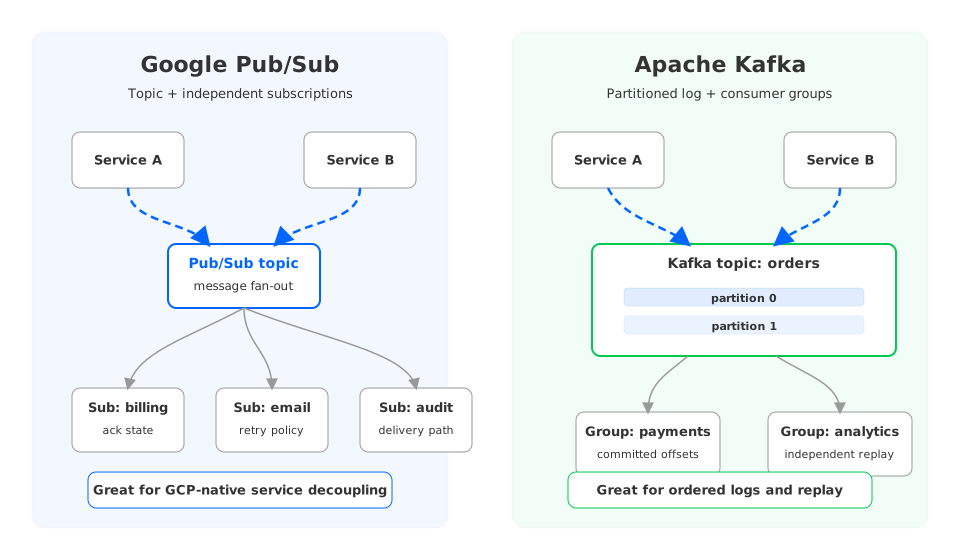
Pub/Sub starts from a cloud service model: publishers write to topics, subscribers consume through subscriptions, and Google Cloud owns the infrastructure elasticity behind the service. Kafka starts from a log model: producers append records to partitioned topics, consumer groups read by offsets, and ordering, replay, and client compatibility become part of the application contract. The right choice depends less on the word "event" and more on what the service boundary must remember after the first delivery succeeds.
1What Microservices Need from Event Infrastructure
Microservices create a specific kind of messaging pressure. A checkout service should not block because an email service is slow. A billing workflow should survive a temporary inventory outage. An audit service should process every domain event without asking the producer to know it exists. These are classic decoupling requirements, and Pub/Sub handles many of them cleanly because each subscription can represent a separate delivery path.
The harder requirements arrive after the system is running. A team may need to replay every OrderPaid event from last Tuesday because a downstream projection was wrong. A fraud service may need an independent view of the same event stream without disturbing payments. A CDC pipeline may need stable ordering per entity and integration with stream processing jobs that already use Kafka clients. Those requirements make the event stream feel less like a transient notification channel and more like shared operational history.
Separate the requirements before choosing the platform:
- Delivery decoupling means one service can publish without knowing every consumer. Pub/Sub subscriptions are a strong fit for this pattern inside Google Cloud.
- Replay autonomy means one consumer can recover historical events without changing another consumer's position. Kafka consumer groups make this a core operating model.
- Ordering scope defines what "in order" means: per entity, per tenant, per partition, or not required. This decision is more important than the product name.
- Ecosystem compatibility decides whether Kafka Connect, Kafka Streams, Flink, schema tooling, and existing clients remain part of the system.
These requirements can coexist. A microservice platform might use Pub/Sub for GCP-native service triggers while keeping Kafka for domain events, CDC, and stream processing. The mistake is forcing every event into one category because the first project worked well.
2Where Pub/Sub Fits Well
Pub/Sub is a natural fit when the microservice problem is elastic fan-out inside Google Cloud. It removes broker sizing, storage planning, partition reassignment, and cluster patching from the application team. Producers publish to topics; subscribers use pull or push subscriptions; delivery, retry, dead-letter handling, filtering, and acknowledgement behavior are managed through Pub/Sub configuration rather than broker operations.
That operating model is useful for service notifications, serverless triggers, operational events, and workflows where the event is primarily a delivery mechanism. Cloud Run, Cloud Functions, Dataflow, and other Google Cloud services can integrate with Pub/Sub without requiring an application team to operate Kafka infrastructure. For many GCP-native microservices, that is the point: the event bus should disappear into the platform.
Pub/Sub also supports message ordering through ordering keys when ordering is enabled, and it supports replay-oriented operations through retention, snapshots, and seek. Those features matter because they prevent Pub/Sub from being reduced to "a queue." Still, the abstractions are Pub/Sub abstractions. A subscriber acknowledges messages; it does not commit Kafka offsets. A subscription can seek to a timestamp or snapshot within retention behavior; it does not expose Kafka's partition-offset model to applications.
Use Pub/Sub when the system looks like this:
- Services are mostly GCP-native and do not need Kafka protocol compatibility.
- The primary goal is decoupled delivery, not a durable event log shared by many independent processing systems.
- Ordering is scoped by ordering keys and can be validated in the Pub/Sub delivery model.
- The team prefers service-level configuration over operating brokers, disks, controllers, and partition movement.
This is not a lesser architecture. It is a different contract. Pub/Sub fits many microservice workloads because it does not ask application teams to think like Kafka operators.
3Where Kafka Fits Well
Kafka fits when microservices need the event stream to behave like a durable, ordered log. Producers append records to topic partitions. Consumers read those records by offset. Consumer groups let multiple applications maintain their own progress through the same topic. Ordering is guaranteed within a partition, so teams can design keys around entity-level ordering while still scaling the topic across partitions.
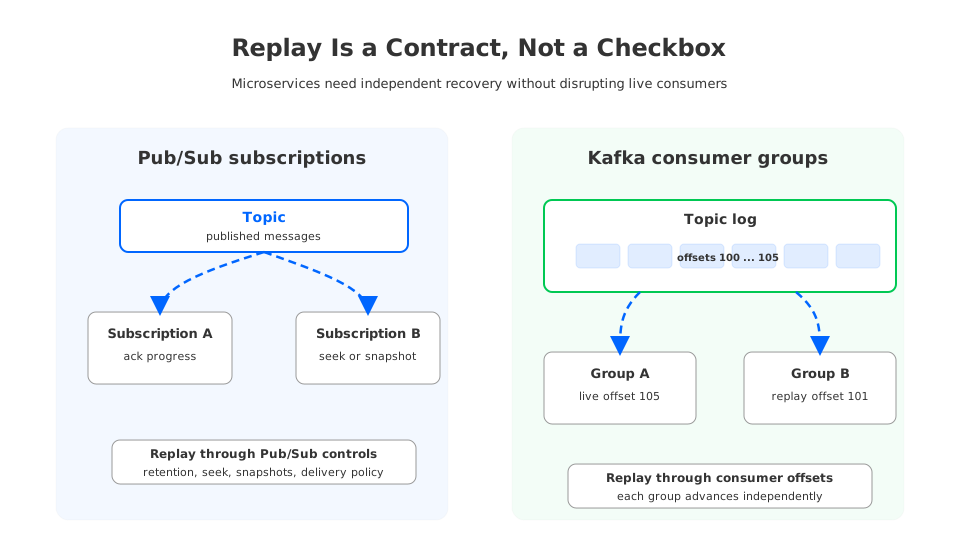
That model is powerful for domain event streams, audit logs, CDC fan-out, and stream processing. A payments service can publish events once, while fraud detection, analytics, billing reconciliation, and audit consumers each maintain their own position. If the analytics job fails, it can replay without resetting the fraud service. If a service needs to rebuild state, it can read historical records subject to retention. The log becomes a shared source of truth for multiple applications.
Kafka's ecosystem adds another reason to keep it. Kafka Connect pipelines, Kafka Streams applications, Flink jobs, schema workflows, lag dashboards, and client libraries all assume Kafka concepts. Replacing Kafka with Pub/Sub may reduce infrastructure work, but it also changes clients, replay runbooks, connector behavior, and observability. For an estate that is already Kafka-shaped, the migration is an application rewrite, not a service rename.
Kafka is strongest when these statements are true:
| Microservice requirement | Why Kafka fits |
|---|---|
| Multiple teams consume the same event history | Consumer groups track progress independently. |
| Replay is part of normal recovery | Offsets and retention make historical reads an expected workflow. |
| Ordering is tied to entity keys | Partitioning gives a precise ordering scope. |
| Stream processing and connectors are central | Kafka ecosystem tools can stay in place. |
| The platform spans clouds or vendors | Kafka APIs reduce provider-specific application coupling. |
The tradeoff is operations. Self-managed Kafka on GKE or Compute Engine gives control but keeps the platform team responsible for brokers, storage, upgrades, security, observability, and incidents. Google Cloud Managed Service for Apache Kafka reduces that burden while preserving Kafka APIs. Either way, Kafka semantics remain visible because they are part of the system's contract.
4Ordering: Keys Are Not Partitions
Ordering is the most common place where Pub/Sub and Kafka comparisons become too vague. Kafka preserves order within a partition. If all events for customer-123 use the same Kafka key and land in the same partition, a consumer can process that customer's events in order. The platform gets parallelism from many partitions, while each entity's order is protected by key design.
Pub/Sub ordering uses ordering keys. Google Cloud documents ordered delivery as a feature that must be enabled and used deliberately. Messages with the same ordering key can be delivered in order to subscribers, but this is not Kafka partitioning under another name. The operational model includes publishing behavior, subscription settings, acknowledgement behavior, and service-specific delivery semantics.
This distinction changes microservice design. If a domain aggregate requires strict per-entity ordering, both systems need a stable entity key. In Kafka, that key maps into partitioned log behavior and consumer-group processing. In Pub/Sub, that key maps into ordered delivery behavior for subscriptions. The designs can satisfy similar business requirements, but validation should be different.
A good architecture review asks four questions:
- What entity defines the ordering boundary?
- What happens when a key becomes hot?
- Can one slow consumer block progress for a key or partition?
- How will the team prove ordering after retries, redeploys, and backfills?
When nobody can answer those questions, the workload is not ready for either platform. Ambiguous ordering requirements become incident tickets later.
5Replay: Seek Is Not the Same as Offset Ownership
Replay is not a button. It is an operational promise about who can go back, how far they can go, and what happens to everyone else while they do it. Kafka makes replay feel native because each consumer group has its own offsets. A group can reposition consumption without changing another group's committed offsets, assuming the data is still retained.
Pub/Sub has replay features too. Google Cloud documents message retention, snapshots, and seek operations that can move a subscription to a point in time or snapshot. That is valuable for recovery, but the control is attached to Pub/Sub subscriptions and retention behavior. A microservice designed around Kafka offsets cannot treat Pub/Sub seek as a replacement without changing runbooks and application assumptions.
For microservices, replay usually breaks into three scenarios:
| Scenario | Pub/Sub design question | Kafka design question |
|---|---|---|
| A consumer missed messages | Should the subscription seek within retention? | Should the group reset offsets? |
| A downstream bug corrupted state | Can one subscription replay without disrupting others? | Can one group rebuild from retained offsets? |
| A platform needs audit history | Is Pub/Sub retention the right long-term contract? | Is topic retention sized for audit reads? |
The answer may favor Pub/Sub or Kafka, depending on the service. A notification workflow may not need long historical replay. A financial event log probably does. The important point is to write the recovery command before production traffic arrives, because the tool you choose will be judged during recovery.
6Operations: Managed Service vs Managed Semantics
Pub/Sub is operationally attractive because Google Cloud owns the service infrastructure. Microservice teams still manage IAM, schemas where used, subscriptions, filters, retry policy, dead-letter topics, quotas, monitoring, and idempotency. But they do not manage broker machines. That is a meaningful reduction in operational surface.
Kafka operations depend on the deployment. Self-managed Kafka puts the full lifecycle on the platform team. Google Cloud Managed Service for Apache Kafka provides a fully managed service for Apache Kafka clusters, which helps teams keep Kafka APIs while moving more cluster lifecycle work to Google Cloud. This is often the right middle ground when the organization needs Kafka semantics but wants fewer broker tasks.
The subtle issue is that managed Kafka and Pub/Sub manage different things. Managed Kafka reduces Kafka infrastructure ownership. Pub/Sub changes the messaging model. If an application depends on Kafka offsets, partition ordering, Kafka Connect, or Kafka Streams, Pub/Sub is not an operational shortcut; it is a semantic migration. If an application only needs GCP-native async delivery, Kafka may be unnecessary.
7Where AutoMQ Fits on GCP
Some teams reach this decision point with a precise requirement: keep Kafka semantics, but change the cloud infrastructure shape behind Kafka. Traditional Kafka stores durable log data on broker-local disks and replicates across brokers. In cloud deployments, that couples compute capacity, storage capacity, recovery, and scaling. A platform with large retained logs or frequent scale changes can spend too much energy moving or protecting broker-local state.
AutoMQ fits after the team has decided that Kafka compatibility still matters. AutoMQ is a Kafka-compatible cloud-native streaming platform that separates compute from storage and uses object storage as the durable storage layer. On GCP, that means teams can evaluate a Kafka-compatible path where producers, consumers, connectors, and stream processors remain Kafka-oriented while the storage model is no longer centered on broker-local disks.
That does not make AutoMQ a replacement for every Pub/Sub workload. If the goal is GCP-native service triggers and minimal Kafka semantics, Pub/Sub remains a strong fit. AutoMQ is relevant when the team wants Kafka's log, replay, and ecosystem behavior, but the traditional Kafka operating model is the constraint. The product enters the architecture as a Kafka-compatible option, not as a reason to ignore Pub/Sub's strengths.
8Workload-Based Recommendation
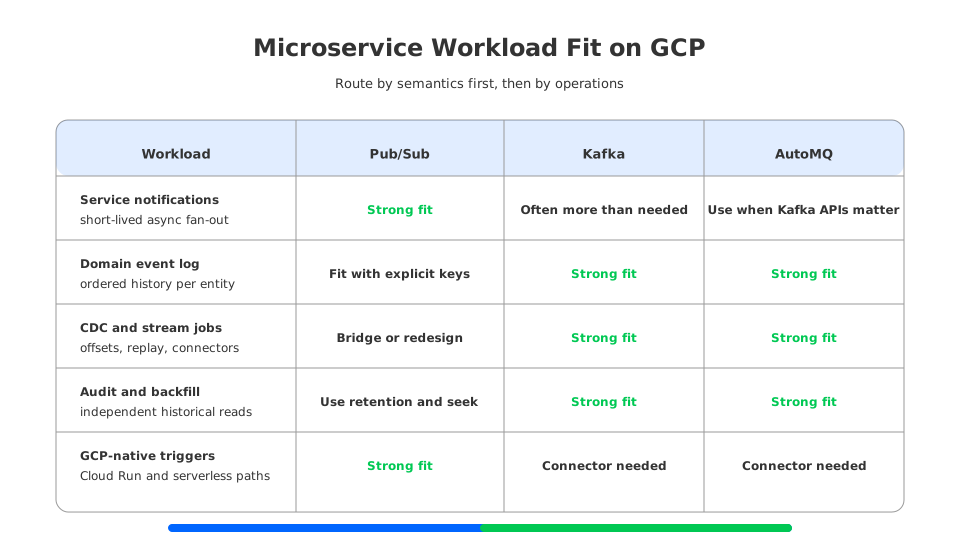
Route the decision by workload, not by platform preference. A service notification path and a domain event log may both be called "microservice events," but they behave differently under replay, ordering, and incident response.
| Workload pattern | Stronger fit | Reason |
|---|---|---|
| Service notifications | Pub/Sub | Elastic fan-out and GCP-native delivery matter more than log semantics. |
| Domain event log | Kafka or AutoMQ | Entity ordering, retention, and independent consumers are central. |
| CDC and stream processing | Kafka or AutoMQ | Offsets, connectors, and stream processing ecosystem usually matter. |
| Audit backfill | Kafka or AutoMQ | Many consumers may need independent historical reads. |
| Cloud Run or serverless triggers | Pub/Sub | Native integration reduces platform plumbing. |
| Existing Kafka estate on GCP | Managed Kafka or AutoMQ | Kafka clients and tooling can remain the baseline. |
The most reliable proof of concept tests the uncomfortable cases: a hot ordering key, a slow consumer, a failed deployment that requires replay, a schema change, a dead-letter path, and a rollback. Happy-path publish and consume demos are useful, but they do not answer the questions that SREs and architects will face at 02:00.
If your team is evaluating Kafka-compatible infrastructure on Google Cloud, review the AutoMQ overview and deployment model after you have written down your ordering, replay, and ecosystem requirements. That sequence keeps the decision honest: first define the event contract, then choose the infrastructure that can operate it.
9References
- Google Cloud Pub/Sub overview
- Google Cloud Pub/Sub message ordering
- Google Cloud Pub/Sub replay and seek overview
- Google Cloud Pub/Sub subscriptions
- Choose between Pub/Sub and Managed Service for Apache Kafka
- Google Cloud Managed Service for Apache Kafka overview
- Apache Kafka documentation
- Apache Kafka consumer design
- Apache Kafka topic and log design
- AutoMQ overview
10FAQ
10.1Is Pub/Sub better than Kafka for microservices on Google Cloud?
Pub/Sub is often a better fit for GCP-native service decoupling, serverless triggers, and elastic fan-out when the application does not need Kafka APIs or offset-based replay. Kafka is usually a better fit when microservices need a durable event log, partition-level ordering, independent consumer groups, and Kafka ecosystem compatibility.
10.2Can Pub/Sub replace Kafka for existing microservices?
It can replace Kafka for some delivery-oriented workloads, but it is not a drop-in replacement for Kafka clients, offsets, partitions, Kafka Connect, or Kafka Streams. Treat the migration as an application contract change and validate ordering, replay, observability, and rollback behavior.
10.3Does Pub/Sub support message ordering?
Yes. Pub/Sub supports ordered delivery when message ordering is enabled and publishers use ordering keys. That model should be validated separately from Kafka partition ordering because ordering keys and Kafka partitions are different abstractions.
10.4Does Pub/Sub support replay?
Yes. Pub/Sub supports replay-related operations through message retention, snapshots, and seek. Kafka replay is based on retained log data and consumer offsets, so the recovery runbooks and application assumptions are different.
10.5When should AutoMQ be considered instead of Pub/Sub?
Consider AutoMQ when the workload still needs Kafka protocol compatibility, Kafka ecosystem tools, partitioned-log semantics, and independent replay, but the team wants a cloud-native storage model that reduces reliance on broker-local disks. Pub/Sub remains a strong fit when Kafka semantics are not required.


