
Table of Contents
Table of Contents
Teams do not usually search for a Pulsar alternative because Apache Pulsar is weak technology. Pulsar has a serious architecture: brokers handle serving, Apache BookKeeper stores ledgers, metadata coordinates the cluster, and the model supports tenants, namespaces, topics, subscriptions, and geo-replication. That separation can be attractive when the platform team wants multi-tenancy and messaging semantics beyond a classic Kafka topic. The search starts when those strengths stop matching the team's actual constraint: Kafka applications, Kafka Connect or Kafka Streams dependencies, limited Pulsar expertise, or a cloud bill that makes the storage and replication model harder to defend.
That is why a useful "Pulsar alternatives" guide should not pretend there is one winner for every workload. The right alternative depends on what you are replacing: the Pulsar protocol, a self-managed Pulsar cluster, a managed Pulsar service, or a broad messaging-and-streaming platform. For many teams, the practical question is narrower: "Can we keep Kafka clients and ecosystem tools, reduce operational risk, and avoid rebuilding every application?"
1Why Teams Look for a Pulsar Alternative
Pulsar often enters an architecture discussion because it separates serving from storage and has a rich multi-tenant model. The official Pulsar architecture describes brokers, BookKeeper bookies, and metadata services, with brokers receiving messages and BookKeeper providing persistent storage. That split can help operators reason about isolation, storage, and replication. It also means a production team must understand more moving parts than a single Kafka broker cluster, especially when they run Pulsar themselves.
The replacement conversation usually starts in a few places:
- Kafka ecosystem fit. Existing applications may already use Kafka producers, consumers, Kafka Connect, Kafka Streams, Schema Registry-compatible tooling, or operational dashboards built around Kafka semantics. A Pulsar-native move can turn a platform decision into an application migration.
- Operational specialization. Pulsar, BookKeeper, and metadata services each have their own failure modes and tuning surfaces. That is not a flaw, but it does require the right on-call expertise.
- Managed-service preference. Some teams want to stop running streaming infrastructure and move to a managed Kafka or managed Pulsar service. Others need bring-your-own-cloud deployment because data control matters more than convenience.
- Cloud cost structure. Multi-AZ streaming systems can generate persistent storage, replication, and network costs that are easy to underestimate during the design phase.
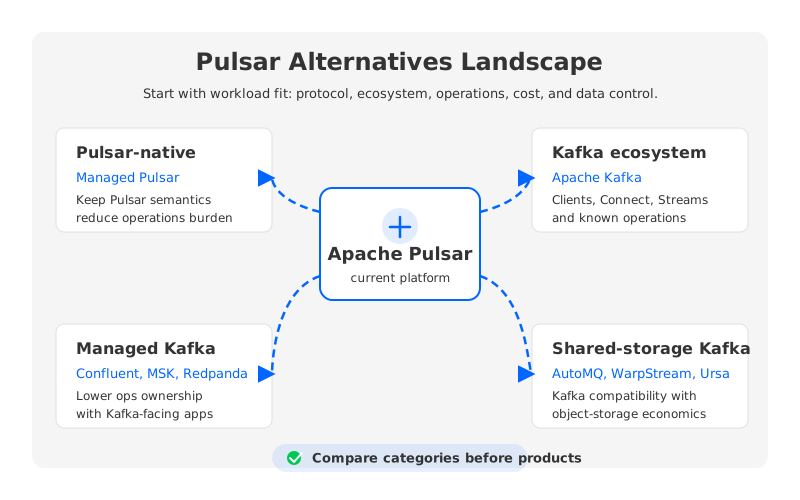
Those reasons point to different products. A team that loves Pulsar semantics but dislikes operating it should evaluate managed Pulsar. A team that primarily wants Kafka clients, Kafka connectors, and Kafka operational muscle memory should evaluate Kafka-compatible platforms.
2What to Compare Before Replacing Pulsar
A replacement decision should start with compatibility, not vendor positioning. Pulsar and Kafka are both used for streaming, but their data models, protocol surfaces, ecosystem assumptions, and operational defaults differ. A "Pulsar alternative" can mean "another streaming system," yet still be a poor migration target if your producers, consumers, connectors, and governance tooling do not move cleanly.
Use these dimensions before looking at product names:
| Dimension | What to Ask | Why It Matters |
|---|---|---|
| Protocol compatibility | Do existing applications speak Pulsar, Kafka, or both? | Protocol changes create application migration work. |
| Ecosystem dependency | Are Kafka Connect, Kafka Streams, ksqlDB, or Schema Registry part of the platform? | Tooling compatibility often dominates the migration timeline. |
| Deployment model | Self-managed, fully managed, BYOC, private cloud, or hybrid? | Data control and operational ownership change across models. |
| Storage architecture | Local disks, tiered storage, BookKeeper, or object-storage-backed shared storage? | Storage design shapes scaling, recovery, and cloud cost. |
| Migration path | Can workloads move topic by topic with validation and rollback? | Big-bang streaming migrations are rarely worth the drama. |
The important part is the order. Compatibility first, economics second, vendor features third. If your applications are mostly Kafka-compatible already, a Kafka-native or Kafka-compatible alternative may reduce migration risk. If your applications depend deeply on Pulsar tenants, namespaces, or subscription modes, a Pulsar-native managed service may preserve more behavior.
3Pulsar Alternatives by Category
The market is easier to understand when alternatives are grouped by architecture and migration path. A raw list of "top Pulsar competitors" hides the main trade-off: some options preserve Kafka compatibility, some preserve Pulsar semantics, and some change the storage layer more aggressively than traditional Kafka.
3.1Apache Kafka Ecosystem
Apache Kafka is the obvious alternative when the team wants to standardize on the largest event-streaming ecosystem. Kafka's official documentation covers the core broker model as well as Kafka Connect for integration and Kafka Streams for stream processing. That ecosystem depth matters because migration cost is often paid in connectors, client libraries, monitoring conventions, and developer familiarity rather than in broker features alone. Self-managed Kafka gives teams maximum control, but it also returns disk capacity planning, partition reassignment, broker recovery, and upgrade responsibility to the platform team. If the reason you are leaving Pulsar is operational complexity, self-managed Kafka may trade one operational surface for another unless your organization already has strong Kafka muscle.
3.2Managed Kafka Services
Managed Kafka services reduce operational ownership without forcing teams away from Kafka. Confluent Cloud provides a fully managed Kafka platform with surrounding services. Amazon MSK provides a managed Apache Kafka service inside AWS. Redpanda Cloud offers a managed version of Redpanda.
The attraction is clear: keep the Kafka-facing application model while shifting infrastructure operations to a vendor or cloud provider. This can be the lowest-friction Pulsar alternative for teams that already know Kafka but do not want to operate a cluster themselves. The trade-off is that managed does not automatically mean simple. You still need to understand limits, networking, quotas, feature support, and cost drivers.
3.3Kafka-Compatible Shared-Storage Platforms
A different class of Pulsar alternative keeps the Kafka protocol but changes the storage architecture. Instead of binding durable log data to broker-local disks, these systems place persistent data in cloud object storage and make broker or agent compute more elastic. WarpStream describes itself as a diskless, Apache Kafka-compatible streaming platform built on cloud object stores. AutoMQ is a Kafka-compatible streaming platform built on object storage, with shared storage used to decouple Kafka compute from durable data.
This category addresses a cloud-era problem. Traditional Kafka's local-disk design was reasonable when disks were attached to servers and intra-cluster replication was part of the software's durability story. In cloud environments, durable object storage, managed metadata, and API-driven compute change the economics. The question becomes whether the streaming platform should keep copying large volumes of data between stateful brokers, or make broker compute closer to a serving layer over shared durable storage.
Kafka-compatible shared-storage platforms are a strong fit when your team wants Kafka clients and ecosystem compatibility, but also wants a storage model that can reduce data movement during scaling and recovery. The point is not "object storage good, local disk bad." Latency-sensitive workloads, heavy compaction requirements, and strict feature compatibility requirements should be tested carefully.
This is where AutoMQ fits naturally. AutoMQ is not a Pulsar-protocol replacement. It is a Kafka-compatible, object-storage-backed streaming platform for teams that want to stay in the Kafka ecosystem while changing the cost and elasticity profile of the storage layer. Existing Kafka clients and ecosystem tools remain the center of the migration story, while shared storage reduces the amount of durable data tied to any one broker.
3.4Pulsar-Native Managed Services
If your team adopted Pulsar for Pulsar-specific semantics, the cleanest alternative may be a managed Pulsar service rather than a Kafka-compatible system. StreamNative Cloud, for example, offers managed Pulsar and Kafka services and supports fully hosted and BYOC deployment models.
Managed Pulsar is a strong fit when the problem is operations, not architecture. You keep the Pulsar model and move infrastructure burden to a provider. It is a weaker fit when the real pain is ecosystem alignment with Kafka applications.
4How to Build a Shortlist
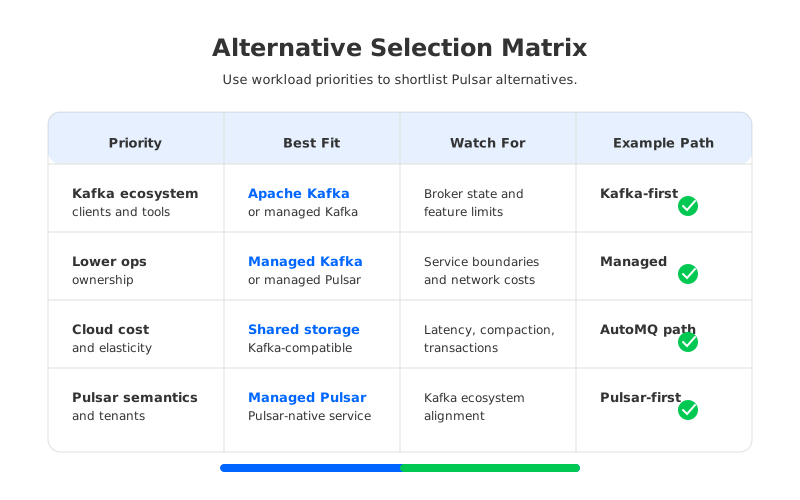
The shortlist should come from workload constraints rather than product popularity. Start with the protocol surface, then storage architecture, then deployment model. A team with Pulsar-native workloads and strong multi-tenant requirements should not be pushed into Kafka because Kafka has a larger ecosystem. A team whose applications already speak Kafka should not accept a protocol translation project without a compelling reason.
Use this pattern to narrow the field:
- Choose Apache Kafka or managed Kafka if the main goal is ecosystem standardization and the team is comfortable with Kafka's operational or managed-service trade-offs.
- Choose Kafka-compatible shared storage if the main goal is to keep Kafka clients while improving elasticity, recovery, and cloud cost structure.
- Choose managed Pulsar if the team needs Pulsar semantics but wants to reduce infrastructure ownership.
- Choose Redpanda if Kafka API compatibility is important and the team wants a different broker implementation with a simplified deployment model.
- Choose StreamNative Kafka or Pulsar services if the team wants a managed service portfolio that spans Kafka and Pulsar.
That shortlist should be tested with real workloads. Do not stop at a feature matrix. Run representative producers and consumers, validate consumer group behavior, test connector compatibility, simulate node failure, inspect observability, and compare the bill under expected retention and traffic patterns.
5Kafka-Compatible Migration Path
The safest migration path is incremental. A team moving away from Pulsar should avoid turning protocol migration, data migration, connector migration, and operational migration into one event. That design creates too many unknowns at once.
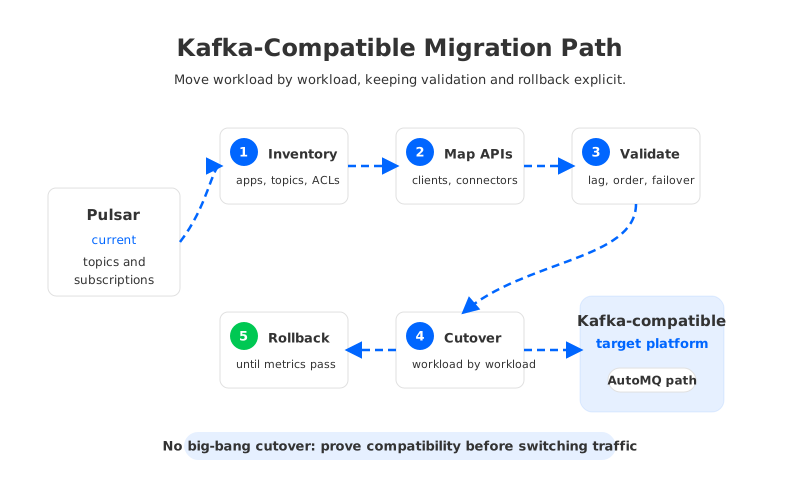
A Kafka-compatible path usually has five phases. First, inventory producers, consumers, topics, subscriptions, connectors, retention policies, and security rules. Second, identify which workloads already use Kafka clients or can move with low risk. Third, run a target platform with mirrored data or dual writes long enough to validate lag, ordering, throughput, and failure behavior. Fourth, cut over workload by workload rather than cluster by cluster. Fifth, keep rollback paths open until observability proves the target platform is stable under normal and peak traffic.
The migration is not only technical. SREs need runbooks, data engineers need connector behavior they trust, and finance teams need cost reports that map to actual traffic rather than vendor estimates. A good Pulsar alternative makes those conversations concrete.
6Decision Checklist
Before committing to a Pulsar alternative, answer these questions:
| Item | Good Signal | Risk Signal |
|---|---|---|
| Client compatibility | Existing producers and consumers work with limited code change. | Migration depends on protocol translation or application rewrites. |
| Connector coverage | Critical sources and sinks are supported and tested. | Connectors exist on paper but not in your deployment model. |
| Storage economics | Retention, replication, and network costs are modeled from real traffic. | Cost analysis uses vendor claims without workload replay. |
| Operational ownership | Runbooks, alerts, upgrades, and failure handling are clear. | Managed-service boundaries are vague. |
| Feature fit | Transactions, compaction, ordering, and replay behavior match workload needs. | Missing features are discovered during late-stage testing. |
The right Pulsar alternative reduces the risk that made you search in the first place. If the risk is Pulsar operations, managed Pulsar may be enough. If the risk is Kafka ecosystem mismatch, choose a Kafka-native path. If the risk is cloud cost and elasticity in a Kafka-heavy environment, evaluate Kafka-compatible shared-storage platforms such as AutoMQ using your own traffic profile rather than a generic ranking.
For teams evaluating that last path, the next useful step is a workload-level proof of concept: run your Kafka clients, replay representative traffic, test failure recovery, and compare the operational model against your current Pulsar or Kafka baseline. AutoMQ's documentation is a useful starting point for understanding how Kafka compatibility and object-storage-backed shared storage fit together.
7FAQ
7.1How should I choose a Pulsar alternative?
There is no universal answer. Apache Kafka is the strongest default when ecosystem breadth matters. Managed Kafka services fit teams that want Kafka compatibility without self-managing brokers. Kafka-compatible shared-storage platforms are worth testing when cloud cost, elasticity, and recovery speed are major drivers. Managed Pulsar is often right when the workload depends deeply on Pulsar semantics.
7.2Is Kafka a direct replacement for Pulsar?
Kafka can replace Pulsar for many event-streaming workloads, but it is not a drop-in replacement for every Pulsar deployment. Pulsar tenants, namespaces, subscription modes, and tooling may require redesign. Kafka is a stronger fit when applications already use Kafka clients or when the organization wants to standardize on Kafka ecosystem tools.
7.3What is a Kafka-compatible Pulsar alternative?
A Kafka-compatible Pulsar alternative accepts Kafka clients and preserves Kafka-facing application behavior while replacing the current Pulsar deployment. Examples include Apache Kafka, managed Kafka services, Redpanda, WarpStream, StreamNative Kafka Service, and AutoMQ. Compatibility varies by product and feature, so test transactions, compaction, security, connectors, and consumer group behavior before migration.
7.4Where does AutoMQ fit among Pulsar alternatives?
AutoMQ fits when the team wants a Kafka-compatible path rather than a Pulsar-protocol path. It keeps Kafka clients and ecosystem tools central while using object-storage-backed shared storage to reduce durable data bound to broker-local disks. That makes it relevant when elasticity, data movement, and storage cost are part of the replacement decision.
7.5Should I choose managed Pulsar or Kafka-compatible streaming?
Choose managed Pulsar when Pulsar semantics are the reason the platform exists and the pain is operational ownership. Choose Kafka-compatible streaming when application compatibility, connector availability, Kafka skills, or Kafka-based governance matter more than Pulsar-specific features. Mixed requirements need both paths tested with the same workload and cost model.
8References
- Apache Pulsar architecture overview
- Apache Kafka documentation: Kafka Connect
- Apache Kafka documentation: Kafka Streams
- Confluent Cloud overview
- Amazon MSK developer guide
- Redpanda architecture documentation
- WarpStream introduction
- WarpStream architecture
- StreamNative Cloud overview
- StreamNative Cloud Kafka clients
- StreamNative Cloud data streaming engine
- AutoMQ overview
- AutoMQ difference with Apache Kafka


