
Table of Contents
Table of Contents
Teams usually start searching for "Pulsar as a Kafka alternative" after Kafka has become both essential and expensive to operate. The platform works, applications depend on it, and the company has already standardized on event streaming. The frustration comes from the parts around the platform: broker disk pressure, slow partition reassignment, cross-region replication complexity, multi-tenant isolation, cloud cost, and the amount of operational knowledge required to keep clusters calm during traffic spikes.
Apache Pulsar deserves attention in that conversation. Its architecture separates serving from storage through brokers and Apache BookKeeper, and its tenant, namespace, subscription, and geo-replication model can be attractive for organizations that want a more explicitly multi-tenant streaming system. The harder question is whether Pulsar is the right alternative to Kafka for your specific pain. A replacement decision is not only a broker decision; it touches clients, connectors, stream processing, security, observability, incident response, and team skills.
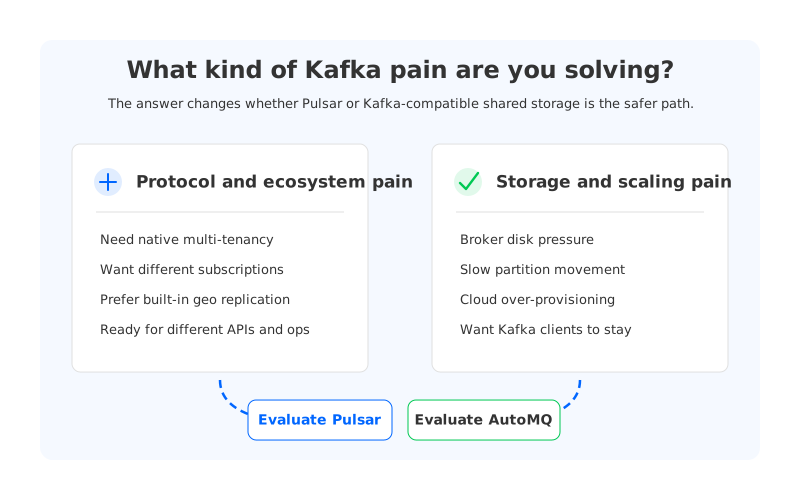
The most useful way to evaluate Pulsar is to split Kafka pain into two categories. Some teams are unhappy with the Kafka protocol and ecosystem model itself. Others like Kafka's API and ecosystem, but dislike the traditional broker-local storage model that makes cloud scaling and recovery heavy. Pulsar can be a strong answer to the first category when its native model fits the workload. For the second category, a Kafka-compatible shared-storage system may solve the root problem with less migration risk.
1Why Pulsar Gets Considered as a Kafka Alternative
Pulsar is not a random queue trying to borrow Kafka search traffic. It is a serious distributed messaging and streaming project with architectural choices that address real platform concerns. Its official architecture describes a cluster made of brokers, BookKeeper bookies for persistent storage, and a metadata store. That split gives Pulsar a different operational shape from traditional Kafka, where brokers host and replicate the logs they serve.
That design leads to several concrete benefits. Brokers can focus on serving traffic and dispatching messages while storage is handled by BookKeeper ledgers. Tenants and namespaces give administrators a native hierarchy for isolating teams and applications. Subscription types give more flexibility than a single consumer group mental model. Geo-replication is built into the Pulsar design rather than being treated mainly as an external mirroring concern.
These benefits matter when a platform team is building a shared messaging service for many internal teams. The questions are often organizational as much as technical:
- How do we isolate teams without creating a cluster per team?
- How do we apply retention, replication, and permissions at a useful administrative boundary?
- How do we support both queue-like and stream-like consumption patterns?
- How do we operate cross-region messaging without bolting every behavior onto external tooling?
Pulsar's answer is coherent. If those are the problems driving the search, it belongs on the shortlist. The danger is assuming that architectural coherence automatically makes it a low-risk Kafka replacement.
2What Pulsar Changes Compared With Kafka
Kafka's center of gravity is the partitioned log and the ecosystem around it. Producers write records to topic partitions, consumers track offsets, Kafka Connect moves data between systems, and Kafka Streams builds applications on the same protocol. Over time, this has become more than a messaging API. It is an operational and integration contract across a large number of systems.
Pulsar changes that contract. It has topics, partitions, subscriptions, cursors, tenants, namespaces, brokers, bookies, and ledgers. Some concepts map cleanly to Kafka ideas, but they are not identical. The vocabulary alone is a signal: Pulsar is not "Kafka with different internals." It is a different streaming system with its own design center.
| Evaluation area | Kafka expectation | Pulsar model | Migration implication |
|---|---|---|---|
| Administrative boundary | Cluster, topic, ACL, quota patterns | Tenant and namespace hierarchy | Platform governance may improve, but policies must be redesigned |
| Consumption model | Consumer groups and offsets | Subscriptions and cursors | Consumer behavior needs workload-level validation |
| Storage model | Broker-local logs with replication | BookKeeper ledgers behind brokers | Operations shift from broker disk to broker/bookie coordination |
| Integration layer | Kafka Connect and Kafka-native tools | Pulsar IO, Functions, clients, and compatibility options | Connectors and stream processors need compatibility testing |
| Geo-replication | Commonly built with replication tooling | Native geo-replication model | Cross-region design may simplify, but semantics still need testing |
The table does not mean Pulsar is worse. It means the migration is a system conversion, not a binary swap. A greenfield team can evaluate Pulsar on its own terms. A Kafka-heavy organization has to evaluate the cost of changing a working ecosystem.
3The Hidden Migration Surface
Kafka migrations fail in boring places. A producer library behaves differently under retries. A connector stores offsets in a way the migration plan did not preserve. A dashboard loses its useful metrics because the names and labels changed. A rollback path exists on a slide but not in the data plane. None of these issues make headlines, but they decide whether a replacement project earns trust.
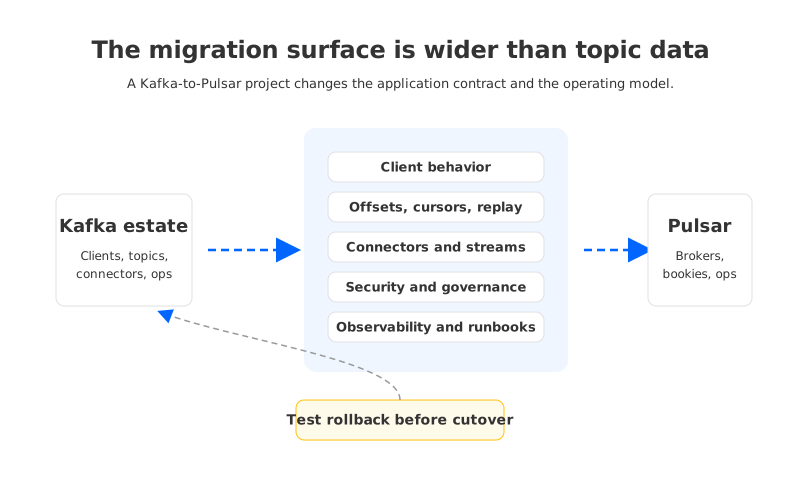
The migration surface is wider than topic data. It includes every assumption around how applications produce, consume, observe, secure, and recover streaming workloads. Before choosing Pulsar as a Kafka alternative, a review board should test the following areas with production-shaped workloads:
- Client behavior: batching, compression, retries, ordering, idempotence assumptions, timeout behavior, and error handling under partial failure.
- Consumer progress: offset or cursor translation, replay behavior, slow consumers, dead-letter flows, and backfill operations.
- Connectors and stream processing: Kafka Connect, Kafka Streams, Flink connectors, schema registry usage, state stores, and exactly-once assumptions.
- Security and governance: authentication, authorization, tenant mapping, namespace policy design, audit requirements, and ownership boundaries.
- Observability and operations: metrics, logs, alerts, runbooks, capacity planning, broker failure, bookie failure, and region failover.
- Rollback: the exact process for moving producers and consumers back if the migration reveals semantic or operational gaps.
The rollback point deserves special attention. A migration that can only move forward is not an engineering plan; it is a bet. Pulsar can be a good bet in the right context, but high-value Kafka estates should not confuse confidence with reversibility.
4When Pulsar Is a Strong Fit
Pulsar is strongest when the target platform wants Pulsar's native model, not merely relief from Kafka operations. A team building a multi-tenant internal messaging platform from scratch may prefer tenants and namespaces as first-class primitives. A company with cross-region messaging requirements may value Pulsar's geo-replication model. A platform that needs multiple subscription modes may find Pulsar's consumption semantics useful.
It also fits teams that are willing to adopt a different operational stack. BookKeeper is powerful, but it is not free complexity. Operators need to learn how brokers, bookies, ledgers, metadata, caches, and placement policies behave under load and failure. That knowledge can be worth acquiring when Pulsar's model matches the organization's platform goals.
Pulsar is less compelling when the real complaint is narrower: Kafka is expensive on cloud disks, partition reassignment takes too long, brokers are hard to scale down, or storage-heavy workloads force over-provisioned compute. Those are serious problems, but they do not necessarily require leaving Kafka's application contract. They require changing the storage architecture beneath that contract.
5When Keeping the Kafka API Is the Safer Move
Kafka's ecosystem is the reason many replacement projects become larger than expected. The protocol is embedded in services, data pipelines, deployment templates, Terraform modules, dashboards, runbooks, onboarding guides, and team muscle memory. That installed base has economic value. A platform decision should spend it only when the target model pays back more than the migration consumes.
This is where a third path appears. If your pain comes from traditional Kafka's broker-local storage, you can look for a system that preserves Kafka compatibility while changing the storage and scaling model. AutoMQ is one example of that category: a Kafka-compatible cloud-native streaming system that moves durable stream storage to object-storage-backed shared storage and makes brokers stateless around that shared layer.
The distinction matters. Pulsar asks, "Would a different streaming model serve us better?" AutoMQ asks, "Can we keep the Kafka contract while removing the storage and elasticity problems created by broker-local disks?" Those are different questions, and they produce different migration risk profiles.
For Kafka-heavy organizations, compatibility reduces the number of moving parts that need to change at once. Existing Kafka clients can remain relevant. Kafka Connect and Kafka ecosystem tools remain part of the plan, subject to normal validation. Operational teams still need to learn the shared-storage architecture, but they are not also rewriting every application-facing assumption at the same time.
6Three Strategic Paths
The decision is easier when you stop treating "Pulsar versus Kafka" as a winner-takes-all argument. Most teams are choosing among three strategies: stay on Kafka and improve operations, move to Pulsar and adopt its native model, or keep Kafka compatibility while replacing the storage architecture.
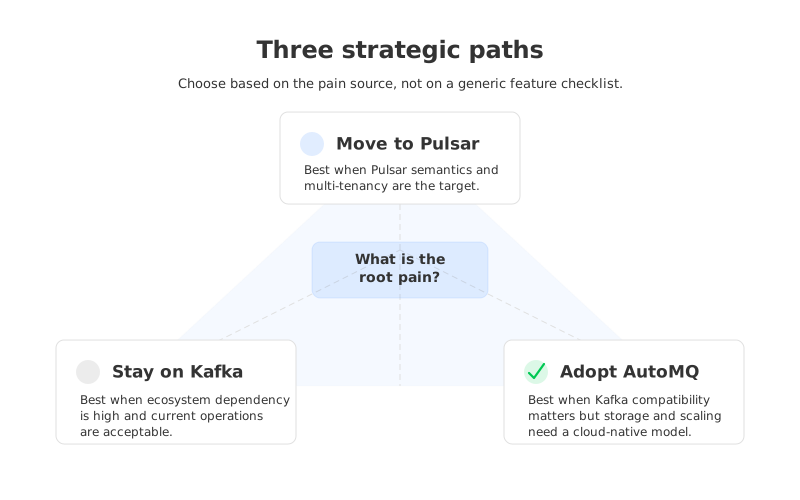
Each path is reasonable under the right pressure:
- Stay on Kafka when the ecosystem dependency is high, the cost problem is acceptable, and the organization has strong Kafka operations.
- Move to Pulsar when its tenant, namespace, subscription, storage, and geo-replication model directly matches the platform you want to build.
- Adopt Kafka-compatible shared storage when the main pain is cloud elasticity, storage cost structure, broker recovery, or partition movement, and rewriting Kafka workloads would create more risk than value.
The third path is not a claim that every Kafka estate should choose AutoMQ. It is a reminder to define the problem before selecting the replacement. If the problem is "Kafka's protocol limits us," Pulsar deserves serious evaluation. If the problem is "Kafka's traditional storage model is expensive and slow to operate in the cloud," changing the storage architecture while keeping Kafka compatibility may be the cleaner move.
7A Practical Evaluation Checklist
A useful proof of concept should avoid toy benchmarks. Throughput charts can help, but they rarely expose the compatibility and operations issues that appear after a platform becomes shared infrastructure. Use a production-shaped evaluation instead.
Start with three representative workloads: one high-throughput producer and consumer path, one connector-heavy pipeline, and one stream-processing workload with state and replay requirements. Run failure scenarios before celebrating steady-state performance. Kill brokers, bookies, or nodes. Pause consumers. Force backlog catch-up. Test schema changes, ACL updates, and region failover. Then ask how much application code, platform automation, and operational practice had to change.
The strongest evaluation scorecard combines technical fit and migration cost:
| Question | Why it matters |
|---|---|
| Are we changing the API because we need Pulsar semantics, or because Kafka storage hurts? | Prevents solving a storage problem with a protocol migration |
| Can every critical connector and stream job move without semantic surprises? | Protects the data platform from edge-case failures |
| Do operators understand the target platform's failure modes? | Avoids replacing one known operational burden with an unfamiliar one |
| Is rollback tested with real offsets, cursors, and replay behavior? | Turns migration risk into an engineering control |
| Does the target platform reduce total complexity after 12 months? | Keeps the decision focused on long-term operating cost |
If Pulsar wins that evaluation, the migration has a clear rationale. If AutoMQ or another Kafka-compatible shared-storage platform wins, the rationale is different but equally valid: the organization wanted cloud-native Kafka economics without spending its Kafka ecosystem advantage.
8FAQ
8.1Is Pulsar a real Kafka alternative?
Yes. Apache Pulsar is a real alternative for teams that want its native architecture, multi-tenancy model, subscription semantics, and geo-replication design. It should be evaluated as a different streaming system, not as a transparent Kafka clone.
8.2Can Pulsar replace Kafka without application changes?
Usually, a production replacement requires validation beyond basic client compatibility. Applications, connectors, stream processors, security policies, metrics, alerts, and rollback procedures may all need work. The exact scope depends on how deeply your platform depends on Kafka-specific behavior.
8.3When is Pulsar better than Kafka?
Pulsar can be a better fit when multi-tenancy, namespace-level governance, flexible subscription patterns, and cross-region messaging are central requirements. It is especially worth evaluating for greenfield platforms that do not already have a large Kafka ecosystem dependency.
8.4When is Kafka-compatible shared storage better than Pulsar?
Kafka-compatible shared storage is often a better fit when the team likes Kafka's API and ecosystem but dislikes traditional Kafka's cloud storage, scaling, reassignment, or recovery behavior. In that case, changing the storage architecture may create less migration risk than changing the streaming API.
8.5Where does AutoMQ fit in this decision?
AutoMQ fits the third path: keep Kafka compatibility while using object-storage-backed shared storage and stateless brokers to address cloud elasticity and storage economics. It is most relevant when the problem is Kafka's infrastructure model rather than Kafka's application ecosystem.
9References
- Apache Pulsar Architecture Overview
- Apache Pulsar Multi Tenancy
- Apache Pulsar Geo-Replication
- Apache Pulsar Functions Overview
- Apache Pulsar IO Overview
- Apache Kafka Documentation: Connect
- Apache Kafka Streams Documentation
- Apache Kafka Documentation: Message Delivery Semantics
- AutoMQ Architecture Overview
- AutoMQ Native Compatibility with Apache Kafka
- AutoMQ Stateless Broker
- AutoMQ Migration Overview


