
Table of Contents
Table of Contents
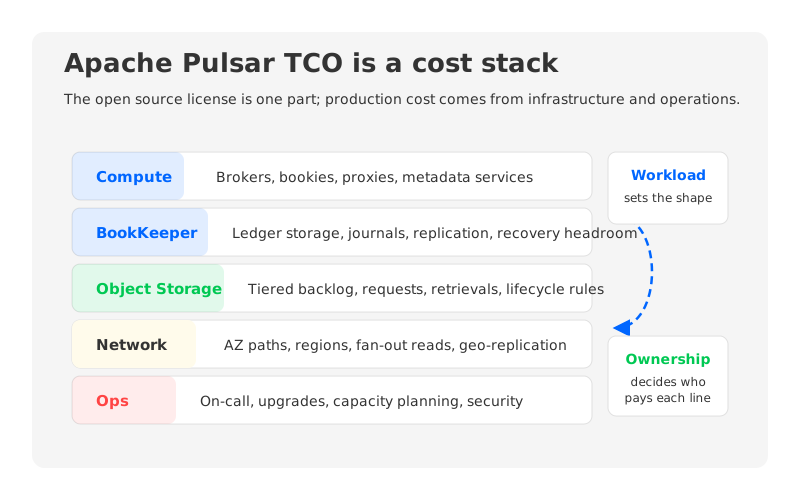
Apache Pulsar does not have a license fee in its open source form, but a production Pulsar bill still arrives every month. It shows up as compute for brokers and bookies, block storage, object storage, cross-zone or cross-region transfer, observability, managed service fees, and the engineering time required to keep the platform healthy. That is why "Pulsar cost" is the wrong question if it means "what is the software price?" The better question is what workload shape turns Pulsar into a cost-effective architecture, and what workload shape makes the operating model expensive.
Pulsar's architecture is attractive because it separates serving from storage. Brokers handle producers, consumers, admin APIs, and dispatch; Apache BookKeeper bookies store persistent message data as ledgers; metadata services coordinate the cluster; tiered storage can offload older backlog to object storage. Those pieces are useful, but every piece has a cost meter attached to it. A realistic Pulsar TCO model prices the system as a distributed streaming platform, not as one broker process.
1Pulsar Is Open Source, But Production Is Not Free
The first TCO mistake is treating open source as a substitute for capacity planning. Open source removes a software license line, but it does not remove the infrastructure required for durability, availability, and operational control. In Pulsar, persistent topics rely on BookKeeper for message storage, and BookKeeper is not a passive disk bucket. It is a storage cluster with bookies, ledgers, ensembles, journals, disks, and replication behavior that must be sized and operated.
A cost estimate should begin with ownership boundaries. Self-managed Pulsar means your team pays the cloud provider for compute, disks, object storage, networking, Kubernetes or VM infrastructure, observability, and backup systems. Managed Pulsar shifts part of the operational burden to a vendor, but the bill may include service fees, support, throughput meters, storage meters, and infrastructure pass-through depending on whether the deployment is hosted or BYOC. Internal platform-managed Pulsar often sits between those models: there may be no vendor invoice, but engineering time and shared infrastructure still belong in the TCO calculation.
The distinction matters because a low raw infrastructure estimate can be misleading. If the platform requires a small group of senior SREs to watch BookKeeper storage pressure, tune retention, manage geo-replication, and coordinate upgrades, labor is not a footnote. It is part of the product cost.
2The Main Pulsar Cost Drivers
Pulsar TCO is easier to reason about when you separate workload-driven costs from architecture-driven costs. Workload-driven costs grow with write throughput, read fan-out, retention, and replication. Architecture-driven costs come from the number of moving parts required to serve the workload reliably. Both matter, and they compound under multi-tenant production use.
| Cost driver | What creates the cost | What to measure before estimating |
|---|---|---|
| Broker compute | Producer ingest, consumer dispatch, topic lookup, admin traffic, offload reads | Peak and average throughput, consumer fan-out, protocol mix |
| BookKeeper storage | Persistent ledger writes, replication, journal and ledger disks | Retention window, backlog, write rate, disk throughput |
| Object storage | Tiered storage offload, long-term backlog, request and retrieval activity | Offload threshold, read frequency, storage class, object count |
| Networking | Client traffic, broker-to-bookie writes, replication, geo-replication, load balancers | AZ layout, regions, VPC paths, egress destinations |
| Operations labor | Upgrades, rebalancing, troubleshooting, capacity forecasting, security | On-call model, release cadence, internal platform maturity |
The table is not a price sheet. Cloud prices vary by region, service, discount program, and deployment model. What stays stable is the structure: every Pulsar bill is a combination of compute, storage, data movement, service management, and human work.
3Compute: Brokers, Bookies, Proxies, And Metadata
Broker compute is usually the most visible part of a Pulsar deployment because brokers sit directly in the client path. They accept producer writes, dispatch messages to consumers, perform topic lookup, expose REST APIs for administration, and read from BookKeeper when backlog falls outside broker cache. If a workload has high consumer fan-out, the broker side of the bill can grow even when the write rate is moderate, because the same stored data may be dispatched to many consumers.
Bookie compute is easier to underestimate. Bookies are BookKeeper servers handling ledger fragments, journal writes, reads, and replication. Apache BookKeeper's model stripes entries across bookies in an ensemble, so capacity planning depends on bookie count, disk layout, and replication requirements. Proxies, load balancers, metadata services, Kubernetes nodes, monitoring agents, and log collection may not dominate the invoice, but they raise the minimum viable footprint.
4BookKeeper Storage: The Cost Center Behind Retention
Retention is where Pulsar cost becomes concrete. A topic backed by a managed ledger writes data into BookKeeper ledgers, and those ledgers are replicated across bookies according to the durability configuration. The more data you retain in the hot BookKeeper layer, the more storage capacity and disk throughput you must provision. That is different from storing archived files in object storage, because BookKeeper storage has to support the write and read behavior of a live streaming system.
This is why "how many days of retention?" is not a harmless product question. Seven days of retention at a modest write rate may be easy. The same window at a higher ingest rate, with multiple tenants and replay-heavy consumers, can require more bookies, faster disks, separate journal and ledger devices, or more recovery headroom. A model that includes only steady-state GB-month storage misses the moments when distributed storage becomes operationally expensive.
5Object Storage And Tiered Storage
Pulsar tiered storage can reduce pressure on BookKeeper by moving older backlog to long-term storage such as Amazon S3, Google Cloud Storage, Azure Blob Storage, Aliyun OSS, or S3-compatible systems. The official Pulsar documentation describes the mechanism as offloading sealed, immutable segments from the managed ledger to the configured storage backend while keeping the data accessible to consumers. That is a useful design for long retention, audit trails, and replay workloads where not all historical data needs to stay on bookies.
Tiered storage changes the shape of the bill rather than removing it. Object storage pricing includes storage volume, request types, retrievals, data transfer, lifecycle transitions, and in some storage classes minimum duration rules. Pulsar offloading also introduces operational details such as bucket credentials, offload thresholds, deletion lag, upload cleanup, and read priority for offloaded data.
The right mental model is "BookKeeper for hot streaming storage, object storage for older backlog." If most reads are near-real-time and long retention is rarely replayed, tiering can be effective. If consumers scan old data, the object storage request and retrieval profile matters. A cost estimate should include both replay frequency and history volume.
6Networking And Replication
Networking is the line item that surprises teams after the cluster is already live. Pulsar traffic includes producer-to-broker and broker-to-consumer paths, broker-to-bookie writes, BookKeeper replication, load balancer or proxy traffic, observability export, cross-VPC access, and sometimes geo-replication across regions. AWS describes data transfer costs in broad categories such as transfer between Availability Zones, transfer between Regions, and transfer out to the internet; streaming systems can touch several of those categories at once.
Geo-replication deserves separate attention. Pulsar can replicate messages across clusters and manages replication at the namespace level, but every replicated byte has to move. Fan-out matters as well: a topic with one producer and many independent consumer groups has a very different network profile from a topic with one producer and one consumer.
7Managed Pulsar Pricing: What The Vendor Fee Does And Does Not Cover
Managed Pulsar can be the right choice when the team wants Pulsar semantics without building deep operational expertise in-house. StreamNative, for example, publishes pricing and billing documentation for hosted, dedicated, and BYOC deployment models, with dimensions such as cluster type, compute units, storage units, ingress, egress, functions, connectors, support, and infrastructure ownership. The important lesson is not one specific starting price; it is that managed Pulsar still has workload-sensitive meters.
In hosted models, the provider may absorb more infrastructure management. In BYOC models, the data plane can run in the customer's cloud account, but cloud infrastructure costs may still be paid directly to the cloud provider. Procurement teams should ask whether the service fee replaces real operational labor, and whether pricing dimensions align with bursty traffic, high retention, and a large connector estate.
8Workload Inputs For A Pulsar Cost Estimate
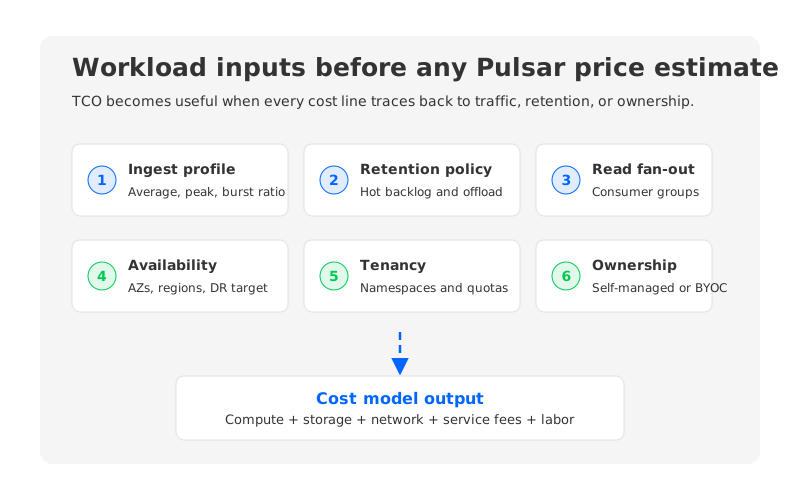
A useful TCO estimate starts with workload inputs, not vendor names. Teams that begin with a product comparison often end up debating architecture before they know what must be priced. The minimum worksheet should include the write path, read path, retention path, availability target, and operating model.
Start with these inputs:
- Average and peak ingest throughput in MiB/s. Peak-to-average ratio determines how much capacity sits idle during normal periods.
- Consumer fan-out by topic or tenant. One stored byte may be delivered multiple times to independent applications.
- Retention and backlog policy for hot BookKeeper storage and offloaded object storage. Separate compliance retention from replay retention.
- Availability topology across zones and regions. A single-AZ test estimate is not a production multi-AZ or multi-region estimate.
- Operations model including self-managed, vendor-managed, BYOC, support tier, and internal on-call expectations.
With those inputs, the estimate becomes less emotional. You can ask whether BookKeeper storage grows faster than expected, whether object storage retrievals matter, whether cross-zone traffic is a top driver, and whether a managed service fee is replacing real labor.
9Comparing Pulsar Cost With Kafka-Compatible Shared Storage
Some teams evaluating Pulsar are not trying to adopt Pulsar-specific semantics. They are trying to reduce the cost and operational friction of Kafka in the cloud. That distinction matters. If the real goal is lower Kafka TCO, changing protocols introduces application migration work that may be larger than the infrastructure savings.
This is where Kafka-compatible shared storage becomes relevant. AutoMQ is a cloud-native streaming platform that keeps Kafka protocol compatibility while moving durable stream storage to S3-compatible object storage. Instead of asking teams to rewrite Kafka applications to Pulsar clients, it keeps the Kafka API and changes the storage architecture underneath. Brokers become closer to stateless compute, and durable data lives in shared object storage rather than being tied to broker-local disks.
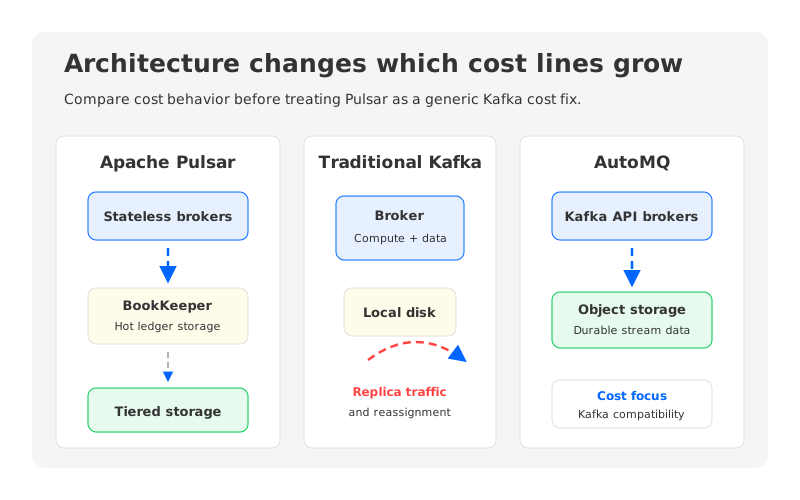
That does not make AutoMQ a replacement for every Pulsar use case. If your team needs Pulsar's subscription model, namespace semantics, or multi-protocol platform direction, Pulsar should be evaluated on those merits. If your team wants to reduce Kafka cloud cost while preserving Kafka clients, Kafka Connect, Kafka Streams, and existing operational knowledge, a Kafka-compatible shared-storage path can avoid a protocol migration while still addressing storage and elasticity pressure.
The cost comparison should therefore be framed as a choice between goals:
| Goal | More natural evaluation path | Cost question to ask |
|---|---|---|
| Adopt Pulsar semantics | Apache Pulsar or managed Pulsar | Can we fund the new operating model and migration surface? |
| Keep Kafka applications unchanged | Managed Kafka or Kafka-compatible platforms | Can we reduce storage, scaling, and network cost without rewriting clients? |
| Reduce long-retention storage pressure | Pulsar tiered storage or shared object storage | Which reads stay hot, and which history can move to object storage? |
| Reduce operations labor | Managed service or simpler architecture | Which responsibilities leave the team, and which remain? |
10A Practical Pulsar TCO Worksheet
Before a proof of concept, write a one-page worksheet and force every number to connect to a workload assumption. This keeps the evaluation grounded and prevents the common habit of comparing a production Kafka bill with a small Pulsar test cluster.
Use this structure:
- Estimate monthly write volume from average ingest throughput and retention.
- Estimate read volume from consumer fan-out and replay behavior.
- Size broker capacity for peak dispatch as well as average ingest.
- Size BookKeeper storage for hot backlog, replication, disk throughput, and recovery headroom.
- Size object storage for offloaded backlog, request profile, retrievals, and lifecycle policy.
- Add networking for client paths, internal replication, cross-zone traffic, and cross-region replication.
- Add observability, support, upgrade work, and on-call coverage.
The uncomfortable part is step 7. A platform that looks efficient on cloud resources may still be expensive if it requires rare expertise. A managed service may be reasonable if it removes a large operational burden.
Return to the original question: "how much does Pulsar cost?" It costs whatever your workload forces brokers, bookies, object storage, networks, managed services, and operators to do. Price the behavior, not the logo. If your evaluation is really about lowering Kafka cloud TCO while keeping Kafka compatibility, include AutoMQ's pricing calculator beside your Pulsar worksheet so the architecture comparison is based on the same workload inputs.
11FAQ
11.1Is Apache Pulsar free?
Apache Pulsar is open source, so there is no license fee for using the open source software. Production Pulsar still requires compute, storage, networking, monitoring, security, backup, and operational labor.
11.2What is the biggest Apache Pulsar cost driver?
It depends on the workload. High retention often pushes BookKeeper and object storage cost. High fan-out pushes broker compute and network cost. Multi-region replication pushes data transfer. Self-managed deployments can make operations labor a major cost driver even when raw cloud infrastructure looks reasonable.
11.3Does Pulsar tiered storage reduce cost?
Tiered storage can reduce pressure on BookKeeper by moving older backlog to long-term object storage. It is most useful when long-retention data is rarely replayed. The estimate should still include object storage volume, requests, retrievals, lifecycle rules, and the operational work required to configure and monitor offloading.
11.4How should I estimate Pulsar TCO?
Start with workload inputs: average and peak ingest, read fan-out, retention, availability topology, region count, and operations model. Then map those inputs to broker compute, BookKeeper storage, object storage, network transfer, managed service fees, observability, and engineering labor.
11.5Is managed Pulsar lower cost than self-managed Pulsar?
Managed Pulsar can reduce operational labor, but it is not automatically lower cost. Compare the vendor's billing dimensions, support fees, infrastructure responsibility, minimum footprint, and marketplace terms against the internal cost of running Pulsar yourself.
11.6Where does AutoMQ fit in a Pulsar cost evaluation?
AutoMQ fits when the team is evaluating Pulsar mainly to reduce Kafka cloud cost, not because it needs Pulsar-specific semantics. It keeps Kafka compatibility while using object storage as the durable storage layer, which can change storage, scaling, and recovery economics without requiring a Kafka-to-Pulsar application migration.
12References
- Apache Pulsar architecture overview
- Apache Pulsar tiered storage overview
- Apache Pulsar geo-replication
- Apache BookKeeper concepts and architecture
- AWS key principles for pricing
- Amazon S3 pricing
- Amazon EBS pricing
- AWS Global Network data transfer FAQs
- StreamNative pricing
- StreamNative Cloud billing overview
- AutoMQ difference with Apache Kafka
- AutoMQ stateless broker documentation


