
Table of Contents
Table of Contents
The risky part of a Pulsar migration is rarely the first copied message. A bridge can move bytes from Kafka to Pulsar, a test producer can publish events, and a demo consumer can read them back. Production risk appears later, when a Kafka Streams application expects changelog topics, a connector uses Kafka Connect internal state, an incident runbook reads offsets in a familiar way, or a rollback needs both platforms to agree on what has already been processed.
That is why "Pulsar migration risk" should be evaluated as a semantic migration, not a transport project. Apache Pulsar has a different model for tenants, namespaces, topics, subscriptions, schemas, and connectors. Kafka has a mature ecosystem around partitions, consumer groups, offsets, Connect, Streams, transactions, broker metrics, and operational automation. Those models can be mapped, but they are not identical.
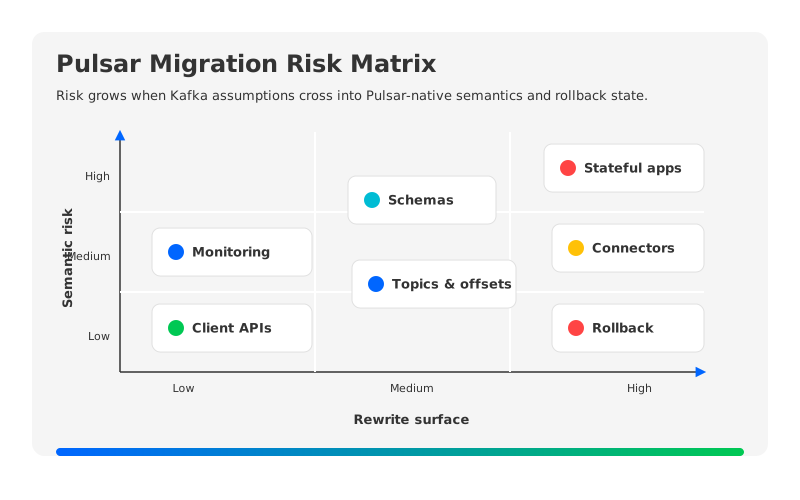
The practical question is not whether Pulsar is a good streaming system. It is whether the specific Kafka estate in front of you can move to Pulsar without rewriting more application logic, platform automation, and rollback procedure than the migration business case can tolerate.
1Why Pulsar Migrations Are Not Just Data Copies
Kafka-to-Pulsar migration often begins with a deceptively simple plan: replicate topics, switch producers, switch consumers, and decommission Kafka. That plan works only for workloads where Kafka is used as a basic append log and where applications make few assumptions beyond produce, consume, and commit progress. Many production Kafka environments are not that simple. Kafka is also the contract behind connectors, schemas, state stores, admin tools, ACL workflows, monitoring, and incident response.
Pulsar adds another layer of translation because its core abstractions differ. A Pulsar topic lives under a tenant and namespace. Consumers attach through subscription types such as exclusive, failover, shared, and key-shared. Pulsar also has its own schema registry model and Pulsar IO connector framework. These are useful building blocks, but they make migration planning more than a field-by-field rename exercise.
There are three common failure modes:
- The happy path passes while the platform path fails. A client smoke test succeeds, but Terraform topic automation, ACL management, metrics, or connector restart behavior changes under load.
- The data path moves while processing semantics drift. Ordering, offset handling, deduplication, retry behavior, compaction, or transaction assumptions change enough to affect correctness.
- The cutover works while rollback is undefined. Teams can send new writes to Pulsar, but they cannot confidently return to Kafka without duplicates, gaps, or unclear consumer positions.
A serious migration plan treats these as first-class design constraints. The larger the Kafka estate, the more important the non-message parts become.
2Kafka And Pulsar Concept Mapping
The first migration artifact should be a concept map. It forces the team to decide which Kafka concepts are being preserved, translated, replaced, or retired. That matters because many risks hide behind familiar words. A "topic" exists in both systems, but Kafka topics are not organized under Pulsar's tenant and namespace hierarchy. Kafka consumer groups and Pulsar subscriptions both coordinate consumption, but their operational knobs, subscription modes, and retry patterns are not identical.
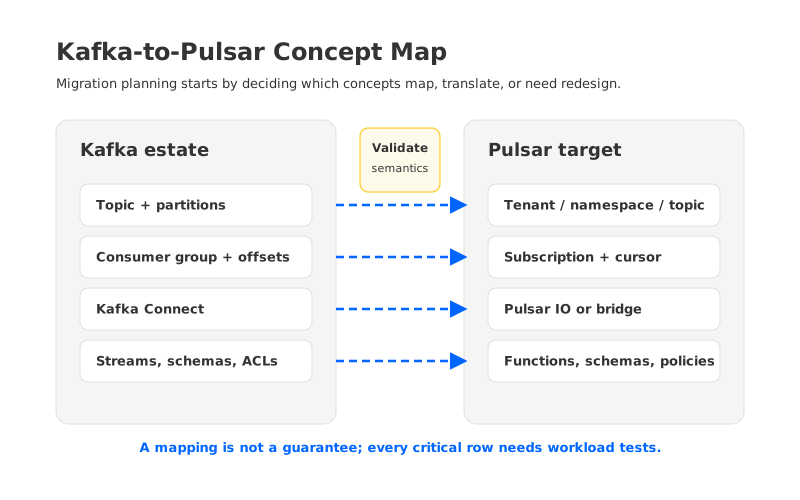
The mapping below is a starting point for architecture review. It is deliberately conservative; any row that says "needs validation" should be tested with the actual workload, not with a toy producer.
| Kafka concept | Pulsar concept | Migration risk |
|---|---|---|
| Topic | Persistent topic under tenant and namespace | Naming, tenancy, retention, authorization, and automation need remapping |
| Partition | Partitioned topic | Ordering and partition count assumptions should be tested under real key distribution |
| Consumer group | Subscription | Subscription type changes delivery behavior; shared and key-shared patterns need workload tests |
| Offset commit | Cursor / subscription position | Rollback and replay procedures must translate progress carefully |
| Kafka Connect | Pulsar IO or external connector bridge | Connector catalog, internal state, transforms, errors, and restart behavior may differ |
| Schema Registry | Pulsar schema registry or external registry | Compatibility rules and client integration must be validated |
| Kafka Streams | Pulsar Functions, Flink, custom apps, or retained Kafka Streams elsewhere | Stateful processing migration is an application rewrite unless the Kafka layer remains |
| Transactions / exactly-once workflows | Pulsar transaction features or application-level design | Semantics are not automatically portable and need correctness tests |
This table also explains why migration scope can expand quickly. A platform team may think it is moving "50 topics," but the real move includes producers, consumers, internal topics, stream processors, connector state, schemas, IAM rules, dashboards, and incident procedures. The topic count is usually the least interesting number.
3Compatibility Risks To Validate
Kafka compatibility in a Pulsar migration can mean several different things. It may mean Kafka clients connect through a protocol handler or adapter. It may mean a connector can read Kafka and write Pulsar. It may mean applications are rewritten to native Pulsar clients. Those paths have different risk profiles, and mixing them without a clear boundary is how migrations become hard to reason about.
For Kafka-heavy teams, the compatibility audit should cover six layers:
- Client API behavior. Test producer acknowledgements, idempotent producer settings, batching, compression, headers, record keys, retries, consumer group rebalances, and offset commits.
- Data semantics. Validate ordering by key, duplicate handling, retention, replay, compaction-like workflows, delayed messages, dead-letter behavior, and backpressure under failure.
- Administration. Re-run topic creation, partition changes, retention updates, ACL or permission workflows, namespace policies, quota changes, and audit logging.
- Security. Map Kafka authentication and authorization to Pulsar authentication, authorization, tenants, namespaces, and service accounts.
- Observability. Replace broker, topic, partition, lag, connector, and consumer metrics with Pulsar equivalents before cutover rehearsals.
- Failure behavior. Test broker loss, BookKeeper or storage pressure, network partitions, slow consumers, restart storms, and multi-zone failure assumptions.
The most expensive issue is not an unsupported feature discovered early. That is annoying but useful. The expensive issue is a feature that appears to work under normal traffic and diverges only during replay, failover, or rollback.
4Connector, Schema, And Stream Processing Risks
Connector migration deserves its own workstream because connectors are small systems, not passive pipes. Kafka Connect workers manage connector configs, tasks, offsets, status, errors, internal topics, converters, single message transforms, and restart behavior. Pulsar IO has its own source and sink model. A connector name appearing in both ecosystems does not prove that the operational behavior, failure handling, or configuration surface is equivalent.
Schema migration has a similar trap. Kafka teams often rely on Confluent Schema Registry or another external registry with compatibility rules embedded into CI/CD, connector configs, and producer libraries. Pulsar has schema support built into its client and broker ecosystem, but the migration still needs to decide where schemas live, how compatibility is enforced, how old consumers read new messages, and how failed deployments are rolled back. Schema drift is a data contract problem, not a documentation problem.
Stateful stream processing is usually the highest-risk category. Kafka Streams applications use Kafka topics for input, output, repartition topics, and changelog state. If those applications are rewritten to Pulsar Functions, Flink, or another processing engine, the migration becomes a processing-platform migration as well as a broker migration. If they remain on Kafka Streams through a Kafka-compatible surface, the team must test the exact API and semantic coverage used by the topology.
Use this triage model:
| Workload class | Migration posture | Why |
|---|---|---|
| Stateless ingestion producers | Usually lowest risk | Basic produce paths are easier to test and roll back |
| Simple consumers | Low to medium risk | Offset and replay semantics still need validation |
| Sink connectors | Medium risk | Connector config, batching, errors, and idempotency matter |
| Source connectors and CDC | Medium to high risk | Ordering, schema evolution, offsets, and replay affect correctness |
| Kafka Streams or transactional apps | Highest risk | State, changelogs, transactions, and exactly-once assumptions are hard to translate |
This does not mean high-risk workloads cannot move. It means they need a different plan. Treating a CDC connector and a stateless log producer as the same migration unit is a good way to hide the hard work until the final rehearsal.
5Cutover And Rollback Plan
A migration with no rollback plan is a one-way deployment. That may be acceptable for a greenfield workload, but it is a poor default for an estate that already runs revenue, fraud, payments, observability, personalization, or operational control loops. Rollback should be designed before the first production cutover rehearsal, because the rollback plan determines how you replicate data, track progress, and freeze writes.
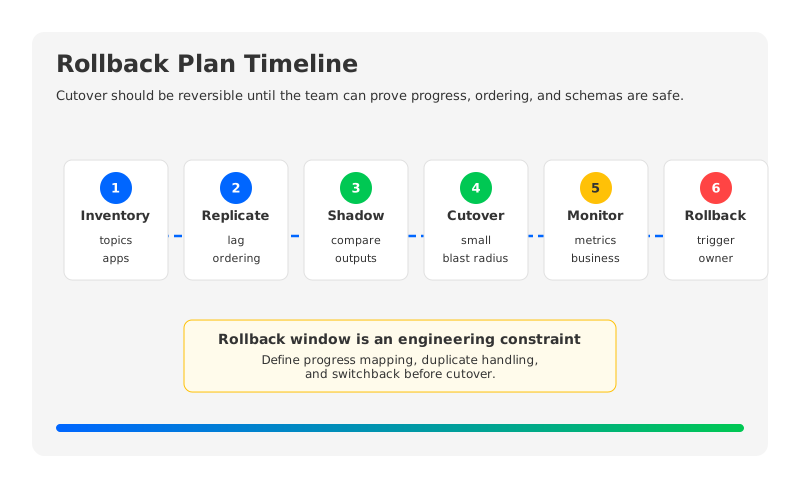
The safest pattern is phased and measurable:
- Inventory. Classify each topic by producer count, consumer count, connector dependency, schema dependency, processing dependency, and blast radius.
- Replicate. Run a Kafka-to-Pulsar bridge long enough to observe lag, ordering, schema behavior, message size limits, and backpressure.
- Shadow. Let consumers read from Pulsar without taking action, then compare output, lag, error rates, and replay behavior against Kafka.
- Cut over. Move a small workload first, keep the old path available, and freeze unrelated changes during the window.
- Monitor. Watch both platform metrics and business-level correctness signals. Broker health alone is not enough.
- Rollback. Define the exact trigger, owner, last safe offset or cursor, producer switchback procedure, duplicate-handling rule, and communication path.
The rollback window should not be vague. If the team cannot explain whether rollback is possible after 10 minutes, 2 hours, or 2 days of writes on the new platform, the cutover is not ready. The answer depends on whether data is being mirrored back, whether consumers are idempotent, whether ordering must be preserved, and whether schema evolution can be reversed.
6How AutoMQ Reduces Rewrite Surface For Kafka Teams
Once the migration risk is framed this way, another path becomes visible. Some teams evaluate Pulsar because they want to escape operational or cost pressure in Kafka, not because they specifically need Pulsar's tenant/namespace/subscription model. For those teams, the hard question is whether leaving Kafka semantics is necessary to solve the underlying problem.
AutoMQ belongs to the category of Kafka-compatible shared-storage streaming systems. It keeps the Kafka-facing contract for clients and ecosystem tools, while replacing Kafka's broker-local storage layer with S3Stream, a shared streaming storage architecture backed by S3-compatible object storage and WAL storage. The intent is to change the cloud infrastructure model without asking every application team to relearn the messaging model.
That distinction changes the migration surface. A Kafka-to-Pulsar migration may require concept mapping across topics, subscriptions, schemas, connectors, stream processing, and operations. A Kafka-to-AutoMQ migration is still a production migration, but the main validation shifts toward cluster cutover, data synchronization, client compatibility, performance, and operational runbooks under a Kafka-compatible API. It does not remove testing. It removes an entire class of application rewrite questions for teams that want to remain in the Kafka ecosystem.
This is where AutoMQ should be compared honestly. If the organization wants Pulsar-native capabilities, multi-tenant namespace modeling, or a broader Pulsar ecosystem, Pulsar may be the right target. If the organization wants Kafka behavior with a cloud-native storage architecture, AutoMQ is a lower-rewrite alternative worth evaluating in the same migration readiness process.
7Migration Readiness Checklist
Before approving a Kafka-to-Pulsar migration, the architecture review should ask questions that are uncomfortable enough to be useful. A migration plan that only lists topic names is not ready. A plan that lists semantic assumptions, failure tests, and rollback triggers is much closer.
Use this checklist as the minimum bar:
- Compatibility inventory. List client libraries, Kafka protocol features, topic configs, compacted topics, transactions, admin APIs, ACLs, quotas, and monitoring dependencies.
- Connector inventory. Record every connector, transform, converter, internal topic, offset dependency, sink idempotency rule, and restart procedure.
- Processing inventory. Identify Kafka Streams, Flink, Spark, ksqlDB, custom consumers, state stores, changelog topics, and exactly-once workflows.
- Schema inventory. Map registries, compatibility rules, producer validation, consumer fallback behavior, and release pipelines.
- Operational inventory. Replace dashboards, alerts, runbooks, capacity models, backup procedures, and incident drills before production cutover.
- Rollback design. Define switchback mechanics, duplicate handling, offset or cursor translation, reverse replication, freeze windows, and authority to abort.
- Candidate comparison. Test Pulsar, AutoMQ, or any managed Kafka option with the same workload matrix, not with vendor-specific demos.
The search for "Pulsar migration risk" usually starts with fear of downtime. Downtime is only one symptom. The deeper risk is semantic drift: the platform keeps moving messages, but the organization can no longer explain processing progress, connector state, schema compatibility, or rollback safety. Solve that, and the migration becomes an engineering decision rather than a production gamble.
If your goal is to modernize Kafka operations without rewriting Kafka-facing applications, review AutoMQ's architecture and migration documentation, then test it with the same readiness checklist you use for Pulsar. The fair comparison is not product label versus product label; it is rewrite surface, operational risk, rollback clarity, and workload fit.
8FAQ
8.1What is the biggest risk in migrating from Kafka to Pulsar?
The biggest risk is assuming that moving messages proves application compatibility. Kafka workloads often depend on offsets, consumer groups, connector internals, schemas, admin APIs, Kafka Streams state, transactions, compaction, and monitoring conventions. Those dependencies need explicit validation before cutover.
8.2Is Pulsar compatible with Kafka?
Pulsar has Kafka-related adapters and protocol-handler options, and the ecosystem includes Kafka-to-Pulsar migration patterns. Compatibility should still be tested against the exact Kafka features your workload uses. Basic producer and consumer behavior is not the same as full platform compatibility.
8.3Can Kafka Connect connectors move directly to Pulsar?
Some connectors can be replaced with Pulsar IO connectors or bridged through external tooling, but this is not a universal drop-in move. Validate connector configuration, offset storage, schema handling, transforms, error handling, restart behavior, and sink idempotency before assuming equivalence.
8.4How should teams plan rollback for a Kafka-to-Pulsar migration?
Define rollback before cutover. The plan should specify producer switchback, consumer progress mapping, duplicate handling, reverse replication requirements, schema rollback rules, the maximum safe rollback window, and the authority to abort the migration.
8.5When is Pulsar a good migration target?
Pulsar is a strong candidate when the team wants Pulsar-native concepts such as tenants, namespaces, subscriptions, and its broader messaging model, and when the workload's Kafka dependencies can be mapped or rewritten safely. It is less straightforward when the main goal is to preserve Kafka semantics while changing infrastructure economics.
8.6How does AutoMQ reduce migration risk for Kafka teams?
AutoMQ keeps the Kafka-facing API and ecosystem while changing the storage architecture underneath Kafka. For teams that want cloud-native shared storage but do not want to rewrite applications around Pulsar concepts, that can reduce the migration surface to cluster cutover, synchronization, compatibility testing, and operational validation.
9References
- Apache Pulsar Documentation: Concepts Overview
- Apache Pulsar Documentation: Messaging Concepts
- Apache Pulsar Documentation: Kafka Client Adapter
- Apache Pulsar Documentation: Pulsar IO Overview
- Apache Pulsar Documentation: Understand Schemas
- Apache Kafka Documentation
- Apache Kafka Streams Introduction
- AutoMQ Documentation: S3Stream Shared Streaming Storage
- AutoMQ Documentation: Migrate to AutoMQ Cloud


