
Table of Contents
Table of Contents
Searching for a Pulsar replacement usually means the debate has moved beyond a feature comparison. A team has already run Apache Pulsar long enough to feel friction: operational complexity, unexpected cost drivers, skill gaps, connector gaps, or pressure to standardize around Kafka. That does not mean Pulsar was a bad choice. It means the architecture, team, and business constraints may no longer line up the way they did when Pulsar entered the platform.
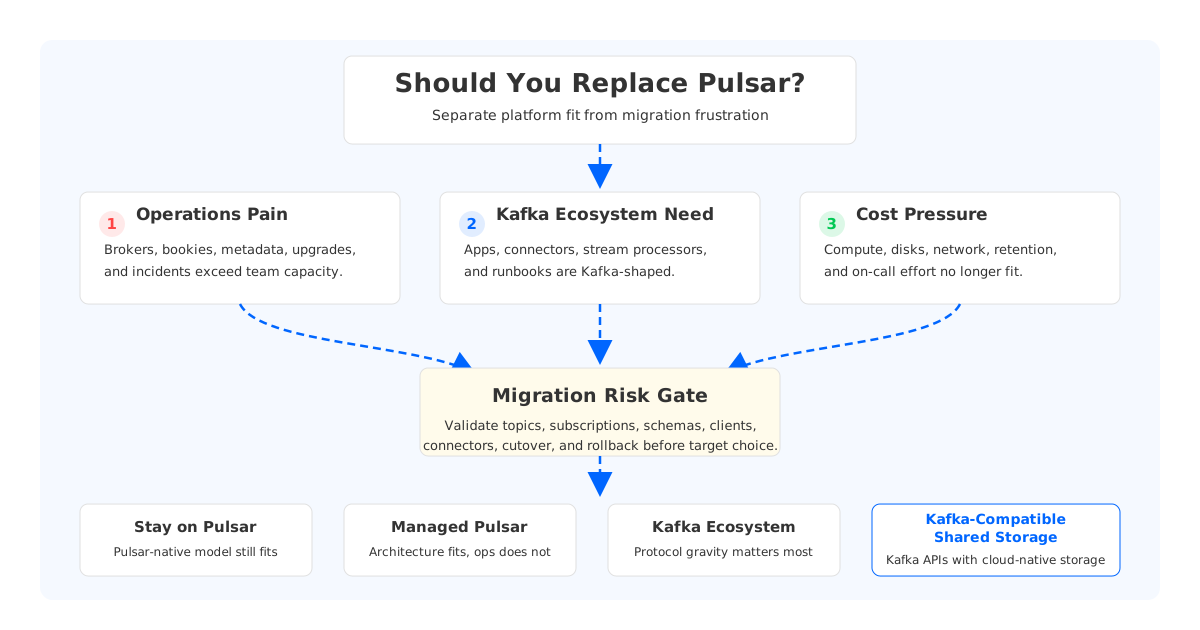
The first mistake is treating "replace Pulsar" as a binary verdict. Some teams should stay on Pulsar and tune the operating model. Some should move to managed Pulsar because the architecture still fits but self-management does not. Others should migrate back toward the Kafka ecosystem because applications, data tools, and hiring all point there. A smaller but important group wants Kafka compatibility without returning to the broker-local disk model that made cloud Kafka expensive or slow to scale in the first place.
1Signs Pulsar May No Longer Fit Your Team
Pulsar's architecture is powerful because it separates serving from storage. Pulsar brokers handle producers, consumers, topic lookup, and dispatch, while Apache BookKeeper stores persistent message data in ledgers. The design gives teams useful tools for multi-tenancy, namespace-level administration, subscriptions, geo-replication, and tiered storage. It also expands the operating surface: brokers, bookies, metadata services, managed ledgers, offload policies, subscription behavior, schema handling, and connector infrastructure all have to work together.
Replacement pressure often appears when that surface area becomes larger than the team can justify. The issue is rarely one dramatic failure. It is the accumulation of small operational costs: upgrades take more coordination, incidents require narrower expertise, capacity planning spans more components, and debugging needs people who understand both the application path and the storage path.
The strongest triggers usually fall into a few categories:
- Operational concentration risk. If only one or two engineers understand brokers, bookies, metadata, and offload behavior, Pulsar becomes fragile even when the cluster itself is healthy.
- Kafka ecosystem dependency. If most applications, connectors, stream processors, governance tools, and observability workflows are Kafka-shaped, running Pulsar may force translation at too many edges.
- Cost pressure. Pulsar can separate storage and serving capacity, but cloud bills still include compute, disks, network traffic, metadata services, long-retention storage, and on-call time.
- Procurement and managed service constraints. Some organizations can approve managed Kafka or Kafka-compatible BYOC platforms more easily than a self-managed Pulsar estate.
- Team skill alignment. A platform is not only an architecture. It is also hiring, runbooks, incident drills, and the confidence to operate under pressure.
Those triggers do not automatically make Pulsar the wrong platform. They do indicate that the replacement question is real enough to model, because the cost of staying is no longer only technical.
2Cases Where Staying on Pulsar Is Reasonable
A credible Pulsar replacement guide has to include the reasons not to replace it. Pulsar remains a reasonable fit when its native model solves problems that Kafka-compatible systems would have to approximate. If tenants, namespaces, multiple subscription types, and geo-replication are central to your application design, moving away can create more work than it removes.
Greenfield messaging platforms often benefit from Pulsar's abstractions because they can design applications around Pulsar from the start. Teams using Pulsar Functions or Pulsar IO connectors may also have application logic and integration patterns that are already tied to Pulsar's ecosystem. The same is true for organizations that invested deeply in namespace policy, schema enforcement, and operational tooling around Pulsar's admin model.
Staying can be the right answer when the pain is specific and fixable:
| Symptom | Better first move than replacement | Why it may work |
|---|---|---|
| BookKeeper capacity pressure | Revisit bookie sizing, ledger placement, and retention | The architecture may fit, but the deployment is undersized |
| Long-retention storage cost | Review tiered storage and offload policy | Older data may not need the same storage tier as active traffic |
| Too much manual operations work | Evaluate managed Pulsar or stronger automation | The problem may be self-management rather than Pulsar itself |
| Confusing application behavior | Audit subscription type, schema, and client settings | Semantics mismatches can look like platform failure |
This matters because a migration can be more disruptive than an upgrade, a managed-service move, or a focused tuning project. Replace Pulsar when the mismatch is structural. Do not replace it because the last incident was painful and the postmortem is still fresh.
3Replacement Options by Architecture
Once the structural mismatch is clear, the next question is not "which vendor should we buy?" It is "which architecture should own the next version of the platform?" Four categories usually come up in production evaluations.
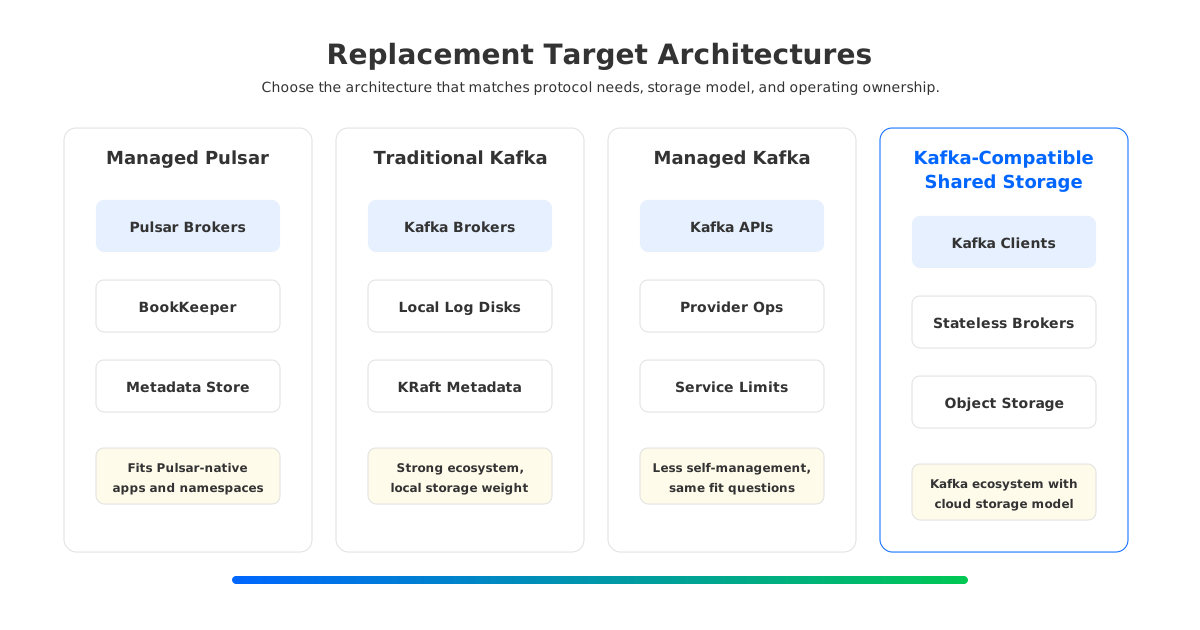
Traditional Apache Kafka is the most direct path back to the Kafka ecosystem. It gives teams broad client support, Kafka Connect, Kafka Streams, familiar consumer group behavior, and a large operational knowledge base. The tradeoff is that classic Kafka still revolves around broker-hosted partition logs. When partitions move, data moves; when disks fill, brokers need capacity; when the cluster grows, reassignment and balancing become real projects.
Managed Kafka reduces the infrastructure burden but does not remove every architectural constraint. It can be the right answer for teams that want Kafka semantics and a service provider to handle much of the control plane and operations. The evaluation should still include storage cost, cross-zone traffic, scaling behavior, connector availability, networking model, and data-control requirements.
Managed Pulsar keeps the Pulsar architecture while outsourcing much of the operational work. This can be a strong option when the team still wants Pulsar's tenant and namespace model but no longer wants to manage brokers, bookies, and upgrades directly. It is less compelling when the organization wants to reduce Pulsar-specific application and tooling surface area.
Kafka-compatible shared storage is the middle path for teams that want to leave Pulsar but avoid going back to a broker-local disk architecture. AutoMQ fits here: it is a Kafka-compatible cloud-native streaming platform that moves durable data into object-storage-backed shared storage and makes brokers more stateless. The practical implication is that applications can continue to use Kafka clients and ecosystem tools while the storage and scaling model changes underneath.
4Migration Risks to Check Before Moving
The hard part of replacing Pulsar is not drawing the target architecture. It is finding the contracts hidden inside production workloads. Pulsar topics, namespaces, subscriptions, schemas, connectors, authentication, and client behavior do not map one-to-one to every Kafka replacement path. Even a move toward Kafka can be straightforward for one workload and risky for another.
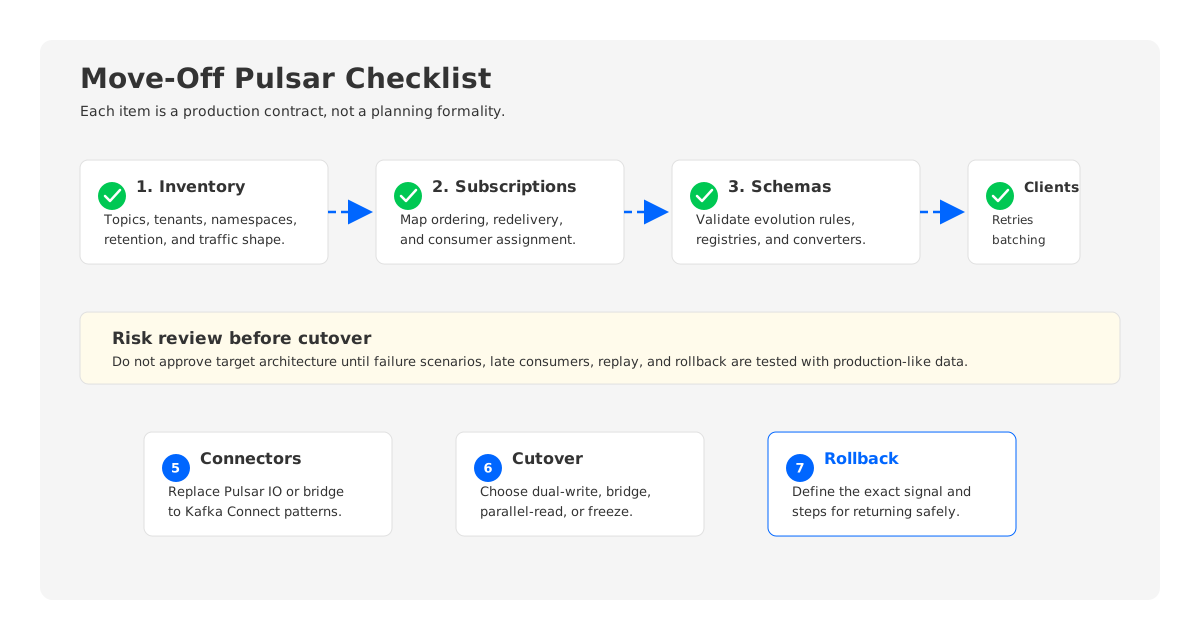
Start with topics and subscriptions. Pulsar supports subscription modes such as exclusive, failover, shared, and key-shared, and those semantics influence ordering, redelivery, and consumer behavior. A target platform may express the same intent differently through consumer groups, partitions, assignment strategies, or application code. That mapping should be tested with real ordering and failure scenarios, not only with a producer-consumer demo.
Schemas are the next source of risk. Pulsar has schema support as part of its platform model, while many Kafka deployments use external schema registries or connector-level converters. If producers and consumers rely on schema evolution rules, compatibility checks, or generated client behavior, the migration plan needs an explicit schema transition path.
Connectors and stream processing deserve their own workstream. Pulsar IO and Kafka Connect are different integration ecosystems. Kafka Streams jobs, Flink jobs, and other processors may depend on offset behavior, checkpointing assumptions, partitioning, or connector metadata. A safe plan inventories these dependencies before choosing a cutover pattern.
The cutover itself should be designed around reversibility. For some workloads, a dual-write or bridge phase is enough to validate downstream behavior. For others, you may need backfill, parallel consumption, offset translation, or a read-only freeze. RPO and RTO depend on those choices, so they should be written as workload-specific targets rather than generic platform promises.
5Why Kafka-Compatible Shared Storage Can Be the Middle Path
Many Pulsar replacement projects start because the organization wants Kafka again. That desire is usually about ecosystem compatibility, not nostalgia. Kafka clients, Kafka Connect, Kafka Streams, monitoring tools, and team experience are hard to replace because they sit across many teams. If Pulsar introduced too much friction at those boundaries, moving toward Kafka compatibility is rational.
The catch is that some teams left Kafka for architectural reasons in the first place. Broker-local storage can make cloud operations heavy: scaling can trigger data movement, retention increases disk planning pressure, and recovery can be tied to how much data has to be copied or rebuilt. Returning to the same storage model may solve ecosystem friction while reintroducing the original cloud infrastructure problem.
AutoMQ enters the decision at this point, after the problem has been split into protocol fit and storage fit. As a Kafka-compatible shared-storage system, AutoMQ is relevant when the desired outcome is "Kafka ecosystem, cloud-native storage model." Durable data lives in object-storage-backed shared storage, while brokers are designed to be more stateless. That can reduce the amount of broker-local data movement involved in scaling, replacement, and recovery.
This is not the same as saying every Pulsar workload should move to AutoMQ. A Pulsar-native application that depends heavily on Pulsar subscription modes, namespace policies, or Pulsar Functions may still be better served by Pulsar or managed Pulsar. AutoMQ is most relevant when the migration goal is to return to Kafka-compatible application contracts while changing the economics and operability of Kafka storage.
6Pulsar Replacement Checklist
Treat the replacement plan as an architecture review plus a migration design, not as a product selection meeting. The checklist below is intentionally concrete because vague platform debates tend to hide the work that determines whether migration succeeds.
| Area | Question to answer | Evidence to collect |
|---|---|---|
| Workload fit | Which workloads are Pulsar-native, and which are only using basic pub/sub? | Topic inventory, subscription modes, client libraries |
| Ecosystem | Which systems expect Kafka APIs or Kafka Connect conventions? | Connector list, stream processing jobs, governance tools |
| Schema | How are schemas registered, validated, and evolved? | Schema definitions, compatibility policies, producer and consumer behavior |
| Data movement | How will historical data, active writes, and late consumers move? | Retention map, replay requirements, backfill plan |
| Cutover | What is the smallest reversible migration unit? | Per-topic migration batches, dual-run plan, rollback criteria |
| Operations | Who will operate the target platform under incident pressure? | Runbooks, alert mapping, upgrade plan, access model |
| Cost | Which cost driver is the real problem? | Compute, storage, network, managed service fees, team time |
The most useful output is not a yes-or-no answer. It is a short list of workloads that should stay on Pulsar, workloads that can move safely, and workloads that need more testing because their semantics are unclear.
7FAQ
7.1What is the main reason teams replace Pulsar?
The most common reason is not that Pulsar cannot scale. Teams usually look for a Pulsar replacement when operational complexity, Kafka ecosystem dependency, cost pressure, or organizational skill gaps outweigh the benefits of Pulsar's architecture. The trigger is often a mismatch between platform design and team reality.
7.2Is Kafka the default replacement for Pulsar?
Kafka is often the default candidate because of its ecosystem, client support, Kafka Connect, Kafka Streams, and operational familiarity. It is not automatically the right replacement. If the team left Kafka because broker-local storage made cloud operations painful, a Kafka-compatible shared-storage system may fit better than a traditional Kafka deployment.
7.3Can Pulsar be migrated to Kafka without downtime?
It depends on workload design, client behavior, data retention, bridge strategy, and cutover requirements. Some workloads can migrate through dual-write or parallel-read phases with minimal user-visible interruption. Others need pauses, backfill, offset mapping, or application changes. Avoid fixed downtime promises until the migration unit and rollback path are tested.
7.4What should be tested before moving off Pulsar?
Test topic and subscription mapping, schema evolution, connector behavior, client retries, ordering, redelivery, stream processing state, authentication, metrics, alerting, and rollback. The highest-risk tests are usually failure scenarios and late-consumer behavior, not happy-path publish and consume.
7.5When should a team stay on Pulsar?
Stay on Pulsar when its tenant and namespace model, subscription modes, geo-replication, Pulsar Functions, or Pulsar IO connectors are central to the application design. Also consider managed Pulsar when the architecture fits but the team no longer wants to self-manage brokers, bookies, and upgrades.
7.6Where does AutoMQ fit in a Pulsar replacement plan?
AutoMQ fits when the team wants Kafka-compatible clients and ecosystem tools but also wants to avoid the traditional broker-local disk model. It is a candidate for workloads where the Pulsar replacement goal is not only "move to Kafka," but "move to Kafka compatibility with a cloud-native shared-storage architecture."
If the replacement debate started with frustration, bring it back to evidence: which workloads are Pulsar-native, which boundaries require Kafka compatibility, and which cost drivers come from storage architecture rather than the protocol. For teams evaluating the Kafka-compatible shared-storage path, review the AutoMQ architecture and test it against your own throughput, retention, cutover, and rollback requirements.


