
Table of Contents
Table of Contents
When teams search for Pulsar vs Confluent cost, they are usually trying to answer a procurement question with an architecture comparison. Confluent Cloud is a managed Kafka ecosystem platform. Apache Pulsar is an open source streaming system with a different broker and storage design, and commercial Pulsar offerings such as StreamNative package that design in several deployment models. Comparing them by opening two pricing pages misses the expensive part: the bill depends on who owns capacity planning, storage growth, networking paths, connectors, upgrades, incident response, and migration work.
A fair comparison starts by admitting that "Confluent vs Pulsar pricing" can mean several different things. It may mean Confluent Cloud vs a managed Pulsar service. It may mean Confluent Cloud vs self-managed Pulsar on Kubernetes. It may mean keeping Kafka clients and connectors on Confluent, or moving application teams to Pulsar clients and Pulsar operational semantics. Those are not small differences. They change both the monthly invoice and the engineering calendar behind it.
1Why Pricing Pages Are Not Enough
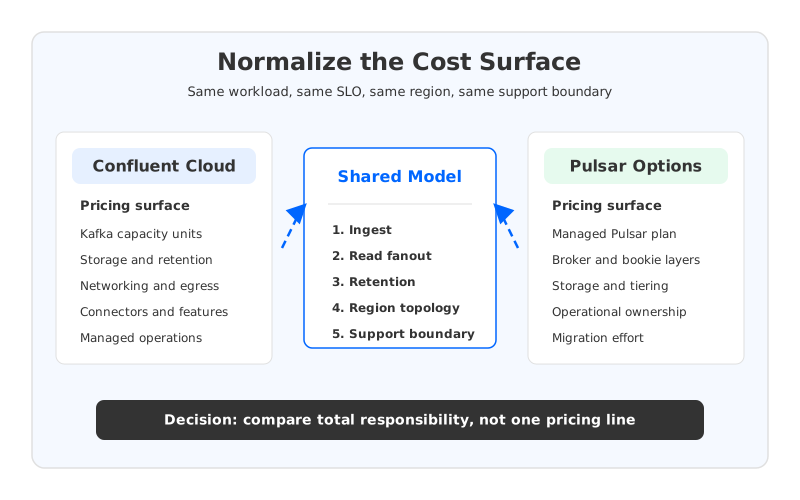
Pricing pages are useful, but they are not an architecture model. Confluent documents Confluent Cloud billing dimensions, cluster types, CKUs for dedicated Kafka capacity, networking, storage, and related resources. StreamNative's pricing page presents deployment paths such as Serverless, Dedicated, and BYOC for StreamNative Cloud. Both are legitimate ways to package a streaming platform, but neither tells you what your bill will be until you define the workload with enough precision.
The first mistake is comparing a managed service quote with an open source software cost. Open source Pulsar has no license fee, but production Pulsar still needs brokers, BookKeeper bookies, metadata storage, monitoring, upgrades, security, support, and people who know how to operate the system. Confluent Cloud has a service bill, but that bill includes a managed Kafka platform boundary that may replace work your team would otherwise carry. The comparison becomes meaningful only when the responsibility boundary is the same.
The second mistake is treating migration as a footnote. A Kafka team already running Kafka clients, Kafka Connect, Schema Registry, ksqlDB, or Flink jobs on Confluent is not buying a blank streaming system. It is buying continuity, or paying to break continuity. Pulsar has its own strengths, especially its broker and BookKeeper separation, multi-tenancy model, and topic architecture, but those strengths do not erase the cost of changing clients, operational runbooks, connectors, access control, and rollback paths.
2Normalize The Workload First
Procurement spreadsheets become more useful when every vendor or architecture is forced through the same workload scenario. That scenario does not need to predict every future topic. It needs to make hidden assumptions explicit enough for engineering, finance, and operations to debate the same object.
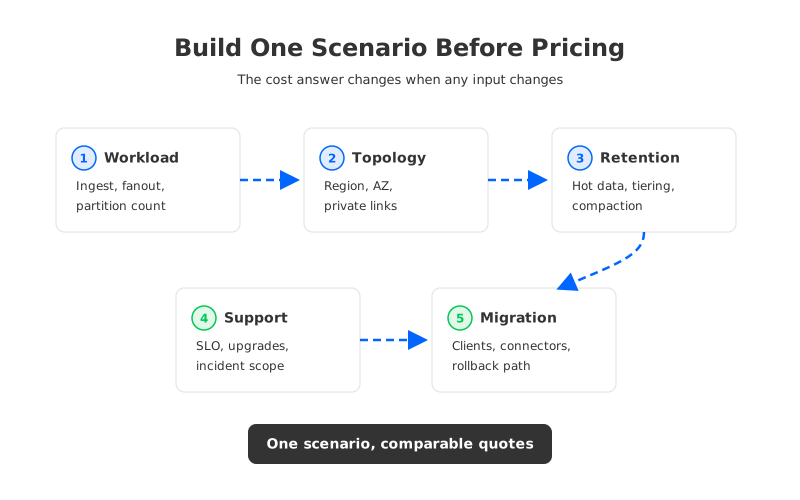
Use these inputs before asking whether Pulsar or Confluent has the lower total cost:
- Ingest throughput and write pattern. Sustained write throughput drives capacity units, broker sizing, storage writes, and replication behavior. Bursty workloads also need a decision about headroom.
- Read fanout. One consumer group and many consumer groups put different pressure on serving capacity and outbound bandwidth. A workload with high fanout can turn a storage comparison into a network comparison.
- Retention and compaction. A 24-hour operational log and a 30-day replay buffer are different cost profiles. Long retention makes storage architecture and tiering policy central to the decision.
- Availability topology. Multi-AZ, multi-region, private networking, and disaster recovery requirements change both provider pricing and cloud infrastructure charges.
- Support and operations boundary. A managed service reduces some operational work, but the exact boundary varies. Ask who handles upgrades, scaling, incidents, security patches, and capacity recommendations.
- Migration scope. Client compatibility, connector coverage, schema governance, application rewrites, and rollback planning can outweigh a narrow platform price delta.
This normalization step is unglamorous, which is why it saves money. If one proposal assumes a single region and another assumes multi-region recovery, the comparison is already broken. If one quote includes enterprise support and another assumes internal on-call ownership, the lower monthly line may be hiding labor cost.
3Confluent Cost Considerations
Confluent Cloud cost is not a single meter. The billing view can include Kafka capacity, storage, networking, connectors, stream processing, governance, support plan choices, and marketplace billing mechanics. Dedicated clusters introduce CKUs, while other cluster types expose different limits and feature sets. That makes Confluent attractive when the buyer values the broader Kafka ecosystem as a managed platform rather than only the raw broker layer.
The convenience premium is easiest to justify when the organization is already standardized on Kafka. Existing clients keep their protocol. Kafka Connect and managed connectors may reduce integration work. Schema Registry and governance features can be part of the same operating model. For platform teams that would otherwise assemble and operate these pieces themselves, the service bill is not only a broker bill; it is a way to buy back engineering time and operational risk.
That does not make Confluent automatically cost-effective for every workload. High-throughput workloads, long retention, heavy read fanout, private networking, and enterprise feature requirements should be modeled carefully. A team should also separate "we need Kafka compatibility" from "we need the full Confluent platform." Those are related, but not identical. The first is a technical compatibility requirement; the second is an ecosystem and operations decision.
The most common Confluent cost surprise is network and data movement. Cloud data transfer rules can be separate from the service page, and private connectivity choices can change the effective cost surface. If finance only sees the platform invoice and engineering only sees cloud architecture diagrams, no one owns the full number. Bring both views into the same model before renewal.
4Pulsar And Managed Pulsar Cost Considerations
Apache Pulsar's architecture changes the cost conversation because brokers and durable storage are separate roles. The official Pulsar architecture describes a cluster as brokers, BookKeeper bookies for persistent storage, and a metadata store for coordination. That separation can be useful: it lets teams think independently about serving traffic, storage durability, and metadata coordination. It also means the operations model has more moving parts than a buyer may expect from the phrase "open source streaming."
For self-managed Pulsar, the cost is mostly cloud infrastructure plus operations. Brokers need CPU, memory, and network. Bookies need storage capacity, disk performance, and careful sizing. Metadata services need their own reliability model. Monitoring, backup, upgrade, security, load balancing, and incident response become internal responsibilities. The software license line may be low, but the system still has a production cost.
Managed Pulsar shifts some of that burden to a provider. StreamNative, for example, presents Serverless, Dedicated, and BYOC deployment options on its pricing page. That packaging can make Pulsar easier to adopt than building the entire stack yourself, but buyers still need to understand what the plan includes, what appears on the cloud bill, and how support and enterprise features are handled. The useful question is not "Is Pulsar lower cost than Confluent?" It is "Under this workload and support boundary, where does Pulsar move cost: provider fee, infrastructure, or internal engineering?"
Pulsar can be compelling when an organization wants its architecture traits enough to absorb adoption work. Multi-tenancy, topic design, backlog handling, and storage separation may be valuable for certain platform strategies. The cost risk appears when a Kafka estate is already mature and the team underestimates the ecosystem delta. A platform can have an appealing run-rate and still be expensive to adopt if every application team has to participate in the migration.
5Migration And Ecosystem Cost
Migration is where many Pulsar vs Confluent comparisons lose their honesty. Confluent is Kafka-native. Pulsar is not Kafka with a different logo; it has its own clients, protocol, admin model, topic model, and operational concepts, even though adapters and interoperability options exist. If the existing estate is small, that difference may be manageable. If the estate has hundreds of producers, consumers, connectors, schemas, dashboards, and runbooks, it becomes a program.
The migration budget should include work that does not appear in a pricing table:
- Application changes for producers and consumers, including error handling and performance testing.
- Connector replacement or redesign when a managed connector is unavailable or behaves differently.
- Schema, governance, authentication, authorization, and audit changes.
- Observability changes for lag, backlog, broker health, storage health, and incident diagnosis.
- Parallel run, backfill, cutover, and rollback planning.
- Training for SREs, platform engineers, and application teams.
There is a reason Kafka compatibility has commercial value. It protects the ecosystem investment already made by application teams. That value is not sentimental; it is an avoidable migration budget. A Pulsar move can still be justified, but the justification has to include the value of Pulsar's architecture and managed offering, not only a lower-looking monthly platform line.
6Where AutoMQ Fits
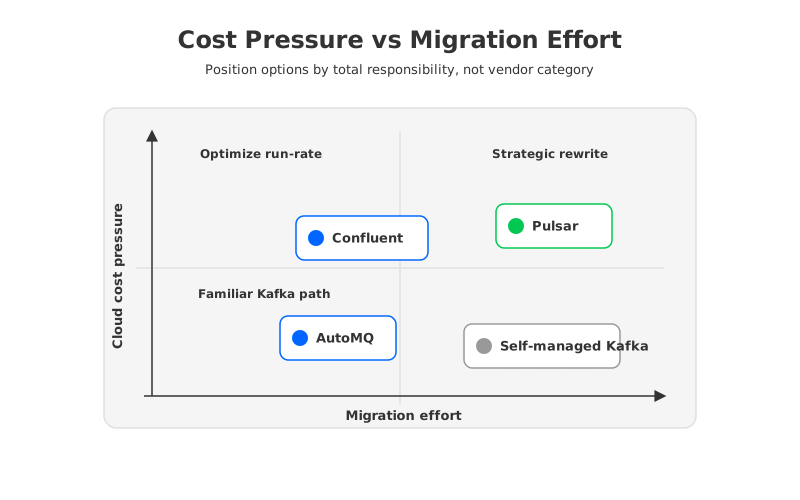
Some teams arrive at the Pulsar vs Confluent cost question because they want a third path: keep Kafka compatibility, reduce cloud infrastructure pressure, and avoid turning a cost project into a full application rewrite. That is where AutoMQ enters the evaluation as a Kafka-compatible cloud-native streaming system rather than as another Pulsar or Confluent packaging option.
AutoMQ keeps Kafka protocol compatibility while moving durable stream storage to object storage and making brokers more stateless. The architectural bet is different from classic Kafka's broker-local disk model and different from Pulsar's broker plus BookKeeper model. For cost analysis, the important point is that object storage economics and stateless broker operations can change the TCO profile without asking teams to abandon Kafka clients, Kafka Connect patterns, and existing Kafka-oriented operational knowledge.
This does not remove the need for a real cost model. Object storage, cloud networking, deployment model, BYOC requirements, retention, and support still matter. The reason AutoMQ belongs in a Confluent vs Pulsar cost shortlist is narrower and more practical: if the buyer's main pain is Confluent run-rate or cloud resource efficiency, and the estate is already Kafka-centric, a Kafka-compatible shared-storage path may reduce migration scope compared with moving to a different streaming API and operations model.
7Procurement Checklist
Before approving a platform decision, ask each vendor or internal proposal to answer the same questions. The goal is not to force every option into the same architecture. It is to make the tradeoffs visible enough that the organization knows what it is buying.
| Question | Why it matters |
|---|---|
| What exact workload is priced? | Prevents comparing different ingest, fanout, retention, and region assumptions. |
| What is included in the service fee? | Clarifies support, upgrades, connectors, governance, and capacity planning. |
| What cloud charges remain outside the vendor invoice? | Surfaces storage, networking, private connectivity, and marketplace effects. |
| What changes for application teams? | Captures client, connector, schema, and test work that procurement may miss. |
| What is the rollback path? | A low run-rate is risky when exit cost is undefined. |
| Who owns incidents? | Separates managed operations from customer-owned production responsibility. |
| How does the platform scale down? | Over-provisioning and idle capacity can become a quiet recurring cost. |
The right answer may still be Confluent. It may be managed Pulsar. It may be AutoMQ, MSK, or a carefully operated self-managed stack. The point is to compare systems at the level where money is actually spent: workload, responsibility boundary, ecosystem continuity, and migration risk.
If your shortlist includes a Kafka-compatible shared-storage path, price it with the same scenario model rather than a separate spreadsheet. AutoMQ's pricing page and documentation overview are useful next stops for that comparison.
8FAQ
8.1Is Pulsar lower cost than Confluent?
It depends on workload and responsibility boundary. Self-managed Pulsar can reduce direct vendor fees, but it adds cloud infrastructure and internal operations. Managed Pulsar changes that balance again. Confluent Cloud may carry a higher service bill for some workloads, but it can reduce ecosystem and operations work for Kafka-centric teams.
8.2Why is Confluent often priced differently from open source Pulsar?
Confluent Cloud is a managed Kafka ecosystem platform, not only broker software. The bill can include managed Kafka capacity, storage, networking, connectors, governance, stream processing, and support-related choices. Open source Pulsar has no software license fee, but production operation still requires infrastructure and skilled ownership.
8.3What cost inputs matter most in a Pulsar vs Confluent comparison?
Start with ingest throughput, read fanout, retention, availability topology, network paths, support boundary, and migration scope. These inputs explain most of the difference between a realistic estimate and a misleading pricing-page comparison.
8.4When does Pulsar make sense as a Confluent alternative?
Pulsar can make sense when the team values Pulsar's architecture and is prepared for the ecosystem and operational transition. It is a stronger candidate when the organization is not deeply locked into Kafka clients, Kafka Connect, and Confluent-specific platform features, or when the strategic benefits justify migration work.
8.5Where does AutoMQ fit compared with Pulsar and Confluent?
AutoMQ is relevant when a team wants Kafka compatibility and a cloud-native storage model aimed at reducing infrastructure pressure. It is not a Pulsar replacement. It is a Kafka-compatible option for teams that want to keep much of the Kafka ecosystem while evaluating object-storage-backed shared storage and BYOC-style deployment economics.


