
Table of Contents
Table of Contents
Searching for Pulsar vs Confluent sounds like a vendor comparison, but the real decision is deeper than a feature checklist. Confluent Cloud is a managed platform built around Apache Kafka and the Kafka ecosystem. Apache Pulsar, and managed Pulsar offerings such as StreamNative Cloud, follow a Pulsar-native architecture with different assumptions about storage, tenancy, subscriptions, and geo-replication. Treating them as interchangeable managed queues is how teams end up comparing the wrong risks.
The harder question is not "Which product has more buttons in the console?" It is "Which event streaming ecosystem do we want to standardize on for the next several years?" That decision touches client APIs, schema governance, connectors, operational ownership, cloud networking, data residency, and the migration path from the systems already running in production. A platform that looks attractive in a proof of concept can become expensive if it forces application teams to rewrite clients or rebuild observability patterns they already trust.
1Quick Comparison Table
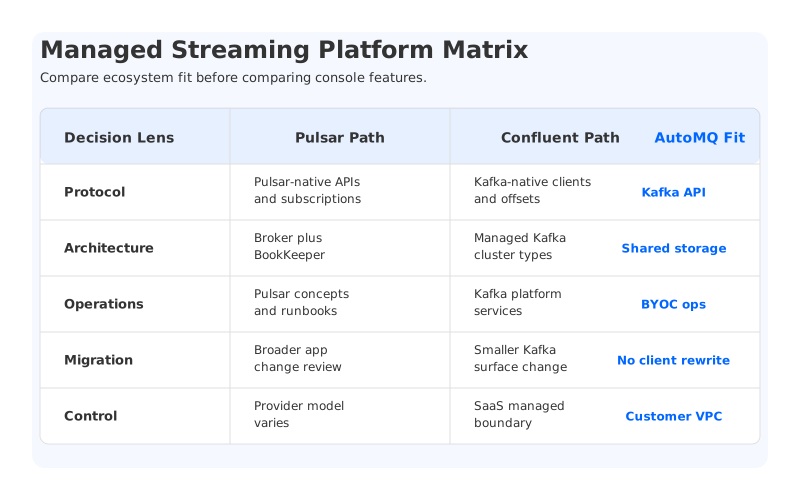
The first useful cut is to separate protocol fit from managed-service fit. Confluent is the more direct path for teams whose workloads, clients, and operational habits are already Kafka-shaped. Pulsar is stronger when the team wants Pulsar's native model: tenants, namespaces, subscription modes, tiered architecture with brokers and BookKeeper, and built-in geo-replication patterns. Both can be operated as managed platforms, but they pull the organization toward different ecosystem centers.
| Decision area | Pulsar / StreamNative direction | Confluent Cloud direction | What to watch |
|---|---|---|---|
| Primary ecosystem | Pulsar clients, Pulsar IO, Pulsar Functions, tenants, namespaces | Kafka clients, Kafka Connect, Kafka Streams, Schema Registry | Client and tooling rewrites matter more than console polish |
| Managed operations | Pulsar-native managed service options, including SaaS and BYOC-style patterns depending on provider | Managed Kafka clusters with documented cluster types, networking, connectors, and governance features | Map operational responsibility before comparing list prices |
| Data model | Topic, namespace, tenant, subscription, cursor, BookKeeper ledger | Topic, partition, offset, consumer group, broker log | Concepts overlap, but they are not identical |
| Migration from Kafka | Requires protocol, client, connector, and operational model review | Usually closer to existing Kafka applications | Compatibility reduces migration risk, but does not remove architecture review |
| Global replication | Pulsar has native geo-replication concepts | Confluent provides multi-region and networking options in its cloud platform | Replication semantics and failover runbooks need workload-level testing |
| Cost model | Depends on provider, deployment model, storage, compute, and operations | Depends on cluster type, throughput, storage, networking, connectors, and support model | Compare workload bills, not slogans |
This table is intentionally conservative. A serious streaming platform decision should not pretend that a few green checks settle the matter. The strongest signal is usually the gravity of the ecosystem already surrounding your applications: client libraries, connector estate, schema practices, deployment automation, incident runbooks, and the team's mental model for debugging lag, retention, and failover.
2Protocol And Ecosystem Fit
Kafka and Pulsar both move records through topics, but their abstractions shape different engineering habits. Kafka applications typically reason about partitions, offsets, consumer groups, log retention, and broker-level capacity. Pulsar applications add a different vocabulary: tenants and namespaces for multi-tenancy, subscriptions for consumption patterns, cursors, and a storage layer built around Apache BookKeeper. That extra separation is not cosmetic. It affects how teams design isolation, retention, and cross-region behavior.
Confluent's center of gravity is Kafka. That matters if your organization already runs Kafka clients, Kafka Connect connectors, Kafka Streams applications, schema registry integrations, and dashboards built around Kafka metrics. In that world, a managed Confluent deployment is not a protocol migration. It is a change in operational ownership and commercial model. You still need to validate supported APIs, cluster type limits, networking, security, and connector coverage, but the application surface stays familiar.
Pulsar's center of gravity is Pulsar. It can be a strong fit for teams that want Pulsar's architectural model rather than a managed version of Kafka. The trade-off is that Kafka compatibility cannot be assumed as a blanket property. Even when bridge layers or protocol handlers exist, the operational semantics underneath remain Pulsar semantics. That distinction matters for exactly-once assumptions, connector behavior, client observability, and incident response. A compatibility layer can reduce friction; it does not turn one ecosystem into the other.
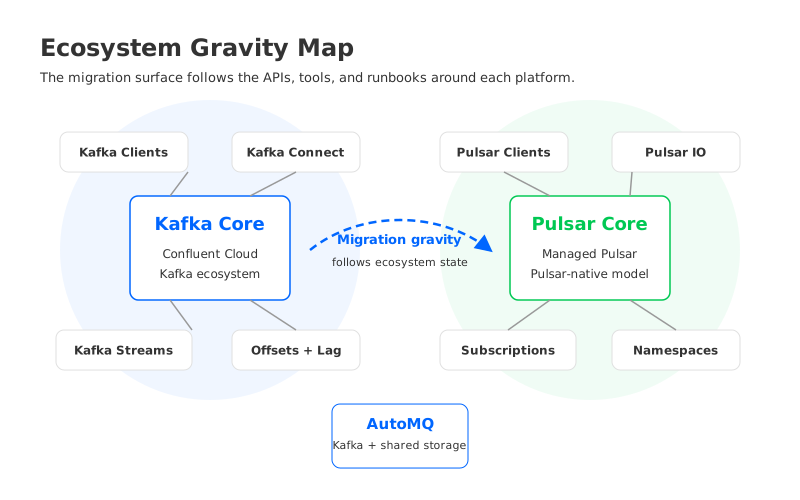
The practical test is straightforward: list the applications and platform components that would touch the streaming layer during a migration. If most of them are Kafka-native, Confluent or another Kafka-compatible platform keeps the change boundary smaller. If the team is prepared to adopt Pulsar-native concepts and sees value in its multi-tenancy and subscription model, Pulsar deserves a real evaluation. The mistake is choosing Pulsar because it seems like "managed Kafka with different branding" or choosing Confluent because it seems like "Kafka, therefore no architecture decision." Both shortcuts hide work.
3Managed Service And Operational Responsibility
Managed streaming platforms reduce the work of running brokers, upgrades, security patches, and control-plane workflows. They do not remove architecture ownership from the buyer. Someone still needs to decide how clusters are isolated, how private networking is configured, how connectors are governed, how quotas are set, where data lives, and how failover is tested. The difference is that the provider automates parts of the platform while the customer keeps responsibility for workload design and risk acceptance.
Confluent Cloud documents a mature managed Kafka surface: cluster types, client access, private networking, connectors, and platform services. That gives Kafka-heavy teams a recognizable path from self-managed Kafka or another managed Kafka service into a broader managed ecosystem. The value goes beyond fewer brokers to maintain; it is the breadth of Kafka-adjacent services around the core cluster. For teams that already standardized on Kafka semantics, that breadth can shorten the time from platform decision to production rollout.
Managed Pulsar services are evaluated differently. The buyer should ask how much of Pulsar's operational complexity is truly handled by the provider: broker and BookKeeper operations, upgrades, isolation, geo-replication, connector runtime, monitoring, and capacity management. Pulsar's architecture gives powerful primitives, but a managed service has to package those primitives into day-to-day workflows. A good proof of concept should include failure drills and operational handoffs, not only throughput tests.
4Cost And Data Control
Cost comparisons between Pulsar and Confluent are easy to oversimplify because each platform charges through a different product model. Confluent Cloud exposes choices such as cluster type and managed platform features; Pulsar managed services may separate infrastructure, service fee, storage, and operational model differently. Self-managed Pulsar moves more work into the customer's team, while fully managed services shift that work back to the provider. None of those models is inherently wrong. They are different ways to allocate infrastructure cost, engineering labor, and vendor responsibility.
The better cost question is workload-specific. A realistic model should include sustained ingress, egress, retention, read fan-out, cross-region replication, private networking, connector runtime, schema services, support, and in-house platform labor. It should also include elasticity risk: the cost of over-provisioning for peaks, and the operational cost of scaling down without destabilizing the cluster. Streaming platforms are rarely expensive because one line item is surprising; they become expensive because storage, network, compute, and operations reinforce each other.
Data control belongs in the same conversation. A pure SaaS model can be operationally attractive, but regulated teams often care about where the data plane runs, which account owns the storage, how private connectivity is enforced, and what metadata leaves the environment. BYOC-style deployment changes that boundary by keeping more infrastructure inside the customer's cloud account, while still allowing a managed control experience. The buyer's security team will usually care about this boundary before it cares about a benchmark chart.
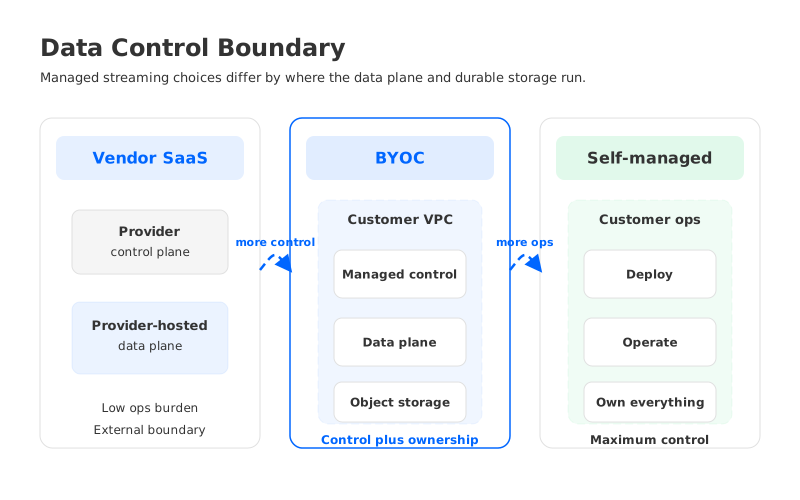
This is where a third path becomes relevant for Kafka-heavy teams. AutoMQ is a Kafka-compatible, cloud-native streaming platform that separates Kafka compute from durable storage by using shared object storage. Its BYOC model is designed for teams that want Kafka protocol compatibility and customer-side data control, while changing the cost and elasticity profile of the Kafka data plane. It is not a Pulsar replacement in the protocol sense. It is an option for teams whose real requirement is "Kafka ecosystem, less broker-local storage burden, stronger control boundary."
5Migration Paths And Lock-In Risks
Migration risk is where the Pulsar vs Confluent decision becomes concrete. If a team already uses Kafka producers, consumers, Connect, Streams, and Kafka-oriented monitoring, the safest migration path is usually the one that keeps those interfaces stable. That does not automatically mean Confluent is the final answer, but it does mean a Kafka-compatible option starts with a smaller blast radius. The migration plan can focus on networking, authentication, topic configuration, throughput testing, and operational cutover.
Moving to Pulsar is a larger architectural migration. That can be worth it when Pulsar's model is the goal, especially for teams that value its namespace and subscription semantics or have Pulsar expertise in-house. The plan should be honest about application changes, connector alternatives, schema compatibility, training, and runbook rewrites. A platform rewrite disguised as a managed-service switch is the sort of project that surprises everyone except the engineers who warned about it in the first planning meeting.
Lock-in also looks different across the choices. Confluent lock-in risk often comes from managed platform services, commercial terms, and cloud-specific integration choices around a Kafka core. Pulsar lock-in risk can come from adopting Pulsar-specific APIs, operational concepts, and provider packaging. Kafka-compatible shared-storage systems such as AutoMQ reduce a different class of lock-in by keeping the Kafka application surface while moving storage and operations toward a cloud-native model. The right question is not whether lock-in exists. It always exists somewhere. The question is where you want the switching cost to live.
6Where AutoMQ Fits
AutoMQ fits the part of this decision tree where the buyer likes the Kafka ecosystem but dislikes the traditional Kafka operating model. Confluent addresses that pain by providing a rich managed Kafka platform. Pulsar addresses a different pain by offering a different streaming architecture and data model. AutoMQ keeps the Kafka protocol and client ecosystem, then changes the storage architecture underneath: brokers become more stateless, durable data lives in object storage, and scaling is less tied to moving partition data between broker-local disks.
That architectural position is useful for a specific kind of team. They may be comparing Pulsar and Confluent because Confluent feels expensive or too vendor-managed, but Pulsar feels like too much application change. They may want BYOC for security review, predictable infrastructure ownership, or cloud-account control. They may also want Kafka compatibility because the organization has years of application code and operational knowledge around Kafka. In that situation, a Kafka-compatible shared-storage platform is not a compromise between Pulsar and Confluent. It is a different answer to the question the search query is really asking.
The evaluation should still be workload-driven. If the application roadmap calls for Pulsar-native semantics, evaluate Pulsar directly. If the organization wants the broadest managed Kafka platform surface, evaluate Confluent directly. If the organization wants Kafka compatibility, customer-side data control, and a storage model built around cloud object storage, include AutoMQ in the shortlist and run the same workload model across all candidates. The decision gets much clearer when every option is forced through the same traffic, retention, networking, and migration assumptions.
7Decision Guide
Use Confluent Cloud when Kafka compatibility and Kafka ecosystem services are the dominant requirements. This is the most natural comparison point for organizations with Kafka applications already in production, especially if managed connectors, governance, and a broad cloud service surface are part of the platform strategy.
Use Pulsar or a managed Pulsar provider when the team wants Pulsar's native architecture, not merely a lower-cost Kafka substitute. Pulsar deserves attention when tenants, namespaces, subscription modes, and geo-replication concepts match the application model and the team is ready to operate in Pulsar terms.
Evaluate AutoMQ when the requirements read like this: keep Kafka clients and tooling, keep the data plane in a customer-controlled environment, reduce dependence on broker-local disks, and make storage elasticity part of the architecture rather than a capacity-planning afterthought. For that path, the next useful step is to model your actual workload with the AutoMQ pricing calculator or start a BYOC evaluation through AutoMQ Cloud.
8FAQ
8.1Is Pulsar a drop-in replacement for Confluent Cloud?
No. Confluent Cloud is a managed Kafka platform, while Pulsar is a different streaming system with its own APIs, operational model, and ecosystem. Some compatibility layers can reduce migration friction, but a production migration still needs application, connector, monitoring, and runbook validation.
8.2Is Confluent better than Pulsar for Kafka workloads?
For Kafka-native workloads, Confluent usually starts closer to the existing application surface because it is built around Kafka semantics and the Kafka ecosystem. Pulsar may still be the right choice when the team wants Pulsar-native capabilities enough to accept a broader migration.
8.3How should teams compare managed streaming platform pricing?
Compare a real workload rather than a base price. Include ingress, egress, retention, read fan-out, private networking, replication, connectors, support, and in-house operations. Then run the same assumptions across Confluent, Pulsar managed services, self-managed options, and Kafka-compatible alternatives such as AutoMQ.
8.4Where does AutoMQ fit in a Pulsar vs Confluent evaluation?
AutoMQ fits when the team wants Kafka compatibility and BYOC-style control, but also wants a cloud-native storage architecture based on shared object storage. It is not a Pulsar-native platform; it is a Kafka-compatible option for teams trying to reduce Kafka operational and storage constraints without rewriting Kafka applications.
9References
- Confluent Cloud cluster types
- Confluent Cloud client applications
- Confluent Cloud networking overview
- Confluent Cloud connectors
- Apache Pulsar concepts overview
- Apache Pulsar architecture overview
- Apache Pulsar geo-replication
- Apache Pulsar IO overview
- StreamNative Cloud overview
- AutoMQ BYOC overview
- AutoMQ pricing calculator


