
Table of Contents
Table of Contents
Many Pulsar evaluations start with a Kafka problem, not a Pulsar requirement. A team is paying too much for replicated disks, waiting too long for partition reassignment, or watching broker recovery become a data movement project. The search query says "Pulsar alternative" or "Pulsar vs Kafka cloud storage," but the real question is sharper: do you need Pulsar-native semantics, or do you need to keep the Kafka API while changing the storage architecture underneath it?
That distinction matters because Apache Pulsar and Kafka-compatible shared storage solve different classes of pain. Pulsar is a full messaging and streaming system with its own broker, BookKeeper, namespace, subscription, and geo-replication model. Kafka-compatible shared storage keeps the Kafka protocol and ecosystem in place, then changes where durable data lives and how brokers scale. Confusing those two choices leads to migrations that are technically impressive but strategically noisy.
1The Real Question Behind Pulsar Evaluations
When a cloud team starts looking at Pulsar, the trigger is often operational friction in a traditional Kafka deployment. Local broker disks fill unevenly. Expansion creates reassignment work. Cross-zone replication and over-provisioned storage show up in FinOps reviews. Recovery after a broker failure is not only a failover event; it is also a question of how much data must move before the cluster is comfortable again.
Those are serious reasons to revisit the architecture, but they do not automatically imply a protocol migration. A Kafka estate usually includes producer and consumer clients, Kafka Connect connectors, Kafka Streams jobs, schema tooling, ACL models, observability dashboards, runbooks, and years of operational habits. The cost of replacing that surface area is not measured only in engineering hours. It also appears as release risk, retraining, parallel operations, and a longer path to proving that the target system behaves correctly under real workload failure modes.
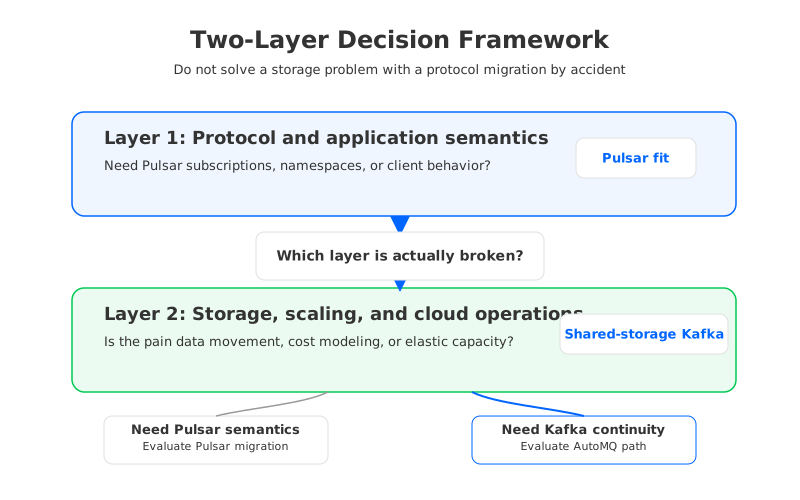
So the first decision is not "Pulsar or Kafka?" It is whether the target state requires Pulsar-specific capabilities or whether the existing Kafka ecosystem remains the right application interface.
| Evaluation Question | Points Toward Pulsar | Points Toward Kafka-Compatible Shared Storage |
|---|---|---|
| Application semantics | You need Pulsar subscription modes, tenant and namespace structure, or Pulsar-native messaging patterns. | Your applications already speak Kafka and the API contract should stay stable. |
| Migration scope | You can change clients, operational models, and platform tooling as part of the program. | You want to reduce architecture pain without rewriting the streaming estate. |
| Storage goal | You want Pulsar's broker and BookKeeper separation as part of a broader platform change. | You want object-storage-backed durability and stateless brokers while preserving Kafka behavior. |
| Decision owner | Architecture team is standardizing on a different event platform. | Platform, SRE, and FinOps teams are optimizing an existing Kafka platform. |
This framing is useful because it keeps the Pulsar discussion honest. Pulsar may be a strong fit when its own model is the reason for the move. It is a heavier choice when the problem is mostly that traditional Kafka couples compute, replication, and local disk too tightly for cloud economics.
2When Pulsar-Native Architecture Is Worth the Move
Pulsar's architecture separates serving from storage: brokers handle serving, while Apache BookKeeper stores durable ledgers. Its official architecture documentation describes a system built around brokers, metadata, BookKeeper bookies, and managed ledgers rather than the broker-local log model that Kafka operators are used to. That separation is one reason Pulsar often enters conversations about multi-tenancy, geo-replication, and large-scale messaging topologies.
The strongest Pulsar case appears when the application architecture benefits from Pulsar-specific semantics. Pulsar supports multiple subscription types, including exclusive, failover, shared, and key-shared subscriptions. It also has a tenant and namespace model that can be attractive when a platform team wants administrative boundaries built into the messaging layer. Geo-replication is another explicit part of the Pulsar design, with official documentation for replicating messages across clusters.
Those features are not decorative. They can shape how applications are written and how platform teams define ownership. A team building a greenfield multi-tenant messaging service, or one that wants Pulsar's subscription model as a first-class application primitive, should evaluate Pulsar on its own terms instead of treating it as a drop-in Kafka cost optimization tool.
The trade-off is that Pulsar-native value comes with Pulsar-native change. Operators need to understand brokers, bookies, ledgers, metadata, topic policies, namespace policies, and the failure behavior of the full stack. Application teams may need Pulsar clients and revised assumptions around consumption. Tooling that was built for Kafka might not carry over without adapters or replacement. For some teams, that is a worthwhile platform redesign. For others, it is extra migration surface hiding behind an architecture improvement.
3When Keeping Kafka Compatibility Matters More
Kafka compatibility is not a checkbox for teams that already run production Kafka; it is the operating boundary of the platform. The official Apache Kafka documentation describes APIs for producers, consumers, streams, connect, and administration. In practice, those APIs become the contract between the platform team and dozens or hundreds of application teams. Changing that contract is possible, but it should be done only when the Pulsar semantics are worth the blast radius.
This is where many Pulsar evaluations stall. The team likes the idea of separated storage and more elastic operations, but the business does not want a client migration. The organization has connector pipelines, stream processing jobs, and monitoring built around Kafka concepts. The architecture committee may still approve a platform modernization program, but it will ask the same practical question: why change the application interface if the main pain is storage, scaling, and recovery?
For Kafka-heavy organizations, compatibility protects several assets at once:
- Existing clients and deployment pipelines can remain the default path, which reduces the number of teams involved in the first migration wave.
- Kafka Connect and Kafka Streams investments remain relevant, including connectors, transformations, operational metrics, and failure playbooks.
- SRE runbooks can evolve around infrastructure behavior instead of being rewritten around a different messaging model.
- Procurement and risk reviews can focus on platform architecture, data placement, and service ownership rather than a complete application protocol switch.
That does not mean Kafka compatibility should win every time. It means the burden of proof changes. If Pulsar's semantics are the reason for the move, a migration can be justified. If the pain is traditional Kafka's cloud storage model, Kafka-compatible shared storage deserves a separate evaluation before the team commits to a different protocol.
4How Shared-Storage Kafka Changes the Equation
Traditional Kafka was designed around a broker-local log. Kafka's own design documentation explains how the log is represented as files and relies on the filesystem cache. That design has served Kafka well, but it also means that storage, compute, and replication concerns are tightly bound to broker instances. In cloud environments, that binding can turn routine operations into expensive data movement.
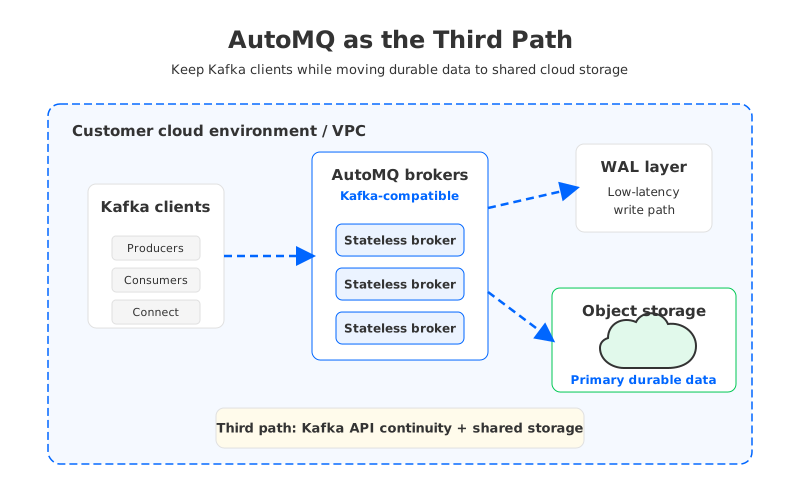
Shared-storage Kafka changes the foundation instead of changing the application API. Durable data moves to object storage or cloud storage, while brokers become closer to stateless serving nodes. The system still needs a low-latency write path for durability and performance; a serious architecture cannot wave away the latency profile of object storage. The point is to use a storage layout where durable data is no longer owned by a single broker's local disk.
This is the architectural opening for AutoMQ, a Kafka-compatible cloud-native streaming platform that uses object storage as primary durable storage and stateless brokers for elastic operations. AutoMQ's open source architecture documents describe S3Stream shared streaming storage, WAL storage, S3 storage, and stateless broker design. AutoMQ BYOC adds a deployment path where teams can run the data plane in their own cloud environment while using AutoMQ to operate the platform.
The result is a third path, not a slogan. A team can keep Kafka clients and ecosystem tooling while evaluating whether shared storage reduces the operational pain that pushed them toward Pulsar in the first place. That trade-off is especially relevant when the migration goal is to reduce TCO, improve scaling, or make recovery less dependent on broker-local data placement.
5Decision Matrix: Pulsar, Traditional Kafka, and AutoMQ
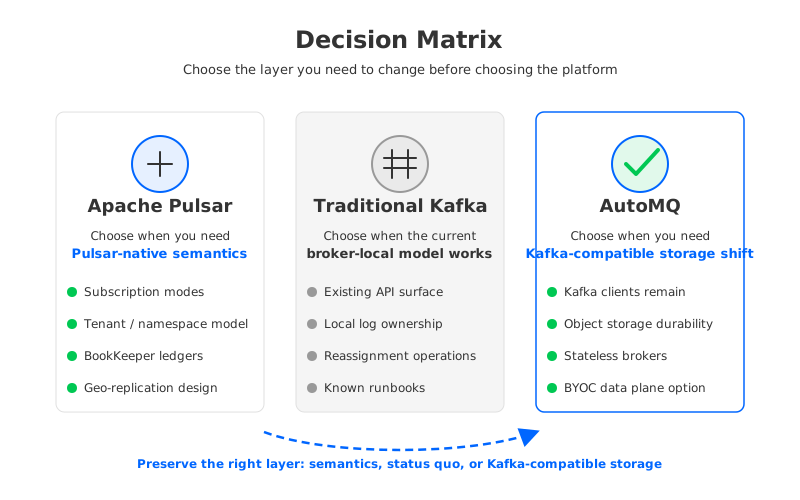
A decision guide should make one thing clear: the right answer depends on what you are trying to preserve. Pulsar preserves neither the Kafka API nor the Kafka operational model, but it offers its own architecture and semantics. Traditional Kafka preserves the current ecosystem but also preserves the broker-local storage model that triggered the review. AutoMQ preserves Kafka compatibility while changing the storage and broker model.
| Criterion | Apache Pulsar | Traditional Kafka | AutoMQ |
|---|---|---|---|
| Primary reason to choose | Pulsar-native messaging, subscription, namespace, and geo-replication model. | Existing Kafka deployments that already meet cost, scaling, and recovery goals. | Kafka-compatible modernization when storage, scaling, or cloud cost is the main pain. |
| Application impact | May require client, tooling, and operational model changes. | Lowest application change if the platform stays as-is. | Designed to keep Kafka clients and ecosystem tools relevant. |
| Storage architecture | Brokers serve data while BookKeeper stores ledgers. | Broker-local logs backed by local or attached disks. | Object-storage-backed shared storage with stateless broker design. |
| Cloud elasticity | Strong architectural separation, but requires Pulsar operational expertise. | Scaling can involve partition reassignment and storage rebalancing. | Scaling and recovery can be modeled as compute and metadata operations rather than large broker-local data movement. |
| Data control model | Depends on the deployment or managed Pulsar provider. | Depends on self-managed or managed Kafka deployment. | AutoMQ BYOC can run in the customer's cloud environment. |
The matrix is not a vendor scorecard. It is a way to stop arguing at the wrong layer. If the team needs Pulsar-native capabilities, compare Pulsar distributions, managed Pulsar options, operational maturity, and migration tooling. If the team needs to keep Kafka while changing the economics of cloud storage and scaling, compare shared-storage Kafka options, including AutoMQ, against the current Kafka baseline.
6A Practical PoC Plan
A good proof of concept should be boring in exactly the right way. It should not start with the easiest demo topic or the loudest vendor benchmark. It should start with a workload that represents the reason the evaluation exists: storage growth, reassignment pain, recovery time, cross-zone traffic, or migration risk.
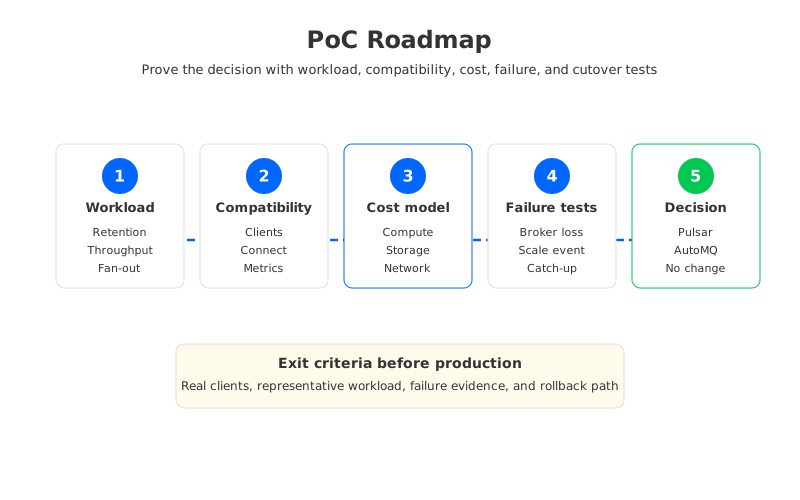
Use a short PoC plan with explicit exit criteria:
- Select one representative Kafka workload, including retention, throughput, partition count, consumer fan-out, and failure expectations.
- Test application compatibility with existing producers, consumers, Kafka Connect jobs, and observability dashboards.
- Build a cost model using public cloud storage, compute, and network assumptions rather than a generic percentage-saving claim.
- Run failure and scaling tests that include broker loss, capacity expansion, consumer catch-up, and operational rollback.
- Decide whether the next step is a Pulsar migration, a Kafka-compatible shared-storage migration, or no platform change.
For AutoMQ, the compatibility test should include client behavior, topic management, connector assumptions, monitoring, and migration workflow. The cost model should use the AutoMQ pricing calculator together with your workload assumptions, not a borrowed benchmark. The architecture test should also confirm deployment boundaries for AutoMQ BYOC, including where data is stored, how the environment is operated, and what your security team needs to review.
The search that started this decision may have been "Pulsar alternative," but the architecture choice should end with a clearer question: which layer do you actually need to change? If your team wants to validate a Kafka-compatible shared-storage path, review the official AutoMQ documentation and book a technical discussion with your workload assumptions in hand.
7FAQ
7.1Is Pulsar a direct replacement for Kafka?
Pulsar can replace Kafka in some architectures, but it is not a drop-in replacement in the operational sense. It has its own broker and BookKeeper architecture, subscription model, administration model, and client ecosystem. Teams should treat it as a platform migration unless they have already validated compatibility at the application and tooling layers.
7.2When is Pulsar the better choice?
Pulsar is more compelling when the target system needs Pulsar-native features such as its subscription modes, tenant and namespace model, or geo-replication design. It is also worth evaluating for greenfield platforms where the organization is free to choose a different application contract rather than preserving Kafka clients.
7.3When is Kafka-compatible shared storage the better choice?
Kafka-compatible shared storage is more compelling when the team wants to keep Kafka clients, Kafka Connect, Kafka Streams, and existing operational knowledge, but traditional Kafka's broker-local storage model is creating cloud cost, scaling, or recovery pain. In that situation, changing the storage architecture may solve the real problem with less application disruption.
7.4Is AutoMQ a Pulsar alternative?
AutoMQ is not a Pulsar clone. It is a Kafka-compatible cloud-native streaming platform, so it is a Pulsar alternative only for teams whose Pulsar evaluation is driven by Kafka cloud architecture pain rather than Pulsar-specific semantics. If the team needs Pulsar-native behavior, Pulsar should remain on the shortlist.
7.5How should a team compare AutoMQ vs Pulsar?
Compare them by decision layer. First decide whether the application interface should remain Kafka-compatible. Then compare storage architecture, deployment model, operational ownership, migration path, and cost model. A PoC should include real clients, representative retention and throughput, failure tests, and a rollback plan.
7.6Can AutoMQ run in a customer's cloud environment?
AutoMQ BYOC is designed for teams that want the data plane in their own cloud environment. The exact deployment and operational model should be validated against the official AutoMQ BYOC documentation and the organization's security requirements before production rollout.
8References
- Apache Pulsar Architecture Overview
- Apache Pulsar Messaging Concepts and Subscription Types
- Apache Pulsar Geo-replication
- Apache Kafka APIs
- Apache Kafka Filesystem and Storage Design
- AutoMQ Architecture Overview
- AutoMQ S3Stream Shared Streaming Storage
- AutoMQ Native Compatibility with Apache Kafka
- AutoMQ BYOC Overview
- AutoMQ Migration Guide
- AutoMQ Pricing Calculator


