
Table of Contents
Table of Contents
Pulsar vs Kafka is often framed as an architecture debate: brokers and BookKeeper on one side, Kafka brokers and partitions on the other. That framing is useful, but it misses the decision most Kafka teams actually face. They are not choosing a streaming system in a vacuum. They already have producers, consumers, schemas, Kafka Connect jobs, Kafka Streams applications, dashboards, ACL patterns, incident runbooks, and a mental model built around Kafka behavior.
Apache Pulsar deserves attention because its architecture is genuinely different. Pulsar separates serving from storage through brokers and Apache BookKeeper, supports multi-tenancy as a first-class concept, and offers multiple subscription modes that Kafka does not map to one-for-one. Those are real strengths, especially for teams designing a platform from the ground up. The harder question is whether Pulsar is a Kafka replacement for an existing Kafka estate or a platform rewrite with a compatibility bridge.
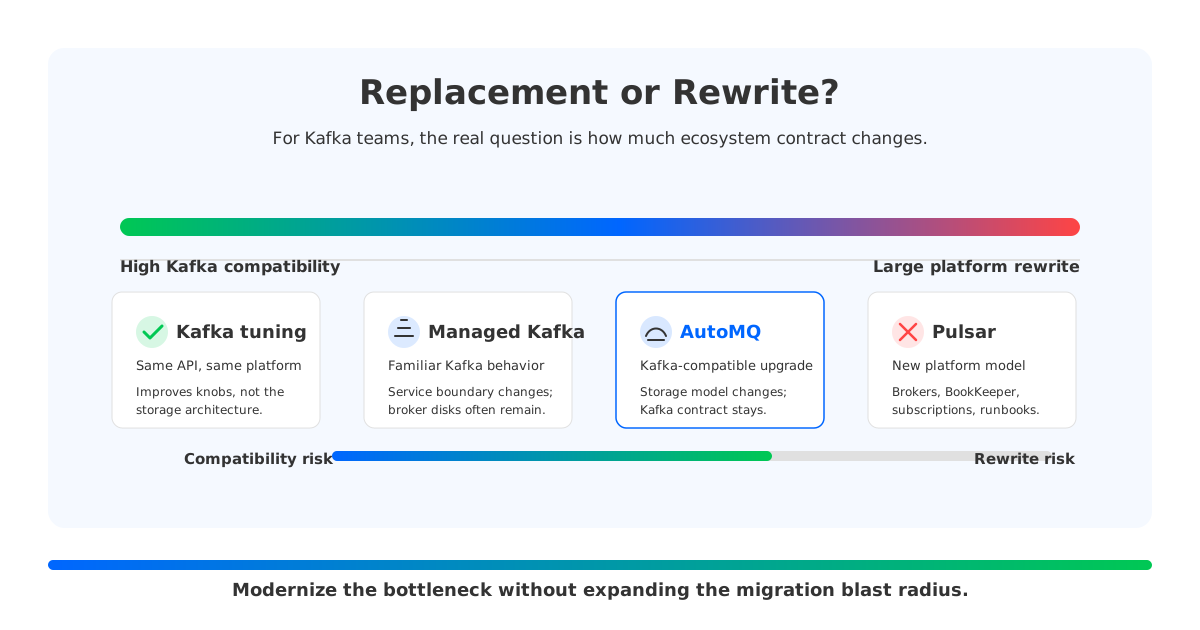
For Kafka teams, the replacement question should start with the blast radius. A broker swap that preserves the Kafka protocol, client behavior, Connect ecosystem, Streams semantics, operational tooling, and security model is one kind of project. A move to a different messaging model, client API, storage stack, metadata stack, and operational vocabulary is another. Both can be justified. They should not be budgeted as the same migration.
1What Pulsar Does Differently
Pulsar's core architecture splits responsibilities across brokers, BookKeeper bookies, and a metadata store. Pulsar brokers handle producers and consumers, route traffic, coordinate with metadata, and write messages to BookKeeper. BookKeeper provides persistent message storage through ledgers, while the metadata store handles topic metadata, schema, broker load data, and cluster coordination. That is a different shape from Kafka's traditional broker-local log model, where brokers own partition replicas and serve reads from the local log.
This difference is why Pulsar often looks attractive in cloud and multi-tenant conversations. Storage capacity can scale through BookKeeper. Brokers can focus on serving traffic. Pulsar's tenant, namespace, and topic hierarchy gives platform teams a built-in administrative model for shared environments. Its subscription types, including exclusive, shared, failover, and key_shared, allow consumption patterns that do not behave exactly like Kafka consumer groups.
The tradeoff is that Pulsar is not "Kafka with a different storage layer." It is a different platform with its own concepts:
- Topics and subscriptions are modeled differently. Kafka teams think in topics, partitions, offsets, and consumer groups. Pulsar teams also reason about tenants, namespaces, managed ledgers, cursors, and subscription types.
- The storage stack has more named components. Pulsar production operations include brokers, BookKeeper bookies, and metadata-store choices such as ZooKeeper or other supported backends.
- Tiered storage is still a tier. Pulsar can offload older backlog data from BookKeeper to long-term storage such as S3 or GCS, but BookKeeper remains the persistent message storage layer for active data.
- Kafka compatibility is not the same as Kafka identity. Protocol handlers and commercial interoperability layers can reduce application migration work, but they add a compatibility surface that must be tested against the exact Kafka APIs and behaviors your estate uses.
None of this is a critique of Pulsar. It is the point of Pulsar. The architecture gives Pulsar room to solve problems in its own way, and that can be valuable when the organization is ready to adopt the full model. Trouble starts when a team treats that adoption as a drop-in Kafka replacement because both systems can move event streams.
2Why Kafka Ecosystem Compatibility Matters
Kafka's stickiness rarely comes from the broker alone. The broker is the visible part, but the operational estate usually extends far beyond it. Kafka's official API surface includes producer, consumer, Streams, Connect, and Admin APIs, and many teams depend on all of them in direct or indirect ways. A payments service may use the Java producer and consumer APIs. A data platform may run Debezium, sink connectors, schema governance, custom SMTs, and Kafka Streams state stores. SREs may run lag exporters, Cruise Control-style workflows, ACL automation, and topic provisioning built around Kafka assumptions.
That ecosystem surface changes the meaning of "Pulsar Kafka alternative." If the team is writing fresh applications against Pulsar-native clients, the comparison is direct: which platform model fits the workload? If the team is replacing a Kafka estate, the comparison is mediated by everything around Kafka.
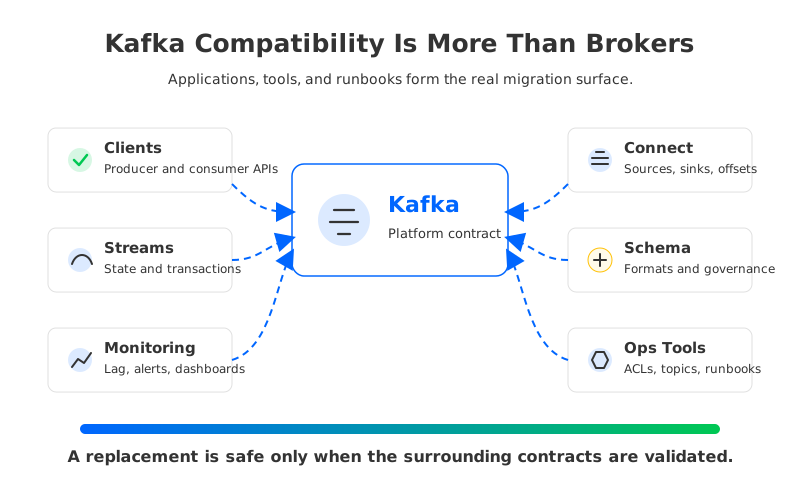
The compatibility audit should be boring and specific:
| Evaluation area | Why it matters in a Kafka replacement | What to test before choosing Pulsar |
|---|---|---|
| Client behavior | Producers and consumers depend on retries, batching, ordering, offsets, and error handling | Real client versions, configs, idempotence settings, transactions if used, and failure behavior |
| Consumer groups | Rebalance behavior and offset commits are part of application correctness | Group coordination, lag reporting, offset reset, commit semantics, and partition assignment expectations |
| Kafka Connect | Connectors are often migration blockers because they mix protocol, schemas, offsets, and operational state | Source and sink connectors, transforms, DLQ behavior, offset storage, status topics, and restart behavior |
| Kafka Streams | Streams applications depend on changelog topics, repartition topics, state stores, and exactly-once settings | Topology compatibility, state restore, standby tasks, transactional behavior, and rolling upgrades |
| Security and governance | ACLs, TLS, SASL, audit trails, and tenant boundaries are embedded in platform process | Authentication, authorization, secrets, audit evidence, network policy, and self-service workflows |
| Observability | Operators trust existing metrics, dashboards, alert thresholds, and incident playbooks | Lag metrics, broker health, storage saturation, metadata health, connector status, and alert parity |
This table is deliberately operational rather than ideological. A Kafka team does not need to prove Pulsar is "worse" to discover that a Pulsar migration is expensive. It only needs to discover that several production contracts live outside the broker and need new validation. A connector job that mostly works is not good enough if its offset recovery behaves differently during a sink outage. A consumer group that passes a happy-path test is not good enough if its lag metrics no longer mean what the on-call engineer expects.
This is also where protocol-level compatibility can be helpful but insufficient. Kafka compatibility can reduce application changes, especially for simple producer and consumer workloads. It does not automatically preserve every operational assumption around Connect, Streams, quotas, ACL automation, rebalance behavior, observability, and rollback. The more mature the Kafka estate, the more the migration depends on the edges.
3Operational Differences Teams Should Budget For
Pulsar changes the operating model. Kafka teams are used to brokers, partitions, replicas, ISR, controller behavior, log directories, and consumer group coordination. Pulsar introduces brokers, bookies, ledgers, cursors, namespaces, tenants, bundle ownership, metadata-store health, and BookKeeper disk behavior. Experienced distributed systems engineers can learn that model, but learning time is still migration cost.
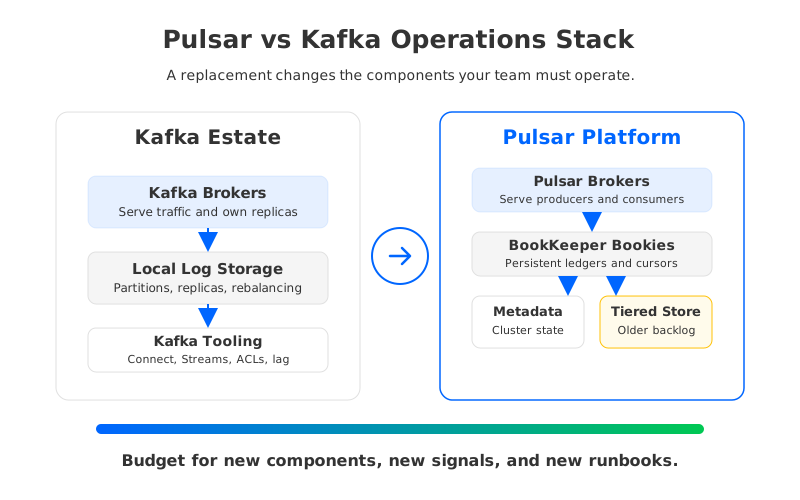
The biggest budget item is not the first cluster installation. It is the second-order work that arrives after a platform becomes production-critical:
- Capacity planning shifts from broker disks to BookKeeper and broker serving capacity. That can be a better abstraction for some workloads, but it changes the failure domains and the saturation signals operators must watch.
- Metadata health becomes a first-class operational dependency. Pulsar metadata stores hold cluster-specific metadata and coordination state, so platform teams need clear backup, recovery, upgrade, and incident procedures.
- Tiered storage requires policy and failure-mode design. Pulsar can offload sealed segments from BookKeeper to long-term storage, but teams still need to configure buckets, credentials, offload thresholds, deletion lag, and incomplete multipart upload cleanup.
- Multi-tenancy needs governance, not only configuration. Tenants and namespaces are powerful, but shared clusters require quota policy, ownership, alert routing, access control, and cost allocation.
- Runbooks need translation. Kafka incidents such as under-replicated partitions, controller instability, log directory pressure, or consumer lag have familiar playbooks. Pulsar incidents use a different vocabulary and different component boundaries.
These differences can be a good reason to choose Pulsar. A team that wants Pulsar-native multi-tenancy, geo-replication patterns, flexible subscriptions, and BookKeeper-backed storage may decide the new operating model is worth it. The mistake is treating operational retraining as a minor line item. A streaming platform is not a library. Once it carries production traffic, the team needs confidence at 2 a.m., not only during a benchmark.
Cost modeling has the same shape. Pulsar may reduce or reshape some storage costs through BookKeeper scaling and tiered storage, but the bill is not one-dimensional. Teams should model brokers, bookies, metadata store nodes, disks, object storage, request volume, cross-zone traffic, observability, backup, managed service fees if applicable, and migration overlap. If Pulsar is evaluated through a managed provider, the provider's packaging and data-plane model need to be part of the worksheet. Architecture changes the cost structure; it does not remove the need for workload-specific math.
4Compatible Replacement vs Platform Rewrite
A practical Kafka replacement plan starts by separating compatibility from modernization. Compatibility means preserving the application-facing and operations-facing contracts that the current estate depends on. Modernization means changing the platform architecture to improve cost, elasticity, multi-tenancy, or operational safety. The safest migration path is often the one that modernizes the bottleneck while keeping the contracts that do not need to change.
That gives Kafka teams three broad paths:
| Path | What changes | What usually stays familiar | Main risk |
|---|---|---|---|
| Tune or move managed Kafka | Service boundary, broker sizing, storage settings, operational ownership | Kafka clients, Connect, Streams, offsets, tooling, runbooks | Kafka's broker-local storage model and rebalancing costs may remain |
| Adopt AutoMQ as a Kafka-compatible architecture upgrade | Storage architecture, broker statefulness, scaling and recovery mechanics | Kafka protocol, Kafka ecosystem surface, application mental model | Must validate target-version compatibility and workload performance |
| Adopt Pulsar as a platform rewrite | Messaging model, client surface, operations stack, storage components, platform vocabulary | Some concepts and interoperability paths may carry over | Migration scope expands beyond brokers into applications and operations |
The phrase "platform rewrite" is not a warning label. It is a scope label. A greenfield platform may benefit from choosing Pulsar-native semantics from day one. A company consolidating multiple messaging systems may value Pulsar's broader messaging model enough to rewrite applications and runbooks. A team building shared multi-tenant messaging as a product may prefer Pulsar's tenant and namespace model over retrofitting similar governance around Kafka.
An existing Kafka estate has a different default. Its first job is to protect the contracts that already work. If the main pain is Kafka storage cost, slow reassignment, broker replacement, or cloud elasticity, changing the storage architecture while keeping Kafka compatibility can be a cleaner move than changing the whole platform model. If the main pain is that Kafka's semantics are the wrong fit for the product, Pulsar becomes a more natural candidate even if the migration is larger.
This distinction also helps with executive communication. "We are replacing Kafka with Pulsar" sounds like a platform swap. "We are rewriting the streaming platform around Pulsar-native semantics" sounds like a program with application migration, training, tooling, incident response, and rollback work. The second statement is less glamorous, but it is closer to the work.
5Where AutoMQ Fits
AutoMQ fits the part of the decision where Kafka teams want architecture change without ecosystem rewrite. AutoMQ is Kafka-compatible and reuses Kafka's computing layer while replacing the storage layer with a shared-storage architecture. Its design moves durable data away from broker-local disks and uses WAL plus object storage through S3Stream, so brokers can become stateless from an operations perspective.
That makes the comparison with Pulsar more precise. Pulsar separates serving and storage by adopting Pulsar's own broker, BookKeeper, metadata, topic, subscription, and client model. AutoMQ separates compute and storage inside the Kafka-compatible boundary. The former can be attractive when the team wants Pulsar as the platform. The latter is attractive when the team wants to keep Kafka as the contract while fixing the cloud-native pain created by broker-local storage.
For a Kafka estate, AutoMQ is most relevant when the current pain looks like this:
- Broker expansion or replacement takes too long because partitions must move large amounts of data.
- Retention-heavy workloads make broker-attached storage and cross-node replication expensive to scale.
- Kubernetes or cloud auto-scaling is constrained by stateful broker disks.
- Application teams depend heavily on Kafka clients, Connect, Streams, Admin APIs, and existing operational tooling.
- The migration team wants a smaller blast radius than a full messaging-platform rewrite.
This does not make AutoMQ the universal answer. A serious evaluation still needs a proof of concept with real client versions, production-like traffic, connector jobs, security settings, observability, and rollback procedures. That means the decision is not limited to "stay on traditional Kafka" or "rewrite to Pulsar." There is a middle path: keep the Kafka ecosystem boundary and change the storage architecture underneath it.
6Decision Guide for Kafka Teams
The cleanest answer depends on whether the team is greenfield or already deep into Kafka. Greenfield teams can ask a product-design question: which messaging model should our platform expose? Existing Kafka teams need to ask a migration-risk question: which contracts can we preserve, and which ones are worth changing?
Use this decision frame before committing to a Pulsar replacement:
| If your situation looks like this... | Pulsar may fit when... | AutoMQ may fit when... |
|---|---|---|
| You are building a new shared messaging platform | You want Pulsar-native tenants, namespaces, subscriptions, and BookKeeper-backed architecture | You want the platform contract to be Kafka from day one |
| You run many Kafka applications today | You are willing to rewrite clients, tooling, runbooks, and parts of the ecosystem | You want existing Kafka clients and ecosystem tools to remain the primary contract |
| Your pain is storage cost and slow scaling | You also want to adopt Pulsar's broader platform model | You want shared storage, stateless brokers, and faster scaling inside a Kafka-compatible model |
| Your pain is Kafka's semantics | Pulsar's subscription and messaging model solve the application problem | Kafka compatibility is less important than changing the programming model |
| Your migration window is tight | You have a mature compatibility layer and a tested rollback plan | You want the smallest possible application-facing change |
The uncomfortable part of replacement planning is that the right technical architecture may still be the wrong migration. Pulsar can be the better platform for a new workload and the wrong replacement path for a mature Kafka estate. Kafka can be the familiar platform and still carry storage and elasticity problems that need architectural repair. AutoMQ's role is to give Kafka teams another option: replace the part that hurts without forcing every application and operator to learn a different streaming contract.
7Sources
- Apache Pulsar architecture overview
- Apache Pulsar overview
- Apache Pulsar messaging concepts
- Apache Pulsar tiered storage overview
- Apache Kafka API documentation
- Kafka protocol documentation
- AutoMQ compatibility with Apache Kafka
- AutoMQ stateless broker
- AutoMQ S3Stream overview
- AutoMQ WAL storage
8FAQ
8.1Is Pulsar a drop-in replacement for Kafka?
Not in the broad sense. Pulsar can support interoperability paths and Kafka protocol compatibility layers in some environments, but Pulsar has its own architecture, client model, subscription semantics, storage stack, metadata layer, and operational vocabulary. For an existing Kafka estate, treat Pulsar as a platform migration unless your exact client, connector, Streams, security, and observability requirements have been proven against the target deployment.
8.2When is Pulsar a good Kafka alternative?
Pulsar is strongest when the team wants Pulsar-native capabilities rather than a broker-for-broker Kafka swap. Greenfield multi-tenant messaging platforms, workloads that benefit from Pulsar's subscription modes, and organizations ready to operate brokers, BookKeeper, and metadata stores as a coherent platform may find Pulsar compelling.
8.3What is the biggest migration risk when replacing Kafka with Pulsar?
The biggest risk is underestimating the ecosystem surface. Kafka applications often depend on more than produce and consume calls. Kafka Connect, Kafka Streams, Admin APIs, ACL automation, schema workflows, lag monitoring, incident runbooks, and rollback tooling all need validation. The migration fails when the broker path works but the surrounding production contracts do not.
8.4How is AutoMQ different from Pulsar in this comparison?
AutoMQ keeps the Kafka-compatible contract and changes the storage architecture underneath it. Pulsar adopts a different platform model with brokers, BookKeeper, metadata stores, Pulsar clients, and Pulsar-native concepts. AutoMQ is therefore a closer fit when the team wants a Kafka-compatible architecture upgrade; Pulsar is a closer fit when the team wants to adopt Pulsar as the new platform.
8.5Should a Kafka team choose Pulsar, Kafka, or AutoMQ?
Choose based on migration scope, not only architecture diagrams. Stay with Kafka or managed Kafka when familiarity and service boundaries matter more than storage-model change. Evaluate Pulsar when the workload benefits from Pulsar-native semantics and the organization can fund a platform rewrite. Evaluate AutoMQ when the goal is to keep Kafka clients and ecosystem behavior while addressing storage cost, scaling, and stateful broker operations.


