
Table of Contents
Table of Contents
Teams rarely compare Apache Pulsar and managed Kafka because they are curious about messaging theory. The question usually appears after a production platform has become expensive to operate, slow to scale, or difficult to govern across teams. Pulsar looks attractive because it separates serving and storage responsibilities through brokers and BookKeeper. Managed Kafka looks attractive because it keeps the Kafka ecosystem while moving some operational work to a provider. The real decision is whether your next streaming platform should change the application contract or preserve it while changing the operating model.
That distinction matters because migration risk is rarely concentrated in the cluster itself. A cluster can be provisioned, benchmarked, and hardened in a controlled environment. The harder part is the surface area around it: producer libraries, consumer groups, Kafka Connect pipelines, Kafka Streams applications, schema governance, dashboards, alerting rules, incident playbooks, IAM policies, procurement terms, and rollback procedures. If those assets already exist around Kafka, a move to Pulsar is not only a platform migration. It is an ecosystem migration.
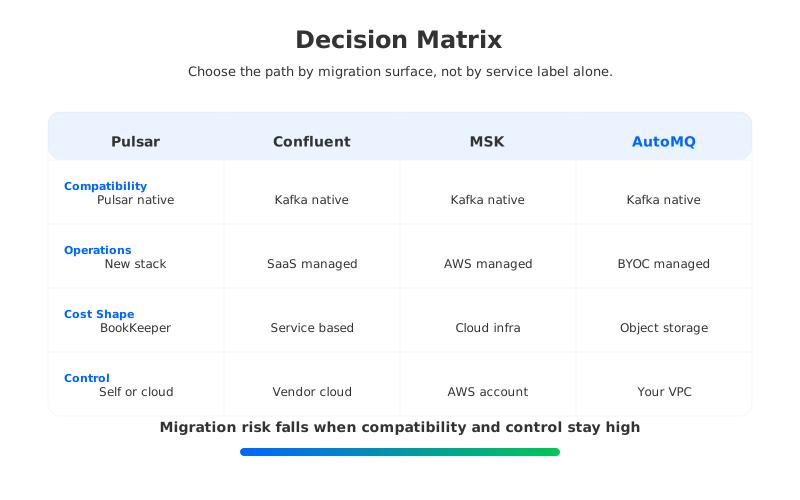
Pulsar and managed Kafka both have credible production use cases. Pulsar can be a strong fit when teams want its native model, multi-tenancy concepts, and separation between brokers and BookKeeper-led storage. Managed Kafka is often lower risk when the organization already has Kafka applications and wants to reduce operational burden without rewriting application contracts. The trick is to evaluate the path, not the label. "Managed" can mean SaaS, a cloud-provider service such as Amazon MSK, or a BYOC model where the control plane is managed while the data plane stays in your cloud account.
1Quick Answer by Starting Point
If you already run Kafka at meaningful scale, managed Kafka usually reduces migration risk more than Pulsar because it preserves the protocol, client behavior, and surrounding ecosystem. Your applications can often keep using Kafka clients, your data pipelines can keep using Kafka Connect, and your teams can reason about familiar concepts such as topics, partitions, offsets, consumer groups, and ACLs. You still need to test compatibility, networking, quotas, and operational boundaries, but the application-facing contract is familiar.
If you already run Pulsar, the answer changes. Moving from Pulsar to managed Kafka may add avoidable application work unless the goal is to standardize on the Kafka ecosystem. In that case, the migration should be treated as a product change for every application team that depends on Pulsar semantics. The cluster target is only one part of the work; the larger job is contract translation.
Greenfield teams have more freedom, but greenfield does not mean risk-free. A platform chosen today becomes a contract for future applications, procurement, observability, staffing, and incident response. Teams should decide whether they want to build around Pulsar-native concepts or Kafka-native compatibility before that contract spreads.
| Starting point | Lower-risk default | Why |
|---|---|---|
| Existing Kafka estate | Managed Kafka | Preserves clients, offsets, Connect, Streams, and operator knowledge. |
| Existing Pulsar estate | Managed Pulsar or Pulsar-native path | Avoids translating Pulsar applications unless Kafka standardization is the goal. |
| Greenfield platform | Depends on ecosystem strategy | Choose Kafka for ecosystem depth, Pulsar for Pulsar-native architecture and tenancy needs. |
| Hybrid estate | Kafka-compatible managed platform for Kafka workloads | Reduces the number of contracts changed at the same time. |
This is why "Pulsar vs managed Kafka" is a migration question before it is a feature checklist. Features matter, but the first-order risk is how much of the estate must change at once.
2Protocol and Ecosystem Compatibility
Kafka compatibility is not a small implementation detail. It is the reason a large number of streaming applications can share a common platform contract even when they are written by different teams in different languages. Kafka clients understand the Kafka protocol, Kafka Connect workers move data between external systems and Kafka topics, Kafka Streams applications assume Kafka's processing and state model, and operational tools often organize their views around Kafka-specific metadata.
Pulsar has its own native APIs and architecture. The Apache Pulsar documentation describes a system composed of brokers, Apache BookKeeper bookies, ZooKeeper, and other components that together handle serving, storage, and coordination. That architecture is one reason Pulsar has historically appealed to teams looking for a cloud-native messaging design. It also means a Kafka-heavy organization must ask whether compatibility layers, rewrites, or dual-stack operations will be acceptable for production workloads.
Kafka-on-Pulsar style compatibility can reduce some friction, but compatibility layers should be evaluated as engineering surfaces, not as magic erasers. A team still has to validate client behavior, admin APIs, authentication, authorization, metrics, consumer group semantics, operational tooling, and failure modes. A demo that produces and consumes messages is useful, but it does not prove that every connector, stream processor, alert, and rollback procedure behaves as expected.
Managed Kafka has the advantage of preserving the Kafka contract more directly. Confluent Cloud is built around Apache Kafka as a managed data streaming platform. Amazon MSK is AWS's managed service for Apache Kafka. Other managed Kafka providers differ in architecture, pricing, and responsibility boundaries, but they generally start from the same application-facing assumption: Kafka applications should remain Kafka applications.
3Operations Model and Ownership
"Managed" is one of the most overloaded words in infrastructure. It can mean the provider runs the entire service in its environment. It can mean the cloud provider automates broker provisioning while the customer still owns VPC design, capacity planning, client behavior, and many incident decisions. It can also mean a BYOC model where the vendor manages a control plane while the data plane runs in the customer's cloud account.
That boundary matters because operational risk does not disappear when a service is managed. It moves. Someone still owns network paths, private connectivity, IAM integration, data residency, encryption posture, observability, quota management, upgrade windows, and incident escalation. SaaS may reduce cluster operations but place the data plane outside your cloud account. A cloud-provider service may keep infrastructure inside your account but still require capacity and cost management.
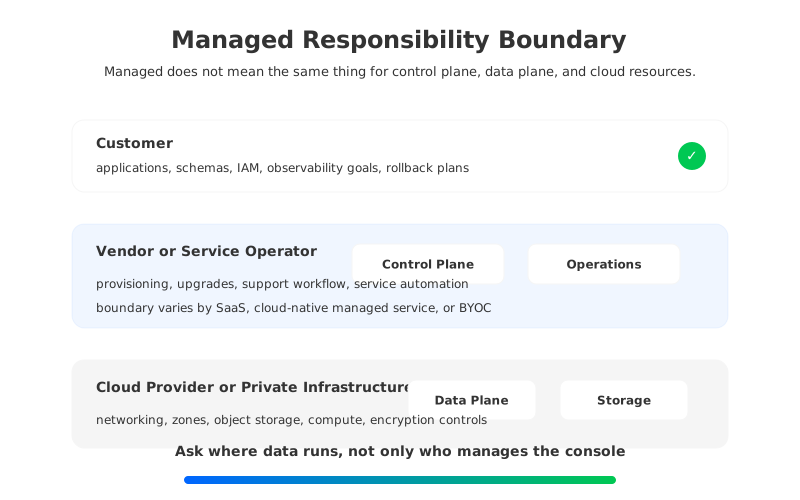
Pulsar brings a different operational model. Its broker and BookKeeper separation can be powerful, but it also introduces components and failure domains that Kafka teams may not already operate. SRE teams should ask whether the value of Pulsar-native architecture offsets the migration and training cost.
Managed Kafka options should be compared by ownership boundary rather than by marketing category:
- Who owns the data plane, and where does customer data physically run?
- Who handles broker upgrades, partition movement, storage growth, and failure recovery?
- How are private networking, IAM, encryption, audit logging, and observability integrated?
- What is the rollback path if latency, cost, or application compatibility misses expectations?
- What happens if you later leave the provider?
These questions determine how your team will behave during the first major incident.
4Cost and Networking Tradeoffs
Cost comparisons between Pulsar and managed Kafka become misleading when they only compare service fees. The meaningful comparison includes software or service pricing, compute, storage, cross-zone traffic, egress, private connectivity, support, and the people required to operate the platform.
Pulsar's architecture separates brokers from durable storage through BookKeeper. That can give teams more control over storage behavior, but the storage tier still has to be sized, monitored, and protected. In a managed Pulsar offering, some of that burden moves to the provider. In self-managed Pulsar, it remains part of the platform team's footprint.
Traditional Kafka and many managed Kafka services are shaped by the economics of replicated broker-local storage. Replication is essential for durability and availability, but in cloud environments it can interact with cross-zone networking and over-provisioning in ways that are hard to see until traffic grows. Tiered storage can help with long retention, but it does not automatically make brokers stateless or remove every operational cost tied to partition movement and local disk.
This is where a newer category of Kafka-compatible systems enters the evaluation. AutoMQ is a Kafka-compatible cloud-native streaming platform that moves Kafka log storage onto shared object storage and makes brokers more stateless. In a BYOC deployment, the data plane can run in the customer's cloud environment while AutoMQ provides a managed control-plane path. For Kafka-heavy organizations, that combination targets a specific problem: reduce broker-local storage pressure without changing the Kafka application contract.
That does not make AutoMQ the default answer to every Pulsar comparison. It makes it a relevant managed Kafka option when the team wants Kafka compatibility, cloud-native storage economics, and more control over where data runs. The decision should still be tested against workload shape, latency requirements, cloud provider constraints, and security governance.
5Migration and Rollback Risk
The safest migration is not the one with the fewest steps on a slide. It is the one that preserves the most production assumptions while changing the fewest contracts at the same time. For an existing Kafka estate, those assumptions include client libraries, authentication flows, topic naming, consumer group behavior, offset management, connector behavior, and observability semantics. Changing all of them during a platform migration creates a wide blast radius.
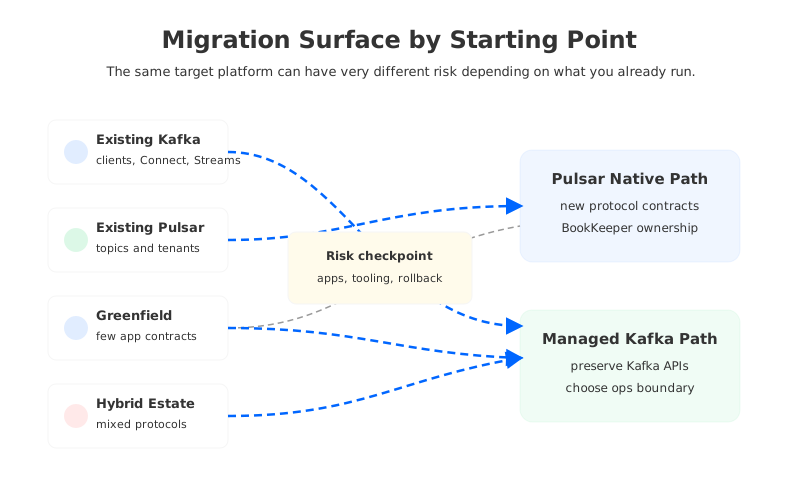
A managed Kafka migration can often be staged around replication and cutover patterns. Teams may use Kafka-native tooling, dual writes, MirrorMaker 2-style replication, connector-by-connector migration, or application group cutovers depending on risk tolerance. None of these paths is automatic, and each has tradeoffs around ordering, lag, offsets, schema evolution, and rollback. The advantage is that the language of the migration remains Kafka.
A Kafka-to-Pulsar migration has a different risk profile. It may be reasonable when the target architecture aligns better with the organization's long-term platform direction. But the plan has to account for application contract changes, operational model changes, and team skill changes. If those changes are accidental side effects of trying to reduce Kafka operations, the team may be solving one problem by creating several new ones.
Rollback is the neglected part of this discussion. A production migration plan should answer three questions before the first high-value workload moves: how do producers fail back, how do consumers preserve or translate progress, and how do operators detect that the target platform is not behaving within expected limits? Managed services reduce some failure modes, but they do not remove the need for rollback design.
6Where AutoMQ Fits Among Managed Kafka Options
AutoMQ fits the part of the managed Kafka landscape where teams want Kafka compatibility but do not want broker-local storage to dictate cost, scaling, and recovery behavior. Its architecture uses shared object storage as the durable storage foundation while keeping Kafka protocol compatibility for clients and ecosystem tools. That is a different proposition from both Pulsar-native adoption and conventional managed Kafka built around local broker storage.
For a platform architect, the question is whether the migration surface is smaller for the workloads you already have. If your teams are deeply invested in Kafka clients, Kafka Connect, Kafka Streams, and Kafka operational practices, preserving that contract has real value. If your cost pressure comes from storage, replication, or slow data movement during scaling and recovery, a Kafka-compatible shared-storage architecture is worth evaluating.
For a CTO or FinOps leader, the ownership model matters as much as the architecture. A BYOC path can keep the data plane in a customer-controlled cloud environment while reducing the day-to-day burden of running Kafka infrastructure. That helps organizations that need data control, private networking, and cloud-account ownership without returning to a fully self-managed Kafka estate.
The practical next step is to map your migration surface before comparing vendors. List the applications, connectors, stream processors, schemas, dashboards, alert rules, security policies, and rollback paths that would change under each option. Pulsar may win when its native architecture is the better long-term platform. Managed Kafka may win when preserving the Kafka contract is the highest-value risk reduction. AutoMQ belongs in that second conversation when the team also wants object-storage-backed Kafka economics and a BYOC operating model.
7Decision Checklist
Use this checklist before committing to either path:
- Start with the current estate. Count Kafka applications, Connect jobs, Streams apps, schemas, dashboards, and consumer groups before comparing platform features.
- Separate managed service value from architecture value. A service can be managed and still leave you with cost, networking, and rollback responsibilities.
- Validate compatibility at the edges. Test admin APIs, security, connectors, lag monitoring, offset behavior, and incident workflows.
- Model cost by workload shape. Include storage retention, replication, cross-zone traffic, compute, provider fees, support, and operational labor.
- Design rollback before cutover. Migration risk is not under control until producer fallback and consumer progress are understood.
The comparison becomes clearer once the decision is framed this way. Pulsar is a platform shift. Managed Kafka changes the operating model while keeping the Kafka contract. AutoMQ is one managed Kafka-compatible option for teams that want that contract plus a shared-storage architecture. If your current pain is Kafka operations, changing the whole application ecosystem may be more migration than you need.
For teams evaluating this path, build a workload-level migration map, then test the options that keep the smallest number of production assumptions in motion. If Kafka compatibility and data-plane control are high-priority requirements, AutoMQ's BYOC Kafka platform is one candidate to include in that evaluation.
8FAQ
8.1Is Pulsar better than managed Kafka?
Neither is universally better. Pulsar is a different streaming platform with its own architecture and operational model. Managed Kafka is usually a lower-risk path for organizations already invested in Kafka clients, Kafka Connect, Kafka Streams, and Kafka operational tooling.
8.2Is managed Kafka the same as Kafka SaaS?
No. Managed Kafka can refer to SaaS platforms, cloud-provider services such as Amazon MSK, or BYOC models where the vendor manages a control plane while the data plane runs in the customer's cloud account.
8.3Can Pulsar run Kafka clients?
Pulsar ecosystems have offered Kafka protocol compatibility approaches, but production teams should validate compatibility in detail. Client behavior, admin APIs, authentication, metrics, consumer groups, connectors, and rollback procedures all need testing.
8.4When should a Kafka team choose Pulsar?
Pulsar can make sense when the team wants Pulsar-native architecture and is willing to adopt its application and operational model. That is a strategic platform decision, not a small operational optimization.
8.5Where does AutoMQ fit in this comparison?
AutoMQ fits as a Kafka-compatible managed or BYOC path for teams that want to preserve Kafka application contracts while changing the storage and operations model. It is most relevant when migration risk, data-plane control, and cloud storage economics are central requirements.


