
Table of Contents
Table of Contents
An AWS team comparing Pulsar vs MSK is usually not asking a generic messaging question. It is asking whether the streaming platform should stay close to the Kafka ecosystem that already runs across the organization, or whether the team should adopt a different cloud-native architecture with a different operational model. That decision touches application compatibility, data retention, cross-AZ networking, incident response, procurement, and the shape of the platform team itself.
Amazon MSK is the AWS-native managed service for Apache Kafka. Apache Pulsar is an open source streaming and messaging platform with a broker and BookKeeper storage architecture. Both can run serious production workloads, but they optimize for different kinds of teams. The interesting question is not which one is "better" in the abstract. It is which trade-off your AWS environment can absorb.
1Quick Answer By AWS Workload
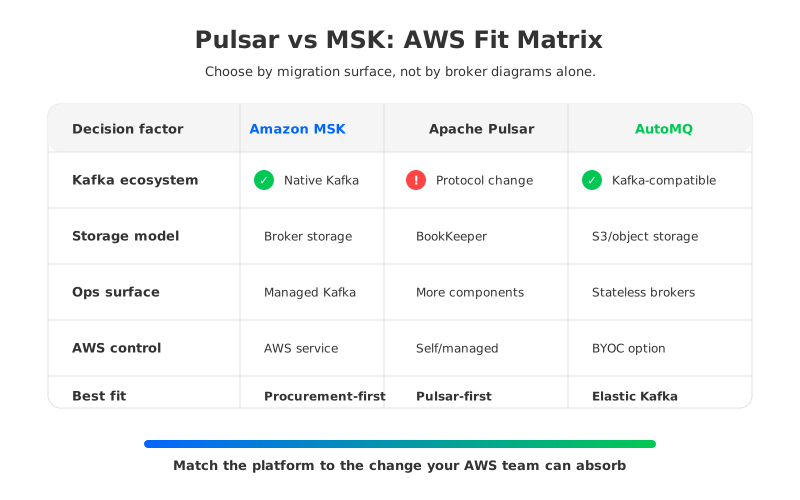
If your applications already depend on Kafka clients, Kafka Connect, Kafka Streams, Schema Registry patterns, or existing Kafka operational knowledge, Amazon MSK is usually the lower-friction path. MSK keeps the Kafka API and gives procurement, security, IAM, VPC networking, CloudWatch, and AWS support a familiar shape. That familiarity matters when the streaming platform is already part of a larger AWS estate rather than a greenfield research project.
Pulsar becomes more attractive when the workload values Pulsar-specific features enough to justify a platform shift. Its architecture separates stateless brokers from persistent storage in Apache BookKeeper, supports multiple subscription types, and has a multi-tenant namespace model. Those capabilities come with a different client protocol, admin model, and operational vocabulary.
For AWS teams, the first cut often looks like this:
| Team priority | Better first fit | Why it usually points there |
|---|---|---|
| Keep Kafka applications unchanged | Amazon MSK | Native Kafka compatibility keeps existing clients and tooling in place. |
| Adopt Pulsar features such as flexible subscriptions and namespace-level tenancy | Apache Pulsar | Pulsar's model is designed around these semantics rather than Kafka compatibility. |
| Reduce cloud storage and scaling friction without changing Kafka APIs | AutoMQ | Kafka-compatible shared storage keeps the API familiar while moving durable data to object storage. |
| Minimize vendor onboarding inside AWS procurement | Amazon MSK | It is an AWS service with AWS billing, IAM integration, and support paths. |
| Build a multi-protocol streaming platform from first principles | Apache Pulsar | Pulsar is a broader messaging and streaming system, not only a Kafka service. |
The table is blunt because the wrong decision is rarely caused by missing one feature. It is usually caused by underestimating the migration surface. A team can like Pulsar's architecture and still spend the project rewriting integrations. A team can like MSK's simplicity and still discover storage or scaling pressure at higher retention and throughput.
2Kafka Compatibility And Ecosystem Fit
MSK's strongest argument is compatibility. It is managed Apache Kafka, so teams can preserve producer and consumer clients, topic conventions, partitioning assumptions, Kafka Connect pipelines, and operational dashboards that already speak Kafka. This does not remove every migration task; teams still need to choose broker types, versions, authentication, monitoring, and networking. But it keeps the application-facing contract stable, which is often the difference between a platform migration and a company-wide application rewrite.
Pulsar changes more of that contract. Pulsar has its own client libraries, topic and namespace model, subscription types, admin APIs, and storage architecture. There are adapters and ecosystem bridges, but an AWS architecture review should treat Pulsar adoption as a platform change, not as a drop-in MSK replacement. That is not a criticism. It is a warning against comparing only broker diagrams while ignoring application ownership.
The compatibility questions are specific:
- Which applications use Kafka protocol features directly, such as transactions, consumer group behavior, partition keys, or Connect connectors?
- Which teams own those applications, and can they change client code during the migration window?
- Which observability, schema, security, and incident workflows assume Kafka semantics?
- Which parts of your estate are batch replay systems, real-time serving systems, or event-driven applications with different tolerance for rework?
When most answers point back to Kafka, MSK has an advantage. When the team is intentionally building around Pulsar semantics, Pulsar may be worth the change. The gray zone is the AWS team that wants cloud-native elasticity and lower storage friction without giving up Kafka. That is where architecture matters more than product labels.
3Storage And Scaling Model
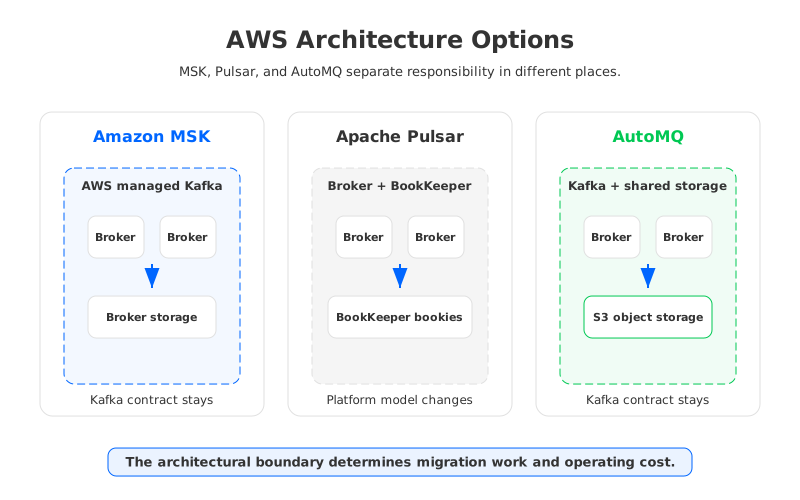
Traditional Kafka clusters tie durable data to broker-local storage. In MSK Standard brokers, AWS describes storage as customer-managed through features such as EBS storage, tiered storage, provisioned storage throughput, auto-scaling, and capacity alerts. MSK Express brokers shift more storage management to MSK and are designed for higher elasticity, throughput, resilience, and ease of use. These options improve the managed Kafka experience, but the core user question remains: how much does storage growth affect broker sizing, scaling, and recovery?
Pulsar takes a different route. A Pulsar broker is stateless for message serving, while persistent message data is written to BookKeeper bookies. That separation is powerful because brokers and storage nodes can scale along different axes. BookKeeper stores ledgers, replicates entries across bookies, and supports horizontal capacity and throughput growth by adding bookies. In exchange, the platform team operates a more distributed system with brokers, bookies, metadata stores, and service discovery paths to reason about.
The cloud lesson is that "separate compute and storage" is not one design. Pulsar separates brokers from BookKeeper storage. MSK offers managed Kafka with Standard, Express, Serverless, and tiered options. A Kafka-compatible shared-storage system separates Kafka brokers from object storage while preserving the Kafka protocol. The same phrase can hide different failure modes, cost models, and migration plans.
4AWS Cost Components To Compare
Cost comparisons between Pulsar and MSK get messy because the bill is not one line item. MSK pricing includes broker instance usage, storage, optional provisioned storage throughput, and, depending on the mode, data in, data out, cluster hours, partition hours, private connectivity, and replication-related charges. AWS data transfer rules still matter for traffic that crosses environment boundaries.
Pulsar cost is assembled differently. If self-managed on AWS, the bill usually comes from compute for brokers, bookies, proxies, and metadata components; block storage or local disks for BookKeeper; load balancers; cross-AZ traffic; observability; backups; and engineering time. If Pulsar is consumed through a managed vendor or marketplace offer, the pricing model changes again. That is why a clean "Pulsar vs MSK price" answer can be misleading without the workload shape.
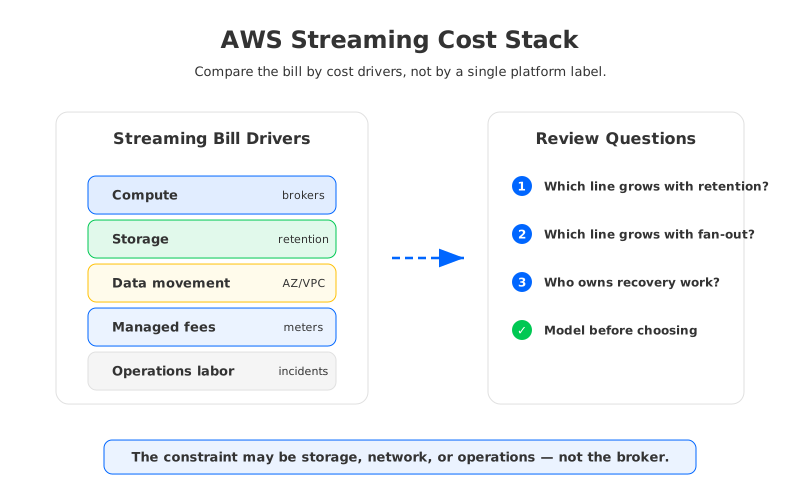
The useful comparison is not a single monthly number. It is a cost stack:
- Compute: broker, bookie, proxy, connector, and supporting service capacity. Over-provisioning can dominate when traffic is bursty.
- Storage: provisioned EBS, managed broker storage, tiered storage, object storage, and retention-driven growth.
- Data movement: cross-VPC, cross-region, internet egress, PrivateLink, replication, and fan-out reads.
- Managed service fees: cluster hours, partition hours, data-in/data-out meters, marketplace subscriptions, and support.
- Operations labor: upgrades, rebalancing, incident handling, capacity planning, security reviews, and platform onboarding.
This is where AWS teams should be careful with benchmarks. A low storage price does not automatically mean a low streaming bill if the architecture increases data movement or operational overhead. A managed service premium may be reasonable if it removes work that your team is not staffed to do. The better question is: which line item becomes the constraint when retention, throughput, partition count, or consumer fan-out grows?
5Operations And Networking
MSK fits naturally into AWS operational habits. Teams can use AWS identity, VPC constructs, CloudWatch, AWS support, MSK Connect, and MSK Replicator. They still need Kafka expertise, especially for partition planning, client behavior, topic retention, scaling choices, and incident diagnosis. Managed Kafka reduces infrastructure work, but it does not make the streaming workload disappear as an engineering discipline.
Pulsar operations are different. The architecture gives operators more dimensions to tune, such as broker load balancing, BookKeeper journal and ledger storage, metadata stores, proxies, namespace policies, and subscription behavior. For a team that wants those controls, Pulsar can be a strong fit. For a team whose main goal is to keep Kafka applications running with fewer AWS surprises, those extra dimensions may become an adoption tax.
Networking is the quiet part of the decision. In AWS, the difference between clients in the same VPC, clients across VPCs, clients across accounts, and replicated clusters across regions can change both architecture and cost. MSK has documented private connectivity and replication options. Pulsar can be exposed through proxies, load balancers, and service discovery, but the team owns more of the design. The right comparison is not "does it connect?" It is "who operates the connection path when something breaks at 2 a.m.?"
6Where AutoMQ Fits On AWS
The gap between MSK and Pulsar is not only a vendor gap. It is an architectural gap. Some AWS teams want Kafka compatibility because their applications, connectors, and operational knowledge already depend on it. The same teams may want the storage-compute separation that makes Pulsar appealing. That combination points to a third category: Kafka-compatible streaming with shared object storage.
AutoMQ is a Kafka-compatible cloud-native streaming platform that uses object storage such as S3-compatible storage as the durable storage layer. The goal is not to turn Kafka into Pulsar or replace every AWS-native service decision. It is to keep Kafka protocol compatibility while moving durable data away from broker-local disks, so scaling and recovery depend less on moving large volumes of data between brokers.
That distinction matters in AWS architecture reviews. A Kafka-compatible shared-storage design can preserve Kafka clients and ecosystem integrations while changing the storage economics underneath. Stateless brokers make capacity changes closer to compute operations, while object storage changes how teams think about retention and durability. In a BYOC deployment model, teams can also keep infrastructure and data control inside their own cloud environment.
AutoMQ is not the answer to every Pulsar vs MSK question. If your team needs Pulsar's subscription model or has already standardized on Pulsar clients, keep evaluating Pulsar on its own merits. If your team wants the most AWS-native managed Kafka procurement path, MSK remains the obvious baseline. AutoMQ enters when the team wants Kafka compatibility, object-storage-backed durability, stateless broker operations, and cloud cost elasticity in the same AWS design.
7Decision Guidance For AWS Teams
The easiest way to decide is to rank the change you are willing to accept. If application change is expensive, start with the Kafka-compatible options. If operational model change is acceptable but application compatibility is not, compare MSK against Kafka-compatible shared-storage platforms. If protocol change is acceptable because the platform team wants Pulsar-specific semantics, evaluate Pulsar with a full migration plan.
For procurement-first teams, MSK is often the shortest path because it sits inside AWS purchasing and support workflows. For Kafka ecosystem-first teams, MSK and AutoMQ deserve closer evaluation than Pulsar because the application contract stays closer to what teams already run. For Pulsar feature-first teams, Pulsar should be evaluated for the features that made it attractive in the first place: subscription flexibility, tenancy model, and broker-storage separation. For cost-elasticity-first teams, the real comparison is how each architecture handles retention growth, scaling events, cross-AZ design, and operational labor.
One practical evaluation pattern works well:
- Run a compatibility inventory of clients, connectors, admin tools, and observability systems.
- Model the AWS cost stack with your own throughput, retention, partition count, and fan-out.
- Test scaling and recovery operations, not only steady-state throughput.
- Include networking paths across VPCs, accounts, Availability Zones, and regions.
- Decide whether the team wants a Kafka platform, a Pulsar platform, or a Kafka-compatible shared-storage platform.
The answer should feel less like a product preference and more like an operating model choice. MSK keeps AWS teams close to managed Kafka. Pulsar asks teams to adopt a different streaming architecture. AutoMQ sits in the middle for teams that want Kafka compatibility with object-storage-backed cloud architecture. If the original search was "Pulsar vs MSK," the better question is: which change do you want your applications, operators, and AWS bill to absorb?
To explore the Kafka-compatible shared-storage path on AWS, start with the AutoMQ AWS evaluation path alongside your MSK and Pulsar proof of concept.
8FAQ
8.1Is Apache Pulsar a direct replacement for Amazon MSK?
Not in the narrow sense. Amazon MSK is managed Apache Kafka, while Pulsar uses its own protocol, clients, topic model, and broker plus BookKeeper architecture. Pulsar can replace some streaming use cases, but AWS teams should treat it as a platform migration rather than a drop-in MSK swap.
8.2Is MSK better if we already run Kafka applications?
MSK is usually the lower-friction starting point when existing applications depend on Kafka clients, Kafka Connect, Kafka Streams, or Kafka operational patterns. The main reason is compatibility, not a universal technical advantage. If the team also wants shared-storage elasticity, compare MSK with Kafka-compatible object-storage-backed platforms before changing protocols.
8.3Does Pulsar cost less than MSK on AWS?
There is no reliable generic answer. MSK cost depends on the chosen mode, broker usage, storage, partition and data meters, private connectivity, replication, and AWS data transfer. Pulsar cost depends on how it is deployed, including brokers, bookies, metadata services, storage, networking, observability, and operations labor. Use your own throughput, retention, fan-out, and availability model.
8.4Where does AutoMQ fit in a Pulsar vs MSK evaluation?
AutoMQ fits when the team wants Kafka protocol compatibility but also wants storage-compute separation backed by object storage such as S3-compatible storage. It is not a Pulsar feature replacement. It is a Kafka-compatible architecture option for AWS teams that want to reduce broker-local storage dependence while preserving Kafka ecosystem compatibility.
8.5Should AWS teams choose MSK Serverless, MSK Express, or MSK Standard before considering Pulsar?
They should at least understand the differences. MSK Standard offers more customer-managed configuration, MSK Express shifts more broker storage management to MSK and is designed for higher elasticity, and MSK Serverless uses a different pricing and operating model. If those options solve the problem without changing application protocols, they may reduce migration risk.


