
Table of Contents
Table of Contents
Teams usually compare Pulsar vs Redpanda after they have already rejected a simple answer. Apache Pulsar is not a minor variation of Kafka; it is a multi-layer messaging system with brokers, Apache BookKeeper storage, metadata services, tenants, namespaces, and multiple subscription models. Redpanda takes the opposite route: keep the Kafka-facing application surface, but replace the traditional Kafka implementation with a single-binary broker built in C++ and designed around Kafka API compatibility. Both can be reasonable choices, but they pull an architecture review in different directions.
That distinction matters because a streaming platform decision rarely fails at the feature checklist level. It fails when the migration team discovers that "Kafka-compatible" did not mean "all our tooling behaves the same," or when a platform team realizes that separating serving from storage created a new storage service to operate. The productive question is not which product is more impressive. It is which failure mode, migration surface, and cost structure your organization is prepared to own.
1Quick Comparison Table
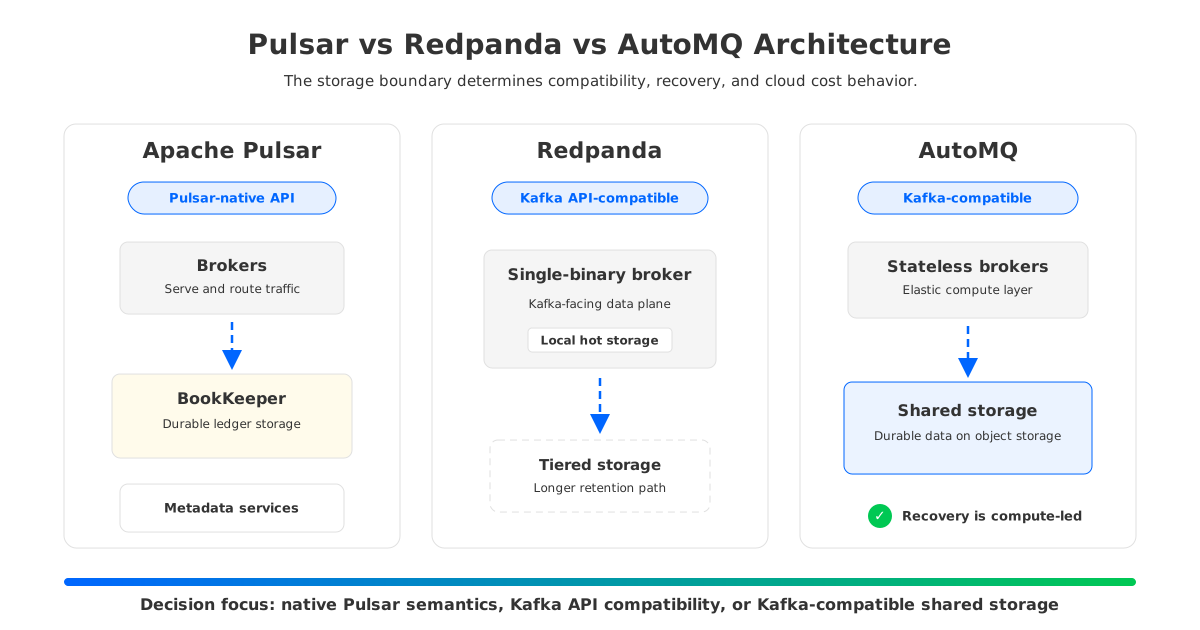
The short version: Pulsar is strongest when its native messaging model is part of the application design. Redpanda is strongest when Kafka API compatibility, broker simplicity, and low-latency local storage are the center of the requirement. A third category, Kafka-compatible shared storage, becomes relevant when the team wants to keep Kafka-facing applications while changing the broker-local disk economics that still shape many Kafka alternatives.
| Dimension | Apache Pulsar | Redpanda | AutoMQ |
|---|---|---|---|
| Primary compatibility story | Pulsar-native API and messaging model; Kafka compatibility is not the core identity | Kafka API-compatible streaming platform | Kafka-compatible streaming with shared storage |
| Storage architecture | Brokers serve traffic; BookKeeper bookies store ledgers; metadata services coordinate the cluster | Broker-local storage with tiered storage options for longer retention | Object-storage-backed shared storage with stateless brokers |
| Operational shape | More moving parts, but strong separation between serving and durable storage | Simpler broker footprint, but durable data is still tied to broker storage for the hot path | Brokers act more like elastic compute because durable data lives in shared storage |
| Best fit | Multi-tenant messaging, geo-replication, varied subscription semantics, Pulsar-native apps | Kafka-facing workloads that need performance and a simpler operational model | Kafka-facing workloads that need elasticity, recovery, and cloud cost control |
| Main evaluation risk | Application semantics and BookKeeper expertise | Kafka feature parity for your exact workload and storage growth | Workload-specific latency and connector validation |
This table should not be read as a ranking. It is a map of architectural commitments. Pulsar commits to a layered messaging system. Redpanda commits to Kafka API compatibility with a different broker implementation. AutoMQ commits to Kafka compatibility while moving durable storage away from broker-local disks.
2Protocol and Ecosystem Differences
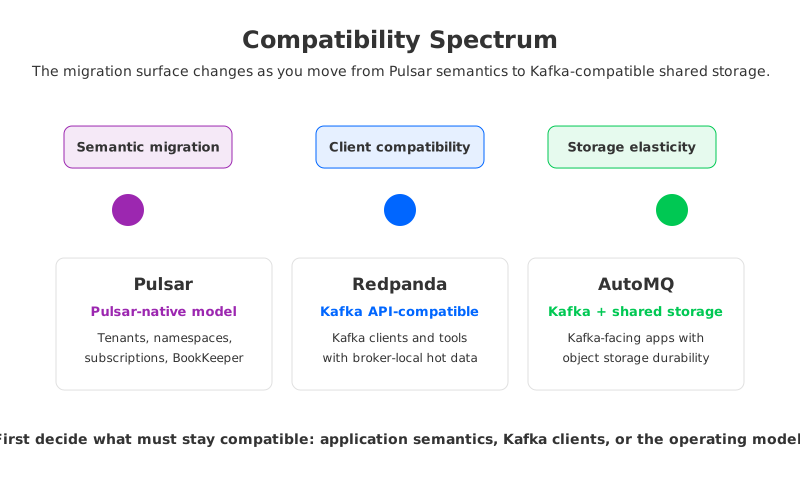
Protocol choice is the first migration cost because it touches every producer, consumer, connector, schema workflow, and runbook. Pulsar's native model gives teams concepts that Kafka does not expose in the same way: tenants, namespaces, topics, subscriptions, and a broker/storage split built around BookKeeper ledgers. Those concepts are valuable when the application already uses them. They become migration work when the organization standardizes around Kafka clients, Kafka Connect, Kafka Streams, and Kafka-oriented observability.
Redpanda starts from the Kafka side of the room. Its documentation positions Redpanda as Kafka API-compatible, which means the platform aims to work with Kafka clients and Kafka ecosystem tools without requiring applications to adopt a separate Pulsar client model. That is a meaningful advantage when the evaluation is driven by existing Kafka applications, but it still needs proof. Compatibility is not a slogan; it is a workload-by-workload test across client versions, transactions, compaction, security, admin APIs, schemas, connectors, and monitoring.
The same nuance applies to Pulsar's Kafka-related options. Pulsar can expose Kafka compatibility through integrations, and some organizations successfully support both Pulsar and Kafka-facing applications. The trade-off is operational and semantic complexity. A team that primarily wants Kafka compatibility should ask why it is adding a Pulsar-native control plane and BookKeeper storage layer to get there.
3Storage Architecture Comparison
Pulsar's architecture separates brokers from durable storage. Brokers handle serving and routing, while BookKeeper bookies store durable ledgers. That design is one reason Pulsar appealed to cloud-native platform teams before "stateless broker" became a common marketing phrase. Separating serving and storage can make some scaling and failure scenarios cleaner, but it also means the platform team operates a distributed log storage system underneath the broker layer.
Redpanda intentionally removes some of that stack complexity. It uses a single-binary architecture and stores topic data through the broker path, with tiered storage available for retention-oriented use cases. This can make the operational surface smaller than a Pulsar deployment that includes brokers, bookies, and metadata services. The trade-off is that the hot path still has a broker-local storage character: capacity, recovery, and performance planning remain tied to the broker layer.
Tiered storage does not erase that distinction. Tiering can move older data to object storage and reduce pressure from long retention, but it is not the same as designing the primary durability boundary around shared storage from the start. If a workload's pain is "we keep too much old data," tiered storage may be enough. If the pain is "scaling and recovering brokers requires too much stateful data movement," the team should evaluate shared-storage architectures directly.
This is where AutoMQ enters as a third route rather than a Redpanda or Pulsar clone. AutoMQ is a Kafka-compatible streaming system that uses object-storage-backed shared storage and stateless brokers. For teams attracted to Pulsar's storage separation but constrained by Kafka ecosystem requirements, that combination is worth evaluating: it preserves the Kafka-facing application model while changing the storage boundary that drives scaling and recovery.
4Operations and Scaling Trade-Offs
Operations is where architecture becomes budget, staffing, and sleep. Pulsar's moving parts are not accidental; they exist because the system separates concerns. Brokers can be scaled separately from bookies, and geo-replication is a first-class part of the Pulsar story. The price of that separation is specialized operational knowledge. BookKeeper capacity, ledger recovery, metadata health, broker load, and subscription behavior all become part of the platform team's vocabulary.
Redpanda reduces the number of services an operator has to reason about. A smaller deployment shape can make upgrades, monitoring, and incident response easier to explain, especially for teams already fluent in Kafka-like operations. But fewer components do not mean fewer decisions. Broker sizing, partition placement, local disk throughput, tiered storage behavior, and failure recovery still need production-grade testing.
The operational difference shows up most clearly during growth and failure:
- Scaling compute. Pulsar can separate broker serving capacity from bookie storage capacity, while Redpanda scales through brokers that also participate in storage and partition ownership. Shared-storage Kafka-compatible systems push this further by reducing the amount of durable data tied to any broker.
- Recovering failed nodes. Pulsar recovery involves BookKeeper and metadata coordination. Redpanda recovery follows a broker-local data model. Shared-storage systems aim to turn recovery into reassignment of compute rather than large broker-to-broker data copy.
- Changing retention. Pulsar and Redpanda both support storage designs that can help with retention, but the cost and operational behavior depend on how much data remains on local or specialized storage before it moves to object storage.
- Explaining incidents. Pulsar incidents often require understanding broker, bookie, and metadata interactions. Redpanda incidents often look more familiar to Kafka operators, but with Redpanda-specific internals and metrics.
These are not edge cases. They are the daily mechanics of running a streaming platform.
5Cloud Cost Implications
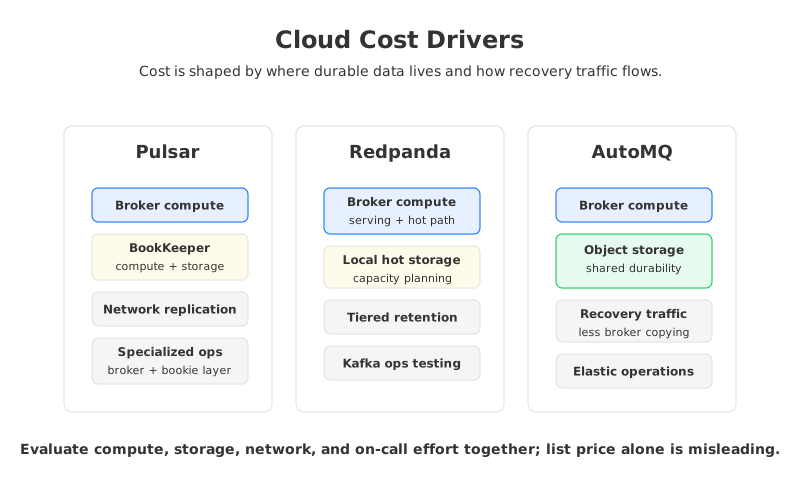
Cloud cost is not a single price line. A self-managed Pulsar cluster can spend money on broker compute, BookKeeper compute, bookie storage, metadata infrastructure, cross-zone replication, load balancers, observability, and the people who keep those pieces healthy. Redpanda shifts that cost shape toward broker compute, local disk, network, tiered storage, and managed service fees if Redpanda Cloud is used. Both can be cost-effective for the right workload, and both can become expensive when the workload pushes against the storage model.
The cost conversation should start with drivers rather than list prices:
| Cost Driver | Why It Matters in Pulsar | Why It Matters in Redpanda | What to Test |
|---|---|---|---|
| Compute | Brokers and bookies can scale differently, but both need capacity planning | Brokers carry the core serving and storage path | CPU headroom under producer, consumer, and recovery load |
| Local or specialized storage | BookKeeper storage capacity and performance are central | Broker-local hot storage shapes performance and recovery | Disk throughput, retention growth, and rebuild behavior |
| Object storage | Useful for tiered storage and long retention | Useful for tiered storage and archival retention | Request patterns, cache hit rate, and read-after-retention behavior |
| Network | Replication and cross-zone placement can dominate cloud bills | Replication, client traffic, and tiered storage movement matter | Cross-zone topology, fan-out, and recovery traffic |
| Operations labor | More subsystems require deeper expertise | Fewer subsystems, but compatibility and storage tuning remain | Upgrade time, incident steps, and on-call confidence |
The most expensive architecture is the one that looks lower cost in a spreadsheet and then forces the team to over-provision for recovery, rebalance windows, or unpredictable retention growth. This is why storage architecture belongs in the same conversation as license or service pricing. A platform that reduces one line item while increasing operational risk has not really reduced cost.
6When Pulsar Is the Better Fit
Choose Pulsar when the native Pulsar model is central to the product or platform. Multi-tenancy through tenants and namespaces, flexible subscription modes, built-in geo-replication patterns, and the broker/BookKeeper split can be compelling for organizations building a messaging platform rather than a Kafka-compatible event log. Pulsar is also attractive when the team already has Pulsar expertise and the application uses Pulsar semantics deeply enough that moving to Kafka would be an application rewrite, not an infrastructure migration.
The caution is operational honesty. Pulsar's architecture gives you more separation, but it also gives you more relationships to understand. A team should be comfortable with BookKeeper operations, metadata service behavior, topic and namespace policies, and client semantics before treating Pulsar as the lower-risk option.
7When Redpanda Is the Better Fit
Choose Redpanda when the application estate is Kafka-facing and the team wants a Kafka API-compatible system with a simpler broker footprint than a traditional multi-service deployment. It is especially relevant when low-latency performance, Kafka client compatibility, and a clearer operational model are higher priorities than Pulsar-native features. Teams evaluating Redpanda should run their actual Kafka clients, connectors, security configuration, admin workflows, and observability stack before making the call.
The caution is the storage boundary. Redpanda can simplify the stack, but it does not automatically remove the consequences of broker-owned hot data. If your main pain is disk-heavy recovery, retention-driven over-provisioning, or slow scaling because data is tied to brokers, tiered storage may help, but it may not be the full architectural shift you are looking for.
8Where AutoMQ Fits
AutoMQ fits when the Pulsar vs Redpanda debate reveals a third requirement: keep Kafka compatibility, but change the storage model. This is common in teams that like Pulsar's separation of serving and storage but cannot afford a Pulsar-native migration, or in teams that like Redpanda's Kafka-facing posture but want less durable data tied to broker-local disks. In that case, the choice is no longer only Pulsar's layered messaging architecture versus Redpanda's Kafka API-compatible broker. It becomes a question of whether Kafka-compatible shared storage can reduce the operational and cost pressure that started the evaluation.
The architecture is not magic. Object storage changes latency, request, and caching trade-offs, so the proof of concept still has to use real producers, consumers, connectors, and failure scenarios. The upside is that stateless brokers and shared durable storage can make scaling and recovery feel more like compute operations than storage migration projects. For cloud teams, that difference can be more important than another line in a feature matrix.
If your comparison started with Pulsar vs Redpanda, keep the first decision grounded: do you need Pulsar-native semantics, Kafka API compatibility with a broker-local hot path, or Kafka compatibility with shared storage? Teams that land in the third category should read the AutoMQ architecture docs and test a representative workload before locking into another stateful streaming stack.
9FAQ
9.1Is Redpanda a replacement for Pulsar?
Redpanda can replace Pulsar for workloads that can move to Kafka-facing APIs and Kafka-style operational patterns. It is not a drop-in replacement for Pulsar-native semantics such as tenants, namespaces, and Pulsar subscription behavior. Treat it as a Kafka-compatible alternative, not as a Pulsar clone.
9.2Is Pulsar better than Redpanda?
Pulsar is better for teams that need Pulsar-native messaging semantics, broker/storage separation through BookKeeper, and built-in multi-tenant patterns. Redpanda is better for teams that prioritize Kafka API compatibility, a simpler broker deployment shape, and Kafka ecosystem continuity. The right answer depends on the application surface and the storage model you want to operate.
9.3Does Redpanda support Kafka clients?
Redpanda is designed around Kafka API compatibility and is commonly evaluated with Kafka clients and ecosystem tools. Production teams should still validate their exact client versions, security settings, transactions, compaction behavior, admin APIs, connectors, and monitoring expectations.
9.4Why does Pulsar use BookKeeper?
Pulsar uses Apache BookKeeper as the durable log storage layer beneath brokers. This separates message serving from ledger storage, which can help with scaling and durability patterns. It also means operators must understand BookKeeper capacity, recovery, and metadata interactions.
9.5When should AutoMQ be considered in a Pulsar vs Redpanda evaluation?
Consider AutoMQ when the target is Kafka-compatible streaming with object-storage-backed shared storage and stateless brokers. It is most relevant when Pulsar-specific semantics are not required, but the team wants to avoid keeping durable streaming data bound to broker-local disks.
10References
- Apache Pulsar architecture overview
- Apache Pulsar tiered storage
- Apache Pulsar geo-replication
- Redpanda architecture documentation
- Redpanda Kafka API support
- Redpanda Tiered Storage documentation
- Redpanda Cloud BYOC overview
- AutoMQ overview
- AutoMQ compatibility with Apache Kafka
- AutoMQ migration overview


