
Table of Contents
Table of Contents
Teams searching for "Pulsar vs WarpStream" are usually past the generic streaming-platform question. They already know traditional Kafka can become expensive and operationally heavy when local broker disks, partition reassignment, and cross-zone replication sit in the critical path. The real question is which architectural escape route gives them cloud economics without creating a larger migration problem.
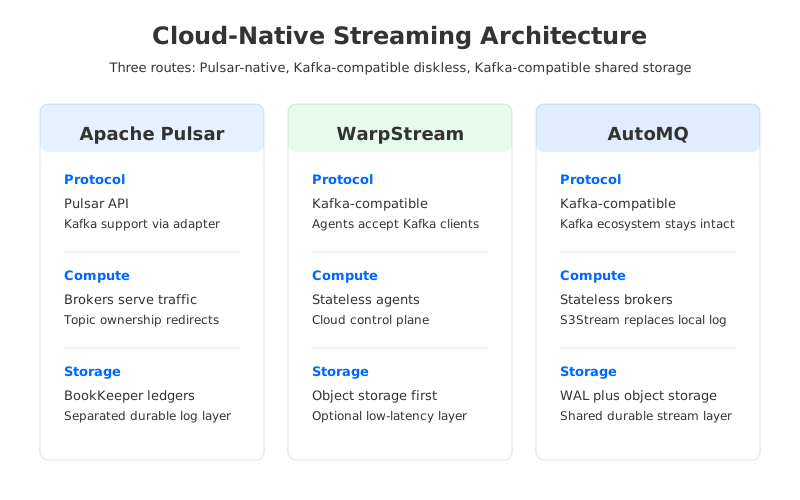
Apache Pulsar and WarpStream both attack the same broad pain, but they do it from different starting points. Pulsar separates serving from durable storage through brokers and Apache BookKeeper, and it brings its own protocol, client model, subscription semantics, and ecosystem. WarpStream keeps Kafka clients in the picture and moves the log toward a diskless, object-storage-backed model operated through agents and a cloud control plane. Those two choices sound similar at the slogan level: both are cloud-native streaming systems. Under production constraints, they feel very different.
1Quick Answer
Choose Pulsar when you want a Pulsar-native platform and are willing to adopt its client API, operational model, topic ownership behavior, BookKeeper storage layer, and subscription semantics. Pulsar can fit teams that value multi-tenancy, retention, geo-replication, and the broader Pulsar ecosystem more than Kafka API continuity.
Choose WarpStream when your starting point is Kafka and your priority is reducing broker-local disk operations by using object storage as the core durable layer. The major attraction is architectural: Kafka-compatible clients can connect to WarpStream agents while data is persisted in cloud object storage, which changes the cost and scaling profile compared with Kafka brokers that own local log segments.
Consider AutoMQ when you want the same broad direction as object-storage-backed Kafka, but with Kafka-compatible brokers, shared storage, a WAL layer, and S3Stream replacing Kafka's local log storage. AutoMQ is not a Pulsar-native replacement; it is a shared-storage path for teams that want to preserve Kafka applications, Kafka Connect, Kafka Streams, and operational skills.
| Decision factor | Pulsar | WarpStream | AutoMQ |
|---|---|---|---|
| Primary ecosystem | Pulsar-native | Kafka-compatible | Kafka-compatible |
| Durable storage model | BookKeeper ledgers | Object storage-backed | WAL plus object storage through S3Stream |
| Migration from Kafka | Higher application and tooling surface | Lower client rewrite surface | Lower client rewrite surface |
| Operational shift | Pulsar brokers, metadata, BookKeeper | Agents plus cloud control plane | Kafka-compatible brokers with shared storage |
| Natural fit | Pulsar-first platform strategy | Diskless Kafka-compatible workloads | Kafka workloads needing shared-storage elasticity |
This is not a simple ranking. A team already committed to Pulsar concepts may not care that WarpStream keeps Kafka clients. A team with hundreds of Kafka producers, consumers, connectors, and dashboards may care about that more than any single storage feature.
2Architecture Differences
Pulsar is a layered distributed system. Pulsar brokers receive producer and consumer requests, route traffic for topics, and use a metadata store for ownership and coordination. Persistent message data is stored in Apache BookKeeper, where ledgers provide the durable log abstraction beneath Pulsar topics. Brokers do not own the same kind of local partition logs as classic Kafka brokers.
That design gives Pulsar a different center of gravity from Kafka. A production Pulsar deployment asks the platform team to understand brokers, bookies, managed ledgers, metadata stores, service discovery, and sometimes proxies. The payoff is a system built around Pulsar's own model; the cost is that the operational vocabulary changes.
WarpStream starts from the opposite side of the decision. It presents a Kafka-compatible interface through agents and builds the durable log around cloud object storage. Its own docs describe the platform as diskless and Apache Kafka-compatible, built directly on object stores such as S3. Local broker disks stop being the durable data home, and the system leans into cloud storage economics.
AutoMQ sits near WarpStream on the compatibility axis but differs in implementation. AutoMQ keeps Kafka protocol compatibility while replacing Kafka's native log storage with S3Stream, backed by object storage and a WAL storage layer. Brokers become stateless because durable stream data is no longer tied to broker-local disks.
The architectural question is not "Which system uses object storage?" The sharper question is "What must be rewritten, re-operated, or re-learned before the storage benefit shows up?"
That framing prevents a common mistake. Pulsar, WarpStream, and AutoMQ all separate compute and storage in some way, but they separate different things at different boundaries. Pulsar separates brokers from BookKeeper. WarpStream separates agents from object storage and coordinates through a cloud service. AutoMQ separates Kafka-compatible brokers from durable storage through S3Stream and WAL.
3Kafka Compatibility and Migration Risk
Kafka compatibility is not a checkbox for teams with real production history. It touches client libraries, serializers, schema registry choices, Kafka Connect connectors, Kafka Streams applications, consumer group behavior, admin scripts, dashboards, alerts, and the mental model engineers use when debugging lag at 2 a.m. If a platform change breaks enough of that surface, the migration becomes an application modernization program.
Pulsar can interoperate with Kafka in limited ways, and the Pulsar ecosystem has tooling for Kafka-on-Pulsar scenarios. Still, the primary platform is Pulsar. If you adopt it while hoping your Kafka estate will remain untouched, pressure-test that assumption against actual applications and workflows.
WarpStream's value proposition is clearer for Kafka-heavy teams. Kafka clients can be configured to connect to WarpStream agents, and the platform documents Kafka protocol and feature support directly. That does not remove every migration risk. It moves the risk away from wholesale client rewrites and toward feature compatibility, operational boundaries, performance tuning, and networking.
AutoMQ follows the Kafka-compatible path as well. It presents a Kafka-compatible broker layer while changing the storage layer below it. For teams that depend on Kafka Connect, Kafka Streams, and existing Kafka clients, that compatibility preserves more of the application estate while addressing the core cloud problem: durable data is no longer pinned to broker-local storage.
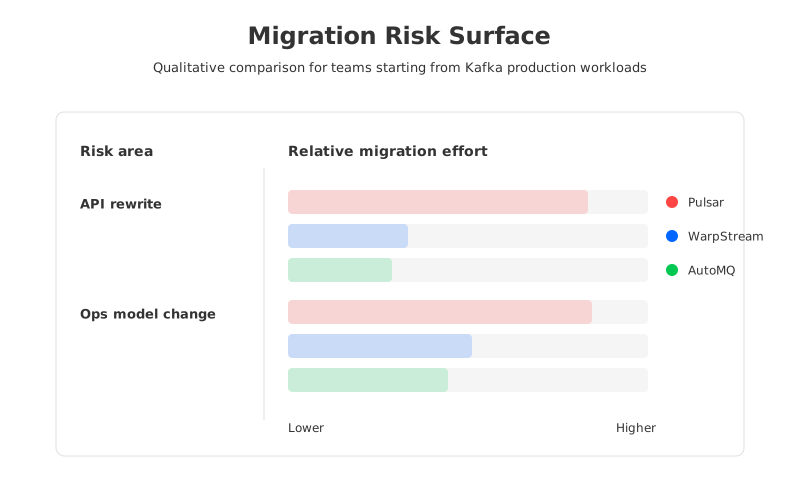
Migration risk usually concentrates in four areas:
- API and client behavior. A Pulsar-native move can require deeper application review, while Kafka-compatible systems reduce that surface but still need protocol-feature checks.
- Connector and stream-processing dependencies. Kafka Connect and Kafka Streams are often more important than the brokers themselves because they encode years of integration work.
- Offset, retention, and replay semantics. Storage architecture changes are manageable only when consumer progress and replay expectations remain predictable.
- Operational rollback. A migration path is safer when traffic can be mirrored, validated, and reversed without rebuilding every consuming application.
Architecture diagrams rarely show this work. A good evaluation should include a feature matrix, a representative producer, a stateful consumer, a Kafka Streams app, a connector, and an incident runbook exercise.
4Latency, Storage, and Cost Tradeoffs
Object storage changes the cost equation because it is elastic, durable, and priced differently from attached disks. It also changes the latency equation because object storage is not a drop-in replacement for a local append log. Any serious cloud-native streaming architecture has to decide where to absorb write latency and where to pay for durability.
Pulsar answers through BookKeeper. Bookies provide the durable ledger layer, and brokers serve traffic above it. This can support strong streaming patterns, but it creates a storage subsystem that must be deployed, scaled, monitored, and tuned. The cost profile includes bookie infrastructure, metadata stores, broker capacity, and the operational cost of running a multi-component system.
WarpStream answers by leaning hard into object storage and using agents as the Kafka-facing layer. That can reduce broker-local disk burden and make capacity planning less tied to partition placement. The tradeoff is that object-storage-first designs often need batching, caching, and feature-specific low-latency paths. WarpStream's docs describe low-latency clusters and lightning topics with additional storage layers such as S3 Express, DynamoDB, or Spanner, a useful signal that low latency is an architectural mode.
AutoMQ answers with a WAL plus object storage design. The WAL layer absorbs write-path demands that object storage alone is not designed to handle, while S3Stream moves durable stream data into shared storage and removes broker-local log ownership. The important nuance is that AutoMQ is not merely tiering old Kafka data into object storage. It replaces Kafka's local log storage path, which is why the broker can become stateless and partition reassignment can become less dependent on bulk data movement.
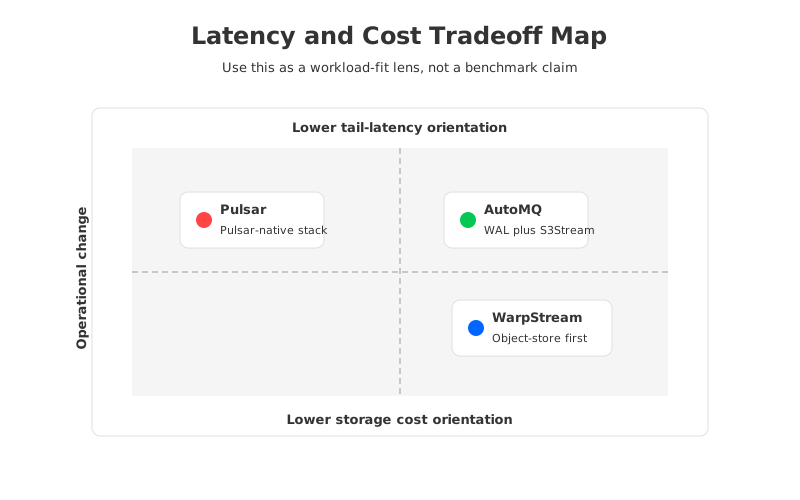
Cost comparisons depend on workload shape. Write throughput, read fanout, retention, cross-zone networking, compaction, compression, object-store request patterns, and support model can all change the bill. Model the dominant cost driver for your workload:
- If retention dominates, object storage economics matter heavily.
- If cross-zone traffic dominates, client placement and zone-local routing matter heavily.
- If tail latency dominates, the write path and cache behavior matter heavily.
- If operations dominate, the number of moving parts and recovery workflow matter heavily.
A system with lower raw infrastructure cost can still lose if it requires a specialized team to operate the storage layer. A cleaner migration path can still lose if its latency mode requires extra infrastructure for critical workloads.
5Operations and Data Control
Pulsar gives operators a rich platform, but the platform has multiple layers. Brokers, bookies, metadata stores, namespaces, tenants, policies, and proxies all become part of the operating model. For teams trying to reduce Kafka operational load without replacing the rest of their data platform, it can be too much change at once.
WarpStream shifts much of the storage burden into object storage and introduces a control-plane relationship. In BYOC-style deployments, agents can run in the customer's environment while coordinating with the vendor's control plane. Buyers should ask about control-plane dependency, failure modes, metadata, and support boundaries.
AutoMQ also speaks to data-control concerns because it can run with data in the customer's cloud environment while preserving Kafka compatibility. The architectural emphasis is different from a pure agent model: AutoMQ keeps Kafka-compatible brokers but makes them stateless through shared storage. Scaling and recovery become less about moving partition data between specific brokers and more about managing compute capacity around shared durable storage.
Pulsar may be the right answer if the organization wants a Pulsar platform. WarpStream may be right if diskless Kafka compatibility and object-storage economics dominate. AutoMQ may be right if the team wants Kafka compatibility, shared-storage elasticity, and a broker architecture that keeps the Kafka operational model recognizable.
6Where AutoMQ Differs
AutoMQ enters the discussion after the main decision has already been framed: if you are trying to avoid a Kafka-to-Pulsar application migration while still fixing Kafka's local-disk storage constraints, the design space narrows to Kafka-compatible systems that move durable data away from brokers.
The distinguishing point is AutoMQ's S3Stream and WAL design. AutoMQ replaces Apache Kafka's native log storage with S3Stream, stores data in object storage in near real time, and uses WAL storage to improve write efficiency and reduce object-storage I/O pressure. In practical terms, that means the system is not treating object storage as an archival tier behind a traditional Kafka primary log. It is making shared storage the foundation of the Kafka-compatible cluster.
For readers comparing Pulsar, WarpStream, and AutoMQ, the useful question is not whether AutoMQ is a universal answer. It is not. The useful question is whether your current pain is protocol migration or storage architecture. If your pain is that Kafka's ecosystem no longer fits your application model, Pulsar deserves serious evaluation. If your pain is that Kafka's storage and operations are misaligned with the cloud, Kafka-compatible shared storage deserves equal attention.
AutoMQ's docs provide a deeper architecture overview for teams that want to inspect the storage model rather than accept a marketing phrase. A practical next step is to map your top 3 Kafka workloads against compatibility requirements, latency expectations, retention profile, and rollback needs, then compare those workloads against Pulsar, WarpStream, and AutoMQ using the same test plan. Start with the AutoMQ architecture overview at docs.automq.com while building that evaluation.
7References
- Apache Pulsar Architecture Overview
- Apache Pulsar Concepts: Messaging
- WarpStream Introduction
- WarpStream Architecture
- WarpStream Protocol and Feature Support
- WarpStream Low Latency Clusters
- AutoMQ Architecture Overview
8FAQ
8.1Is Pulsar a direct replacement for WarpStream?
Not really. Pulsar is a Pulsar-native streaming platform with its own protocol, client model, and BookKeeper-backed storage architecture. WarpStream is designed around Kafka compatibility and object storage. They can solve overlapping infrastructure problems, but the migration surface is very different.
8.2Is WarpStream the same as Pulsar because both separate compute and storage?
No. Pulsar separates brokers from BookKeeper ledgers inside a Pulsar-native architecture. WarpStream presents Kafka-compatible agents and stores data through object storage. Both separate compute and storage, but the protocol, operating model, and migration impact are not the same.
8.3Where does AutoMQ fit in a Pulsar vs WarpStream evaluation?
AutoMQ fits when the buyer wants Kafka compatibility and shared-storage economics but wants to evaluate an architecture based on Kafka-compatible stateless brokers, WAL, and S3Stream. It is not a Pulsar-native platform; it is a Kafka-compatible alternative for teams whose main pain is Kafka's broker-local storage model.
8.4Which option is better for latency-sensitive workloads?
The answer depends on workload shape and configuration. Pulsar, WarpStream, and AutoMQ all have different write paths and storage layers. For latency-sensitive workloads, evaluate tail latency under your own batching, replication, durability, and read-fanout conditions rather than relying on generic platform claims.
8.5Which option reduces migration risk for existing Kafka teams?
Kafka-compatible options generally reduce application rewrite risk because existing Kafka clients and ecosystem tools remain more relevant. That favors WarpStream and AutoMQ for Kafka-heavy estates. Pulsar may still be the right choice when the team intentionally wants Pulsar semantics and is prepared for a broader platform migration.


