
Table of Contents
Table of Contents
The painful part of a Python Kafka client rarely starts with the import statement. It starts when an API service blocks behind a slow broker response, a batch job floods a topic after an upstream outage, or a consumer falls behind because deserialization failures keep retrying the same poisoned payload. At that point, the team is designing a boundary between application code, Kafka protocol behavior, schema ownership, and the streaming platform behind it.
That is why the search for python kafka client production usually hides a larger architecture question. Python services are common in ML feature pipelines, data quality jobs, internal platforms, event-driven APIs, and automation. They sit close to business logic, where payload contracts and retry choices have user-visible consequences. A production design has to decide what the Python process owns and what belongs to the platform.
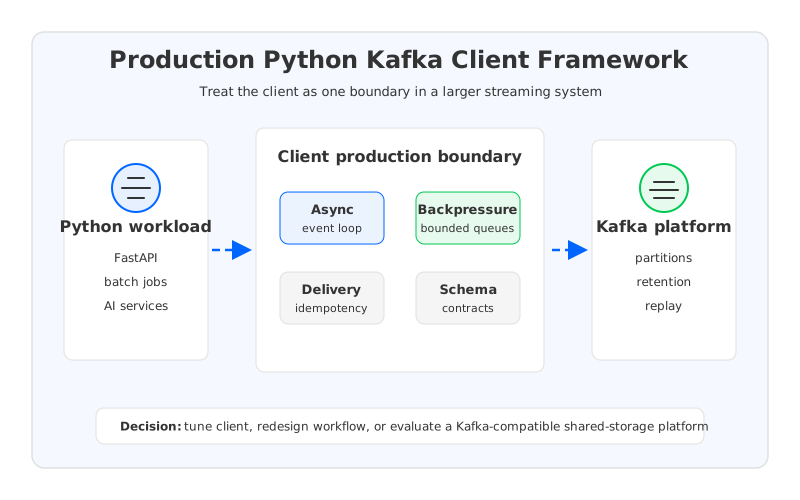
The right answer is not "always use async" or "always use the fastest client." Async I/O can keep a service responsive, but it can also hide unbounded queues. A native binding can reduce per-message overhead, but it will not choose your idempotency key, commit policy, schema rule, or replay strategy.
1Start with the Async Boundary
Python Kafka clients fall into three practical shapes. An asyncio-native client fits services built around an event loop. A synchronous client can work for jobs or workers that isolate Kafka I/O in a dedicated thread or process. A native-library-backed binding is attractive for throughput and protocol maturity. The mistake is treating these as purely performance options.
The first decision is where Kafka I/O is allowed to wait. In an API service, waiting inside the request path couples user latency to broker availability and batch flush behavior. In a batch job, waiting may be fine when the job can checkpoint progress and restart safely. In an enrichment pipeline, the consumer side may wait while the producer side needs strict output ordering and bounded in-flight work.
Use the async boundary to answer concrete questions:
- Which coroutine, thread, or process owns the producer lifecycle? Per-request producers turn connection management into a latency tax.
- Where is the queue between business work and Kafka send calls? If that queue has no size limit, the application has no real backpressure.
- What happens when shutdown begins? A production process needs a deadline for flushing, committing offsets, and leaving the consumer group cleanly.
- Which operations are allowed to block the event loop? Serialization, compression, schema lookup, and large payload transformation can be CPU-heavy even when network I/O is async.
The async design should match the deployment model. A service under Kubernetes termination grace periods needs a different shutdown path than a long-lived worker. A scheduled batch job needs restart semantics. A grouped consumer needs to respect rebalance timing.
2Backpressure Is a Contract, Not a Tuning Flag
Backpressure is where many Python Kafka designs fail because the failure mode is quiet. The producer appears healthy while memory grows. The consumer keeps polling while downstream writes time out. Lag dashboards rise, but the service exposes only a generic error rate. By then, a temporary slowdown has become a replay problem.
A production backpressure design has three layers:
| Layer | Question | Typical control |
|---|---|---|
| Application work | How much business work can wait before Kafka I/O? | Bounded in-memory queues, worker pools, admission control |
| Kafka client | How many records can be buffered or in flight? | Batching, linger, request timeout, max in-flight requests |
| Platform | How much lag, burst, and replay can the cluster absorb? | Partitions, retention, broker capacity, storage architecture |
Moving pressure from one layer to another does not remove it. Increasing producer buffering can smooth small bursts, but it can make shutdown slower after a crash. Increasing consumer concurrency can reduce lag, but it may break ordering if the application processes records from the same partition in parallel.
For Python services, bounded queues are often the simplest defense. Put a maximum size between inbound work and Kafka writes. Decide whether overflow should reject requests, shed noncritical events, or switch to a durable local outbox. Leaving the queue unbounded means memory is your overload policy.
Consumers need the same discipline. Polling Kafka is not completing work. If the consumer commits before downstream side effects complete, retries after a crash may skip unfinished work. If it commits only after every side effect completes, a slow dependency can stall the partition. Production teams need idempotent processing, retry topics, dead-letter handling, and commits tied to completed work.
3Schema Contracts Belong in the Release Process
Python makes it easy to produce dictionaries and JSON. That ease becomes dangerous when Kafka topics become long-lived contracts across teams. A field rename, type change, or nullable assumption can break consumers that were never deployed with the producer. The broker stores bytes, not meaning.
Schema strategy should be decided before traffic grows. Some teams use Avro or Protobuf with a registry. Others use JSON Schema. The format is less important than the operational rule: producers cannot publish a breaking change without compatibility checks, ownership, and rollback planning.
In Python, schema work deserves care because runtime typing does not protect Kafka contracts by itself. Pydantic models, dataclasses, generated Protobuf classes, and Avro serializers can help when they are part of CI and release automation:
- Validate that every produced event has a registered schema or approved contract file.
- Test compatibility against the previous production version.
- Keep subject or topic naming conventions stable.
- Treat unknown fields, defaults, and nullable fields as compatibility decisions.
- Include schema version and event type in observability.
Schema failures also need a runtime path. A consumer that retries the same invalid payload can block a partition. A producer that drops serialization errors without metrics creates silent data loss. Production systems need quarantine, error classification, and owner alerts.
4Delivery Semantics Need Application-Level Honesty
Kafka gives strong building blocks, but production semantics are still a joint design between client, broker, and application. Idempotent producers can prevent duplicate writes caused by some retry paths. Transactions can coordinate produced records and consumed offsets in supported patterns. Consumers control when offsets are committed. These features do not make external database side effects atomic with Kafka.
The honest way to design delivery semantics is to write down the failure matrix. What happens if the producer times out after the broker received the record? What happens if the consumer writes to a database and crashes before committing the offset? What happens if a rebalance starts during a long task?
For many workloads, that means at-least-once processing with idempotent side effects. The event carries a stable business key or event ID. Downstream writes use upsert, compare-and-set, or deduplication. Offset commits happen after the side effect completes. Retry topics isolate transient failures from invalid records.
Exactly-once-style designs fit when the whole path supports the required transaction model. If the application consumes, transforms, and writes back to Kafka, transactions may fit. If it also calls APIs, writes to indexes, or mutates third-party systems, the system still needs idempotency and reconciliation. Describe the real guarantee, not the most optimistic label.
5Observability Must Cross the Client and Broker Boundary
A Python process can be green while the stream is unhealthy. CPU is normal, memory is stable, and requests return 200, yet the consumer group is behind or a retry topic is growing. Kafka observability needs to connect client behavior with platform signals.
At minimum, instrument these paths:
- Producer latency, error class, retry count, batch size, and queue depth.
- Consumer processing duration, commit latency, and lag by partition.
- Serialization failures by schema, topic, event type, and owner.
- Rebalance events, shutdown duration, and flush outcomes.
- Dead-letter and retry topic growth.
OpenTelemetry is useful because Python services often use it already. A trace that links an HTTP request to a produced event, or a consumed event to a downstream write, gives SREs a path from user impact to stream behavior. Metrics still matter for alerting, but traces explain pressure.
Avoid client-only dashboards. Broker request latency, partition skew, storage usage, controller health, and network errors provide context for what the Python client is seeing. If platform and application teams look at different dashboards, Kafka incidents turn into guesswork.
6Security and Configuration Should Be Boring
Kafka client security is straightforward in principle: encrypt traffic, authenticate clients, authorize topics, rotate secrets, and keep configuration out of code. It becomes painful when every Python service invents its own bootstrap logic. A platform should provide a small approved configuration surface.
The secure default is usually a shared internal package or template for TLS context creation, identity, topic naming, observability hooks, and safe timeouts. Teams can still tune throughput and batching, but the baseline is consistent and auditable.
Timeouts deserve the same treatment. Request timeout, delivery timeout, retry backoff, consumer session timeout, and shutdown deadline express different parts of the failure model. A low-latency API producer, bulk ingestion job, and replay worker should not share one timeout profile.
7Where Platform Architecture Enters the Python Discussion
So far, the framework has been vendor-neutral because most Python Kafka failures begin above the broker. Platform architecture starts to matter when workloads create bursty writes, long retention, frequent replay, or AI feature refreshes. Client tuning cannot remove the cost of moving partition data, reserving broker-local capacity, or scaling storage and compute together.
Traditional Kafka deployments use broker-local storage as part of a shared-nothing model. That model has served the ecosystem well, but it makes brokers stateful. When a cluster scales, recovers, or rebalances, data placement is part of the operation. Tiered storage moves older log segments to remote storage, while the active broker layer still carries hot data responsibilities.
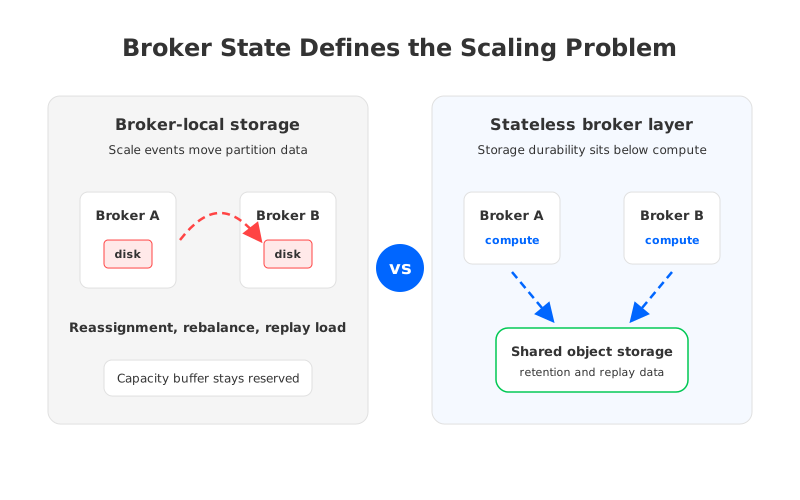
Kafka-compatible shared-storage platforms become relevant even when Python code does not change. If brokers are stateless and durable log data sits in shared object storage, scaling compute capacity becomes closer to scaling a service layer. Replay-heavy workloads can be evaluated against storage architecture and network paths instead of broker disk headroom alone.
AutoMQ fits this category: a Kafka-compatible streaming platform that separates compute from storage, uses stateless brokers, and supports customer-controlled deployments such as BYOC. The positioning matters after the application framework is clear. Weak schema contracts, unbounded queues, and unclear commits remain application problems. When those controls are in place, a shared-storage platform can change the operations behind replay, burst handling, and elastic capacity.
8A Production Checklist for Platform Teams
A useful readiness review should force every layer to show its contract. The Python team explains overload, retries, serialization, commits, and shutdown. The platform team explains partition growth, retention, replay, access control, and broker scaling. The review succeeds when neither team guesses during failure.
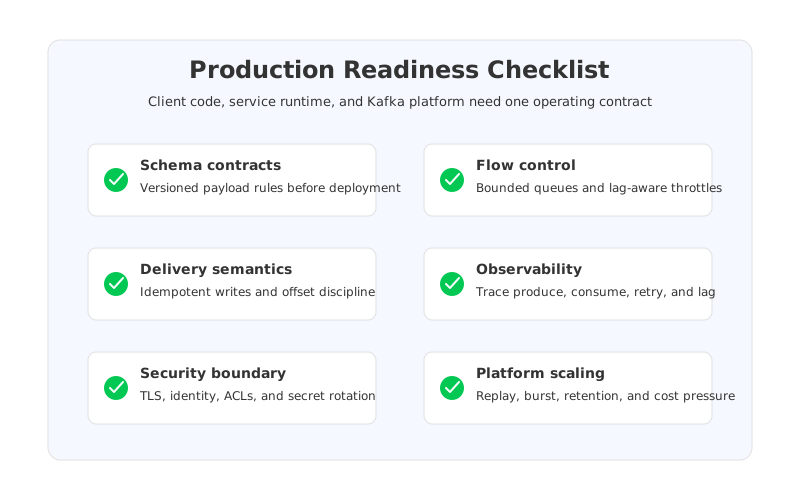
Use this checklist before calling a Python Kafka client production-ready:
| Area | Production question | Evidence to look for |
|---|---|---|
| Async boundary | Can Kafka I/O wait without blocking user-critical work? | Lifecycle owner, shutdown deadline, event-loop safety |
| Backpressure | Is overload bounded and observable? | Queue limits, rejection policy, lag alerts |
| Schema | Can producers deploy without breaking consumers? | Compatibility checks, owner metadata, rollback path |
| Delivery | Are duplicates, retries, and commits designed intentionally? | Idempotency key, commit policy, retry and dead-letter topics |
| Observability | Can SREs connect client symptoms to broker state? | Client metrics, traces, broker dashboards, owner labels |
| Security | Are identity and authorization standardized? | TLS, ACLs, secret rotation, approved config package |
| Platform scaling | Can the cluster absorb burst, replay, and retention needs? | Partition plan, storage model, scaling runbooks, cost review |
This table clarifies when to optimize and when to rethink the platform. If the checklist fails mostly in application areas, fix the client boundary first. If it passes but replay, retention, or burst capacity still dominate cost, evaluate the platform storage model.
Python Kafka production is not a library contest. It is the discipline of making async work, flow control, contracts, delivery guarantees, observability, security, and platform scaling visible before the next incident. Once those decisions are explicit, teams can tune an existing deployment or evaluate a Kafka-compatible shared-storage option such as AutoMQ with a clear technical reason.
9References
- Apache Kafka documentation for producer, consumer, delivery semantics, security, and protocol behavior.
- Apache Kafka Tiered Storage documentation for the local and remote storage model.
- aiokafka documentation for asyncio-based Python producer and consumer behavior.
- kafka-python documentation for synchronous Python client usage.
- Apicurio Registry documentation for schema registry concepts and compatibility controls.
- OpenTelemetry Python documentation for Python traces, metrics, and logs.
- AutoMQ architecture overview for shared storage and stateless broker design.
- AutoMQ stateless broker documentation for broker statelessness and operations.
10FAQ
10.1Which Python Kafka client should I choose for production?
Choose based on the runtime boundary, not only throughput. Asyncio-native clients fit event-loop services, synchronous clients can fit isolated workers and jobs, and native-library-backed bindings can fit higher-throughput paths. All still need bounded buffering, schema checks, delivery semantics, observability, and shutdown behavior.
10.2Is async required for Python Kafka services?
No. Async is useful when the service already uses an event loop or needs to multiplex many I/O operations. A synchronous design can be production-ready when Kafka I/O is isolated, backpressure is explicit, and restart behavior is clear.
10.3How should Python consumers handle backpressure?
Tie polling, processing, and commits to bounded work. Limit in-memory queues, track lag, commit offsets after intended work completes, and separate transient retries from invalid records.
10.4Do I need a schema registry for Python Kafka?
You need a schema governance mechanism. A registry is often clean for long-lived shared topics because it supports compatibility checks and discovery. Smaller systems can start with contract files and CI checks, but producers should not publish breaking payload changes without an automated gate.
10.5When should a Python-heavy team evaluate a shared-storage Kafka-compatible platform?
Evaluate it when application controls are in place but the platform still struggles with replay-heavy workloads, long retention, bursty producers, broker-local capacity planning, or scaling operations. AutoMQ is one option because it keeps Kafka compatibility while changing the storage and broker operating model.


