
Table of Contents
Table of Contents
The expensive part of an Amazon MSK deployment is not always the Kafka cluster line item. It can be the path a record takes after the cluster is healthy: a producer writes from one Availability Zone, a broker serves from another, a consumer group reads from a third, and read fanout turns a topology mismatch into a recurring data transfer charge. The cluster is doing what it was designed to do. The bill is exposing where application topology and broker topology drifted apart.
Rack-aware consumer placement is one way to bring those two maps back together. In Kafka, client.rack lets a consumer advertise its logical location, and replica.selector.class lets the broker prefer a replica that is closer to that client when follower fetching is available and correctly configured. On Amazon MSK, the practical goal is usually simpler than the configuration sounds: keep consumers in the same Availability Zone as the data path they read from whenever the workload and availability model allow it.
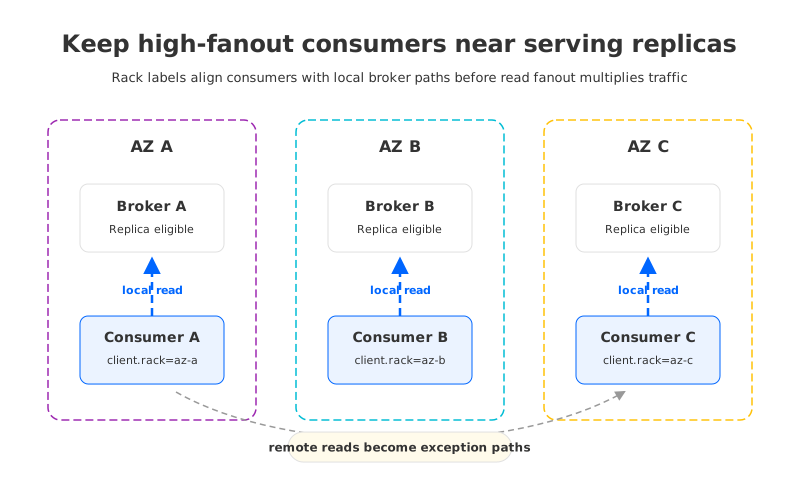
That idea is useful, but it is not a complete cost strategy. A production MSK network model also has producer locality, broker placement, partition leadership, consumer fanout, PrivateLink or VPC routing, failover behavior, and operational exceptions. If the team treats rack awareness as a small tuning flag, it will miss the architecture decisions that decide whether traffic remains local after scaling, failover, or consumer rollout.
1Why MSK traffic cost starts with topology
Amazon MSK is an AWS-managed Kafka service, so many buyers begin with broker instance type, storage, and service mode. Those inputs are visible and important. Network spend is more slippery because it emerges from relationships between clients, brokers, Availability Zones, and AWS data transfer rules. The same ingest rate can create different spend depending on where clients run and how many independent consumer groups read each topic.
Kafka makes the network model especially sensitive to reads. Producer traffic is usually easier to reason about because a record enters the cluster once, then replication and storage rules take over. Consumer traffic can multiply with every team, application, replay job, and analytical pipeline that reads the same retained stream. A topic with stable write throughput can still become a network-cost problem when a downstream group is deployed in the wrong zone or when a backfill runs through a remote path.
The topology review should separate three questions:
- Where is data written? Producer placement affects request latency and whether the first hop crosses a zone, VPC, or account boundary.
- Where is data stored and served? Partition leaders, follower replicas, and broker placement determine which nodes can serve data locally.
- Where is data read? Consumer group placement and read fanout decide whether a small mismatch is multiplied across many applications.
This is why rack-aware consumer placement is attractive. It targets the part of Kafka traffic that can expand quietly: repeated reads from retained logs. It only works as part of a larger placement discipline. If platform engineering does not know which applications are tied to which Availability Zones, the consumer configuration becomes a guess.
2What rack awareness changes, and what it does not
Rack awareness is sometimes described as an infrastructure feature, but the harder work is application ownership. The Kafka client has to carry a location signal. The platform has to map that signal to the broker and replica layout. The deployment system has to keep the signal accurate when pods move, node groups change, or an application is rescheduled during a failure. A stale rack label is worse than no rack label because it creates confidence without locality.
For MSK users, the typical pattern is to align consumer applications running on Amazon EKS, EC2, or another compute layer with the Availability Zone where they should read. The runtime supplies a rack value, usually from instance metadata, node labels, or an explicit deployment setting. Kafka then has enough information to prefer a closer serving path when cluster and broker configuration support it.
That does not remove all cross-zone traffic. Kafka still has replication, leadership, metadata, failover, and rebalance behavior. A consumer may need a non-local path if the local replica is unavailable, lagging, or not eligible for the requested read. Those fallback paths are part of the reliability design. The cost model should include the normal-local path and the exception path.
| Decision area | What to verify | Why it affects spend |
|---|---|---|
| Consumer location signal | client.rack is populated consistently from the real runtime location | A wrong signal can route reads away from the intended zone |
| Broker and replica layout | Brokers are distributed across Availability Zones and replicas are eligible for local reads | Placement only helps when there is a useful local serving option |
| Failure behavior | Consumers continue correctly when the local path is unavailable | Cost optimization cannot break availability or recovery |
| Deployment automation | Scaling, rescheduling, and rollouts preserve the rack value | Manual locality assumptions decay after the first operational event |
| Observability | Metrics show cross-zone bytes, read source, lag, and consumer group movement | Teams need proof that the topology is working after changes |
The most important line is failure behavior. A cost optimization that depends on perfect locality is fragile. A production design should prefer local reads during normal operation, preserve correctness during zone impairment, and make fallback cost visible.
3Build the cost model around read fanout
Network spend becomes easier to reason about when the unit is not "cluster throughput" but "topic bytes multiplied by serving paths." Start with one topic family. Pick a stream with meaningful retention, multiple consumer groups, or replay behavior. Then map write volume, compression, replication, consumer fanout, catch-up reads, and placement boundaries.
For a rough planning model, avoid unsupported precision. AWS data transfer prices vary by Region, service, and path, and the final estimate should use current AWS pricing. The architecture model can still be concrete without inventing numbers. It should show which traffic categories scale with write volume, which scale with read fanout, and which appear only during operational events.
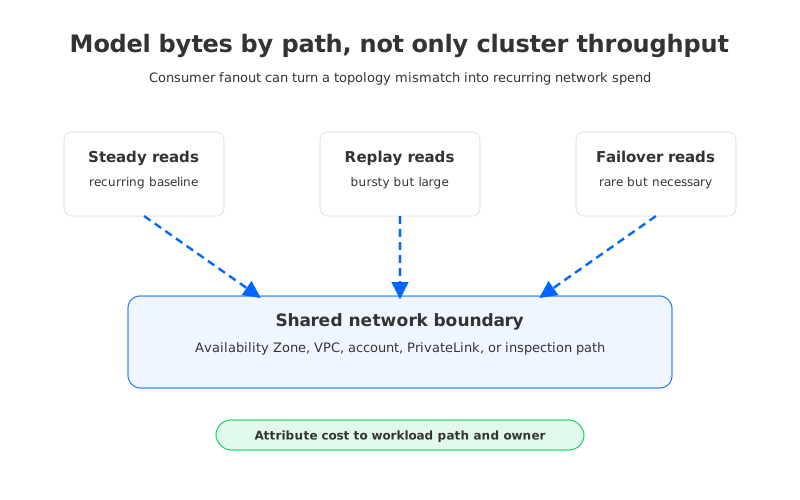
Four categories usually expose the problem:
- Steady-state consumer reads are the recurring baseline. If a consumer group reads across zones every minute of every day, the cost becomes part of the platform run-rate.
- Replay and backfill reads are bursty but large. They matter because a single recovery or analytics job can move much more data than normal production traffic.
- Failover reads are rare but necessary. The design should allow them, then measure them separately so an incident does not look like ordinary workload growth.
- Shared networking paths can hide ownership. Traffic through PrivateLink, cross-VPC connectivity, or centralized inspection may appear outside the MSK service view.
This framing keeps teams from overfitting one application. A rack-aware fix for one consumer group is valuable, but it does not prove the platform is cost-stable. The stronger review asks whether every high-fanout group has an explicit placement rule, every exception path is observable, and application teams understand the cost of remote consumers.
4Architecture choices that change the cost curve
Rack-aware placement is a topology control. It reduces avoidable traffic when the data-serving path and the consumer runtime can be aligned. It does not change the fact that traditional Kafka designs bind durable log ownership, broker placement, replication, and serving behavior tightly together. That coupling is not a flaw in Kafka; it is part of the Shared Nothing architecture that made Kafka reliable and understandable for many production environments.
The cloud complicates that model because Availability Zones are both reliability boundaries and billing boundaries. A design that is correct for availability can still create recurring transfer charges. A locality-tuned design can still need cross-zone movement during failover or rebalancing. The architecture decision is which traffic is structural, which traffic is avoidable, and which traffic is acceptable insurance.
| Option | What it can improve | What still needs validation |
|---|---|---|
| Rack-aware consumers | Steady-state read locality for eligible workloads | Correct rack labels, replica eligibility, fallback behavior |
| Careful client placement | Producer and consumer paths aligned with broker topology | Operational drift as applications move or scale |
| MSK sizing and partition planning | Headroom for peaks, rebalances, and maintenance | Whether extra capacity becomes a permanent baseline |
| Tiered Storage | Long-retention pressure on broker-local storage | Hot-tier behavior, remote reads, recovery, and read fanout |
| Kafka-compatible Shared Storage architecture | Broker/storage coupling and some cross-zone data movement patterns | Migration tests, latency targets, governance, observability |
This is not a ranking. MSK can be the right fit when the team wants an AWS-managed Kafka service and the workload maps cleanly to the topology. Rack-aware placement can be a strong improvement when consumer applications are under the same operational control as the cluster. Tiered Storage can help retention-heavy workloads by moving older completed log segments to remote storage.
The question changes when the cost problem is not one misplaced consumer but the shape of the platform. If a team repeatedly pays for broker-local data movement, permanent headroom, or cross-zone serving paths that are hard to attribute, placement tuning may not be enough. At that point the evaluation should include architectures that separate compute from durable stream storage instead of only tuning where compute runs.
5How AutoMQ fits the evaluation
After the topology and workload model are explicit, AutoMQ becomes relevant as a Kafka-compatible streaming platform built around Shared Storage architecture. AutoMQ keeps the Kafka protocol and ecosystem contract while moving durable stream storage away from broker-local disks and into S3-compatible object storage through S3Stream. Brokers are stateless with respect to durable stream data, while the WAL (Write-Ahead Log) plus cache path supports low-latency writes and reads.
That architecture changes the cost discussion. In a broker-local model, data placement, broker placement, recovery, and network topology are tightly connected. In a Shared Storage architecture, durable data is not owned by a specific broker disk, so compute scaling and broker replacement do not require the same data movement assumptions. AutoMQ documentation also describes zero cross-AZ traffic as a design goal for cloud deployments, which is directly relevant when MSK network spend is driven by avoidable zone-crossing paths.
This does not mean a team should skip validation. A serious comparison should test real Kafka clients, ACLs, transactions if used, consumer group behavior, lag recovery, observability, and rollback procedures. It should also choose the right AutoMQ deployment model and WAL type. AutoMQ Open Source uses S3 WAL and is better suited to latency-tolerant scenarios, while AutoMQ BYOC and AutoMQ Software support additional WAL options for lower-latency production requirements.
The useful comparison is not "MSK versus AutoMQ" as a slogan. It is a workload-specific test: same topics, same partitioning assumptions, same read fanout, same placement map, same failure drills, and the same cost attribution model. If rack-aware placement solves the recurring spend while preserving operations, it may be the right near-term fix. If the spend is structural because durable storage, compute, and zone boundaries are coupled, Shared Storage architecture belongs in the shortlist.
6A practical rollout plan
The safest rollout starts with one high-fanout topic family. Pick a workload where consumer traffic is large enough to matter and application owners can change placement. Instrument the current state first: producer zone, broker path, consumer zone, read volume, lag behavior, and any cross-boundary networking path that receives allocated cost.
Then add rack-aware placement in a controlled way. Start with a group whose availability behavior is understood, whose deployment automation can provide accurate rack values, and whose owners can validate latency, lag, and recovery. Compare the before-and-after network pattern, not only the application success rate.
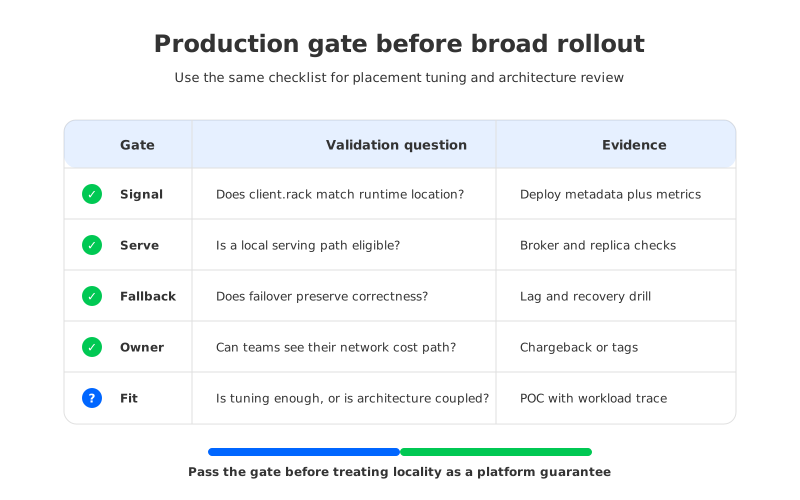
The production gate should answer five questions:
- Is the location signal trustworthy? The rack value must reflect the actual runtime location after scaling, rescheduling, and node replacement.
- Is the local serving path eligible? The broker and replica configuration must support the locality preference the client is advertising.
- Is fallback safe? Consumers must continue correctly when the local path is unavailable, and the extra traffic should be visible as an exception.
- Is ownership clear? Application teams need to know when their placement choices create shared network charges.
- Is the architecture still appropriate? If repeated tuning is needed to keep costs acceptable, the platform may need an architecture review rather than another placement rule.
Return to the original MSK bill after those checks. The useful outcome is not a promise that cross-zone traffic will never happen. It is a platform where normal traffic is local when it should be, exception traffic is measured when it must happen, and structural traffic costs are visible before they become part of the monthly baseline.
If your Kafka cost review is showing recurring cross-AZ traffic or broker/storage coupling that placement rules cannot fully explain, use AutoMQ's guide to saving cross-AZ traffic costs with Shared Storage architecture as a starting point for a workload-specific architecture review.
7References
- Amazon MSK pricing
- Amazon MSK configuration properties
- Amazon MSK client access documentation
- AWS EC2 data transfer pricing
- Apache Kafka consumer configuration documentation
- Apache Kafka broker configuration documentation
- AutoMQ architecture overview
- AutoMQ compatibility with Apache Kafka
- AutoMQ cross-AZ traffic cost guide
8FAQ
8.1Does rack-aware consumer placement eliminate all Amazon MSK network charges?
No. It can reduce avoidable read traffic when consumers, brokers, and eligible replicas are aligned, but Kafka still needs reliable behavior during failover, rebalancing, and replica unavailability. The goal is to make normal traffic local where practical and make exception traffic measurable.
8.2Which Kafka settings matter for rack-aware reads?
The consumer-side client.rack setting advertises the client's logical location. The broker-side replica.selector.class setting controls replica selection behavior. Teams should verify current Apache Kafka and Amazon MSK documentation before rollout because support depends on Kafka version, configuration, and workload behavior.
8.3Why does read fanout matter more than average ingest?
A record is usually written once, but it may be read by many consumer groups, replay jobs, and analytics pipelines. If those reads cross Availability Zone or VPC boundaries, a stable write workload can still create recurring network spend through repeated serving paths.
8.4When is rack-aware placement not enough?
It may not be enough when the main cost driver is structural: broker-local storage growth, repeated data movement during scaling or recovery, permanent spare capacity, or cross-zone paths that are hard to attribute. Those cases deserve an architecture review, not only a client configuration change.
8.5How should AutoMQ be evaluated against MSK for this problem?
Use the same workload trace, topic layout, consumer fanout, placement map, and failure tests. AutoMQ is relevant when teams need Kafka compatibility but want to evaluate Shared Storage architecture, stateless brokers, object-storage-backed durability, and zero cross-AZ traffic design as part of the cost model.


