
Table of Contents
Table of Contents
Teams search for rag ingestion freshness kafka when the retrieval layer starts exposing a platform problem. The vector index may be online, the model endpoint may be healthy, and the application may still return an answer built from yesterday's customer status, an older policy document, or a support ticket that was closed after the last batch job. RAG makes freshness visible because stale context is not hidden in a dashboard. It is turned into confident language and handed to a user, workflow, or agent.
Kafka is a natural part of that conversation because many enterprises already use it as the durable event backbone for CDC, product events, operational telemetry, ticket updates, payments, identity changes, and document lifecycle events. The hard question is not whether Kafka can feed a RAG pipeline. It is whether the Kafka-compatible streaming platform can keep context fresh while supporting replay, governance, elasticity, and migration safety. A production RAG system needs a streaming architecture that behaves well when the AI team changes chunking rules, rebuilds embeddings, adds a new retriever, or runs catch-up jobs beside live ingestion.
1Why Teams Search for rag ingestion freshness kafka
RAG freshness fails in a more awkward way than most data freshness failures. A stale warehouse table usually produces an old report. A stale retrieval layer can produce an answer that sounds current because the language model has no native sense of when the retrieved fact became obsolete. The user sees a confident sentence, not the ingestion lag behind it.
That is why the search intent is usually practical. Platform teams are not looking for a generic "real-time AI" definition. They are trying to answer a set of uncomfortable production questions:
- How fresh is the context at answer time? Consumer lag is useful, but it does not prove that source changes reached the embedding index, metadata filter, and retrieval cache.
- Can we replay safely? RAG teams reprocess data when embedding models, chunking strategies, classification policies, or delete rules change.
- Can ingestion scale without turning into a broker storage project? AI workloads are often bursty. A document import or product launch can change the write and indexing profile faster than a quarterly capacity plan.
- Can security teams approve the data path? RAG often touches customer, employee, financial, or regulated data, so the control boundary matters as much as latency.
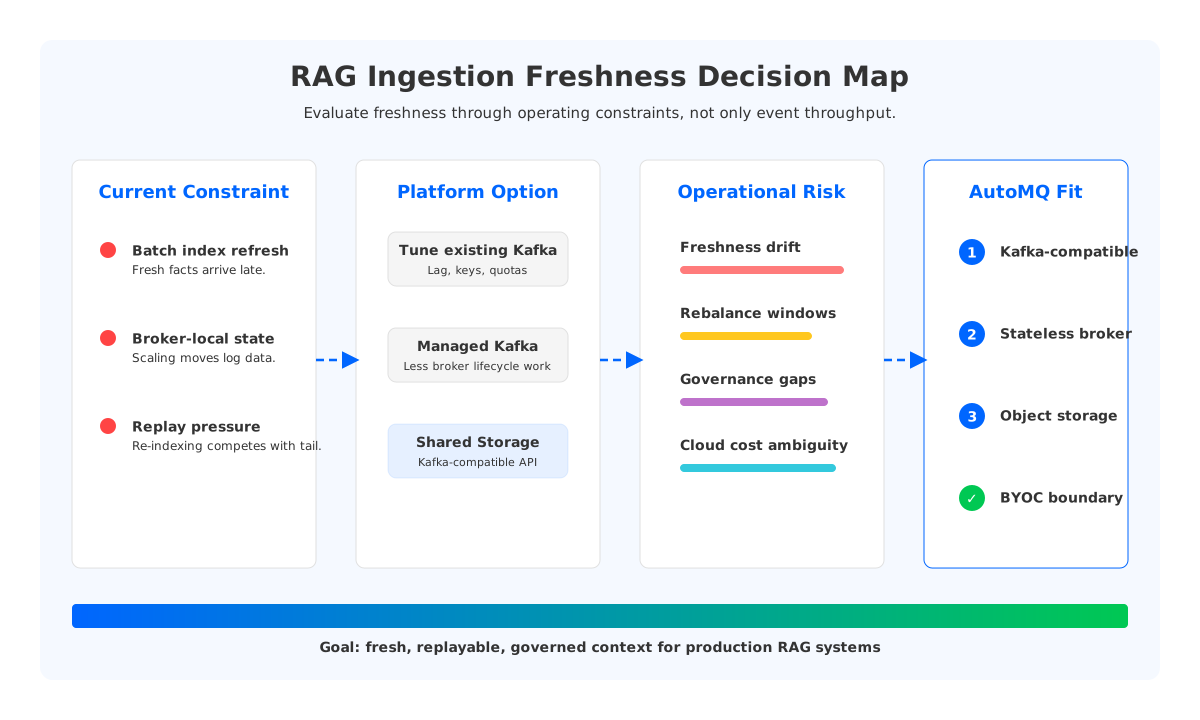
Freshness is therefore an operating property, not a feature toggle. It depends on source capture, broker durability, consumer groups, stream processing, embedding throughput, index writes, cache invalidation, and recovery. Kafka gives teams useful primitives such as ordered partitions, offsets, retention, Consumer groups, and transactions where the workload needs them. The platform decision is about whether those primitives remain predictable under the workloads RAG introduces.
2The Production Constraint Behind the Problem
The prototype version of a RAG ingestion path looks clean on a whiteboard: source events flow into Kafka, a consumer transforms records, an embedding worker writes vectors, and the application retrieves the latest context. The production version has more friction because every stage scales differently. Source systems may emit steady CDC. Embedding workers may spike after a document import. Vector indexes may throttle writes. A compliance change may force replay across months of retained events.
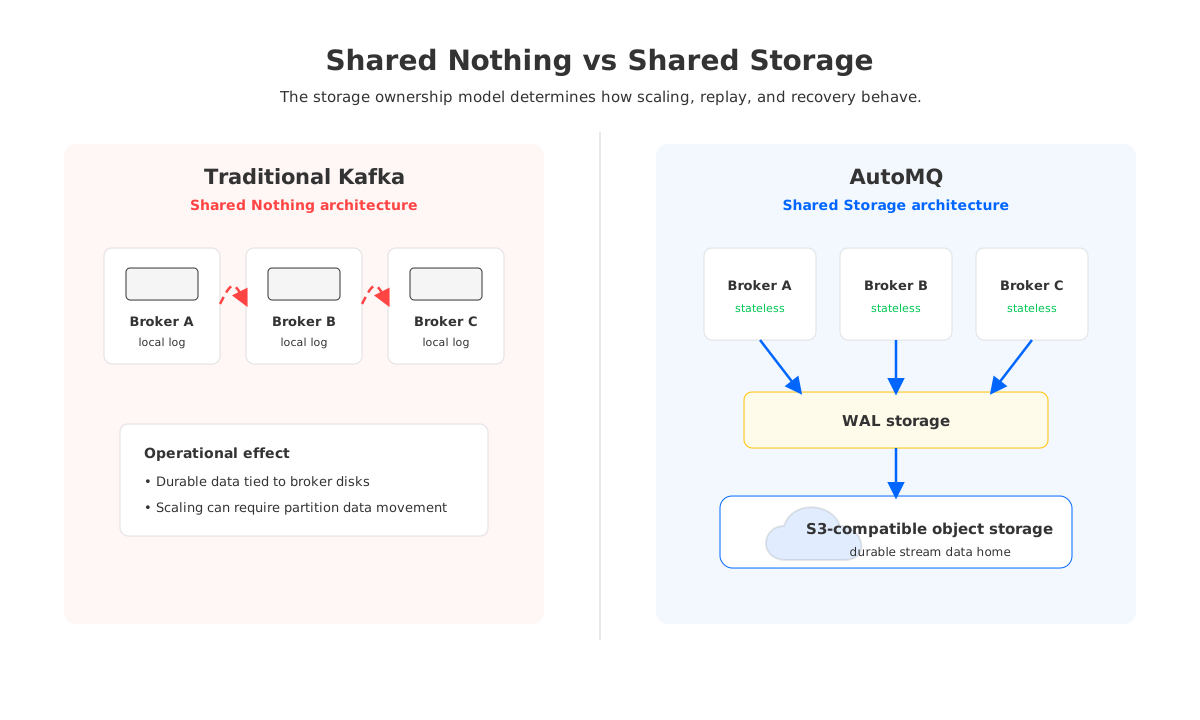
Traditional Apache Kafka is built as a Shared Nothing architecture. Brokers own local log storage, partitions are assigned to broker disks, and replication across brokers provides durability. This design is proven and widely understood. It also couples compute capacity, durable data, and partition ownership. When a broker is added, removed, replaced, or rebalanced, partition movement can become a data movement problem rather than only a scheduling problem.
For RAG ingestion freshness, that coupling appears in four places. Replay can compete with live tail reads when a team rebuilds embeddings. Retention growth can force broker disk expansion when teams keep more history for audit and re-indexing. Multi-AZ availability can introduce replication and network placement costs that must be modeled with cloud pricing pages, not guessed. Scaling a hot ingestion path can require careful partition reassignment, which is operational work during the exact moments when the AI product is under pressure.
Tiered Storage can reduce the local disk burden for older Kafka log segments, and it is worth evaluating when retention is the main issue. The important distinction is that Tiered Storage usually keeps the broker-local log as the hot storage layer while offloading older data. A Shared Storage architecture changes the center of gravity: durable stream data lives in shared storage, and brokers become less tied to local persistent state. That difference affects recovery, scaling, and replay behavior.
3Architecture Options and Trade-Offs
The first option is to tune the existing Kafka estate. This is often the right move when the workload is small, the freshness target is moderate, and the main bottlenecks sit in consumer code or downstream indexing. Better partition keys, producer batching settings, consumer parallelism, quotas, retry policy, and event-age observability can remove a surprising amount of pain. This path preserves known semantics and avoids migration risk, but it does not change the broker-local storage model.
The second option is managed Kafka. A managed service can reduce broker lifecycle work, especially for teams that do not want to own upgrades, monitoring, and failure handling. The evaluation still has to include retention, replay, private connectivity, data residency, observability export, and cost meters. "Managed" changes who operates the system. It does not automatically prove that the architecture matches replay-heavy AI workloads or strict account-boundary requirements.
The third option is a Kafka-compatible shared-storage architecture. In this model, applications continue to use Kafka APIs and ecosystem tools, but the platform changes where durable stream data lives. Brokers handle protocol requests, leadership, caching, and traffic scheduling, while shared storage holds the durable data. The write path still needs a WAL (Write-Ahead Log) or equivalent durability layer for latency and recovery. The key trade-off is architectural: object storage and WAL behavior must be validated, but scaling and broker replacement are less dominated by copying broker-local data.
Platform teams should compare these options through the behavior they need during correction, not only during normal traffic:
| Evaluation dimension | Existing Kafka tuning | Managed Kafka | Kafka-compatible Shared Storage |
|---|---|---|---|
| Compatibility | Highest when no migration occurs | Usually strong, but service limits matter | Must be tested across clients, offsets, transactions, and Connect |
| Replay | Uses existing retention and broker resources | Depends on service limits and storage model | Can place durable history in shared object storage |
| Elasticity | May require partition data movement | Depends on provider implementation | Brokers can be treated more like compute nodes |
| Governance | Strong if already inside approved boundary | Depends on service data path and connectivity | BYOC or self-managed boundaries can be explicit |
| Cost model | Broker disk, replicas, network, operations | Service meters plus networking | Compute, WAL storage, object storage, requests, network |
This table avoids a common trap: selecting a streaming platform by a single benchmark or unit price. RAG ingestion freshness is an end-to-end property. A platform can be fast in the broker layer and still fail if replay breaks tail traffic, if governance blocks data movement, or if migration changes offset behavior that downstream jobs depend on.
4Evaluation Checklist for Platform Teams
A useful RAG platform review starts from the retrieval request and works backward. When a generated answer uses a fact, the team should know when that fact changed, when it entered the event stream, which consumer processed it, when the embedding or index update completed, and whether the answer path can prove it used the intended version. That chain is much more concrete than a promise of "real time."
Use this checklist before committing to a platform migration or a large RAG rollout:
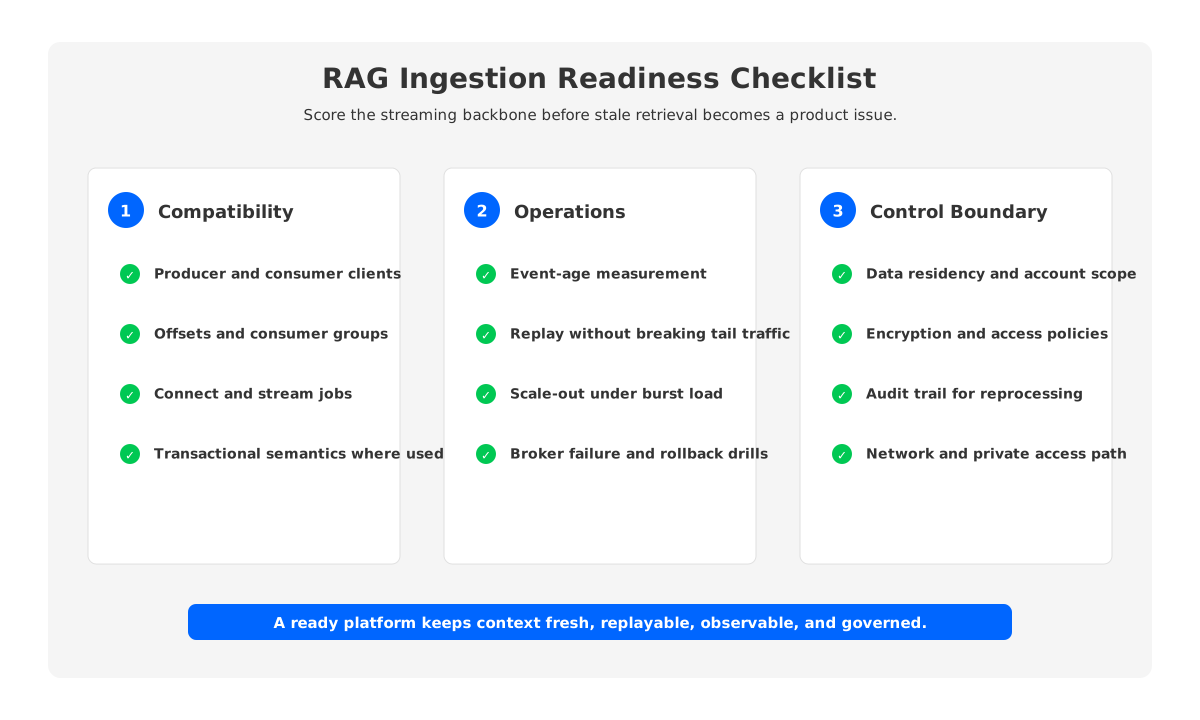
This review also helps separate application issues from platform issues. If freshness misses come from slow embedding calls or non-idempotent index writers, changing the broker architecture will not fix the problem. If freshness misses come from replay competing with broker storage, long rebalance windows, or retention growth tied to local disks, the platform architecture deserves a deeper look.
5How AutoMQ Changes the Operating Model
Once the neutral evaluation is clear, AutoMQ becomes relevant as a specific Kafka-compatible shared-storage option. AutoMQ keeps the Kafka protocol and ecosystem model while replacing Kafka's broker-local storage layer with S3Stream, a shared streaming storage design built around WAL storage and S3-compatible object storage. The point is not to make RAG teams learn a different streaming API. The point is to change the operating model under the Kafka surface.
In AutoMQ, durable data is not permanently pinned to broker-local disks. Brokers are designed as stateless compute nodes that handle Kafka protocol work, caching, scheduling, and leadership, while the storage layer writes through WAL storage and persists stream data in S3-compatible object storage. That matters for RAG ingestion because replay-heavy workloads can keep durable history in shared storage, and capacity changes are less tied to moving large partition data sets between brokers.
The governance boundary also matters. AutoMQ BYOC is designed for customer-controlled cloud environments, and AutoMQ Software is designed for private or self-managed environments. For RAG over sensitive data, that deployment model can be the difference between an architecture that clears review and one that gets blocked. The team can evaluate Kafka compatibility and operational behavior while keeping the data plane, storage, network, and IAM boundary aligned with its own requirements.
There are still trade-offs to validate. WAL type, object storage behavior, cache design, request patterns, private connectivity, and observability all affect the final system. A serious proof of concept should use the same producers, consumers, connector patterns, data volume, retention assumptions, and failure drills as production. AutoMQ is strongest when the team wants to preserve Kafka compatibility but reduce the operational drag caused by broker-local durable state.
6Migration and Readiness Scorecard
The safest migration plan treats RAG freshness as a measurable contract. Start with a representative topic, not a toy stream. Mirror enough data to exercise normal tail ingestion and a real replay window. Run the existing consumers or a production-like indexing worker against the target platform. Then run the failure drills that normally get postponed: broker replacement, consumer restart, re-indexing, schema rollback, and index write throttling.
Score the result with a simple rubric:
| Question | Pass signal | Risk signal |
|---|---|---|
| Can existing clients run without code changes? | Producers, consumers, offsets, and auth work as expected | Client behavior differs under retries or failure |
| Can freshness be measured end to end? | Event age is visible at source, stream, processor, and index | Only broker lag is visible |
| Can replay run beside live traffic? | Tail freshness remains explainable during catch-up | Backfill causes opaque lag or index drift |
| Can the team control the data boundary? | Storage, network, IAM, and observability paths are documented | Security review depends on assumptions |
| Can rollback be rehearsed? | The team can pause, compare, and revert without losing offset context | Rollback depends on manual guesswork |
The scorecard is intentionally operational. RAG systems change quickly because prompts, retrievers, policies, and models change quickly. The streaming platform should make those changes boring enough to repeat.
7FAQ
7.1What does RAG ingestion freshness mean?
RAG ingestion freshness is the age of the data available to retrieval when a model answer is produced. It includes source capture, streaming durability, processing, embedding, index update, cache refresh, and recovery behavior. Kafka consumer lag is one useful signal, but it is not the full freshness measurement.
7.2Is Kafka a good fit for real-time RAG ingestion?
Kafka is a strong fit when the pipeline depends on continuously changing enterprise facts and needs ordering, offsets, Consumer groups, replay, and mature ecosystem integration. The platform still needs validation under replay, retention growth, scaling, and governance requirements.
7.3When is batch ingestion still acceptable for RAG?
Batch ingestion can be acceptable when the source data changes slowly, the product can tolerate older context, and stale retrieval does not create user harm or compliance risk. It becomes fragile when customer state, operational events, security policy, or business decisions change faster than the batch window.
7.4How does Shared Storage architecture help RAG workloads?
Shared Storage architecture can reduce the coupling between broker compute capacity and durable stream data. For RAG workloads that need long retention, frequent replay, and bursty indexing, that separation can make scaling and recovery less dependent on moving broker-local log data.
7.5When should a team evaluate AutoMQ?
Evaluate AutoMQ when the team wants Kafka compatibility but the current operating model is constrained by broker-local storage, slow partition reassignment, replay-heavy AI workloads, cross-AZ traffic exposure, or strict customer-controlled deployment boundaries.
The search for rag ingestion freshness kafka usually starts with stale context, but it should end with a platform test. Define the freshness budget, run replay beside live traffic, and make the control boundary explicit. If broker-local storage is the constraint, try AutoMQ as a Kafka-compatible shared-storage path for production AI data pipelines.
8References
- Apache Kafka Documentation
- Apache Kafka Consumer Groups
- Apache Kafka Message Delivery Semantics and Transactions
- Apache Kafka Connect
- Apache Kafka KRaft
- Apache Kafka Tiered Storage
- AutoMQ Compatibility with Apache Kafka
- AutoMQ Architecture Overview
- AutoMQ S3Stream Shared Streaming Storage
- AutoMQ WAL Storage
- AWS S3 Pricing
- AWS PrivateLink Pricing


