
Table of Contents
Table of Contents
Kafka cost models often begin with write throughput because writes are easy to count. Producers send a known number of MiB per second, replication factor multiplies the durable write path, and retention converts incoming bytes into stored bytes. That model works until the platform becomes valuable. Once many teams depend on the same streams, consumers, replays, and indexing jobs can read far more data than producers write.
That gap is read amplification. It is not a Kafka bug, and it is not automatically waste. A shared event backbone is supposed to let many systems consume the same facts. The cost problem appears when the platform budget treats reads as a small side effect while the architecture behaves as a high-fan-out storage and recovery system. At that point, the real question behind kafka cost is "How many times will every written byte be read, from which storage tier, across which network boundary, and during which failure or replay event?"
1Why Read Amplification Belongs in the First Cost Model
Most Kafka estates start with a write-path mental model. Producers write to partition leaders, brokers replicate data for durability, consumers fetch from assigned partitions, and retention keeps the log available for replay. The Apache Kafka documentation describes these mechanics in terms of producers, brokers, consumers, topics, partitions, replication, and log storage. The cloud bill sees the same mechanics as compute, storage, requests, data transfer, private networking, and operational work.
Read amplification deserves first-class treatment because it can grow without a matching increase in business events. A payment event may be written once and then consumed by fraud detection, ledger posting, customer notifications, warehouse loading, search indexing, alerting, and model training. Later, a schema fix or downstream outage can trigger replay over the same topics. The produced bytes did not change, but the fetched bytes did.
The first model should separate four quantities:
- Write volume: the incoming bytes that producers send to Kafka.
- Live fan-out: the normal number of consumer groups that keep up with the tail of the log.
- Replay demand: backfill, recovery, audit, model retraining, and catch-up reads over older offsets.
- Read path multiplier: cache misses, remote storage fetches, cross-zone traffic, endpoint routing, and decompression or compaction side effects.
That split keeps platform and FinOps teams from arguing over the wrong number. A workload with low write throughput and intense fan-out can pressure brokers more than a larger write-only pipeline. A workload with a high cache hit rate can look efficient during steady state and then become expensive during a replay drill.
2A Practical Formula for Kafka Read Cost Inputs
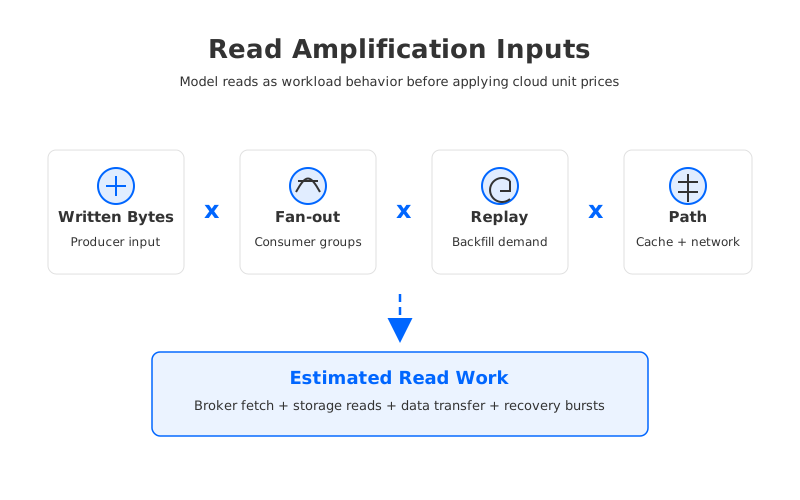
There is no universal read amplification constant. The useful model is a worksheet that starts with workload behavior and then maps it to infrastructure meters. A simple starting point is:
Read bytes = written bytes x consumer fan-out x replay factor x path multiplier
Each term needs a measurement window. Fan-out during a normal hour is not the same as fan-out during an incident. Replay factor during a quiet week may be zero, while replay factor during a migration, warehouse rebuild, or model backfill can dominate the month. The path multiplier is where architecture enters the model: local broker cache, local disk, remote tiered storage, object storage, cross-zone routing, and private connectivity can all change the cost and latency of the same logical fetch.
| Input | What to measure | Why it changes cost |
|---|---|---|
| Tail fan-out | Active consumer groups reading near the latest offset | Multiplies broker fetch work and network traffic |
| Replay window | Bytes fetched from older offsets per day or per incident | Exposes storage tier, cache, and recovery behavior |
| Cache hit rate | Share of reads served from hot broker cache or local tier | Determines how often reads touch disk or remote storage |
| Placement | Consumer, broker, endpoint, and region boundaries | Converts logical reads into charged data paths |
| Recovery mode | Consumer catch-up, broker replacement, and downstream rebuilds | Creates bursts that steady-state averages hide |
The table does not promise a precise bill from five rows. It gives the platform team a way to ask better questions before comparing Apache Kafka, Amazon MSK, Confluent, Redpanda, Aiven, AutoMQ, or any other Kafka-compatible system. Respectful vendor evaluation starts with the same workload assumptions for every option.
3Tail Reads and Replay Reads Are Different Workloads
The most common modeling mistake is treating all reads as tail reads. Tail reads are the normal consumer path: applications follow the latest offsets with relatively predictable latency and throughput. Replay reads are a different workload. They read older data, often faster than real time, often in parallel, and often when some other system is already unhealthy.
Kafka's consumer configuration options make this distinction visible. Fetch size, partition fetch limits, session behavior, and offset management determine how consumers request data and recover progress. A cost model does not need every client setting, but it does need to know whether consumers normally read in small steady batches or periodically create large backfills.
Replay also changes who owns the cost. The Kafka platform team may provision the cluster, but an analytics team may trigger a warehouse reload, a search team may rebuild an index, and a compliance team may request historical export. If the cost model assigns all reads to "Kafka" without recording the consumer workflow, governance becomes impossible. Topic owners need visibility into which consumers create heavy read pressure.
This is where service-level objectives become cost tools. A replay SLO can define how much historical data a consumer may rebuild, how quickly it must catch up, and which producer-latency or transfer-budget limits it must respect. That SLO is technical, but it also carries a financial boundary. It defines the read amplification the platform is willing to support under stress.
4Network Placement Can Turn Reads Into the Main Bill
Cloud networking makes read amplification concrete. AWS publishes separate pricing pages for Amazon MSK, EC2 data transfer, S3, and connectivity services because the charge depends on the path, not on Kafka's logical API. A consumer fetch that stays within a local boundary is a different cost event from a fetch that crosses Availability Zones, VPC endpoints, accounts, or regions.
For broker-local Kafka deployments, writes and replication often get the first network review. Reads deserve the same treatment. A topic with six consumer groups can create more outbound traffic than the original write path. If those consumers are deployed in different zones or behind private connectivity patterns, read fan-out becomes network fan-out. The application team may only see a normal poll() loop, while the infrastructure bill sees repeated movement of the same bytes.
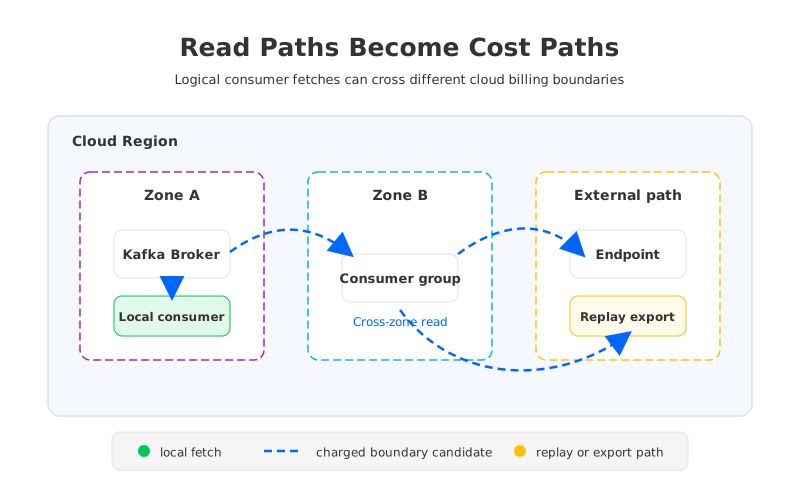
The first placement review should answer three questions. Where are producers, brokers, and consumers running? Which consumers read from the same boundary as the brokers serving their partitions? Which replay or export jobs cross a boundary that normal tail consumers do not cross? These questions are not vendor-specific; they apply to managed Kafka, self-managed Kafka, and Kafka-compatible systems.
Placement also affects procurement comparisons. A platform with a lower broker line can still be more expensive if it pushes high-fan-out reads through chargeable paths. A platform with a higher service line can be cost-effective if it reduces operational work, avoids large recovery transfers, or gives better controls for consumer placement.
5Storage Architecture Shapes the Replay Curve
Kafka's original storage model binds durable log segments to brokers. That model is proven and widely understood, and many teams operate it well. It also means retained data, broker capacity, recovery, and fetch behavior are linked. When reads target older data, the platform must serve those reads from the available local storage and cache design.
Tiered storage changes the retention side of that model by moving older log segments to remote storage while keeping the hot path close to brokers. For read amplification, the important question is not whether remote storage exists. It is how often consumers read from it, how those reads are cached, what request patterns are generated, and whether replay can proceed without hurting tail latency. Remote storage can improve the storage curve while still requiring careful read-path validation.
Shared-storage Kafka-compatible architectures move a different boundary. Durable stream data lives in shared storage, while brokers focus more on protocol handling, coordination, caching, and serving traffic. This can make scaling and recovery less dependent on moving durable data between brokers, but it also puts more importance on WAL design, cache efficiency, object layout, and read amplification controls.
None of these architectures wins every workload by definition. The right choice depends on the shape of the read problem. Short-retention tail workloads may care most about latency and operational simplicity. Long-retention workloads with frequent replay may care more about storage economics and predictable catch-up. High-fan-out event backbones may care most about network placement, cache behavior, and consumer governance.
6The Inputs Most Cost Calculators Miss
Pricing calculators are useful, but many ask for average throughput, retention, and broker size before they ask how the data is consumed. That ordering hides the workloads that usually surprise the team. Reads are harder to model because they are created by organizational success: more consumers, more derived products, more recovery drills, and more analytics.
A stronger cost model should add these read-side inputs before any vendor quote is accepted:
- Consumer group inventory. Count production groups, batch groups, search and analytics readers, stream processors, connectors, and temporary backfill jobs separately.
- Replay frequency. Record normal replay, incident replay, migration replay, and downstream rebuilds as distinct events.
- Read locality. Map which consumers read within the broker's local network boundary and which use cross-zone, cross-VPC, endpoint, or cross-region paths.
- Cache and remote-read behavior. Measure which reads are served hot and which fetch older segments, remote tier objects, or object storage.
- Rate limits and ownership. Define which teams can start replay, at what throughput, and with what visibility into cost and platform pressure.
These inputs also make vendor conversations sharper. Instead of asking "What is your Kafka cost?" ask what happens when normal fan-out, batch replay, downstream rebuild, and broker replacement overlap. The answer will reveal more about architecture than a price table.
7How AutoMQ Fits the Evaluation
AutoMQ should enter the discussion after the workload has been modeled. It is a Kafka-compatible cloud-native streaming platform that uses shared storage with object storage as the durable foundation. AutoMQ documentation describes its S3Stream shared-storage architecture, WAL and cache layers, and deployment guidance aimed at eliminating inter-zone traffic in supported cloud environments.
That design is relevant when read amplification is tied to broker-local storage, recovery movement, long retention, or cross-zone traffic. If replay frequently touches older data, test how the platform serves those reads and how cache behavior changes under pressure. If cross-zone reads are material, compare the current placement model with AutoMQ's zero cross-AZ traffic guidance rather than relying on generic cost claims.
The evaluation should remain workload-led. Amazon MSK can be a strong AWS-native path for teams that want managed Apache Kafka. Self-managed Kafka gives direct operational control to teams willing to own that complexity. Kafka-compatible shared-storage systems such as AutoMQ are worth testing when the expensive part is the interaction between reads, retained data, broker locality, and cloud infrastructure.
8A Buyer Checklist for Read Amplification
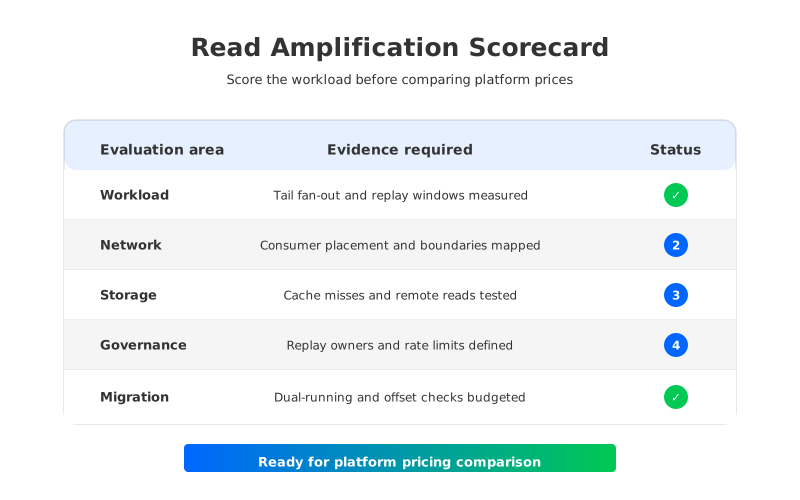
Read amplification work is most useful when it becomes a repeatable review, not a one-time spreadsheet. Platform teams should capture normal days, peak windows, replay drills, and failure events. The goal is to make the cost of shared data visible enough that architects can design for it.
Use this checklist during platform selection or renewal:
| Review area | Pass condition |
|---|---|
| Workload model | Reads are modeled separately for tail, replay, export, and recovery workloads |
| Network model | Consumer placement and charged boundaries are visible before pricing decisions |
| Storage model | Hot cache, local disk, remote tier, or shared storage behavior is tested with replay |
| Governance | Heavy consumers have owners, budgets, and rate limits |
| Migration | Dual-running, offset validation, and rollback paths include replay cost |
The migration row matters because read amplification often spikes during transition. A platform move can require consumers to validate offsets, rebuild state, replay retained data, and run both old and target systems.
9Closing the Loop
The first Kafka bill review usually starts with brokers, storage, and throughput. The more durable review starts with a written byte and follows every future read: live fan-out, replay, cache misses, remote storage, network boundaries, and recovery. Once those inputs are visible, kafka cost becomes an architecture discussion rather than a vendor-price debate.
If your current model cannot explain where replay and fan-out traffic go, use that gap as the next evaluation step. For teams exploring a Kafka-compatible shared-storage design, review AutoMQ's architecture and cost materials with the same workload assumptions: evaluate AutoMQ for read-heavy Kafka workloads.
10References
- Apache Kafka documentation
- Apache Kafka consumer configuration reference
- Apache Kafka tiered storage documentation
- Amazon MSK pricing
- AWS EC2 On-Demand pricing and data transfer
- Amazon S3 pricing
- AutoMQ overview
- AutoMQ S3Stream shared-storage architecture
- AutoMQ guide to eliminating inter-zone traffic
11FAQ
11.1What is read amplification in Kafka cost modeling?
Read amplification is the difference between bytes written to Kafka and bytes later fetched by consumers, replay jobs, exports, and recovery workflows. It matters because each read can consume broker capacity, storage bandwidth, object storage requests, private networking, or data transfer.
11.2Is high read amplification always bad?
No. High fan-out can mean the event platform is valuable. The problem is unmanaged read amplification: no owner, no replay limit, no placement model, and no visibility into whether reads are served from cache, disk, remote storage, or a charged network path.
11.3How should teams measure replay cost?
Measure replay as a separate workload. Record bytes fetched from older offsets, replay duration, consumer throughput, cache hit rate, remote-read volume, broker load, downstream throttling, and the network path used during the replay window.
11.4Does tiered storage remove read amplification cost?
Tiered storage can improve retention economics, but it does not remove read amplification. Older reads may touch remote storage, generate storage requests, and change latency or cache behavior. Replay testing is still required.
11.5When should AutoMQ be evaluated for read-heavy workloads?
Evaluate AutoMQ when read amplification is tied to long retention, recovery movement, broker-local storage pressure, or cross-zone traffic. Test it with real consumer fan-out, replay drills, placement rules, security controls, and rollback requirements.


