
Table of Contents
Table of Contents
Teams usually search for change streams analytics kafka after the first pipeline has crossed an uncomfortable line. The source connector is publishing changes, analysts want fresher data, and downstream services treat Kafka topics as the handoff point between operational systems and analytics. The question is no longer whether Kafka can carry change events. It is whether the platform can keep those events ordered, replayable, governed, and cost-controlled as sources and consumers grow.
That distinction matters because change streams for analytics sit between two kinds of state. The source system owns the truth at the row, document, or transaction-log level. Kafka owns the stream contract downstream consumers depend on: topics, partitions, offsets, retention, consumer groups, and replay. A readiness checklist has to inspect both sides, but the Kafka layer deserves attention because it becomes the shared recovery surface for every analytics team that arrives later.
1Why Teams Search for change streams analytics kafka
The search phrase looks like a tooling question, but the production problem is broader than picking a connector. Kafka Connect can run source connectors that publish database or application changes into Kafka topics. Consumers can feed lakehouse tables, materialized views, search indexes, feature stores, fraud checks, or operational dashboards. This pattern decouples source systems from every downstream reader that wants a fresh copy of business state.
The decoupling is useful, but it shifts pressure into the streaming platform. A nightly batch job can fail and rerun from a bounded input. A change stream has to preserve ordering, offset continuity, schema history, and retention for consumers with different recovery expectations. Once analytics teams rely on the stream, the Kafka platform is no longer a transport detail. It is the durable buffer that decides whether backfills, reprocessing, and incident recovery are routine or painful.
Three production signals usually show that the checklist is overdue:
- Consumer lag becomes a business issue. A dashboard or model pipeline falls behind, and the team needs to replay hours or days of changes without interrupting the source connector.
- Retention changes from a setting into a contract. Analytics teams ask for longer replay windows, audit trails, or late onboarding, which increases the durable data footprint.
- Ownership crosses team boundaries. Database administrators, connector owners, platform engineers, security teams, and analytics consumers all touch the pipeline, but no single runbook covers the full failure path.
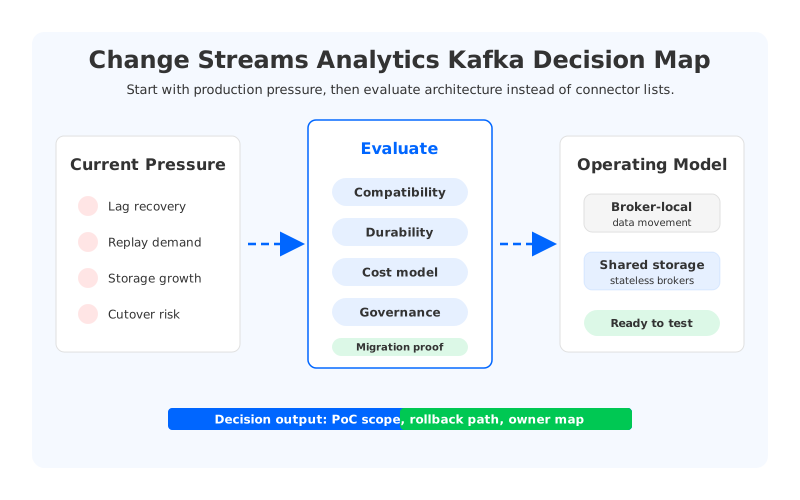
That is why a readiness checklist should not start with a vendor comparison. It should start with the operating promises the platform must keep. If the team cannot define replay window, offset handling, rollback path, and data boundary, changing the platform only moves uncertainty to another interface.
2The Production Constraint Behind the Problem
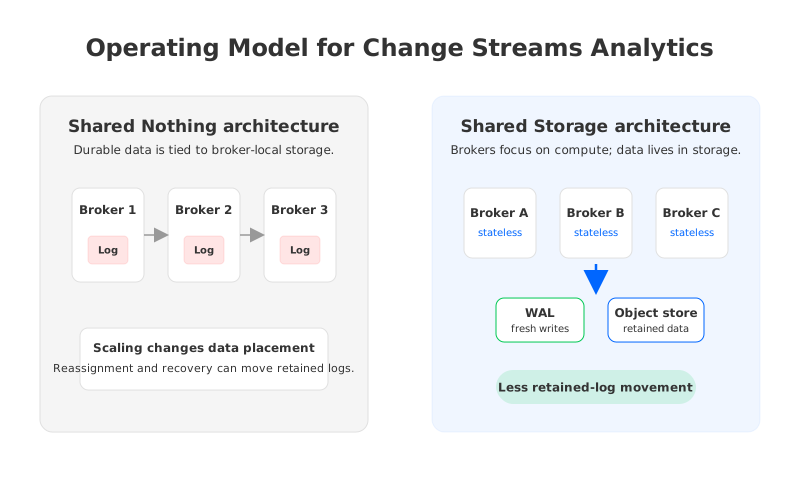
Traditional Kafka uses a Shared Nothing architecture: each broker owns local storage for the partitions it hosts, and durability is achieved through replication between brokers. This model is mature and familiar. It also means compute capacity, durable storage, partition placement, and recovery are tightly connected. When retained data grows, the platform team has to manage broker disks, replica traffic, partition reassignment, and data movement during maintenance or recovery.
Change streams for analytics amplify those constraints because the workload is write-heavy and replay-sensitive at the same time. The source connector produces a steady flow of committed changes, but analytics consumers often read unevenly. A backfill, a failed job, a new consumer, or a schema correction can turn yesterday's retained stream into today's hot read path. The same Kafka cluster has to absorb fresh writes and catch-up reads while preserving consumer group progress.
Tiered Storage can help with long retention by offloading older log segments to remote storage while the active log remains on broker-attached storage. That helps when historical data dominates the footprint. The limitation is that it does not fully remove broker-local storage from the active operating model. For change streams, the difficult moments often involve fresh writes, lag recovery, broker replacement, and cutover timing, not only cold data.
The practical constraint is simple: if every scaling, recovery, or rebalance task is coupled to broker-local durable data, analytics readiness becomes a capacity-planning problem instead of a pipeline-design problem. The platform team can still succeed, but it needs to budget for the work explicitly.
| Pressure point | What the analytics team needs | What the platform must prove |
|---|---|---|
| Fresh ingestion | Committed changes arrive with predictable delay | Source connector throughput and broker write path can keep up |
| Replay | Consumers can reread a known window of history | Retention, storage, and read capacity are modeled together |
| Recovery | Jobs resume from stable offsets | Consumer group and offset behavior survive restart and cutover |
| Governance | Sensitive changes stay within approved boundaries | Network, IAM, encryption, audit, and access controls are mapped |
| Operations | Incidents have one accountable path | Connector, Kafka, and analytics owners share a runbook |
This table separates readiness from optimism. It asks whether the team can explain how the system behaves when the pipeline is behind, the broker fleet is changing, or a downstream table needs rebuilding.
3Architecture Options and Trade-Offs
Most teams compare four architecture paths. Self-managed Kafka gives maximum control over brokers, storage, networking, Kafka Connect, and upgrades, but the team owns the full operational surface. A managed Kafka service reduces some infrastructure work, yet storage model, connector boundary, migration path, and cloud-networking cost still require review. A dedicated CDC or data-integration service may simplify source capture, but it can introduce a separate control plane and different replay or governance model. A Kafka-compatible cloud-native platform keeps Kafka's client and ecosystem contract while changing storage and broker lifecycle underneath.
The right path depends on which constraint hurts first. If the workload has a few sources, short retention, predictable read patterns, and one owning team, conventional Kafka operations may be acceptable. If the platform supports many sources, analytics consumers, strict data boundaries, and unpredictable replay, storage architecture becomes part of the product decision. A connector catalog is not enough; the team needs to test lag, failure, cutover, and retained-data growth.
Compatibility should be split into two layers. API compatibility asks whether Kafka clients, serializers, AdminClient automation, Kafka Connect workloads, Schema Registry usage, and consumer group behavior continue to work. Operational compatibility asks whether monitoring, access control, network isolation, upgrade windows, incident response, and rollback remain understandable. A platform can pass the client test and still fail the operational test if it changes where data lives, who owns the control plane, or how offsets move during migration.
The most useful evaluation starts with workload evidence. Run a representative source connector, produce into the target platform, attach real consumers, force lag, restart connector tasks, change schemas, simulate broker replacement, and rehearse rollback. The purpose is not a perfect benchmark. It is to discover which part of the system becomes stateful under stress.
4Evaluation Checklist for Platform Teams
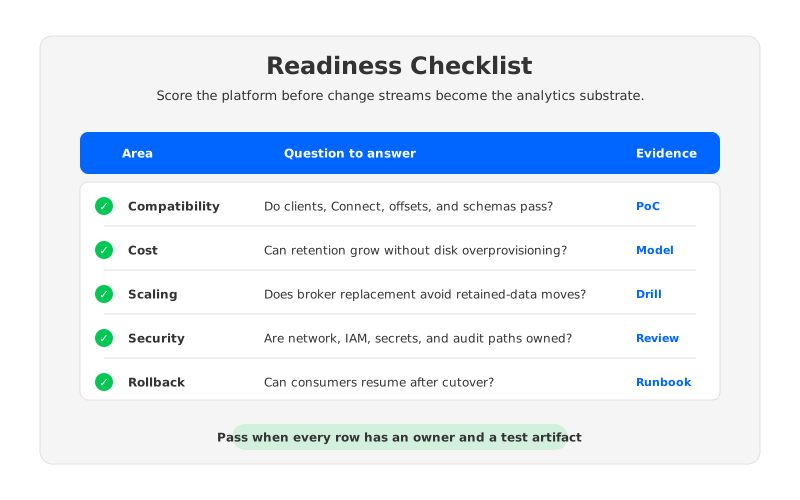
A readiness checklist should be short enough for a design review and concrete enough to drive a proof of concept. Each item needs an owner, a test artifact, and a rollback answer. If an item only produces a "yes" with no evidence, it is not ready.
Use these questions as the baseline:
- Compatibility: Can the platform run the clients, connectors, serializers, ACLs, TLS settings, consumer groups, and monitoring integrations that your estate already uses?
- Cost model: Which costs grow with retained bytes, write throughput, read fan-out, cross-Availability Zone (AZ) traffic, object storage requests, connector workers, and support operations?
- Elasticity: What happens when source writes spike, analytics consumers fall behind, or a broker is replaced during a replay window?
- Governance: Where do credentials, source data, stream data, schema history, logs, metrics, and administrative actions live?
- Migration: Can you preserve topic names, partition counts, offsets, schema expectations, and consumer group progress during cutover?
- Rollback: Can the team stop, rewind, or resume without creating mixed streams that downstream consumers cannot explain?
- Observability: Can one dashboard connect source lag, connector task status, Kafka throughput, consumer lag, storage behavior, and downstream freshness?
The hard part is refusing vague answers. "Kafka-compatible" is not enough unless the specific tools and behaviors you depend on have been tested. "Lower cost" is not enough unless the model includes network traffic, retained data, replay reads, and operational labor. "Managed" is not enough unless the team knows which components remain inside its incident boundary.
5How AutoMQ Changes the Operating Model
After the neutral checklist is complete, AutoMQ becomes relevant as a Kafka-compatible streaming platform with a Shared Storage architecture. Applications continue to use Kafka protocol and API semantics, while persistent stream data moves from broker-local disks into S3-compatible object storage through S3Stream, WAL (Write-Ahead Log) storage, and data caching. The connector is not the main change; the broker lifecycle is.
In a Shared Storage architecture, AutoMQ Brokers are stateless brokers. They still handle Kafka requests, partition leadership, caching, and traffic, but durable stream data is not a long-lived possession of a specific broker disk. Fresh writes go through WAL storage, and retained data lives in S3-compatible object storage. That changes broker replacement, scaling, and partition reassignment because the platform can adjust ownership and traffic without treating every change as a large retained-log copy.
For change streams analytics, this has concrete implications. Longer retention can be planned against object storage rather than only broker-attached disks. Replay windows can be discussed separately from broker fleet size. A broker failure or scaling event does not have to assume retained partition data must be copied before new capacity is useful. The team still needs to test latency, connector behavior, schema handling, consumer lag, and object storage access patterns, but the readiness question shifts from "how much data moves between brokers?" to "which state must be preserved?"
AutoMQ BYOC is relevant when data boundaries matter as much as operations. In BYOC (Bring Your Own Cloud), the control plane and data plane run in the customer's cloud account and VPC, so stream data and operational paths can stay within customer-controlled infrastructure. AutoMQ Managed Connector adds a managed Kafka Connect layer in that environment. AutoMQ Table Topic can also matter for analytics teams that want selected streams written into Apache Iceberg tables without a separate ETL pipeline for every target.
This does not make the checklist optional. Source log retention, connector restart behavior, schema evolution, dead-letter handling, consumer offset policy, and downstream reconciliation still need explicit design. AutoMQ's role is narrower than a blanket promise: it changes the storage and broker operating model so retained change streams, scaling, and recovery are less tied to broker-local data placement.
6Migration and Readiness Scorecard
Treat migration as a state-alignment exercise, not a traffic flip. Inventory every source, connector, topic, partition count, schema dependency, consumer group, retention setting, ACL, and downstream freshness target. Then decide which state must be preserved exactly and which state can be rebuilt. Offsets, schema history, and source log positions deserve more attention than the cutover meeting usually gives them because they determine whether consumers can resume without guesswork.
A practical scorecard has five gates:
- Source gate: The source log retention window is longer than the expected outage, restart, and catch-up time.
- Connector gate: Connector configuration, credentials, schema history, offset storage, and task restart policy are reproducible.
- Kafka gate: Topics, partitions, retention, ACLs, consumer groups, and monitoring are mapped before cutover.
- Validation gate: Freshness, ordering assumptions, duplicate handling, row counts, and downstream table state are measured.
- Rollback gate: The team knows when to stop, how to route writes, and how to prevent consumers from reading mixed streams.
The checklist is intentionally unglamorous because production change streams fail in unglamorous ways. A source log expires before a connector catches up. A consumer group resumes from the wrong point. A schema change reaches analytics before the table contract is ready. A replay that looked safe on paper overloads the cluster during business hours.
The original search was change streams analytics kafka, but the decision is not about a single pipeline. It is about whether change streams can become a shared analytics substrate without forcing every future incident to rediscover the same offset, storage, ownership, and rollback questions. If your team is evaluating a Kafka-compatible platform for this operating model, run the checklist against a real source and use the results to scope an AutoMQ proof of concept: start from AutoMQ Cloud.
7FAQ
7.1Is Kafka a good fit for change streams analytics?
Kafka is a strong fit when multiple consumers need a durable, replayable stream of changes with independent offsets. It is less attractive when the only requirement is a point-to-point data copy with no replay, stream processing, or ecosystem integration.
7.2What is the biggest readiness risk?
The biggest risk is state drift between the source log, connector state, Kafka offsets, and downstream analytics state. A pipeline can keep moving records while consumers lose the ability to explain which changes have been processed.
7.3Does Tiered Storage solve the storage problem for change streams?
Tiered Storage can help with long-retained historical segments, but it does not fully remove broker-local storage from the active write and recovery model. Teams should test hot writes, lag recovery, broker replacement, and replay reads separately.
7.4Where does AutoMQ fit in this architecture?
AutoMQ fits at the Kafka-compatible streaming platform layer. It keeps Kafka protocol semantics while using Shared Storage architecture, stateless brokers, WAL storage, and S3-compatible object storage to change how retention, scaling, and recovery are operated.
7.5Should Kafka Connect and analytics ownership sit in one team?
Not necessarily. The important requirement is one shared runbook that connects source log retention, connector lag, Kafka retention, consumer group progress, schema handling, and downstream freshness.
8References
- Apache Kafka documentation
- Apache Kafka Connect documentation
- Apache Kafka consumer groups and offsets
- Apache Kafka message delivery semantics and transactions
- Apache Kafka KRaft documentation
- Apache Kafka Tiered Storage documentation
- AutoMQ architecture overview
- AutoMQ compatibility with Apache Kafka
- AutoMQ S3Stream shared streaming storage
- AutoMQ WAL storage
- AutoMQ Managed Connector documentation
- AutoMQ Table Topic configuration


