
Table of Contents
Table of Contents
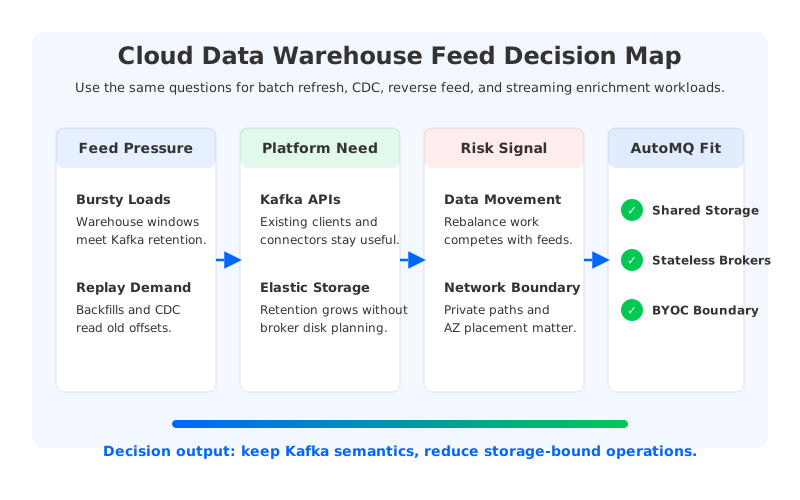
Teams rarely search for cloud data warehouse feed kafka because they are curious about Kafka in the abstract. They search because a feed has become part of the warehouse operating rhythm: nightly loads are no longer enough, CDC volume has grown, reverse feeds need fresher customer data, and the data platform team is being asked why a pipeline that worked in staging behaves differently under production replay. The difficult part is deciding whether the Kafka-compatible platform behind that feed can survive backfills, warehouse maintenance windows, schema drift, cloud network boundaries, and rollback without turning into a second data platform inside the data platform.
Evaluate a cloud data warehouse feed by treating Kafka as the control point for freshness, replay, and operational isolation. A warehouse connector, CDC tool, or stream processor may own one leg of the path, but Kafka owns the buffer where mistakes become recoverable or expensive. A production feed is ready only when the platform can absorb replay and retention pressure without binding every decision to broker-local disks, manual rebalancing, and surprise network paths.
1Why teams search for cloud data warehouse feed kafka
A cloud data warehouse feed usually starts with a reasonable request: make operational data available for analytics faster. The team may already have Kafka in place for CDC events, application events, or integration streams. The warehouse team then asks for those streams to become fact tables, dimension updates, or near-real-time activation feeds. At that point, Kafka stops being only a messaging backbone and becomes the memory of the ingestion system.
That memory has three jobs. It must preserve order within partitions, retain enough history for replay, and expose offsets as durable progress markers. Kafka's consumer model is built around these ideas: a Consumer group divides Topic partitions among members, and offsets define where each consumer resumes. Kafka Connect adds a framework for source and sink connectors, making it a natural fit for warehouse ingestion and adjacent integration work.
The warehouse side changes the stress pattern. Batch-oriented systems often consume in bursts, not smooth streams. CDC can be steady for days and then spike during a bulk update. A schema change can force a connector restart. A late-arriving table can trigger a backfill that reads old offsets while normal ingestion continues. These are the normal operating shape of warehouse feeds.
That shape leads to a different readiness question. The question is not "Can Kafka deliver records to a connector?" The better question is "What happens to the platform when the feed is wrong, late, replayed, paused, or scaled at the same time other applications are using the cluster?"
2The production constraint behind the problem
Traditional Kafka is designed around a Shared Nothing architecture. Each broker owns local log storage, and durability comes from replication across brokers through leader and follower replicas. This model is proven and well understood, especially for teams that already operate Kafka at scale. It also means capacity, recovery, and elasticity are tied to where bytes live.
That coupling matters because feed readiness is mostly about behavior outside the happy path. Increasing retention gives downstream teams more replay room, but it also increases broker storage. Adding partitions improves parallelism, but creates more placement and balancing work. Replacing a broker or reshaping a cluster can require data movement before the platform settles. When a warehouse feed is business-critical, these details stop being background mechanics.
The cloud adds another constraint: the network is part of the bill and the security boundary. Cross-Availability Zone movement, PrivateLink endpoint design, and object storage policy decide whether a feed stays inside a VPC, whether traffic follows the intended route, and whether replay creates hidden infrastructure cost. Model these paths before the feed becomes a production dependency.
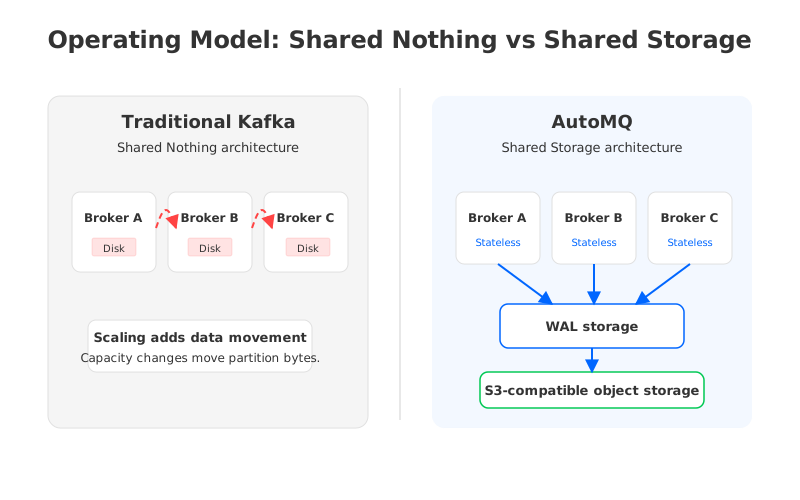
The constraint is simple: a warehouse feed is only as elastic as the storage model behind the Kafka-compatible platform. If scaling requires a large data move, the feed has inherited a storage migration problem. If retention is sized by broker disk rather than replay objectives, the feed has inherited a capacity planning problem. If network paths are designed after deployment, the feed has inherited a governance problem.
3Architecture options and trade-offs
There are several credible ways to build cloud data warehouse feeds with Kafka. A self-managed Kafka cluster gives teams maximum control over broker configuration, networking, connector workers, and observability. That control is valuable when the organization has deep Kafka operations experience. The cost is that the same team owns storage sizing, broker recovery, partition balancing, connector capacity, and cloud infrastructure drift.
Managed Kafka services reduce some operational load, but they do not remove the need to understand storage and networking. A managed service can simplify cluster lifecycle management while still leaving the team to reason about partitions, retention, connector placement, data transfer, and security boundaries. For a warehouse feed, ask whether the managed layer changes failure and scaling behavior, or mainly changes who operates it.
Warehouse-native ingestion and ETL tools offer a different trade-off. They can be productive when the feed is scoped to one warehouse, a few sources, and a predictable freshness target. Risk appears when Kafka is already the offset system of record, multiple consumers need the same stream, or teams need replay independent of the warehouse. Removing Kafka may simplify one pipeline while weakening the broader integration platform.
The options can be evaluated with the same decision matrix:
| Evaluation area | What to verify | Failure mode if ignored |
|---|---|---|
| Compatibility | Kafka clients, Kafka Connect connectors, schemas, security settings, and offset behavior match existing workloads. | The feed works only after client rewrites or connector-specific exceptions. |
| Retention and replay | Retention is sized from recovery objectives, backfill windows, and audit needs. | Replay becomes a special project instead of a normal operation. |
| Elasticity | Peak warehouse windows can be handled without broker-local data migration becoming the bottleneck. | Scaling arrives too late or competes with ingestion traffic. |
| Network boundary | VPC paths, Availability Zone placement, object storage access, and endpoint costs are modeled. | The feed passes functional tests but violates cost or security assumptions. |
| Governance | IAM, encryption, schema control, audit logs, and data ownership are assigned before launch. | Data teams inherit unclear ownership during incidents. |
| Migration and rollback | Dual-run, offset validation, connector restart, and rollback behavior are rehearsed. | Cutover success depends on manual judgment under pressure. |
The matrix keeps the discussion neutral. A team may choose self-managed Kafka, a managed Kafka service, a warehouse-native path, or a Kafka-compatible cloud-native streaming platform. What changes is not the checklist. What changes is how much of the checklist the platform makes routine.
4Evaluation checklist for platform teams
A readiness checklist is more useful than a reference architecture because warehouse feeds fail in specific ways. One team may be blocked by schema ownership. Another may discover that replay traffic shares a network path with customer-facing services. A third may find that connector workers are quick to deploy but hard to scale during maintenance windows. The checklist should expose those differences before production.
Start with compatibility. Confirm Kafka client versions, authentication, connector plugins, schema format, and offset behavior. Kafka compatibility is not only produce and fetch APIs. It also includes admin operations, Connect worker behavior, transactional writes when used, and how consumers commit offsets under retries. Test the actual connector and consumer group pattern that will feed the warehouse.
Then test replay as an operational workflow, not a theoretical feature. Pick a realistic backfill window and run it while normal ingestion continues. Measure behavior when one consumer group reads historical data and another tails fresh data. Check whether lag metrics, connector task state, and warehouse load progress correlate without digging through several consoles. A feed is ready when replay is boring.
Cost modeling should include storage, compute, and network. Storage grows with replay objectives. Connector workers, brokers, and stream processors may need independent scaling. Network is often discovered late: cross-AZ traffic, private endpoints, and object storage requests can all matter. Avoid precise cost claims until the region, workload, retention period, and data paths are defined.
Security and governance need the same specificity. The platform team should know who owns IAM policy changes, who can deploy connector plugins, who approves schema evolution, and where audit evidence lives. For BYOC-style deployments, ask which components run inside the customer's cloud account and which data or metadata leaves that boundary. Warehouse feeds often touch regulated data, so vague boundary diagrams are not enough.
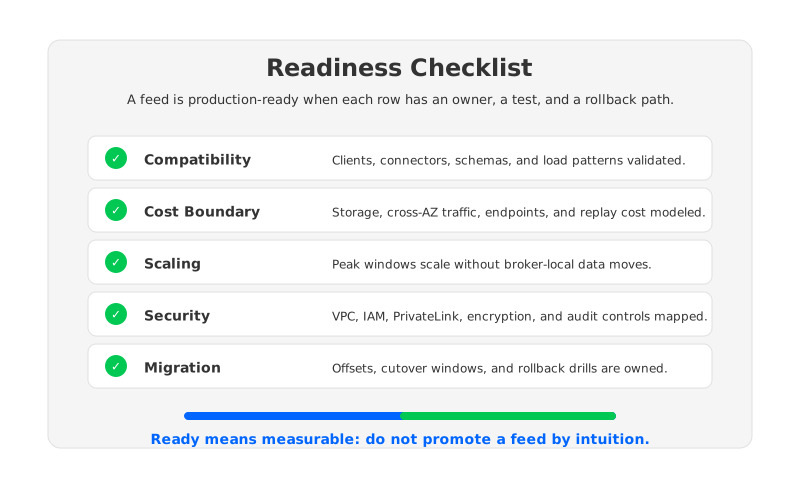
Finally, rehearse migration and rollback. A production cutover needs a source of truth for offsets, a decision point for switching consumers, and a rollback path that does not corrupt warehouse state. If the team cannot explain how to pause, resume, replay, and revert the feed, the architecture is still a diagram.
5How AutoMQ changes the operating model
The neutral checklist points to an architectural requirement: keep Kafka semantics, but stop making broker-local storage the center of every operational decision. AutoMQ fits as a Kafka-compatible cloud-native streaming platform. It keeps Kafka protocol and API compatibility while using Shared Storage architecture backed by S3-compatible object storage, with stateless brokers and WAL (Write-Ahead Log) storage.
That design changes the feed conversation. In a traditional Shared Nothing architecture, broker replacement and scaling are entangled with local log ownership. In AutoMQ, persistent data is stored in shared object storage, while brokers focus on request handling, caching, leadership, and coordination. Scaling no longer has to mean moving large partition data between broker disks before the cluster settles.
For warehouse feeds, this matters in four practical areas:
- Compatibility stays close to the Kafka ecosystem. Existing Kafka clients, Kafka Connect patterns, Consumer groups, and offset-based workflows remain central to the design.
- Retention can be reasoned about through object-storage-backed durability instead of only through broker-local disk pressure.
- Elasticity becomes an operating behavior rather than a storage migration event, because stateless brokers reduce the amount of data tied to each compute node.
- Deployment boundaries are clearer in AutoMQ BYOC, where the control plane and data plane run inside the customer's cloud account and VPC.
AutoMQ's managed Kafka Connect capability is relevant when the feed is connector-heavy. Connector workers, plugins, and task management are part of the operating surface, and AutoMQ documents managed connector deployment and management for BYOC users. For streams that should land directly into lakehouse-style tables, AutoMQ Table Topic writes streaming data into Apache Iceberg tables. That is useful when the goal is to reduce separate ETL steps for analytical storage.
Migration is still work. A cloud-native storage architecture does not remove the need to validate offsets, test cutover, or assign rollback ownership. AutoMQ provides migration documentation for moving from Apache Kafka to AutoMQ and preserving consumption progress, but the platform team still needs to test its own connector behavior, schema rules, and warehouse loading semantics.
6A practical readiness scorecard
Use this scorecard before a feed moves from pilot to production. Give each row an owner and evidence. A "yes" without evidence should be treated as "not yet."
| Readiness question | Evidence to collect |
|---|---|
| Can the platform run the actual connector and client versions? | Compatibility test results, connector task logs, and offset behavior under restart. |
| Can the feed replay the required history while live ingestion continues? | Backfill runbook, lag dashboard, warehouse load validation, and recovery timing. |
| Can retention grow without forcing an urgent broker capacity event? | Retention sizing model and storage growth estimate under peak feed volume. |
| Are network paths and endpoint charges understood? | VPC diagram, Availability Zone placement, PrivateLink design if used, and cloud pricing assumptions. |
| Is governance assigned? | IAM owners, schema approval process, encryption settings, audit log location, and plugin approval workflow. |
| Is rollback rehearsed? | Cutover checklist, rollback trigger, offset source of truth, and warehouse state recovery plan. |
The strongest signal is not a perfect score. It is the absence of vague answers. A smaller feed with a clear rollback plan is safer than a large feed with optimistic assumptions. Kafka makes replay possible, but the platform decides whether replay is routine or an incident.
7FAQ
7.1Is Kafka required for every cloud data warehouse feed?
No. A direct warehouse ingestion tool can be a good fit for narrow, single-destination workloads. Kafka becomes valuable when multiple consumers need the same events, when replay and offsets are important, or when the organization already uses Kafka as the integration backbone.
7.2What is the main risk of using traditional Kafka for warehouse feeds?
The main risk is not Kafka's protocol. It is the operational coupling between broker-local storage, retention, scaling, and recovery. Warehouse feeds often create bursty replay and backfill patterns, which can expose that coupling.
7.3How is Tiered Storage different from AutoMQ's Shared Storage architecture?
Tiered Storage moves older log segments to remote storage while brokers still keep local storage for active data. AutoMQ's Shared Storage architecture stores persistent data in shared object storage and uses stateless brokers, changing the operating model for scaling and recovery.
7.4Where should AutoMQ be evaluated in the architecture?
Evaluate AutoMQ after defining compatibility, replay, cost, governance, and migration requirements. It is most relevant when the team wants Kafka-compatible semantics with a cloud-native storage model and customer-controlled deployment boundaries.
7.5What is a good next step?
Return to the search that brought you here: cloud data warehouse feed kafka. Turn that search into a runbook. List the feed's replay window, connector ownership, network boundary, and rollback path, then test them before cutover. If you want to evaluate a Kafka-compatible platform with Shared Storage architecture and BYOC deployment boundaries, start with the AutoMQ Console.


