
Table of Contents
Table of Contents
Teams do not search for continuous transformation governance kafka because they need another slogan. They search for it when the Kafka estate has become the place where every transformation program has to prove it can run without breaking production. A customer event stream feeds Flink jobs, lakehouse tables, search indexes, fraud models, and operational dashboards. Each downstream team wants more fields, longer retention, fresher data, and a safer rollback path. The platform team is left with the harder question: can the streaming layer keep changing while the business keeps running?
That is the governance problem behind the keyword. It is not limited to schema approval or data catalog tagging. In production Kafka environments, transformation governance is the operating discipline that decides which changes are allowed, which changes require rehearsal, how far a pipeline can drift before it is corrected, and which architecture constraints make every change more expensive than it should be. The answer starts with Kafka mechanics rather than policy language, because the broker storage model often determines how much governance friction the team has to absorb.
1Why teams search for continuous transformation governance kafka
Continuous transformation sounds like an application-layer concern: an enrichment job, a CDC pipeline, a materialized view, a streaming feature, or a table write path. In practice, these changes land on Kafka as retention changes, partition growth, topic fan-out, replay demand, network movement, and migration pressure. A governance process that ignores those physical effects becomes a ticket queue with nicer names.
The most common pattern is a platform team trying to support three pressures at once:
- Application change velocity. Producers add fields, consumers split into more specialized services, and stream processors need controlled backfills. The governance question is whether these changes can be reviewed and rolled forward without pausing the data plane.
- Infrastructure elasticity. A transformation workload may be steady most of the month and burst during recomputation, audit, seasonal traffic, or incident recovery. The governance question is whether capacity changes require days of broker planning.
- Data boundary control. Security and compliance teams want clear ownership over where records, offsets, credentials, and operational metadata live. The governance question is whether the platform can change without losing the boundary model that auditors approved.
Kafka already gives teams strong primitives for this work. Consumer groups coordinate parallel consumption. Offsets make replay and progress tracking explicit. Transactions and idempotent producers can protect write semantics for workloads that need them. Kafka Connect gives a standard integration framework for source and sink movement. KRaft removes the ZooKeeper dependency from Kafka metadata management. These primitives are valuable, but they do not remove the operational constraints created by broker-local storage.
2The production constraint behind the problem
Traditional Kafka follows a Shared Nothing architecture. Each Broker owns local log segments for the partitions assigned to it, and reliability comes from partition replicas across Brokers. That design made sense when Kafka grew up in data center environments where local disk was the obvious durable layer and machine-to-machine replication was a normal cost of fault tolerance.
Cloud infrastructure changes the economics of that assumption. Local or attached block storage has to be provisioned ahead of demand. Multi-AZ deployments introduce data transfer paths between clients, leaders, followers, and consumers. Partition reassignment can require large volumes of data movement because moving ownership also means moving local durable data. None of this is a Kafka API problem. It is a physical architecture problem that shows up whenever governance asks for faster change with lower risk.
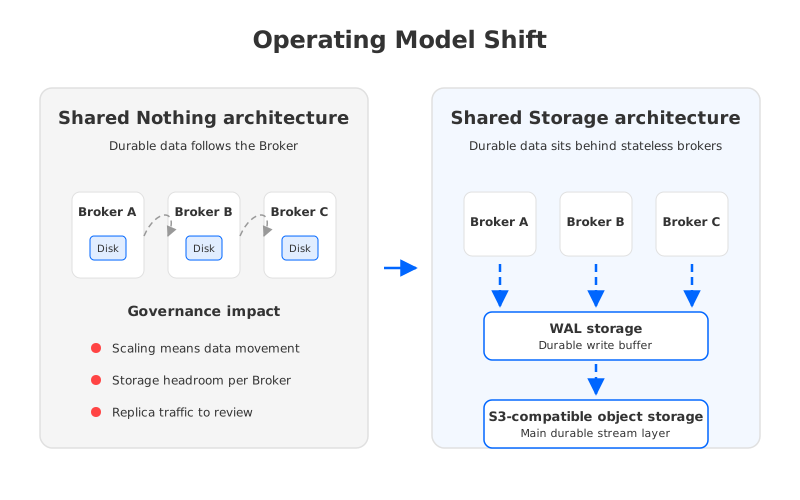
The tension shows up during transformation programs. A team may approve a long-retention topic for audit replay, but the storage headroom has to be reserved on Brokers. A Flink team may need to replay a group from an older offset, but catch-up reads now compete with hot traffic and disk pressure. A platform team may want to scale out for a temporary transformation wave, but adding Brokers is only half the work; the real cost is balancing leaders, replicas, and data placement.
Tiered Storage helps with part of this pressure by offloading older log segments to remote storage while recent data stays local. It is useful for extending retention and reducing the amount of hot local storage required. It does not make Brokers stateless, and it does not remove the operational coupling between live partitions, local disks, leader placement, and reassignment planning. For governance, that distinction matters: moving old data is not the same as changing the operating model for continuous change.
3Architecture options and trade-offs
A serious evaluation should not start by asking which product has the longest feature list. It should start by separating governance controls from architecture constraints. Controls answer questions like who can create a topic, which schema changes are allowed, and which pipelines need approval. Architecture constraints answer whether the approved change can be executed without excessive downtime, overprovisioning, or recovery risk.
The evaluation usually narrows into four options:
| Option | What it preserves | What to test before standardizing |
|---|---|---|
| Self-managed Kafka on local or cloud disks | Full Kafka control and familiar operations | Data movement during scaling, storage headroom, broker recovery, and cross-AZ traffic paths |
| Managed Kafka service | Reduced platform operations for the base cluster | Feature boundaries, cost model, network placement, migration exit path, and governance integration |
| Kafka with Tiered Storage | Kafka semantics plus lower pressure from historical retention | Hot-data sizing, replay behavior, broker locality, and whether scaling still requires heavy reassignment |
| Kafka-compatible shared storage | Kafka-facing applications with a different storage and elasticity model | Protocol compatibility, WAL behavior, object storage dependency, migration method, and operational maturity |
This table is intentionally not a recommendation yet. Each option can be right for a specific boundary. A small internal platform with predictable traffic may prefer operational familiarity. A regulated team may prefer a deployment model that keeps the data plane inside its own cloud account. A lakehouse-heavy team may prioritize retention and replay economics. The governance mistake is pretending these are policy preferences when they are workload constraints.
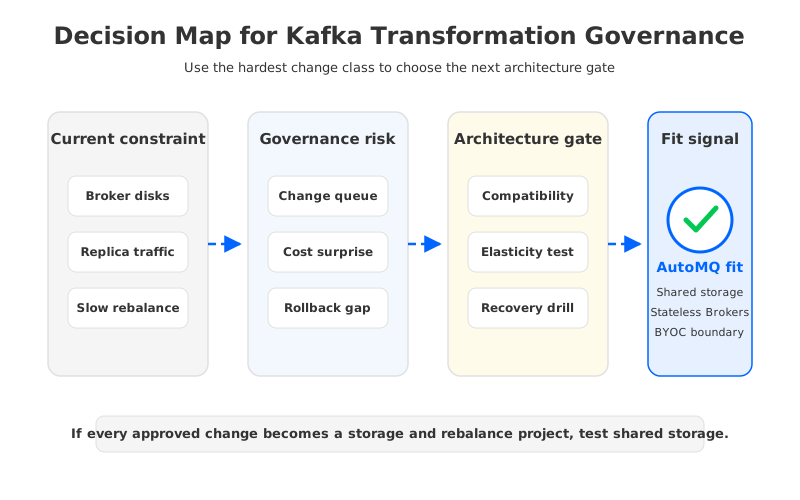
The decision map should force one uncomfortable conversation: which change class hurts the most? If schema review is the bottleneck, improve contracts and CI checks. If connector sprawl is the bottleneck, standardize integration patterns. If every approved change turns into broker sizing, replica movement, and network-cost review, the architecture is carrying governance work that the team cannot automate away with process alone.
4Evaluation checklist for platform teams
A useful readiness checklist is concrete enough to reject an architecture, rather than only score it. The platform team should run it against a representative workload: one high-throughput topic, one long-retention topic, one transformation job with replay, one migration path, and one failure drill. Governance becomes credible when the same checklist is applied before procurement, before migration, and before expanding the platform to more teams.
Use the checklist as a readiness gate:
- Compatibility. Validate Producer, Consumer, AdminClient, Kafka Connect, stream processing, transactions, compaction, security, metrics, and client versions. API compatibility is a claim until your real workload proves it.
- Cost model. Separate compute, storage, network transfer, object storage requests, control plane fees, and operational labor. Do not compare steady-state storage prices while ignoring replay, migration, and cross-AZ paths.
- Elasticity. Measure how the platform scales during a temporary transformation wave. The important question is not whether a node can be added, but whether the workload becomes balanced without prolonged data movement.
- Governance surface. Define who owns topic creation, schema evolution, retention, access, connector configuration, table writes, and incident approval. A platform that hides these controls makes audits harder, not easier.
- Failure recovery. Rehearse Broker replacement, leader movement, object storage degradation, client reconnection, and consumer group recovery. Recovery plans that only exist in documentation tend to fail at the edge cases.
- Migration and rollback. Test offset preservation, producer switchover, consumer progress, dual-write avoidance, and rollback timing. Transformation governance needs a return path as well as a forward path.
- Observability. Track consumer lag, end-to-end latency, Broker pressure, object storage behavior, WAL health, rebalance activity, and cost signals. If the metric is needed for approval, it should be visible during production.
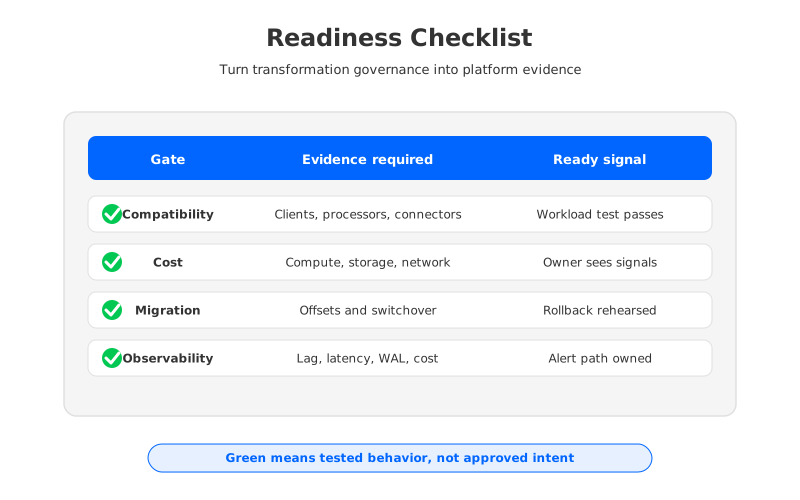
The scoring should be simple. Green means the team has tested the behavior and knows the owner. Yellow means the behavior is understood but still needs a runbook or limit. Red means the architecture or operating model cannot support the change safely. A governance board that cannot produce red items is probably not governing; it is only recording intent.
5How AutoMQ changes the operating model
Once the neutral evaluation exposes broker-local storage as the recurring constraint, AutoMQ becomes relevant as a Kafka-compatible shared storage architecture. It keeps Kafka protocol and ecosystem compatibility while moving durable stream storage to S3-compatible object storage through S3Stream. AutoMQ Brokers remain responsible for Kafka request handling, leadership, caching, and scheduling, but persistent data is no longer tied to the Broker's local disk.
That change alters the governance conversation. Scaling is no longer primarily a data-copy project. Broker replacement is less coupled to restoring local partition data. Long retention is planned around object storage capacity rather than Broker disk headroom. Self-Balancing and seconds-level partition reassignment become more practical because reassignment changes ownership and traffic placement instead of requiring the same kind of large local-data migration that traditional Kafka operators expect.
The WAL (Write-Ahead Log) is the important detail that keeps this from becoming a simplistic "write directly to object storage" story. In AutoMQ, WAL storage is a durable write buffer for low-latency acknowledgement and recovery, while S3 storage is the main durable storage layer. AutoMQ Open Source uses S3 WAL. AutoMQ commercial editions can use additional WAL storage types such as Regional EBS WAL and NFS WAL, depending on deployment and latency requirements. Governance teams should record the WAL type in the architecture decision because it affects latency profile, failure domain, and cloud-resource review.
AutoMQ BYOC also changes the data boundary. In AutoMQ BYOC, the control plane and data plane run in the customer's cloud environment, and customer business data remains in that environment. That matters when continuous transformation programs span regulated domains, private networking, customer-managed cloud accounts, or region-specific controls. The platform team can evaluate Kafka-compatible operations without treating data-plane ownership as an afterthought.
Migration still deserves its own governance gate. AutoMQ Kafka Linking is designed for migration from Apache Kafka or other Kafka-compatible distributions, including byte-to-byte replication and consumer group progress synchronization according to AutoMQ documentation. That does not remove the need for rehearsal. It gives the platform team a concrete migration mechanism to test against the checklist: topic mapping, offset behavior, producer switchover, consumer resume, capacity during sync, and rollback timing.
6Decision scorecard: make the readiness call
The final readiness call should combine architecture fit with operational proof. A team is not ready because a vendor says the platform is Kafka-compatible. It is ready when the representative workload has passed the same checks that production governance will enforce.
Use a five-point score for each category:
| Category | 1 point | 3 points | 5 points |
|---|---|---|---|
| Compatibility | Only basic clients tested | Core clients and processors tested | Full workload, failure cases, and tooling tested |
| Elasticity | Manual scaling with long balancing windows | Scaling works with planned windows | Scaling and balancing fit normal operating windows |
| Cost governance | Infrastructure bill reviewed after deployment | Major cost dimensions modeled | Cost signals tied to workload owners and approval gates |
| Recovery | Runbook exists | Drill completed in staging | Drill completed with production-like traffic and owners |
| Migration | High-level plan | Data sync tested | Switchover and rollback rehearsed with offsets and clients |
Scores are less important than the discussion they force. A low compatibility score means the team should test, not debate. A low elasticity score means the change program will keep paying for capacity buffers. A low recovery score means governance is approving risk that operations cannot yet absorb. That is the practical value of continuous transformation governance in Kafka: it turns broad transformation goals into technical gates the platform can actually operate.
7FAQ
7.1What does continuous transformation governance mean for Kafka?
It means the process and operating model used to control ongoing changes to Kafka-based data flows, including schemas, topics, retention, stream processing, integrations, access, migration, and rollback. In production, it has to include infrastructure behavior because Kafka changes often affect storage, scaling, and recovery.
7.2Is this the same as streaming data governance?
No. Streaming data governance often focuses on data quality, ownership, access, contracts, and compliance. Continuous transformation governance includes those concerns, but it also asks whether the Kafka platform can keep changing safely as workloads, teams, and infrastructure requirements evolve.
7.3Does Tiered Storage solve the governance problem?
Tiered Storage can help with historical retention and local storage pressure. It does not make Brokers stateless, and it does not remove every scaling, recovery, or live-data placement concern. Treat it as one architecture option, not a complete governance model.
7.4When should AutoMQ be evaluated?
Evaluate AutoMQ when the main pain is Kafka's broker-local storage model: slow reassignment, capacity overprovisioning, long retention pressure, cross-AZ traffic review, or operational risk during scaling and migration. The right proof is a representative workload test, not a slide comparison.
If your Kafka governance review keeps returning to the same storage, scaling, and migration risks, make those risks the benchmark. Start an AutoMQ BYOC evaluation with a production-shaped workload through AutoMQ Cloud.


