
Table of Contents
Table of Contents
Teams search for kafka streams modernization when the application logic still works, but the platform around it has started to feel brittle. The topology can join, aggregate, repartition, and maintain state. The problem shows up when a broker replacement takes longer than the application SLO allows, a reprocessing job competes with live traffic, or a migration plan treats Kafka Streams like an ordinary consumer group.
Kafka Streams applications depend on more than input and output topics. They use changelog topics, repartition topics, state stores, committed offsets, transactional producers when exactly-once processing is configured, and restore behavior that can read a lot of history after a rebalance or restart. A platform change that preserves only the happy path of produce and consume calls is not enough. The real question is whether the streaming platform can keep those surrounding contracts stable while storage, scaling, governance, and cost constraints change underneath.
The thesis is straightforward: Kafka Streams modernization is mostly a platform readiness project, not a library rewrite. Before a team changes brokers, deployment model, or cloud architecture, it needs a checklist that covers compatibility, state recovery, retained history, cost exposure, observability, migration, and rollback.
1Why teams search for kafka streams modernization
Most Kafka Streams modernization projects begin with a familiar pressure point. The team has a stateful application that was built when traffic was smaller, retention windows were shorter, and cluster operations were handled by a small group of Kafka specialists. Then the application becomes part of a business-critical workflow. Fraud decisions, personalization features, operational alerts, lakehouse updates, billing state, or AI context pipelines start depending on the output.
At that point, the application runtime is only one part of the risk. A Kafka Streams application can be perfectly reasonable in code while the surrounding Kafka cluster makes every change expensive. State restoration needs changelog history. Repartition topics need enough capacity during bursts. Consumer group rebalances need predictable behavior. Exactly-once processing needs transactional semantics to keep working. Observability needs to connect application lag, broker health, restore progress, and output freshness in one view.
Search intent usually falls into four categories:
- Keep the application, change the platform. The team wants to preserve Kafka Streams code and Kafka client behavior while moving to a cloud-native Kafka-compatible platform.
- Reduce operational drag. Partition reassignment, broker replacement, storage expansion, and capacity planning have become too tied to local disks.
- Support longer replay and rebuild windows. State stores, materialized views, feature pipelines, and table sinks need retained history without turning retention into a broker sizing problem.
- Clarify governance and ownership. Platform, application, security, and FinOps teams need a shared decision model before a production migration.
That last point is easy to underestimate. Kafka Streams sits between application code and platform infrastructure. Modernization fails when either side assumes the other side owns the hard parts.
2The production constraint behind the problem
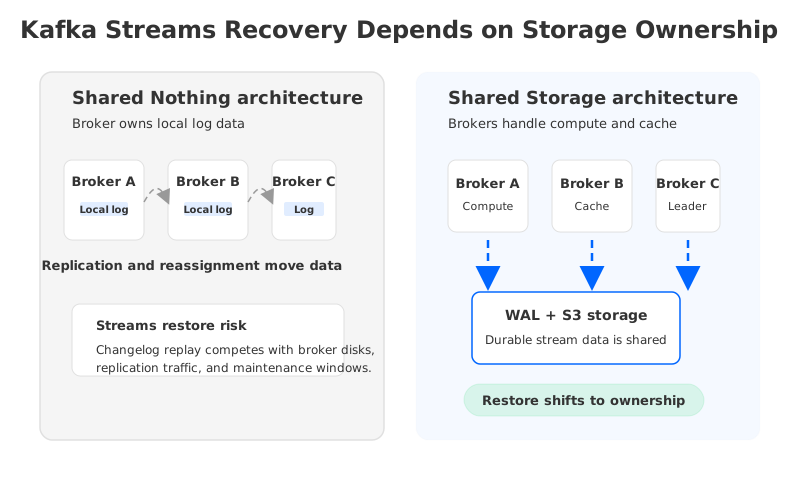
Traditional Apache Kafka uses a Shared Nothing architecture. Each Broker owns local log storage for assigned partitions, and durability comes from replication across Brokers. This model is mature and widely deployed, but it couples application recovery to broker-local storage behavior. When traffic grows, retention grows, or a broker changes, the platform team has to care about where bytes live.
Kafka Streams makes this coupling visible because stateful processing turns retained log data into recovery infrastructure. A restarted task may restore a local state store from a changelog topic. A topology change may create or modify repartition topics. A replay may read a large offset range to rebuild downstream state. These are normal operations, but they are not free. They consume broker read bandwidth, storage headroom, network capacity, and operator attention.
Tiered Storage can help when older log segments are the main pressure. Apache Kafka documents Tiered Storage as a way to move older segments to remote storage while retaining the Kafka log abstraction. That is useful, especially for longer retention. It does not make Brokers stateless, and it does not remove the operational importance of the live log head, leader ownership, local storage pressure, and recovery behavior.
The production constraint is not that Kafka Streams cannot run at scale. It can. The constraint is that a stateful application will expose every weak assumption in the storage and operating model around Kafka. If the platform can only stay healthy through large capacity buffers and careful maintenance windows, the modernization project should start there.
3Architecture options and trade-offs
A useful architecture review separates three decisions that are often mixed together. The first is whether the application should remain Kafka Streams or move to another stream processor. The second is whether the Kafka API and ecosystem should remain the application contract. The third is whether broker-local storage should remain the durable storage model.
Those decisions are related, but they are not the same. A team might keep Kafka Streams and change the Kafka-compatible platform. Another team might move stateful processing to Flink while keeping Kafka as the event log. A third team might keep traditional Kafka and improve operational discipline because the workload does not justify a deeper change.
| Option | When it fits | What to test for Kafka Streams |
|---|---|---|
| Traditional Kafka with stronger operations | The estate is stable, retention is bounded, and the team already has strong Kafka runbooks | State restore time, rebalance behavior, local disk pressure, reassignment windows, and broker replacement drills |
| Kafka with Tiered Storage | Historical retention is the biggest pain, and live-edge operations are manageable | Restore behavior from remote segments, object storage read patterns, hot-path latency, and operational limits |
| Kafka-compatible Shared Storage architecture | The team wants Kafka compatibility while reducing broker-local storage as the center of operations | WAL behavior, object storage durability path, cache efficiency, replay throughput, failure recovery, and migration workflow |
| Processing-platform migration | The application semantics no longer fit Kafka Streams, or the team needs a different processing runtime | State translation, checkpoint model, connector changes, output correctness, and rollback path |
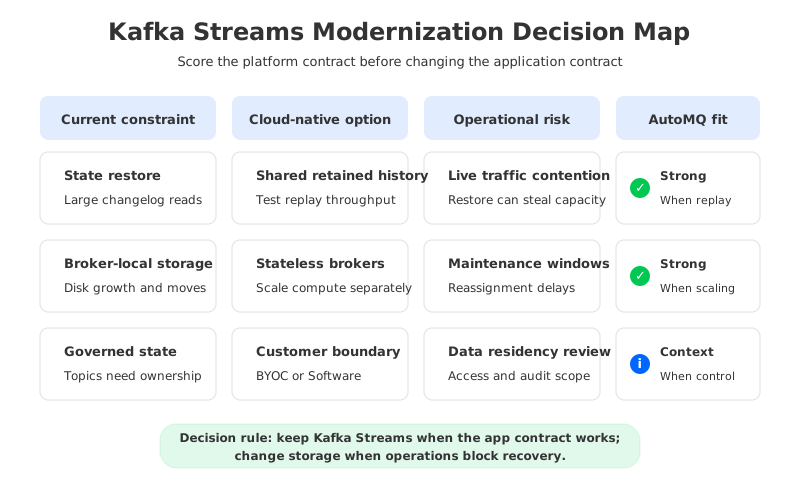
The table is not a ranking. It is a way to avoid a common mistake: treating "modernization" as a synonym for "replace something." Sometimes the right move is to keep Kafka Streams and modernize the storage and operating model behind Kafka. Sometimes the application logic needs to move. The readiness work should make that distinction clear before procurement, migration tooling, or cloud design takes over the conversation.
4Evaluation checklist for platform teams
The strongest checklist starts with the workloads that already exist. Inventory each Kafka Streams application by topology, input topics, output topics, internal topics, state stores, processing guarantees, client versions, authentication, and ownership. Then rank the applications by migration risk. A stateless filter is not in the same category as a multi-stage aggregation with changelog-backed state and exactly-once processing.
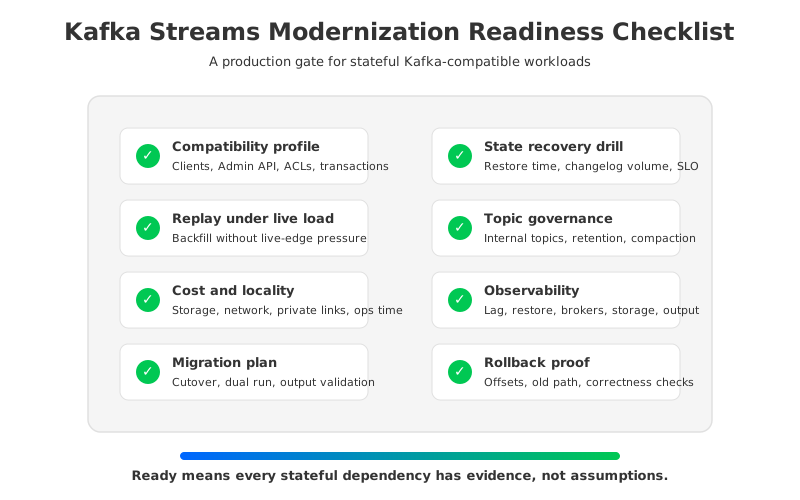
Use the following checklist before choosing a cloud-native Kafka-compatible platform:
- Compatibility. Validate the Kafka client versions, Admin API usage, producer configuration, consumer group behavior, transactions, ACLs, topic configuration, and monitoring tools used by each topology.
- State recovery. Measure state restore time from changelog topics after task restart, broker failure, application redeploy, and topology changes. Record the data volume, not only the elapsed time.
- Internal topic governance. Treat changelog and repartition topics as production assets. They need retention, compaction, naming, access control, and observability rules.
- Replay and backfill. Run controlled reprocessing while live traffic continues. The test should show whether catch-up reads steal capacity from the live edge.
- Cost boundary. Model compute, storage, object storage requests, cross-Availability Zone traffic, private connectivity, and operator time. State restore and replay traffic belong in the cost model.
- Observability. Connect application metrics, consumer lag, restore progress, broker metrics, storage metrics, object storage behavior, and output freshness. A dashboard that only shows broker health will miss application risk.
- Migration and rollback. Prove how producers, application instances, offsets, internal topics, output topics, and downstream consumers move. A rollback is not ready until the old path can still be trusted.
This checklist should be run against a staging workload that resembles production. Synthetic traffic is useful for repeatability, but it often hides the awkward parts: skewed keys, large state stores, compaction-heavy changelogs, uneven partitions, and downstream consumers that read in bursts.
5How AutoMQ changes the operating model
After the neutral evaluation is complete, AutoMQ becomes relevant as a Kafka-compatible streaming platform built on Shared Storage architecture. It keeps the Kafka protocol and ecosystem contract while replacing broker-local log storage with S3Stream, WAL (Write-Ahead Log) storage, S3 storage, and data caching. AutoMQ Brokers act as stateless brokers for durable data ownership, so persistent stream data is not pinned to local broker disks in the traditional model.
For Kafka Streams modernization, that changes what the platform team has to protect. State restoration still reads Kafka topics. Changelog and repartition topics still matter. Application teams still need to test exactly-once processing, key distribution, standby behavior if used, and output correctness. The difference is that broker replacement, scale-out, and reassignment are less dominated by copying local log data between Brokers. The work shifts toward metadata ownership, compute capacity, cache behavior, and object-storage-backed durability.
That shift matters during the events that usually break modernization plans. If a Streams application needs to replay a long range of offsets, the platform can reason about retained history in shared object storage instead of tying every retained byte to broker-local disk growth. If a broker becomes unhealthy, another Broker can take over the compute role because durable data is already outside the failed node. If traffic grows sharply, scaling compute does not have to begin with a large local data movement project.
Deployment boundaries also matter. AutoMQ BYOC runs the control plane and data plane in the customer's cloud account and VPC, while AutoMQ Software serves private data center deployments. For platform teams with regulated stateful processing, that boundary can be as important as the storage model: Kafka records, object storage, networking, and access policies stay within the customer's environment.
AutoMQ is not a replacement for Kafka Streams, Flink, or application-level processing logic. It is a way to keep Kafka compatibility while changing the broker storage and operating model behind the applications. The right test is practical: run one representative topology, restore its state, replay history, scale brokers, fail a broker, validate observability, and rehearse rollback.
6Readiness scorecard
Use a scorecard when the decision is politically noisy. It forces the platform team to attach evidence to each claim and keeps the discussion away from vendor labels.
| Domain | Evidence to collect | Ready signal |
|---|---|---|
| Application contract | Client versions, processing guarantees, internal topics, Admin API use, and security settings | Each topology has a tested compatibility profile |
| State recovery | Restore drills after restart, rebalance, and broker failure | Restore time fits the application SLO without emergency capacity changes |
| Retention and replay | Required history, replay throughput, and backfill impact | Reprocessing can run while live traffic remains within budget |
| Operations | Broker replacement, scale-out, scale-in, and reassignment drills | Operators can explain the recovery path without large local data relocation |
| Governance | ACLs, schemas, topic ownership, audit expectations, and data residency | Security and application owners agree on topic and state boundaries |
| Migration | Cutover plan, dual-run period, rollback procedure, and output validation | The old path remains trustworthy until the new path proves correctness |
The scorecard also exposes cases where modernization should pause. If the team cannot explain internal topic ownership, it is too early to migrate. If state restore has never been measured, the application SLO is based on hope. If rollback depends on manual offset guesses, the plan is not production-ready.
7FAQ
7.1Is Kafka Streams modernization the same as rewriting Kafka Streams applications?
No. It can mean a rewrite, but in many teams it means keeping Kafka Streams applications while changing the Kafka-compatible platform, cloud deployment model, storage architecture, or operational runbooks around them.
7.2What makes Kafka Streams harder to migrate than ordinary consumers?
Kafka Streams applications often depend on state stores, changelog topics, repartition topics, committed offsets, transactional behavior, and restore paths. Those dependencies need explicit tests because a basic consume-and-produce validation does not prove stateful processing readiness.
7.3Does Tiered Storage remove the need for Shared Storage architecture?
Tiered Storage and Shared Storage architecture solve different problems. Tiered Storage moves older log segments to remote storage while keeping the broker-owned log model. Shared Storage architecture changes durable data ownership so Brokers are less tied to local persistent storage.
7.4Where does AutoMQ fit in a Kafka Streams modernization project?
AutoMQ fits after the team has validated compatibility needs, state recovery requirements, replay windows, governance boundaries, and rollback rules. It is most relevant when broker-local storage, reassignment, retention growth, or cloud elasticity is the bottleneck.
7.5What should be tested before production cutover?
Test client compatibility, state restore, internal topic behavior, exactly-once settings if used, live replay, broker failure, broker scale-out, output correctness, observability, security policies, and rollback. The test should use a real topology, not only a sample app.
8Closing the readiness gap
The first sign of Kafka Streams modernization pressure is often a slow recovery drill, an uncomfortable storage bill, or a migration meeting where no one can explain what happens to changelog state. Treat that moment as useful evidence. It means the application has become important enough that the platform contract needs to be written down.
Start with the checklist, score one representative topology, and test the failure paths before changing the production estate. If broker-local storage is the part that keeps turning normal state recovery into an infrastructure project, evaluate AutoMQ's shared-storage approach with your own workload: start from the AutoMQ technical team.
9References
- Apache Kafka Documentation
- Apache Kafka Streams Introduction
- Apache Kafka Consumer Groups
- Apache Kafka Transactions and Semantics
- Apache Kafka Tiered Storage
- Apache Kafka KRaft
- AutoMQ Kafka Compatibility
- AutoMQ Architecture Overview
- AutoMQ S3Stream Shared Streaming Storage
- AutoMQ WAL Storage
- AutoMQ BYOC Overview


