
Table of Contents
Table of Contents
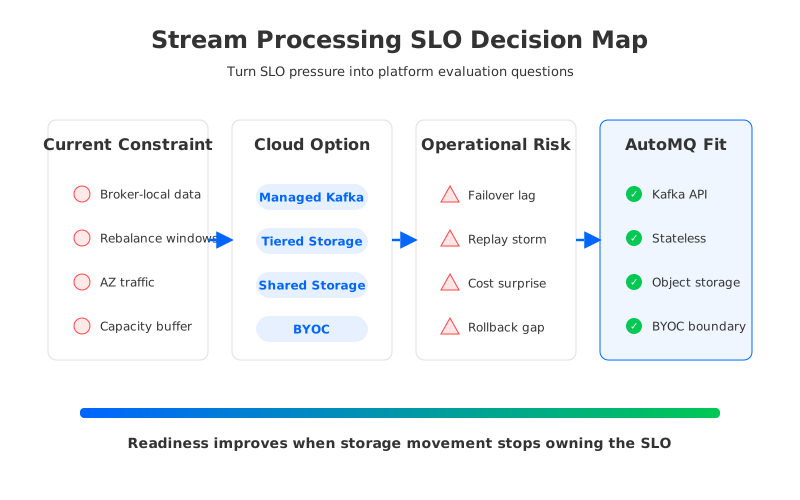
Teams usually search for stream processing slo kafka after the pipeline already matters. The first version of the job worked, the dashboard looked fresh enough, and the backlog stayed small during normal traffic. Then a broker replacement, replay, schema change, or downstream outage turns the Kafka layer into part of the SLO discussion, not a neutral pipe behind it.
That shift is easy to miss because the words sound like application reliability. A stream processing SLO might say that 99% of enriched events must reach a serving table within 60 seconds, or that a fraud feature must not lag source transactions by more than 5 minutes. The processing engine owns checkpoints, state, joins, and output commits, but Kafka owns the substrate that makes those actions recoverable. If Kafka cannot retain source topics, preserve consumer progress, absorb replay, and survive capacity changes without long operational windows, the job's SLO is weaker than it looks on paper.
1Why Teams Search for stream processing slo kafka
Start with the user-visible promise, then work backward into Kafka behavior. A freshness SLO depends on end-to-end event time, consumer lag, checkpoint duration, and sink commit latency. A recovery SLO depends on how far the processor can rewind, whether offsets remain meaningful after cutover, and whether the platform can serve catch-up reads while live traffic continues. A correctness SLO depends on idempotent writes, transactions where used, schema discipline, and predictable Consumer group behavior.
Those requirements cross team boundaries. The Flink or Kafka Streams team can tune state backends and checkpoint intervals, but it cannot make the broker layer scale without partition movement. The SRE team can monitor lag and error budget burn, but it cannot invent a rollback path after the migration has started. The platform team can choose a managed service, but it still needs to know where data lives, who controls network access, and what happens when retention grows from days to months.
2The Production Constraint Behind the Problem
Apache Kafka's core model is still built around partitions, offsets, Consumer groups, and broker-managed logs. That model is powerful because consumers can make progress independently and replay from known offsets. It also means the broker storage layer becomes part of every stream processing SLO once the workload relies on long retention, heavy catch-up reads, or stateful recovery.
Cloud networking makes the problem more concrete. If a deployment spans multiple Availability Zones, replication, client traffic, connector traffic, and private access paths may create billable data transfer depending on the provider and topology. AWS publishes separate pricing pages for EC2 data transfer, PrivateLink, and S3; a production review should check the specific Region, traffic direction, and service boundary before assuming a design is cost-neutral. A stream processing SLO that ignores these paths can be met technically while failing the platform budget.
3Architecture Options and Trade-offs
The second option is managed Kafka. It can reduce the operational burden around provisioning, patching, and routine maintenance, but it does not automatically remove the architectural constraints behind the workload. Teams still need to test client compatibility, transaction semantics, Consumer group behavior, connector ownership, network topology, and retention economics. Managed operations help, but they do not remove the need for an SLO model that spans producer, broker, processor, and sink.
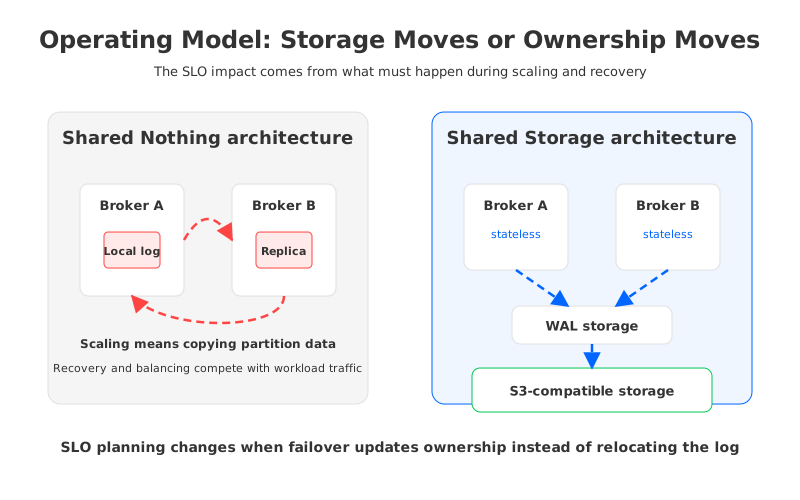
The third option is Kafka with Tiered Storage. Apache Kafka's Tiered Storage design extends the storage model by moving older log segments to remote storage while retaining Kafka's local log for active data. This can help with longer retention and storage pressure, especially when historical reads dominate. It is not the same as a diskless broker model. The broker still has local storage responsibilities for hot data, and platform teams still need to reason about failover, local capacity, segment movement, and how catch-up reads behave under load.
The fourth option is a Kafka-compatible shared-storage platform. In this model, the Kafka protocol surface remains familiar, while durable data is placed in shared object storage and brokers become easier to replace. The trade-off shifts from "how do we move broker-local logs fast enough?" to "does the storage architecture preserve the Kafka semantics our applications rely on, and does the WAL path meet our latency and durability needs?" That question is narrower, but it is still a real engineering review.
| Evaluation area | What to verify | Why it matters for stream processing SLOs |
|---|---|---|
| Compatibility | Producer, Consumer, Admin API, Consumer groups, offsets, transactions, Kafka Connect, and stream processing clients | A small semantic mismatch can break checkpoint recovery or cutover. |
| Retention and replay | Source-topic retention, changelog topics, historical read behavior, and object storage policy | SLO recovery often depends on replaying the exact evidence that produced bad output. |
| Scaling behavior | Partition movement, broker replacement, hot partition handling, and rebalance time | Scaling events should not consume the error budget they are meant to protect. |
| Cost boundary | Storage copies, cross-AZ traffic, private access, object storage requests, and overprovisioned capacity | A reliable design still needs a cost model the platform team can defend. |
| Governance | Encryption, IAM, auditability, VPC boundaries, schema ownership, and data residency | Stream processing pipelines often carry regulated operational facts. |
| Migration and rollback | Topic synchronization, offset preservation, producer cutover, consumer promotion, and rollback criteria | The safest migration is the one whose reversal path was designed before cutover. |
This table is intentionally platform-neutral. If a candidate platform cannot answer these questions with test evidence and official documentation, the risk belongs in the readiness scorecard rather than in a launch meeting footnote.
4Evaluation Checklist for Platform Teams
Compatibility should be tested against the application surface that exists in production, not against a hello-world producer and consumer. List the Kafka features each workload uses: idempotent producers, transactions, Consumer group rebalances, Admin API calls, topic configuration, ACLs, schema tooling, Kafka Connect, Kafka Streams, Flink Kafka connectors, and monitoring integrations. Apache Kafka's official documentation is the baseline for these behaviors, but the validation must use your clients, versions, and failure cases.
Cost readiness needs a traffic map before it needs a spreadsheet. Draw every path: producer to broker, broker to broker, broker to object storage, connector to broker, processor to broker, private endpoint to service, and cross-zone failover path. Then attach provider pricing pages to the paths that can be billed. This discipline prevents the common review failure where teams compare only storage price and overlook replication, inter-zone traffic, private endpoint processing, or capacity held idle for peak windows.
Scaling readiness is about the shape of change. Ask what happens when write throughput doubles for 30 minutes, when one broker becomes unhealthy, when a topic rollout creates hot partitions, or when a failed sink forces a large catch-up read. A platform is not ready because it can add nodes. It is ready when adding nodes, replacing nodes, and rebalancing traffic are predictable enough to protect the stream processing SLO.
Governance readiness is usually where managed services, self-managed clusters, and BYOC designs diverge. The relevant question is not whether the platform has encryption or access control in a generic sense. The question is whether the data path, control path, logs, metrics, object storage, private access, and administrative identity model match the organization's boundary requirements. If the business requires customer-account data residency, the SLO review should include that boundary explicitly.
Migration readiness needs a dry-run plan that covers stateful processors. Topic data is visible, but processing state is often more fragile. Flink checkpoints, Kafka Streams changelog topics, connector offsets, schema IDs, and Consumer group progress all need attention. A migration that preserves bytes but loses offset meaning can still break the SLO because processors resume from the wrong point or require a long replay window.
5How AutoMQ Changes the Operating Model
Once the evaluation has exposed storage movement as a reliability and cost driver, a different architecture becomes worth reviewing. AutoMQ is a Kafka-compatible cloud-native streaming platform that uses Shared Storage architecture. It keeps the Kafka protocol and ecosystem surface while replacing broker-local persistent log storage with S3Stream, WAL storage, and S3-compatible object storage.
The operational change is straightforward to reason about. In a broker-local model, partition data is tied to the broker that stores it. In AutoMQ's Shared Storage architecture, durable data lives in shared object storage, and AutoMQ Brokers are stateless with respect to persistent partition data. A broker replacement or partition reassignment is primarily an ownership and metadata operation rather than a bulk log relocation project. That distinction matters when the stream processing SLO depends on fast recovery and predictable catch-up behavior.
WAL storage is the part that keeps this from becoming a naive "write everything directly to object storage" design. AutoMQ writes incoming data durably to WAL storage, acknowledges the client after the WAL write succeeds, and uploads data to S3 storage in near real time. AutoMQ Open Source uses S3 WAL. AutoMQ commercial editions, including AutoMQ BYOC and AutoMQ Software, support additional WAL storage options for workloads with different latency and deployment requirements. The SLO review should specify the WAL type because latency, durability domain, and infrastructure dependencies vary by implementation.
This architecture also changes cost and elasticity discussions. Because durable data is not replicated through broker-local logs in the same way, the platform can reduce the operational pressure of long retention, replay-heavy workloads, and broker replacement. AutoMQ documentation also describes Zero cross-AZ traffic patterns for S3-based deployment scenarios, which is relevant when inter-zone transfer is a material part of the Kafka bill. Treat that as an architecture property to validate in your topology, not a substitute for reviewing your cloud provider's pricing pages.
The deployment boundary matters as much as the storage design. AutoMQ BYOC runs in the customer's cloud account and VPC, while AutoMQ Software is for customer-managed private environments. For stream processing teams handling regulated data, this means the platform review can separate the Kafka-compatible data path from the vendor management relationship. The exact fit depends on the organization's requirements, but the evaluation moves from "managed or self-managed" to a more useful question: which responsibilities should stay inside the customer environment, and which should be automated by the platform?
6Readiness Scorecard
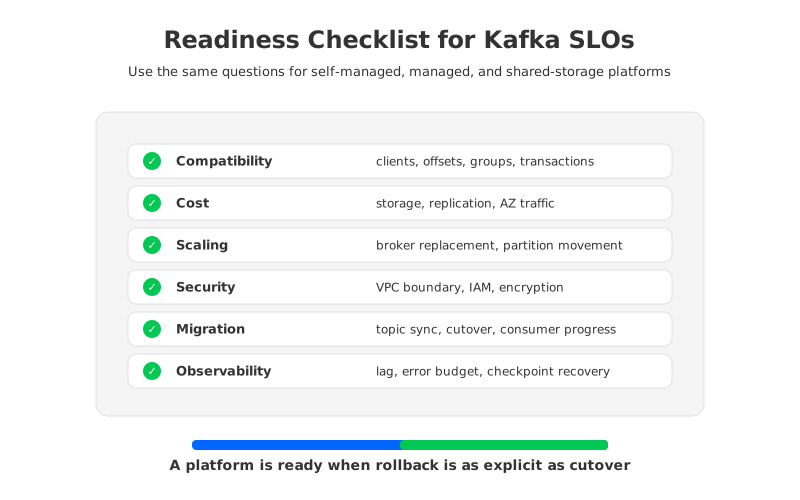
Use the checklist below before declaring a stream processing platform ready for production SLOs. Score each area as pass, needs test, or blocker. The useful outcome is not a perfect score; it is a shared view of which risk belongs to the processing team, the Kafka platform team, the security team, or the migration owner.
| Area | Pass condition |
|---|---|
| SLO definition | Freshness, recovery, correctness, and availability targets are written in user-visible terms and mapped to Kafka behaviors. |
| Kafka semantics | Production clients have tested offsets, Consumer groups, transactions where used, and Admin API behavior. |
| Retention | Source, output, repartition, and changelog topics can retain enough data for replay and rollback. |
| Failure recovery | Broker loss, processor restart, sink outage, and replay storm scenarios have been tested under load. |
| Cost model | Storage, replication, inter-zone traffic, private access, object requests, and idle capacity are included. |
| Governance | VPC boundary, IAM, encryption, audit, schema ownership, and data residency requirements are documented. |
| Migration | Topic sync, producer cutover, consumer progress, checkpoint compatibility, and rollback rules are rehearsed. |
| Observability | Consumer lag, checkpoint duration, error budget burn, broker health, and catch-up read behavior are visible. |
Return to the original search: stream processing slo kafka. The answer is not a single configuration value. It is a readiness model that connects SLOs to the Kafka substrate beneath the processor. When the SLO depends on replay, long retention, broker replacement, and cloud cost control, the storage architecture becomes part of the application reliability story.
If your team is evaluating whether a Kafka-compatible shared-storage model fits that story, start with the open-source project and test it against one real pipeline, not a synthetic producer loop. The next practical step is to review AutoMQ on GitHub and run the checklist against a workload that already has a freshness or recovery SLO.
7FAQ
7.1What is a stream processing SLO in Kafka?
A stream processing SLO is a reliability target for a pipeline that uses Kafka as part of its data path. It may describe freshness, recovery time, correctness, availability, or data completeness. The Kafka layer matters because offsets, Consumer groups, retention, transactions, and replay behavior affect whether the processor can meet that target.
7.2Is Kafka Streams enough for stream processing SLOs?
Kafka Streams provides a processing library, but the SLO still depends on the Kafka cluster, topic design, storage capacity, Consumer group behavior, and downstream systems. The same is true for Flink and other processors. Processing logic and broker operations must be reviewed together.
7.3Does Tiered Storage solve long-retention SLO requirements?
Tiered Storage can help with historical retention by moving older segments to remote storage. It does not remove every broker-local operational concern, and it should not be treated as identical to a shared-storage broker architecture. Teams should test hot-path latency, catch-up reads, failure recovery, and local storage behavior.
7.4When should AutoMQ enter the evaluation?
AutoMQ is relevant after the team has identified broker-local storage movement, retention cost, cross-zone traffic, or broker replacement as SLO risks. It should be evaluated as a Kafka-compatible Shared Storage architecture, especially when the organization wants the Kafka ecosystem with a more elastic cloud operating model.
7.5What should be tested before migration?
Test representative producers, consumers, connectors, stream processing jobs, schema workflows, ACLs, topic configurations, checkpoint recovery, offset continuity, and rollback. A migration plan is not complete until consumer progress and rollback criteria are explicit.
8References
- Google SRE Book: Service Level Objectives
- Apache Kafka documentation
- Apache Kafka KRaft documentation
- Apache Kafka Tiered Storage documentation
- Apache Kafka Connect documentation
- Apache Flink checkpointing documentation
- Apache Flink Kafka connector documentation
- AWS EC2 data transfer pricing
- AWS PrivateLink pricing
- AWS S3 pricing
- AutoMQ Kafka compatibility documentation
- AutoMQ Shared Storage architecture
- AutoMQ WAL storage documentation
- AutoMQ migration overview
- AutoMQ Zero cross-AZ traffic documentation


