
Table of Contents
Table of Contents
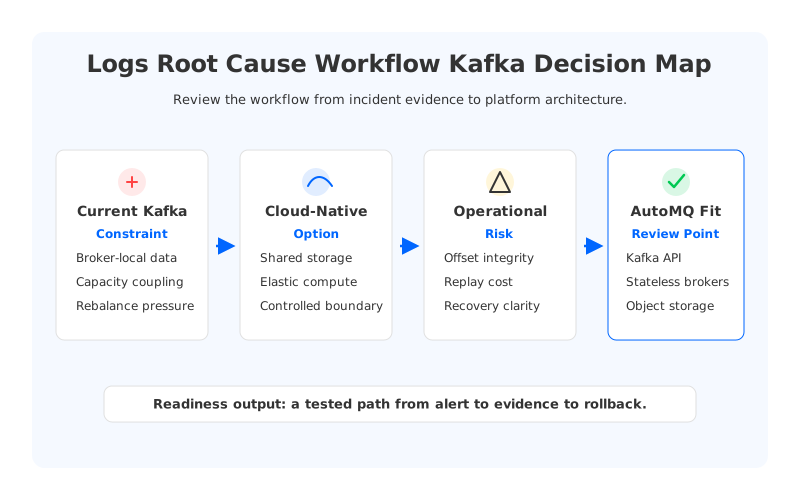
When a platform engineer searches for logs root cause workflow kafka, the problem is rarely a missing dashboard. The team usually already has logs, metrics, traces, alert rules, and a message bus that carries operational events. The pressure comes from what happens after the first alert: an incident channel fills up, consumer lag climbs, brokers start moving leadership, and nobody is sure whether the streaming layer is the cause, the amplifier, or the witness. A readiness review for logs-to-root-cause workflows should therefore test the streaming platform as an operational system, not as a generic event pipe.
That distinction matters because Kafka-compatible streaming sits in the middle of many incident workflows. Application logs may be routed through Kafka topics before indexing. Audit events may feed security systems. Change-data-capture streams may be the fastest way to reconstruct what a service saw before it failed. If the streaming layer is hard to scale, expensive to retain, or slow to recover, the incident workflow inherits those constraints at the worst possible time.
The useful question is not "Can Kafka carry logs?" It can. The sharper question is whether your Kafka-compatible platform can keep root-cause evidence available, ordered, governed, and cost-effective while production is already under stress.
1Why teams search for logs root cause workflow kafka
Logs-to-root-cause workflows become visible when teams stop treating logs as a passive archive. In a production incident, logs are evidence. They need to be correlated with deployments, offsets, consumer group behavior, schema changes, retries, and infrastructure events. Kafka enters the picture because it can preserve event order within partitions, decouple producers from downstream analysis systems, and let multiple consumers build different views over the same operational stream.
That value comes with a catch. The same properties that make Kafka useful for incident analysis also create operational obligations. Topic design affects whether evidence can be joined later. Retention settings determine whether the team can investigate a slow-burn issue that started days earlier. Consumer group assignment and committed offsets determine whether an analysis job resumes from the right point after a failure. Transactions and idempotent producers may matter when duplicated operational events create false leads.
A readiness review should start with the workflow, not the cluster. Ask what an on-call engineer needs to prove during an incident. They may need to answer whether errors began before or after a deployment, whether one tenant or all tenants are affected, whether a downstream indexer skipped a range of offsets, or whether a consumer group fell behind because the stream was overloaded. Those questions map directly to Kafka mechanics: topics, partitions, offsets, Consumer group behavior, retention, authorization, and observability.
The first failure mode is assuming that ingestion success equals investigation success. A system can accept log events and still fail as a root-cause tool if it drops context, hides offset movement, or makes historical reads too slow during a catch-up window. The readiness bar is higher: the platform must support the human path from alert to evidence to decision.
2The production constraint behind the problem
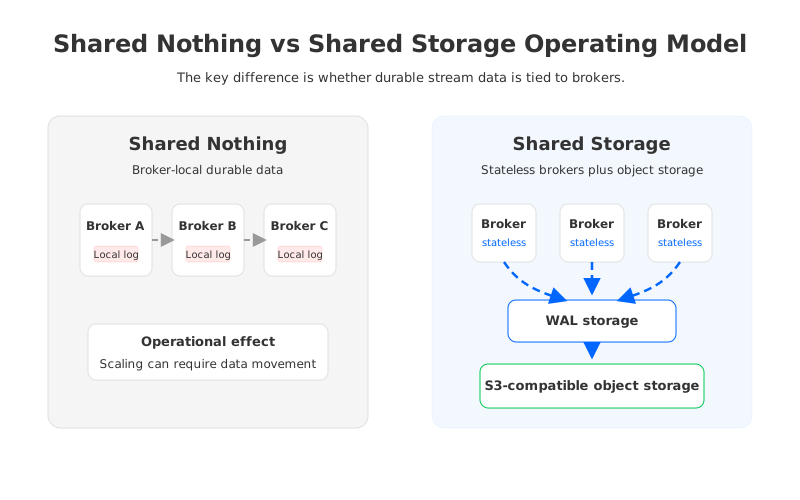
Traditional Kafka was designed around a Shared Nothing architecture. Each broker owns local storage, partitions are placed on specific brokers, and durability is achieved through replicas across brokers. This model is well understood, battle tested, and still a good fit for many self-managed environments. The difficulty appears when the same model is asked to serve cloud-scale log retention, elastic incident bursts, and frequent topology changes.
Broker-local storage makes capacity planning tightly coupled. If log volume grows, the team has to think about disk, broker count, replica placement, rebalance time, and network movement together. During an incident, traffic patterns can change quickly: diagnostic logging increases, consumers replay history, and downstream systems slow down. The Kafka cluster may need more capacity at the exact moment when adding capacity triggers partition movement.
That movement is not a cosmetic detail. In a Shared Nothing architecture, reassigning partitions can involve copying data between brokers. Replication traffic may cross Availability Zone boundaries. Long retention multiplies the amount of data tied to each broker. Even with careful throttling, the cluster spends resources on reshaping itself while it is also serving the workload that triggered the change.
Tiered Storage helps with one part of this problem by moving older log segments to remote storage while keeping active data on broker-local disks. It can improve retention economics and reduce pressure on local storage. It does not fully remove the operational coupling between active partitions and brokers, so teams should evaluate it as a retention feature rather than as a complete answer to elastic incident operations.
For logs-to-root-cause workflows, the production constraint is not raw throughput alone. The constraint is how much uncertainty the platform adds when the team is trying to remove uncertainty from an incident.
3Architecture options and trade-offs
A neutral evaluation should separate three architectural choices that often get mixed together. The first is client compatibility: whether existing producers, consumers, Kafka Streams jobs, Kafka Connect pipelines, and operations tooling continue to behave as expected. The second is storage architecture: whether durable data is primarily bound to broker-local disks, offloaded for older segments, or stored in a shared durable layer. The third is control boundary: whether the team operates the system itself, uses a managed service, or deploys a control plane in its own cloud account.
Those choices interact, but they are not the same choice. A managed service may reduce operational work while still using a broker-local storage model. A Tiered Storage deployment may reduce retention cost while keeping active-segment recovery tied to broker placement. A Kafka-compatible shared-storage system may preserve client contracts while changing the way brokers recover, scale, and rebalance.
| Review dimension | Why it matters for root cause | What to verify |
|---|---|---|
| Kafka behavior | Tools depend on predictable offsets, Consumer group behavior, transactions, and client compatibility. | Test critical clients, replay jobs, Connect tasks, and offset management paths. |
| Storage model | Long retention and replay are central to incident analysis. | Check whether active data is broker-local, tiered, or stored in a shared durable layer. |
| Elasticity | Incidents often create bursty logging and catch-up reads. | Measure scale-out behavior under write spikes and historical replay. |
| Governance | Logs may contain sensitive operational or tenant context. | Validate network boundaries, IAM, audit trails, encryption, and access review workflows. |
| Recovery | The platform may be part of the evidence chain during failure. | Test broker loss, slow node isolation, leader movement, and rollback procedures. |
| Migration | Log pipelines are often connected to many downstream systems. | Prove topic mapping, offsets, schemas, connectors, and rollback before cutover. |
4Evaluation checklist for platform teams
The readiness review should produce evidence, not a deck of opinions. Start with one representative incident workflow and trace it end to end. Pick a high-volume application log topic, one consumer that indexes logs, one analysis job that replays history, and one dashboard or alert that operators use during triage. Then test how the workflow behaves when the stream is healthy, overloaded, recovering, and being migrated.
Use this checklist as a working scorecard:
- Compatibility: Confirm that producers, consumers, Connect workers, Kafka Streams jobs, Schema Registry usage, ACLs, and transaction patterns behave with the target platform. The Apache Kafka documentation is the baseline for concepts such as Consumer groups, offsets, transactions, KRaft, and Connect.
- Cost shape: Separate compute, storage, object storage requests, inter-zone traffic, PrivateLink or private endpoint costs, and observability storage. Avoid average-day estimates for incident systems; replay and burst behavior are part of the cost model.
- Elasticity path: Document what happens when log volume doubles for a limited window. The review should include capacity trigger, broker or node addition, partition movement, and the expected impact on producers and consumers.
- Security boundary: Identify where log data, metadata, metrics, and access credentials live. For sensitive logs, the team should prove that the platform boundary matches its compliance model.
- Recovery drill: Simulate broker failure, slow storage, stuck consumers, and downstream indexer backpressure. The goal is to verify that the streaming layer remains diagnosable while another system is failing.
- Migration and rollback: Treat offsets and consumer progress as first-class migration artifacts. A cutover plan that copies records but loses the operational position of consumers is not ready for incident workflows.
- Observability of the platform itself: Root-cause workflows need telemetry about the stream carrier: broker health, request latency, Consumer lag, partition leadership, storage latency, cache behavior, and failed authorization attempts.
5How AutoMQ changes the operating model
After the neutral review, the architectural requirement becomes clearer: keep Kafka-compatible behavior for applications, but reduce the amount of broker-local state that turns scaling and recovery into data movement. AutoMQ is a Kafka-compatible streaming platform designed around that requirement. It keeps the Kafka protocol and ecosystem surface while replacing broker-local durable log storage with a Shared Storage architecture backed by object storage.
In AutoMQ, brokers are stateless from the perspective of durable stream data. Writes go through S3Stream and WAL (Write-Ahead Log) storage before data is organized in S3-compatible object storage. The WAL layer provides the durable write path needed for acknowledgement and recovery, while object storage becomes the main durable store. Because partitions are not permanently tied to local broker disks, operations such as broker replacement, capacity changes, and partition reassignment depend more on metadata and traffic ownership than on copying large volumes of data between brokers.
That difference matters for logs-to-root-cause workflows in four concrete ways. First, long retention can be evaluated around object storage capacity rather than broker disk headroom. Second, broker failures can be handled without treating the failed broker's local disk as the center of the recovery story. Third, Self-Balancing can focus on continuous traffic distribution instead of turning every imbalance into a storage relocation project. Fourth, zero cross-AZ traffic patterns can reduce one of the hidden costs in multi-AZ Kafka-style deployments when the architecture routes data through shared storage instead of broker-to-broker replication across zones.
AutoMQ also changes the team boundary. AutoMQ BYOC places the control plane and data plane in the customer's cloud account, while AutoMQ Software is designed for customer-managed private environments. For a logs platform that may carry sensitive operational context, this boundary is not a footnote. It affects security review, network design, IAM, and the approval process for support access. AutoMQ Console, Terraform workflows, monitoring integration, Self-healing, and Self-Balancing give platform teams operational handles without asking application teams to rewrite their Kafka clients.
Migration still deserves a careful plan. Kafka compatibility reduces application change, but it does not remove the need to test topic configuration, offsets, schema expectations, Connect behavior, retention policies, and rollback. AutoMQ's Kafka Linking is relevant when teams need to move workloads while preserving message and consumer progress semantics, and open-source migrations can also use Kafka ecosystem tools where their behavior fits the workload. The readiness question is the same either way: can the team prove the evidence chain survives the move?
6Readiness scorecard
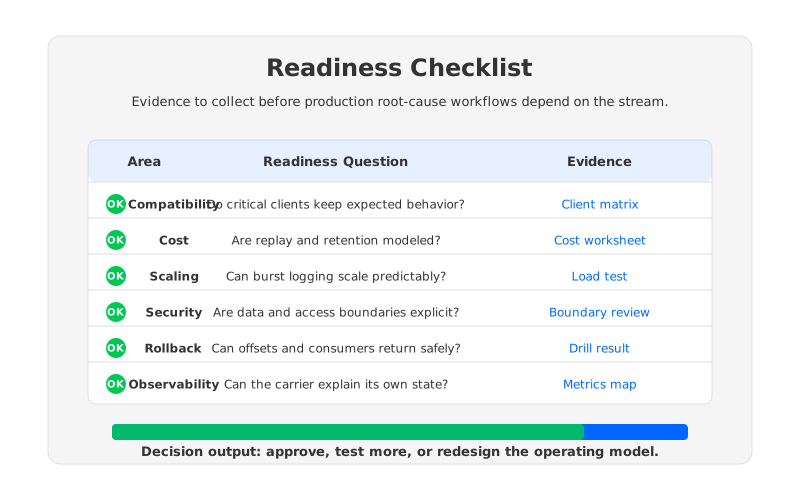
Use a scorecard rather than a binary yes or no. A platform can be ready for low-volume diagnostic logs and not ready for security audit streams with long retention. It can be ready for new workloads and not ready for a migration with complex Consumer group state. Scoring forces the team to name the gap before production names it for them.
| Area | Ready signal | Needs work signal |
|---|---|---|
| Compatibility | Critical clients and tools pass workload-specific tests. | The review assumes Kafka API compatibility without testing offsets, transactions, and Connect paths. |
| Retention | Retention policy matches investigation windows and storage cost model. | Retention is copied from an old cluster without replay or cost validation. |
| Scaling | Burst logging and catch-up reads have a documented capacity path. | Scaling requires manual broker sizing during an incident. |
| Recovery | Broker loss and slow-node scenarios are rehearsed. | Recovery depends on undocumented operator judgment. |
| Governance | Data, metadata, metrics, and access boundaries are explicit. | Log sensitivity is handled after ingestion. |
| Migration | Cutover and rollback preserve records, offsets, and consumer progress. | The plan focuses on copying data but not operational position. |
The scorecard should end with an owner and a next test, not a vague recommendation. If the weakest area is compatibility, run a client matrix. If it is cost, model replay and inter-zone traffic. If it is recovery, schedule a failure drill. If the storage model keeps turning every operational question into a broker-local disk question, it is time to evaluate a shared-storage Kafka-compatible architecture.
For teams that want to test this operating model with their own workloads, start with the AutoMQ docs and run a small replay-oriented proof of concept. The most useful CTA is not a sales meeting; it is a test that tells your on-call team whether the platform helps them find root cause faster. You can start from the AutoMQ project here: try AutoMQ.
7FAQ
7.1Is Kafka a good fit for logs-to-root-cause workflows?
Kafka can be a strong fit when teams need ordered event streams, fan-out to multiple analysis systems, replay, and decoupling between log producers and downstream tools. The platform still needs careful topic design, retention planning, access control, and observability.
7.2Does Tiered Storage solve the whole problem?
Tiered Storage can help with long retention by moving older data to remote storage. It does not fully remove active broker-local storage or every operational effect of partition placement, so it should be evaluated as one component of the architecture.
7.3What should teams test before migrating log pipelines?
Test producer behavior, Consumer group offsets, replay jobs, Connect tasks, schema expectations, authorization, retention, and rollback. A migration that preserves records but loses consumer progress can break incident workflows.
7.4Where does AutoMQ fit in the evaluation?
AutoMQ fits when teams want Kafka-compatible clients with a Shared Storage architecture, stateless brokers, object-storage-backed durability, customer-controlled deployment boundaries, and operational automation for scaling and recovery.


