
Table of Contents
Table of Contents
Teams rarely search for real time aggregation kafka because they are curious about an API call. They search because a dashboard is late, a fraud rule is missing fresh context, or an AI feature needs live signals. The aggregation code may be only a few lines, but the production system around it has to absorb uneven keys, late events, replay, schema changes, and broker maintenance.
That is why real-time aggregation is a platform question before it is a stream-processing question. Kafka Streams, Flink, SQL engines, and custom consumers can all compute counts, windows, joins, and rollups. The harder decision is where state should live, how much data movement the platform creates, and whether the Kafka layer can stay calm while the aggregation workload changes shape.
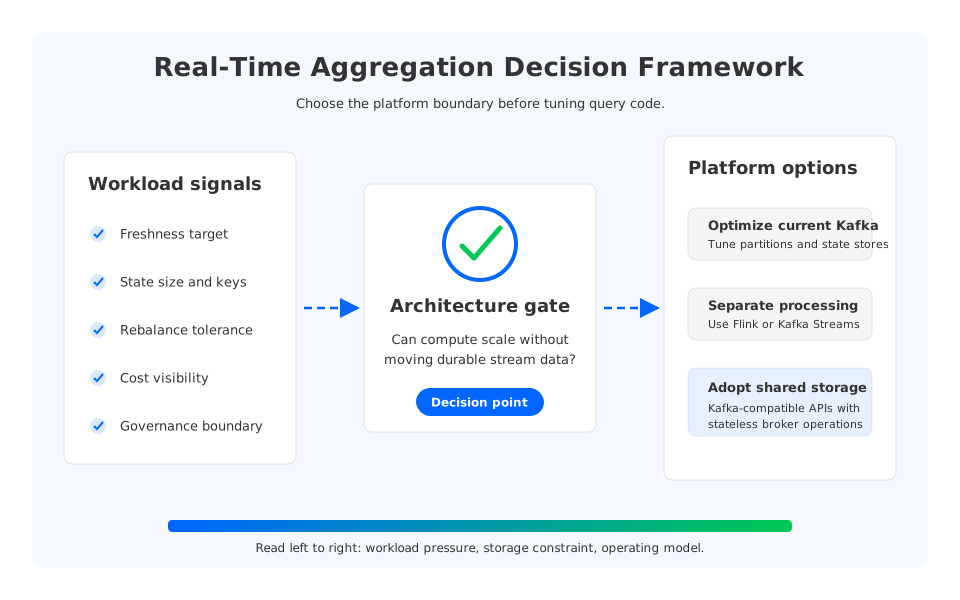
1Why Real-Time Aggregation Kafka Workloads Stress the Platform
Aggregation converts individual records into counts per merchant, balances per account, metrics per device, feature values per user, or lagging indicators per service. The logic sounds straightforward until it meets production inputs. Keys are not uniformly distributed, event time and processing time diverge, and one tenant can become hot while the rest of the topic looks calm.
Kafka is a good substrate for this class of work because it gives teams durable ordered logs, consumer groups, offsets, retention, and a broad ecosystem of clients. Apache Kafka Streams supports grouped aggregations and windowed computations through its DSL, while consumer groups coordinate parallel consumption across partitions. These semantics let teams separate ingestion from processing and recover by replaying records from known offsets.
The catch is that aggregation creates state outside the log as well as pressure inside the log. A counter, window, materialized table, or deduplication index must be updated continuously. Kafka Streams needs state-store and changelog headroom. Flink needs checkpoints and state backends to align with Kafka offsets. Custom services inherit every correctness edge case. In each path, the Kafka layer still carries the raw stream, changelog traffic, replay traffic, and operational events caused by scaling or failure.
The search query hides a broader set of requirements:
- Freshness has a price. A 5-second operational metric, a 1-minute business rollup, and a 15-minute feature table do not need the same storage, checkpoint, and recovery posture.
- State changes the failure mode. Stateless consumers can restart and continue from offsets. Stateful aggregators must also restore local tables, rebuild windows, and keep partial updates consistent.
- Hot keys defeat average planning. A topic may have enough aggregate throughput capacity while one customer, merchant, region, or device type creates an overloaded partition.
- Rebalance cost matters. More partitions or more consumers can increase parallelism, but they also increase coordination, state movement, and operational surface area.
- Cloud network charges are part of architecture. Multi-AZ Kafka deployments protect availability, but replication and cross-zone reads can become a visible line item when every byte is copied through brokers.
Those constraints are reasons to design the Kafka platform and aggregation layer together.
2The Production Constraints Behind the Search
A useful architecture review separates aggregation semantics from platform mechanics. Semantics answer questions such as "Is this a tumbling window or a continuously updated table?" Mechanics answer questions such as "What happens when the topic doubles, the broker fails, or the state store must restore hours of history?" Production incidents usually happen where these two layers meet.
Consider a revenue dashboard built from order events. The product requirement may say "update within 30 seconds." Engineering then has to handle duplicate orders, refunds, late events, and schema evolution. SREs ask how much replay follows a failed deployment, how long restoration takes, and whether scaling processors also causes broker-side partition movement.
The table below is a practical way to keep the review grounded:
| Design question | Why it matters | Common production signal |
|---|---|---|
| Is the aggregate append-only or mutable? | Mutable views need compaction, upserts, or table semantics downstream. | Changelog topics grow quickly or queries read stale corrections. |
| Is the freshness target seconds or minutes? | Lower latency reduces batching room and increases checkpoint pressure. | CPU looks fine, but p99 update lag rises during peaks. |
| How large is recoverable state? | Restore time can dominate incident recovery. | A processor restart causes long catch-up even when live traffic is normal. |
| Are keys evenly distributed? | Hot keys can pin throughput to one partition or task. | One partition lags while the topic-level average hides the issue. |
| What is the replay plan? | Backfills can compete with live processing. | Historical reprocessing consumes broker, network, and state-store I/O. |
This framing prevents a common mistake: treating Kafka as a passive pipe. Kafka is retaining history, replicating data for durability, coordinating consumers, serving replays, and often carrying changelog topics for stateful stream processors. When those duties share broker-local disks, aggregation growth becomes a storage and operations discussion.
3Architecture Patterns Teams Usually Compare
The first pattern is Kafka plus Kafka Streams. It is attractive when the aggregation is close to the event model, the team wants Java-native processing, and operational simplicity matters more than a separate compute framework. Kafka Streams can materialize local state and write changelog topics back to Kafka. The trade-off is that scaling and restoring the processor still pushes traffic through Kafka, and the cluster must retain capacity for both source topics and processor-generated internal topics.
The second pattern is Kafka plus Flink. Flink fits workloads that need richer event-time processing, large state, complex joins, or strict checkpoint control. That separation helps when aggregation becomes a data platform capability, but it also introduces another operational plane: state, checkpoints, job upgrades, savepoints, and source offset coordination.
The third pattern is Kafka feeding an analytical table or serving store. Instead of asking the stream processor to be the query system, the pipeline writes aggregates into Iceberg, ClickHouse, Elasticsearch, Redis, a feature store, or a database optimized for the access pattern. This can improve query ergonomics, but it increases pressure on schemas, idempotency, and exactly-once boundaries.
The fourth pattern changes the Kafka infrastructure itself. Traditional Kafka uses a shared-nothing model where brokers own local log segments and replication happens between brokers. This design is proven, but it couples compute placement to durable data placement. When aggregation traffic grows, the team may add brokers, expand disks, rebalance partitions, and pay for replication traffic even though the business requirement is "let processors scale and recover faster."
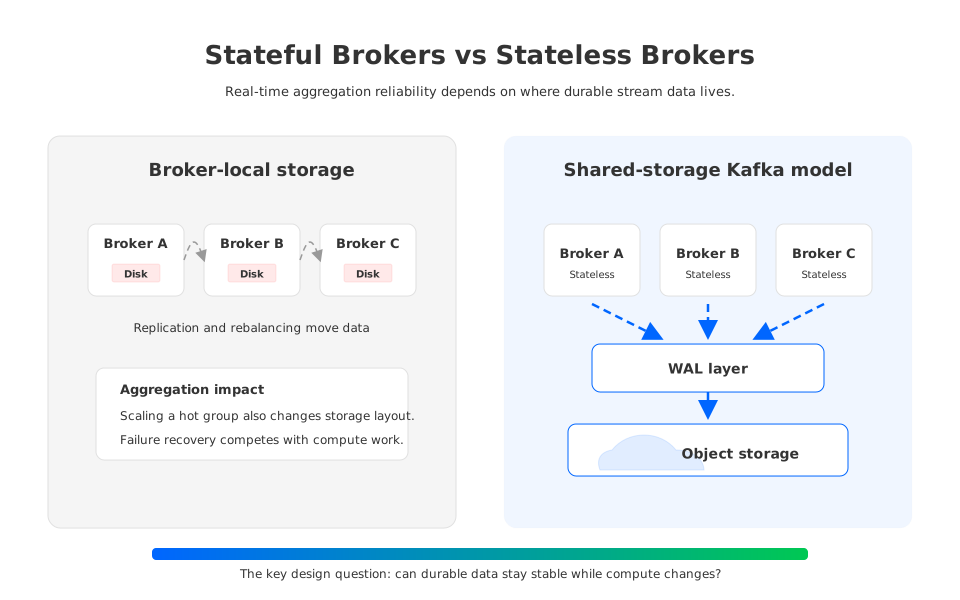
The architectural question is not whether Kafka should be durable. It must be. The question is whether broker-local storage should remain the center of durability when the workload lives in the cloud and changes quickly. Apache Kafka tiered storage recognizes that separating older log data from broker disks can improve elasticity and retention economics. A diskless or shared-storage Kafka-compatible model goes further by making object storage the durable log foundation and allowing brokers to behave more like stateless compute.
That is the point where AutoMQ becomes relevant. AutoMQ is a Kafka-compatible, cloud-native streaming system that keeps the Kafka protocol surface familiar while moving the storage foundation to shared object storage with a WAL layer in front of it. For aggregation workloads, the interesting part is not a separate aggregation API. It is reducing the broker-local data gravity that shows up when teams scale, recover, or rebalance around stateful processing.
4Evaluation Checklist for Platform Teams
Before choosing a processor or a Kafka-compatible platform, write down the operating envelope. It needs enough specificity that SREs, data engineers, and application owners can tell whether they are optimizing the same system.
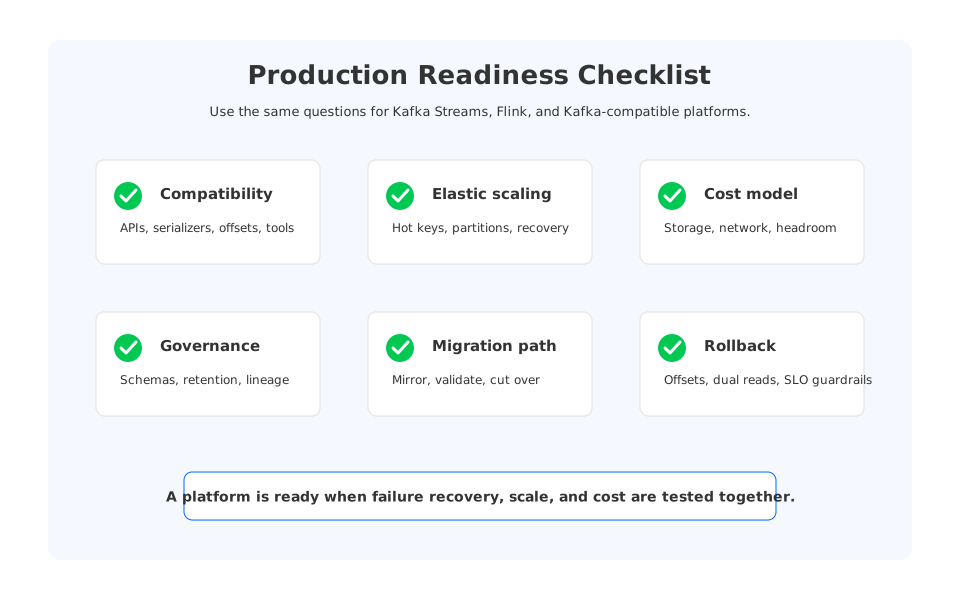
Start with correctness. Define whether the aggregate is a metric, a materialized view, a billing input, a model feature, or an operational alarm. A metric can often tolerate approximation or delayed correction. A billing input usually cannot. These distinctions decide how much effort belongs in deduplication, compaction, watermarking, schema compatibility, and replay testing.
Then test elasticity as a failure exercise, not a happy-path benchmark. Add consumers while traffic is high. Restart processors during replay. Increase partition count with state size. Run a backfill beside live traffic. The goal is to observe whether capacity changes stay in the processing layer or trigger broker-side work that competes with ingestion.
Cost belongs in the same review because real-time aggregation tends to multiply hidden traffic. Replication, changelogs, checkpoints, restore reads, cross-AZ client paths, and backfills are all data movement. AWS documents data transfer pricing separately from compute pricing, and Kafka teams running across Availability Zones need to model that network path alongside broker and storage costs.
A concise checklist keeps the conversation honest:
- Kafka compatibility: Can existing producers, consumers, serializers, ACL patterns, and observability tools continue with minimal change?
- State recovery: How long does a processor or job recover after losing local state, and what does that do to live ingestion?
- Scaling boundary: Can processing scale independently from durable stream storage, or does every scale event require partition movement?
- Cross-AZ behavior: Which paths generate inter-zone traffic: produce, replication, consume, restore, checkpoint, or replay?
- Governance: Are schemas, retention, lineage, and downstream table formats managed as part of the pipeline rather than after the fact?
- Migration and rollback: Can the team mirror topics, validate offsets, compare aggregates, and return traffic if the first attempt fails?
The strongest platforms make these questions boring. They do not remove the need for stream-processing design, but they reduce the infrastructure side effects attached to each processing decision.
5Where AutoMQ Changes the Operating Model
AutoMQ's shared-storage architecture is useful to evaluate after the neutral checklist because it targets the platform mechanics beneath aggregation. It maintains Kafka compatibility for client-facing behavior while separating broker compute from the durable storage layer. Object storage holds stream data, and a WAL layer absorbs the hot write path before data is persisted to shared storage. Brokers can then be treated less like machines that own irreplaceable local disks and more like elastic compute nodes.
That matters for real-time aggregation in three practical ways. First, scaling broker capacity does not have to imply the same kind of durable data movement as a broker-local storage model. Second, recovery design can lean on shared storage rather than restoring all meaning from a failed broker's local disk. Third, cloud cost analysis can focus on explicit read, write, storage, and network paths.
AutoMQ's documentation also describes inter-zone traffic reduction through an S3-based shared storage architecture. For multi-AZ Kafka workloads, this is relevant because aggregation systems often combine high write volume, multiple consumer groups, and replay traffic. Reducing cross-zone broker replication can turn a cost problem back into an architecture choice.
There is also a downstream data architecture angle. Many aggregation systems eventually need both a streaming view and an analytical table. AutoMQ Table Topic is designed to stream Kafka topic data into Iceberg tables with schema-aware conversion and catalog integration. That does not replace Flink or Kafka Streams for complex computation, but it can simplify the path from Kafka-compatible topics to queryable lakehouse data.
The right way to introduce AutoMQ into an existing Kafka estate is still incremental. Start with a workload where the current pain is visible: hot partitions, expensive multi-AZ traffic, slow restore, expensive retention, or a migration backlog caused by broker capacity constraints. Mirror traffic, compare offsets and aggregate outputs, validate dashboards, and keep rollback explicit.
6Decision Table
The final decision is less about picking a fashionable streaming stack and more about matching workload pressure to platform boundaries.
| Situation | Likely first move | When to reconsider the Kafka layer |
|---|---|---|
| Small aggregates, modest state, stable traffic | Kafka Streams on the current cluster | Broker disk, restore time, or changelog growth becomes the bottleneck. |
| Large state, complex event-time joins | Kafka plus Flink | Kafka replay and checkpoint traffic compete with live ingestion. |
| Aggregates mainly serve analytics | Kafka to Iceberg or analytical store | ETL tooling and schema drift become the operational bottleneck. |
| Multi-AZ traffic, rapid growth, heavy replay | Evaluate shared-storage Kafka-compatible architecture | Broker-local storage and replication dominate scaling and cost decisions. |
The original search was about real time aggregation kafka, but the durable answer is about control. Control over freshness, state, replay, storage, and cost. When those controls are explicit, teams can keep using the Kafka ecosystem without letting broker-local data gravity dictate every aggregation decision.
If your next architecture review is already circling around replay cost, multi-AZ traffic, or stateful processor recovery, use the checklist above against your current Kafka cluster and a shared-storage Kafka-compatible option such as AutoMQ. The comparison is most useful when it is run against one real workload, one freshness target, and one rollback plan rather than a generic platform bake-off.
7References
- Apache Kafka Streams DSL API
- Apache Kafka Documentation: Core Concepts
- Apache Kafka Documentation: Tiered Storage
- AWS EC2 On-Demand Pricing: Data Transfer
- AutoMQ Architecture Overview
- AutoMQ WAL Storage
- AutoMQ and Kafka Tiered Storage
- AutoMQ Table Topic Overview
- AutoMQ Inter-Zone Traffic Overview
8FAQ
8.1Is Kafka enough for real-time aggregation?
Kafka is enough for the durable streaming foundation, but aggregation also needs a processing layer and a state strategy. Kafka Streams is a strong fit for many application-local aggregations. Flink is often better for large state, complex event-time logic, and independent processing operations. The Kafka platform underneath both options still needs enough storage, replay, and network capacity.
8.2Should real-time aggregation use Kafka Streams or Flink?
Use Kafka Streams when the aggregation belongs close to an application team, the topology is understandable, and operational simplicity matters. Use Flink when the workload needs advanced event-time semantics, large state, savepoints, or a dedicated data processing runtime. The choice should include recovery time, state size, deployment ownership, and replay behavior, not only API preference.
8.3How does shared storage help Kafka aggregation workloads?
Shared storage can reduce the coupling between broker compute and durable stream data. For aggregation workloads, that can make scaling, recovery, and retention less dependent on broker-local disks. It does not remove the need to design stateful processors carefully, but it changes the operating model beneath them.
8.4Does AutoMQ replace stream processing frameworks?
No. AutoMQ provides a Kafka-compatible streaming platform with a shared-storage architecture. Teams can still use Kafka Streams, Flink, custom consumers, and downstream analytical systems. The value is in changing the Kafka infrastructure layer so stateful processing has less broker-local storage gravity to fight.
8.5What should teams test before migrating an aggregation workload?
Test producer compatibility, consumer offsets, schema handling, aggregate correctness, replay speed, state recovery, cross-AZ traffic, and rollback. A migration is ready only when the team can compare source and target outputs under live-like traffic and return traffic without losing offset discipline.


