
Table of Contents
Table of Contents
AI systems fail in quiet ways when their context is stale. A support agent answers with yesterday's account state. A fraud model misses a transaction sequence because the lakehouse job has not landed. A retrieval pipeline indexes documents in batches, but the business event that changes the answer is still sitting in an operational database. The model may be impressive, but the context plane is still working on a data warehouse clock.
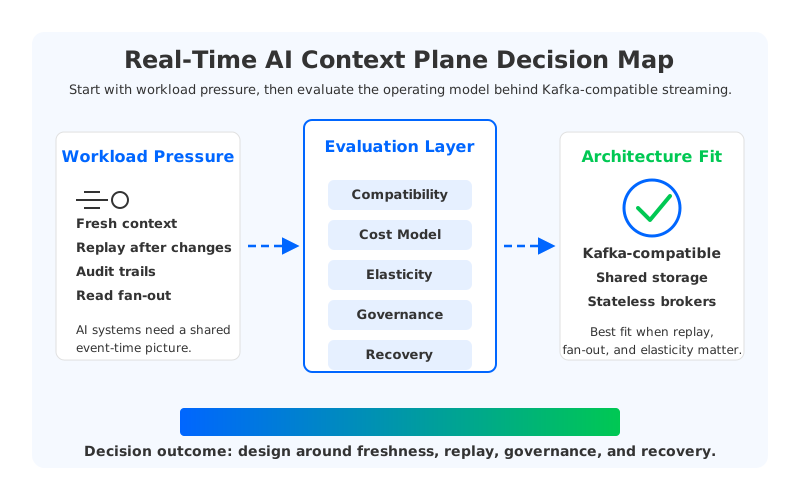
That is why many platform teams are searching for real time ai context plane kafka. They are not trying to replace feature stores, vector databases, lakehouse tables, or orchestration systems with Kafka. They are trying to create a durable, replayable, governed event layer that keeps those systems aligned with what the business knows right now.
Batch ingestion still belongs in that architecture, but it should not be the control plane for freshness. Once an AI application makes decisions against external tools, customer records, or regulated data, the question becomes less "How do we load more data into the lake?" and more "How do we know which context changed, who consumed it, and whether we can replay it after a bad deployment?"
1Why AI Context Needs a Streaming Backbone
The word "context" hides several data shapes. Some context is slow-moving reference data, such as policy documents or product attributes. Some is fast-moving operational state, such as cart changes, payments, tickets, entitlements, clickstream events, and inventory. Some is generated by the AI system itself: prompts, retrieved chunks, tool invocations, evaluation scores, and safety interventions. When these signals move through separate batch jobs, every downstream system develops its own version of time.
Kafka became the default backbone for many real-time systems because it gives teams properties that AI context planes also need. Records are ordered within partitions, retained for replay, and consumed by independent groups. Offsets make progress explicit. Connectors and stream processors can attach without forcing every producer to know every consumer.
The catch is that a context plane has a wider operating surface than a classic event pipeline. It has to serve online systems that care about seconds, analytical systems that care about completeness, and governance systems that care about lineage. If a team treats Kafka as a transport buffer in front of batch storage, it gets the lowest-value part of the architecture.
Three requirements tend to appear as soon as the first AI workflow reaches production:
- Freshness with replay. Context updates need to arrive quickly, but the platform also needs enough retention to rebuild indexes, regenerate embeddings, and replay model-side effects after a schema or prompt change.
- Governance without blocking delivery. Security, masking, data residency, and audit policies have to travel with the event flow. A governance layer that works only after the batch load is late by design.
- Operational isolation. The embedding pipeline should not starve the fraud model, and a backfill for one consumer group should not turn into a cluster-wide storage emergency.
These are infrastructure requirements, not model requirements. A better prompt cannot repair an ingestion plane that loses ordering, hides consumer progress, or makes rollback impractical.
2Where Batch Ingestion Breaks Down
Batch ingestion is efficient when the unit of work is a large, append-friendly dataset. AI context is often the opposite. The important event may be a single entitlement update, a refund reversal, a policy revocation, or a tool result that changes what an agent is allowed to do. Waiting for a scheduled job adds latency, but latency is only the obvious failure mode. The deeper problem is that batch windows blur causality.
Consider a retrieval-augmented generation system that uses customer profile data, support tickets, and product documentation. If documents refresh hourly, tickets stream in near real time, and profile updates arrive through nightly ETL, answer quality depends on which subsystem happened to be current. Teams can add timestamps and reconciliation jobs, but those patches create another system whose job is to explain the first system's inconsistency.
Batch-first context planes also make incident response harder. When a bad transformation corrupts an embedding index, the team needs to know which source events contributed to it and replay from a clean point. When a model evaluation service produces suspicious scores, the team needs to compare the prompts, retrieved context, and policy version used at the time. A durable event log gives those systems a shared time axis.
None of this means every AI context update must be consumed synchronously. The right pattern is usually mixed: stream the facts as they happen, then let downstream systems decide whether to process them online, micro-batch them, or compact them into analytical tables. The key is that the authoritative change history should not be trapped inside a batch job.
3The Architecture Choice Is Really an Operating Model Choice
Once Kafka-compatible streaming becomes the context backbone, the platform team inherits Kafka's operating model. Traditional Kafka's shared-nothing design binds compute and storage inside brokers. Each broker owns local log segments, and durability is achieved by replicating partitions across brokers. That design is proven, but it turns storage growth, traffic spikes, and broker replacement into data movement problems.
For AI context planes, those data movement problems arrive early. Embedding rebuilds produce catch-up reads. New agents create fan-out. Governance teams add audit consumers. Feature pipelines replay historical windows. A single topic may have low write throughput but high read amplification because multiple systems need the same event history.
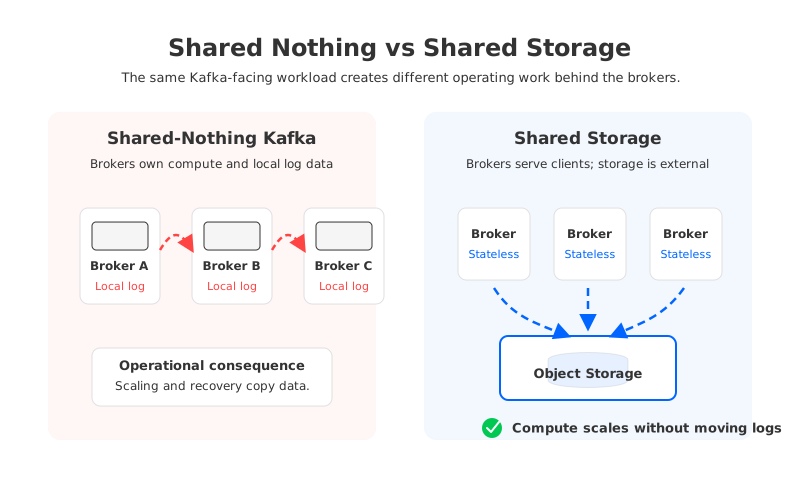
The architectural differences show up in day-two operations:
| Evaluation dimension | Shared-nothing Kafka pressure | What a context plane needs |
|---|---|---|
| Freshness | Local disks and replicas can become bottlenecks during spikes or reassignments. | Low write latency plus predictable catch-up reads. |
| Elasticity | Scaling brokers often implies partition movement and storage redistribution. | Add or remove compute without moving large retained logs. |
| Cost | Multi-AZ replication and retained local storage increase cloud resource usage. | Independent compute and storage scaling, with fewer unnecessary copies. |
| Governance | Audit and replay consumers add read pressure to production brokers. | Durable history with isolated consumers and clear offsets. |
| Recovery | Broker failure can trigger replica catch-up and operational intervention. | Fast broker replacement with data available outside the failed node. |
This table is not a vendor comparison. It separates protocol requirements from operating requirements. A team may need Kafka APIs, consumer groups, offsets, transactions, and Kafka Connect compatibility, but still want a storage model that behaves more like cloud infrastructure than a fleet of disk-owning servers.
4A Neutral Checklist for Platform Teams
A real-time AI context plane should be evaluated as a production substrate, not as an ingestion feature. The platform sits between operational systems and model-facing services, so the failure modes are cross-functional. Data engineering cares about connectors and schemas. SRE cares about scaling and recovery. Security cares about boundaries and audit. Finance eventually cares about retained bytes and network paths.
The useful evaluation question is not "Can this system stream events?" Most systems can. The useful question is whether the system keeps its promises when the AI workload changes shape, because each added tool, memory store, evaluation loop, and guardrail can become another producer or consumer.
Use this checklist before committing a context plane design:
- Protocol and client compatibility. Can existing Kafka clients, consumer groups, offset tooling, stream processors, and connectors continue to work with minimal change?
- Storage independence. Can retained data grow without forcing broker-local disk growth or long partition reassignments?
- Read fan-out behavior. What happens when multiple consumers replay the same history for embeddings, features, audits, and lakehouse ingestion?
- Failure recovery. If a broker disappears, is recovery mostly metadata and compute replacement, or does the cluster need to copy large amounts of data?
- Governance boundaries. Can the deployment respect VPC, account, region, encryption, identity, and operational access requirements?
- Migration and rollback. Can the team dual-run, mirror data, preserve consumer progress, and roll back without losing the event-time picture?
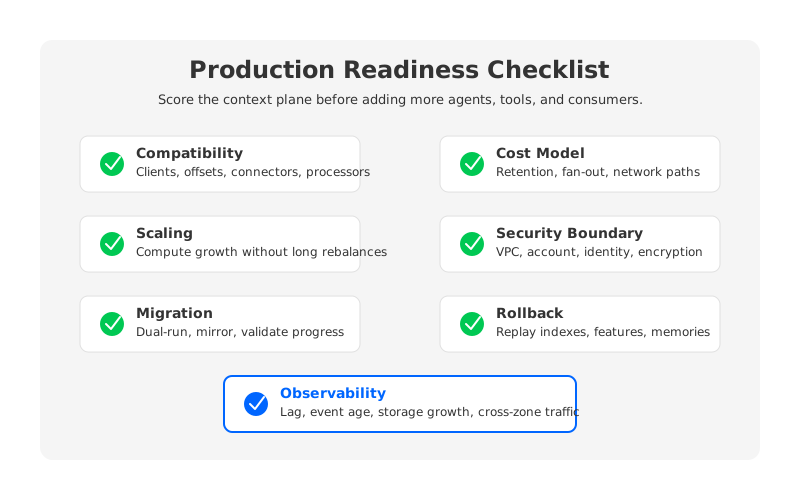
The checklist deliberately starts with compatibility. AI infrastructure teams already have enough moving parts. A context plane that forces every service to adopt another client protocol creates migration risk before it delivers architectural benefit.
5How Shared Storage Changes the Trade-Off
If the operating pain comes from brokers owning both compute and durable data, the natural design move is to separate those roles. In a shared-storage architecture, brokers handle Kafka protocol work and serve clients, while durable log data is stored in a shared storage layer such as object storage. The broker becomes closer to stateless compute. It still matters, but it no longer has to be the permanent home of a partition's bytes.
This is where AutoMQ becomes relevant. AutoMQ is a Kafka-compatible cloud-native streaming platform built on the Apache Kafka codebase, with a shared storage architecture that stores stream data on object storage and uses a WAL layer for low-latency persistence. The point is that the architecture directly targets the operating constraints that make real-time context planes hard to run: broker-local storage, long data movement, coupled compute and retention, and cross-zone replication traffic.
In practical terms, the model changes several design conversations:
- Scaling becomes a compute decision more often than a storage migration. When brokers are not the durable owners of log data, adding capacity does not require copying retained partitions from old brokers to added brokers.
- Retention becomes less tied to broker sizing. Context history can be kept for replay and audit without forcing the same growth curve onto local broker disks.
- Failure recovery becomes less dramatic. A failed broker can be replaced as compute while stream data remains available from shared storage.
- Cloud network cost becomes visible at design time. AutoMQ's documentation describes approaches for eliminating inter-zone traffic by using S3-based storage and zone-aware client access patterns.
There are still trade-offs to evaluate. Object storage has different latency characteristics than local SSDs, so the WAL design and workload profile matter. Governance teams also need to inspect the deployment model, operational access, encryption, and cloud account boundary.
6Migration Patterns That Reduce Risk
The safest migration is rarely a cutover from one ingestion model to another. AI context planes touch too many consumers, and downstream systems often have different tolerances for lag. A better pattern is to make the event log observable first, then move consumers in controlled groups.
Start with one context domain that has clear value and bounded blast radius, such as account state, entitlement changes, support events, or model feedback. Stream the source changes into Kafka-compatible topics, define the schemas, and attach one online path that needs freshness plus one offline path that validates completeness. This exposes partition key choice, retention settings, consumer lag, schema evolution, and alert thresholds.
After that, migration becomes a sequence of operational tests rather than a single architectural promise:
| Readiness area | Test before scaling |
|---|---|
| Producer path | Can producers retry safely, preserve ordering where required, and expose enough metadata for lineage? |
| Consumer path | Can consumer groups recover offsets, replay from known points, and tolerate backfills without starving online consumers? |
| Governance | Are topic ownership, ACLs, encryption, PII handling, and audit sinks defined before broad fan-out? |
| Observability | Are lag, throughput, error rates, storage growth, and cross-zone traffic visible to SREs? |
| Rollback | Can a downstream index, feature table, or agent memory store be rebuilt from the log after a bad release? |
This pattern keeps the architecture honest. If the platform cannot replay one bounded domain cleanly, adding more AI services will not fix it. If it can, the team has a template for the next domain.
If your AI roadmap depends on fresher context, replayable decisions, and governed event history, review AutoMQ's architecture and deployment model in the AutoMQ documentation. The right next step is not a product demo first; it is checking whether your context plane should be designed around broker-owned disks or shared cloud storage.
7References
- Apache Kafka Documentation
- Apache Kafka Connect Documentation
- AutoMQ: What Is AutoMQ
- AutoMQ: Compatibility with Apache Kafka
- AutoMQ Architecture Overview
- AutoMQ S3Stream Shared Streaming Storage
- AutoMQ WAL Storage
- AutoMQ Eliminate Inter-Zone Traffic Overview
- AWS S3 Data Durability
- AWS PrivateLink Pricing
8FAQ
8.1Is Kafka enough for an AI context plane?
Kafka-compatible streaming is a strong backbone for the event layer, but it is not the entire context plane. You still need schema management, stream processing, feature or vector storage, access control, observability, and lifecycle policies. Kafka's role is to provide durable, ordered, replayable change history that downstream systems can consume independently.
8.2When should batch ingestion remain part of the design?
Batch ingestion is still useful for large historical loads, offline analytics, periodic compaction, and rebuilding derived tables. The design smell appears when operational context reaches AI systems mainly through batch jobs. Stream the authoritative changes first, then let batch systems consume or compact them where that makes sense.
8.3Why not send every update directly to a vector database?
Direct writes can work for small systems, but they make replay, auditing, and multi-consumer fan-out harder. A vector database usually stores one derived representation of context. The event log stores the source change history that lets you rebuild that representation when embeddings, chunking, policies, or prompts change.
8.4What should SREs monitor first?
Start with producer error rates, end-to-end event age, consumer lag by group, storage growth, broker saturation, failed connector tasks, and cross-zone traffic. AI-specific metrics such as retrieval freshness and evaluation drift should be connected back to the event-time pipeline so teams can distinguish model issues from context delivery issues.
8.5Where does AutoMQ fit?
AutoMQ fits when a team wants Kafka-compatible semantics but does not want broker-local storage to dominate scaling, retention, and recovery decisions. Its shared storage architecture, stateless broker model, Kafka compatibility, and customer-controlled deployment options make it relevant for teams building real-time context planes on cloud infrastructure.


