
Table of Contents
Table of Contents
A real-time anomaly pipeline is rarely a single model looking at a clean metric stream. In production, it is a chain of operational signals: application logs, broker metrics, payment events, telemetry, security events, traces, and deployment metadata. Kafka often becomes the transport layer because teams already trust its ordering, fan-out, replay, and ecosystem integrations. The difficult question is not whether Kafka can move the events. The question is whether the Kafka-compatible infrastructure can keep the anomaly pipeline useful when traffic spikes, consumers fall behind, retention grows, and the on-call team must explain what happened.
That is why searches for real time anomaly pipeline kafka usually come from teams that are past the demo stage. They are trying to turn detection into an operational loop. A suspicious payment pattern should trigger enrichment, scoring, an alert, and investigation. A rise in broker request latency should reach the SRE before it becomes a customer incident. A drift in IoT sensor values should be visible while the system is still correctable.
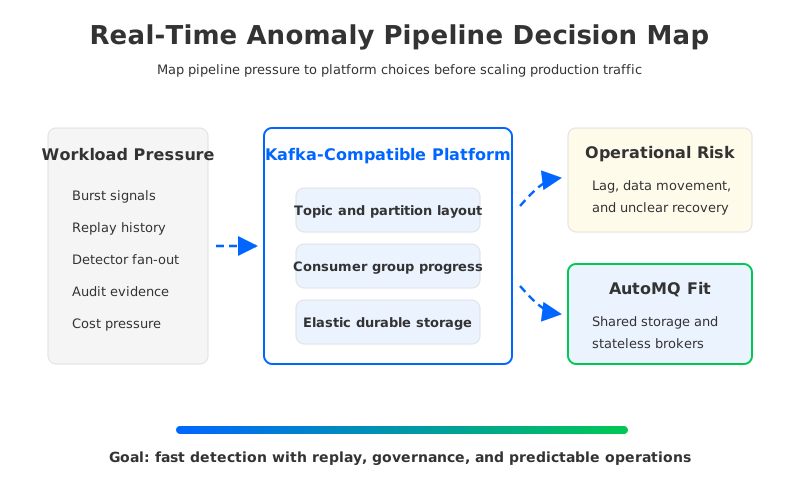
The architecture pressure comes from the word "real-time." Detection latency is only one part of it. The pipeline also needs replayable input for tuning, durable storage for audit trails, stable consumer progress, and enough elasticity to absorb bursts without turning every incident into a capacity exercise. When the transport layer is brittle, anomaly detection starts to behave like another noisy alert source. When the transport layer is predictable, detection becomes a control surface for operations.
1Why Teams Search for real time anomaly pipeline kafka
Most teams begin with a simple mental model: producers write operational signals into Kafka topics, a stream processor computes features or rules, and a consumer writes alerts or enriched records. That model is useful, but it hides the parts that make or break production. The pipeline must decide how long to retain raw signals, how to replay them after a model change, how to isolate high-cardinality telemetry, and how to keep backpressure in one domain from spreading into another.
Kafka is attractive here because it gives teams several properties that anomaly systems need. Topics provide a natural boundary between raw signals, enriched events, scored anomalies, and investigation records. Consumer groups let independent detectors read the same stream without coordinating through a shared database. Offsets give operators a concrete way to reason about progress. Kafka Connect reduces the friction of moving events from databases, observability systems, warehouses, and application services.
The production problem usually has four competing goals:
- Low detection delay, because late anomaly alerts are often worse than no alerts.
- Replayable history, because thresholds, features, and models change after incidents.
- Operational isolation, because security, telemetry, fraud, and platform signals do not fail in the same way.
- Predictable cost, because high-volume operational signals can outgrow the original business case.
These goals pull against each other. Longer retention improves replay and forensics, but increases storage cost. More partitions improve parallelism, but add metadata and balancing work. More consumers improve specialization, but create more places where lag can hide. Good architecture accepts these tensions.
2The Production Constraint Behind the Problem
Traditional Kafka's shared-nothing architecture binds broker compute and broker-local storage together. That design has served stable workloads with predictable capacity. The challenge appears when anomaly pipelines behave like the incidents they are meant to detect: quiet for hours, suddenly busy, then in need of retrospective analysis. Broker-local storage turns those changes into a capacity and data movement problem.
Consider a platform team ingesting operational signals from several environments. During a normal day, the pipeline may keep up with a modest number of detectors. During a release incident, log volume rises, trace sampling changes, and more teams start querying or replaying data. The streaming layer has to serve fresh events and catch-up reads at the same time. If broker disks are the primary storage boundary, scaling the cluster can involve partition movement, replica catch-up, and careful rebalance planning exactly when operators want fewer moving parts.
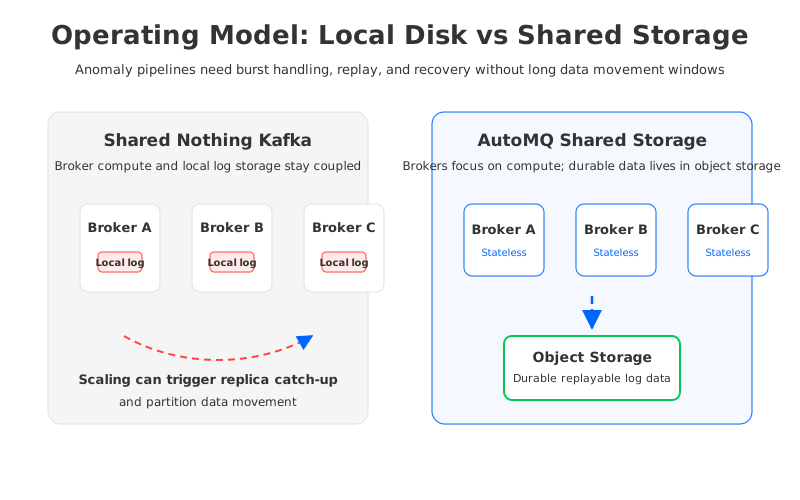
The same constraint shows up in cost accounting. Operational signals are often verbose, uneven, and hard to forecast. Teams may retain them for investigation even when only a small fraction become anomalies. With broker-local storage, retention decisions are coupled to broker sizing, disk layout, and replication overhead. In cloud deployments, multi-AZ durability and cross-zone consumption can also create network cost patterns not obvious from the pipeline diagram.
None of this means traditional Kafka is the wrong foundation. It means the platform team needs to separate the application question from the infrastructure question. The application question is: which signals, features, models, and alert policies identify the right anomalies? The infrastructure question is: can the streaming layer absorb unpredictable signal volume while keeping replay, governance, and recovery under control?
3Architecture Options and Trade-offs
A real-time anomaly pipeline normally has five stages. First, producers emit operational signals from services, databases, devices, security tools, or observability collectors. Second, Kafka-compatible topics normalize those signals into durable streams. Third, stream processing jobs enrich, aggregate, window, or score the data. Fourth, alert and response systems route anomalies to humans or automated actions. Fifth, data lake or warehouse sinks preserve evidence for later investigation.
The stages are straightforward to draw. The trade-offs live between them.
| Design area | What platform teams need to decide | Failure mode when ignored |
|---|---|---|
| Topic layout | Separate raw, enriched, scored, and audit streams by ownership and retention | One noisy signal class consumes shared capacity |
| Consumer groups | Give detectors independent progress and replay controls | A slow detector blocks unrelated workflows |
| Retention | Keep enough history for tuning, forensics, and rollback | Model changes cannot be validated against past incidents |
| Connectors | Standardize ingestion and sinks without hiding operational state | Data enters or leaves the pipeline without clear ownership |
| Governance | Track data boundaries, access, encryption, and auditability | Anomaly data becomes a compliance risk |
| Elasticity | Scale for bursts without long data movement windows | Incidents become cluster resizing exercises |
The table is infrastructure-heavy because anomaly detection quality depends on operational quality. A model can tolerate imperfect features for a short period. It cannot tolerate missing input, unbounded lag, or a replay path that no one trusts. The pipeline must be designed as an operational system first and an analytics system second.
Stream processors such as Flink, Spark Structured Streaming, Kafka Streams, or purpose-built detection services can all sit behind Kafka. The choice depends on state size, windowing needs, model runtime, and team skill. Kafka's role is to keep the event log stable while those processors evolve. That stability is especially important for anomaly work because the definition of "abnormal" changes after each incident.
There is also a subtle governance issue. Operational signals often contain sensitive context: user identifiers, IP addresses, deployment metadata, device locations, or security events. The streaming platform must support clear ownership, access control, encryption, audit trails, and environment boundaries. If those controls are bolted on after the pipeline grows, the organization may end up with a fast anomaly system that is difficult to approve for the signals it actually needs.
4Evaluation Checklist for Platform Teams
Before choosing a Kafka-compatible platform for anomaly pipelines, evaluate it against the operating model, not only the benchmark number. Throughput matters, but burst recovery, storage economics, and migration mechanics decide whether the pipeline survives contact with production. A useful checklist starts with compatibility because most teams cannot rewrite producers, consumers, connectors, and stream processors for another transport layer.
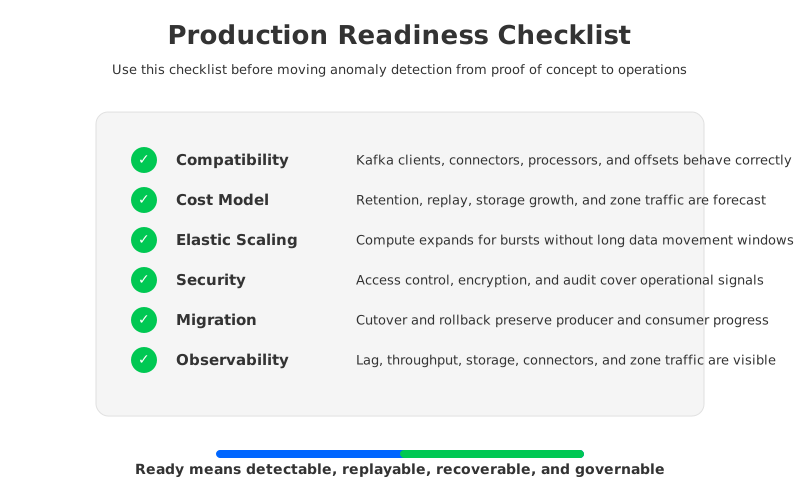
The next dimension is elasticity. Ask how the platform adds compute capacity when ingestion rises, and whether scaling requires large data movement. Ask how it behaves when consumers need catch-up reads while producers continue writing fresh events. Also ask how partition reassignment works, because anomaly pipelines often start small and then grow into many specialized topics.
Cost deserves its own pass. Operational signals are high-volume by nature, and the business value is concentrated in a small subset of events. That makes the storage model important. Retention, replication, object storage, cross-AZ traffic, and catch-up reads can dominate the infrastructure bill. A platform that looks cost-effective for short-lived streams may be less attractive when the pipeline needs weeks of replayable evidence.
The practical evaluation should include these questions:
- Can existing Kafka clients, connectors, and stream processors keep their current protocol and semantics?
- Does the platform separate compute scaling from durable storage growth?
- How quickly can the cluster recover from a broker failure or planned node replacement?
- What happens to inter-zone traffic when producers, brokers, and consumers span availability zones?
- Can security teams enforce access control, encryption, and audit expectations without a special-case pipeline?
- Is there a migration and rollback path that preserves consumer progress?
- Are lag, throughput, storage, connector state, and cross-zone traffic observable in the same operational workflow?
The point is not to score every platform with the same weight. Fraud detection may prioritize low-latency enrichment and replayable history. Platform observability may care more about burst elasticity and cost per retained event. Security anomaly detection may put governance and auditability first.
5How AutoMQ Changes the Operating Model
Once the evaluation moves from application logic to operating model, shared storage becomes the key architectural question. AutoMQ is a Kafka-compatible cloud-native streaming platform that keeps Kafka protocol compatibility while moving durable log storage to object storage through a shared storage architecture. The broker is no longer the long-term owner of local data in the same way traditional Kafka brokers are. That changes how platform teams think about scaling, balancing, and recovery.
For anomaly pipelines, the first effect is clearer separation between compute and storage. Compute capacity can be planned around ingestion, consumption, and processing pressure, while durable history can grow in object storage. That separation matters when teams need to retain operational signals for investigation but do not want retention growth to force proportional broker-local disk growth.
The second effect is recovery behavior. If a broker fails in a local-disk-centered design, the cluster has to account for the data that broker hosted. With shared storage and stateless brokers, replacement focuses more on bringing compute capacity back and less on reconstructing a large local storage footprint. That distinction matters during anomaly incidents because the pipeline may already be under unusual load.
The third effect is cloud traffic control. AutoMQ documentation describes approaches for eliminating inter-zone traffic through its S3-based storage architecture and zone-aware client and broker configuration. For operational-signal pipelines across multiple availability zones, this is not cosmetic. Cross-zone traffic can become a recurring cost center when high-volume consumers and catch-up readers are spread across zones.
AutoMQ should not be treated as a shortcut around pipeline design. Teams still need sane topic boundaries, consumer group ownership, observability, retention policy, connector operations, and governance controls. The architectural difference is that the streaming layer can be operated with less coupling between data growth and broker-local capacity.
6A Practical Build Pattern
A production anomaly pipeline should start with a raw event log that is intentionally plain. Producers write operational signals into domain-owned topics. Stream processors create enriched and scored streams. Alerting systems consume scored anomalies. A lake or warehouse sink keeps evidence for offline analysis and model improvement. If every team invents a different event contract, the anomaly pipeline becomes a set of bespoke integrations instead of a shared operating capability.
The next layer is replay discipline. Raw topics should have retention that reflects investigation needs, not only detector latency. Enriched topics can often have shorter retention because they can be regenerated. Scored anomaly topics should preserve enough context for audit and response. Consumer offsets should be treated as operational state, with clear procedures for reset, replay, and rollback.
Finally, build the pipeline around failure drills. Inject a high-volume signal class. Pause a detector and observe lag recovery. Replace broker capacity. Rebuild an enriched stream from raw history. Verify that alert routing works when a sink is slow. These drills expose whether the architecture is genuinely real-time or merely fast during normal traffic.
The strongest anomaly pipeline is not the one that detects every unusual event. It is the one whose operators can explain, replay, and recover from unusual events while the business is still running.
That operating loop is where Kafka-compatible infrastructure earns its place. The event log becomes the shared memory for detection, response, and post-incident learning. The platform's job is to keep that memory durable, governed, elastic, and affordable enough that teams do not shorten retention or reduce coverage for the wrong reasons.
If your team is evaluating Kafka-compatible infrastructure for anomaly pipelines, review AutoMQ's shared storage architecture and Kafka compatibility in the documentation: Explore AutoMQ for cloud-native Kafka-compatible streaming. Use it as a reference point for the questions above: compatibility first, then elasticity, recovery, traffic control, governance, and migration risk.
7References
- Apache Kafka documentation
- Apache Kafka consumer configuration
- Apache Kafka Connect documentation
- Apache Kafka semantics and transactions
- AutoMQ architecture overview
- AutoMQ native compatibility with Apache Kafka
- AutoMQ inter-zone traffic overview
- AutoMQ migration from Apache Kafka
8FAQ
8.1Is Kafka required for a real-time anomaly pipeline?
No, but Kafka is a strong default when the pipeline needs durable event history, replay, fan-out, and a broad connector ecosystem. Some teams can use a database change stream, a queue, or an observability backend for narrower cases. Kafka becomes more attractive when multiple detectors, sinks, and investigation workflows need the same ordered event history.
8.2What is the hardest part of using Kafka for anomaly detection?
The hardest part is usually not event ingestion. It is keeping lag, replay, retention, connector state, and governance manageable as signal volume grows. Anomaly workloads are bursty by nature, so platform teams need to test failure and catch-up behavior before declaring the pipeline production-ready.
8.3How long should anomaly pipeline data be retained?
Retention should match investigation, tuning, and compliance needs. Raw operational signals often need longer retention than enriched or scored streams because raw history is the source for replay. The exact period depends on incident review practices, legal requirements, storage cost, and whether downstream enrichment can be reproduced.
8.4Where should AutoMQ fit in the architecture?
AutoMQ fits at the Kafka-compatible streaming infrastructure layer. Producers, consumers, stream processors, and connectors interact through Kafka-compatible APIs, while AutoMQ's shared storage architecture changes how the platform handles durable storage, elasticity, balancing, and cloud traffic control.
8.5How should a team validate migration risk?
Start with client and connector compatibility, then test consumer group behavior, offset handling, replay, retention, security settings, observability, and rollback. A migration plan should preserve business continuity first. Performance improvement is useful only when the team can also prove that consumers keep progress and operators can return to a known state.


