
Table of Contents
Table of Contents
Teams usually search for real time business metrics kafka when the business has stopped accepting yesterday's truth. A revenue dashboard that refreshes after the campaign ends is not operational intelligence. A fraud signal that arrives after the account has already moved money is audit data. A supply chain metric that waits for a nightly batch can explain a missed SLA, but it cannot help the operations team prevent it.
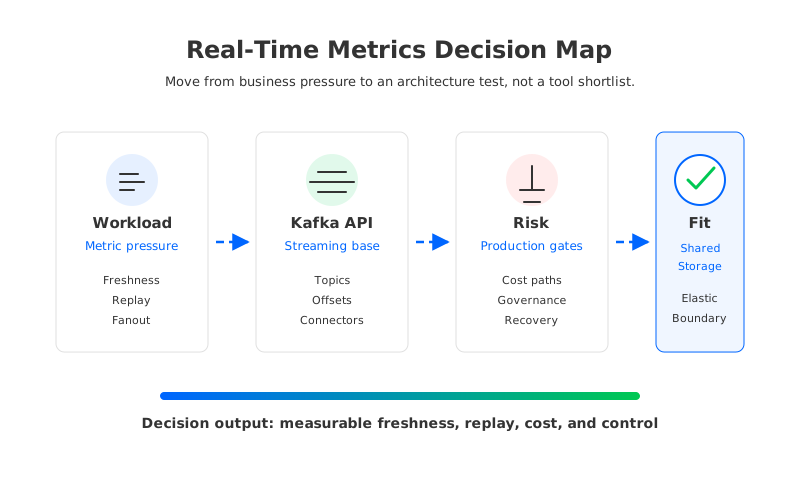
Kafka-compatible streaming enters the conversation because business metrics are no longer produced by one database at the end of a process. Orders, payments, subscriptions, inventory changes, device readings, support tickets, and clickstream events all carry partial truth. The metric becomes useful only after those events are joined, filtered, enriched, and delivered to systems that can act. The architecture question is not whether Kafka can move events. The harder question is whether the platform can keep the metric fresh while traffic, retention, governance, and team ownership change under it.
This is where many real-time metric projects become infrastructure projects. The dashboard owner asks for freshness, the data team asks for replay, SRE asks for predictable recovery, finance asks why the streaming bill rises when average throughput looks flat, and security asks where customer data crosses account or region boundaries.
1Why Teams Search for real time business metrics kafka
The search phrase is practical because the problem sits between analytics and operations. A warehouse can be the system of record for historical analysis, but many business decisions now need a living metric: active users by region, checkout failures by payment provider, promotion conversion by minute, support backlog by severity, inventory burn-down by location, or risk exposure by customer segment. These metrics are not only read by humans. They often drive alerts, feature flags, fraud models, fulfillment decisions, and customer-facing status pages.
Kafka is attractive because it gives teams a durable event log with producers, topics, consumer groups, offsets, and replay. Those primitives fit metrics that need fanout: one consumer updates a dashboard, another writes into a lakehouse table, another feeds a stream processor, and another triggers alerts.
But the moment a business metric becomes real time, its quality depends on more than event transport. Metric freshness is affected by producer batching, broker write latency, consumer lag, stream processing state, connector retries, schema changes, and downstream query serving.
The first design pass should separate four questions that are often blended together:
- What is the metric's action window? A dashboard for executive review, an inventory allocator, and a fraud decision engine can all be "real time" in a conversation, but they tolerate different freshness and recovery behavior.
- What is the replay contract? Some metrics can accept correction later; others require deterministic recomputation from retained events when business logic changes.
- Who owns the boundary? The source application, streaming platform, stream processor, warehouse, and BI layer may belong to different teams, which makes incident ownership a design problem.
- Where does sensitive data live? Customer identifiers, payment metadata, account state, and operational telemetry often require stronger controls than anonymous click counts.
These questions turn a generic Kafka discussion into an architecture review. A Kafka-compatible platform can still fail the metric if it cannot make freshness, replay, cost, and governance visible.
2The Production Constraint Behind the Problem
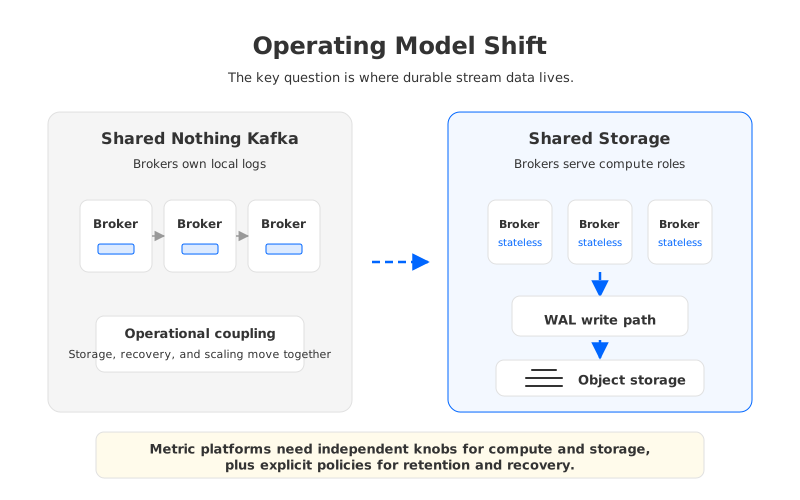
Traditional Kafka uses a Shared Nothing architecture. Brokers own local log segments, partitions have leaders and followers, and replication protects the log across broker failures. That model provides a clear event log abstraction with consumer groups, offset tracking, producer delivery semantics, and a mature ecosystem around Kafka Connect and stream processing.
The constraint appears when the metric workload does not behave like the capacity plan. Business metrics often have uneven traffic. Product launches, sales campaigns, market openings, incidents, billing cycles, and external events can all create short bursts. Retention may also change after launch because teams discover that replay is valuable for metric correction, audit, model training, or backfills. In a broker-local design, those changes translate into disk sizing, partition placement, replication traffic, and operational work.
Cloud deployment adds another layer. Multi-zone Kafka designs need careful placement of clients, brokers, replicas, and consumers. Cross-zone traffic can be a meaningful cost category, and it is easy to under-model because it is not visible in the application code. A metric pipeline can look efficient at the average write rate while still paying for replication, catch-up reads, connector traffic, private networking paths, and retained bytes.
The issue is not that Shared Nothing Kafka is broken. Real-time business metrics expose every coupling in the design: durable storage, partition ownership, replication work, and replacement behavior. When the business asks for more freshness, more retention, and more consumers at the same time, the platform team has fewer independent knobs than the dashboard owner assumes.
3Architecture Options and Trade-Offs
The conservative option is a traditional Kafka cluster, either self-managed or delivered through a managed service. It can be the right choice when throughput is predictable, retention is short, the team already has Kafka SRE muscle, and the cost model is well understood.
The trade-off is operational coupling. Broker count, broker storage, partition balance, replica placement, and recovery time remain part of the metric's reliability story. Tiered storage helps by moving older log segments to remote storage, and Apache Kafka's tiered storage work matters for long retention. But tiered storage does not make brokers stateless. The platform still needs to test hot data behavior, leadership movement, local cache effects, and recovery under the actual metric workload.
Another option is to land events directly into object storage and make the lakehouse the primary metric substrate. This can work when the business accepts analytical freshness and most consumers are query engines or batch transformations. The risk is that teams may end up rebuilding stream semantics around files when they still need low-latency fanout, ordered processing, consumer progress, and application-facing reactions.
A third option is Kafka-compatible streaming with Shared Storage architecture. In this model, applications keep the Kafka API surface while the platform changes the storage and elasticity model underneath. Brokers focus on protocol processing, scheduling, caching, and request serving, while durable stream data is backed by a shared storage layer with a write-ahead log in the hot path. The point is not to remove all operational thinking. The point is to make compute, storage, retention, and broker lifecycle less tightly bound to broker-local disks.
The right comparison is not a feature checklist. It is a failure and growth exercise:
| Decision area | Broker-local Kafka question | Shared-storage question |
|---|---|---|
| Retention growth | Which brokers need more disk and when will data move? | How does object storage, WAL storage, and cache behavior scale? |
| Burst handling | How much broker headroom is reserved for peak writes and reads? | How quickly can compute capacity change without moving retained logs? |
| Recovery | How long does broker replacement or replica catch-up affect the metric? | How does recovery use shared durable data plus WAL state? |
| Cost visibility | How much comes from compute, disks, replication, and cross-zone traffic? | How much comes from compute, object storage, WAL, requests, and networking? |
| Governance | Where do replicas and consumers place sensitive data? | Which account, bucket, VPC, IAM, and audit boundary owns the data path? |
The table narrows the evaluation. If the metric is latency-sensitive, WAL choice and cache behavior deserve real tests. If the metric needs long replay, object storage behavior and catch-up reads matter. If the metric carries regulated data, deployment boundary can be as important as throughput.
4Evaluation Checklist for Platform Teams
A production checklist should start at the application interface because that is where migration risk hides. Test actual client libraries, authentication, producer settings, compression, idempotent writes, transactions if used, schema registry behavior, admin tooling, and consumer group behavior. Kafka compatibility is not proven by a hello-world producer; it is proven when the team's real clients survive failure, rebalance, replay, and cutover.
Cost modeling should follow the metric's full path. Include producers, brokers, connectors, stream processors, object storage or disks, cross-zone traffic, private connectivity, monitoring, and downstream serving. Average throughput is a weak proxy for cost because a real-time metric can be dominated by read fanout, retained history, catch-up reads, and connector retries.
Governance needs equal attention. Business metrics often combine operational telemetry with customer identifiers, account attributes, payment state, or location data. The design needs classification, access control, encryption, audit logs, retention rules, deletion handling, and a clear processing boundary.
Use these gates before a metric stream becomes a production dependency:
- Define freshness as an SLO. "Real time" should become a measurable target that includes ingestion, stream processing, connector delivery, and dashboard or API serving.
- Test replay from realistic offsets. A metric that cannot be recomputed after a logic change is only real time until the first bad calculation.
- Model network paths. Cross-zone replication, consumer placement, private endpoints, and connector traffic can all affect the bill.
- Assign ownership for lag. The runbook should say who acts when producer errors, broker pressure, stream processing backpressure, and dashboard staleness appear together.
- Prove rollback before cutover. Producers, consumers, offsets, ACLs, schemas, and dashboards need a path back or a safe pause state.
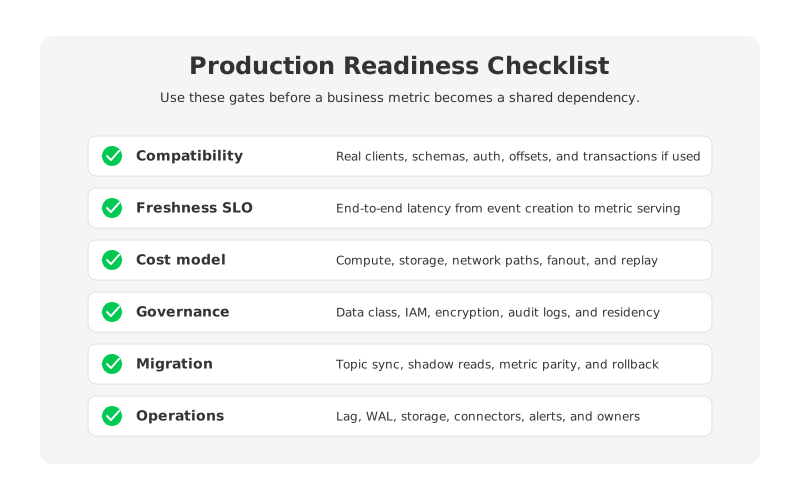
This checklist also prevents a common mistake: treating the streaming platform as isolated middleware. A business metric is a chain, and its weakest owned segment determines whether it is trusted.
5How AutoMQ Changes the Operating Model
After the neutral evaluation, AutoMQ is relevant as a Kafka-compatible, cloud-native streaming platform built around Shared Storage architecture. It keeps Kafka-facing clients and ecosystem expectations while changing the relationship between brokers and durable stream data. That relationship is central to real-time metrics because retention, replay, broker replacement, and burst capacity often determine whether a metric stays useful under pressure.
AutoMQ uses stateless brokers with S3Stream shared storage and WAL storage for the write path. Persistent stream data is stored in object storage, while brokers handle Kafka protocol work, request processing, caching, partition leadership, and scheduling. In practical terms, platform teams can evaluate Kafka compatibility while testing a different operating model: broker lifecycle actions are less tied to copying broker-local retained logs, and storage growth can be reasoned about separately from compute capacity.
That separation matters for business metrics in three areas. Retention becomes easier to discuss as a storage policy instead of a broker disk ceiling. Elasticity becomes easier to test as compute scheduling and traffic balance instead of large data movement. Governance becomes more concrete when the deployment model keeps the data path, object storage, networking, IAM, and audit boundary inside a customer-controlled environment.
AutoMQ BYOC is designed for that customer-controlled cloud boundary, while AutoMQ Software targets customer-managed environments such as private data centers. AutoMQ documentation also covers Kafka compatibility, Shared Storage architecture, WAL storage, Continuous Self-Balancing, cross-zone traffic reduction, and migration through AutoMQ Linking.
There are still trade-offs to validate. Object storage behavior, WAL type, cache warm-up, stream processor state, connector compatibility, and regional cloud design all influence the result. A useful proof of concept reflects the hardest metric, not the easiest topic.
6A Practical Migration Path
Migration should begin with metric lineage. List the source applications, topics, schemas, transformations, consumer groups, connector jobs, dashboards, alerts, owners, and rollback requirements. Then group metrics by blast radius. Customer-facing operational metrics should wait until offset behavior, replay correctness, and failure handling are proven.
Parallel validation is usually the cleanest pattern. Mirror selected topics into the target environment, run shadow consumers, compare derived metrics, and watch lag and error rates before changing the write path. This exposes differences in schema handling, timestamp logic, ordering assumptions, or connector behavior. The migration is complete when the business metric matches, the runbook works, and rollback has been rehearsed.
The final check is trust. Business teams stop using a metric if it is fresh but inconsistent, fast but unexplainable, or unavailable during the moments that matter. The platform's job is to make it observable, recoverable, governed, and costed without surprises.
If your team is evaluating Kafka-compatible infrastructure for real-time business metrics, anchor the review in the metric's action window, replay contract, cost path, and governance boundary. To see how AutoMQ's Shared Storage model, Kafka compatibility, and customer-controlled deployment options fit that evaluation, start with AutoMQ Cloud.
7References
- Apache Kafka Documentation
- Apache Kafka Consumer Configuration
- Apache Kafka Transactions and Semantics
- Apache Kafka Connect Documentation
- Apache Kafka KIP-405: Kafka Tiered Storage
- Amazon S3 User Guide
- AWS Data Transfer Documentation
- AutoMQ Kafka Compatibility
- AutoMQ Shared Storage Architecture
- AutoMQ WAL Storage
- AutoMQ Continuous Self-Balancing
- AutoMQ Linking Migration Overview
8FAQ
8.1Is Kafka a good fit for real-time business metrics?
Kafka is a strong fit when the metric depends on ordered event streams, replay, consumer groups, and fanout to multiple systems. The platform still needs careful design around freshness SLOs, schema evolution, consumer lag, governance, cost, and ownership.
8.2What makes real-time business metrics harder than ordinary streaming ingestion?
The metric is judged by business trust, not only by event delivery. A pipeline can move records successfully while the dashboard is stale, the calculation is inconsistent, or the runbook cannot explain a gap. Freshness, correctness, replay, and observability have to be designed together.
8.3Does Kafka Tiered Storage make brokers stateless?
No. Tiered Storage can move older log segments to remote storage and reduce local disk pressure, but brokers still retain important responsibilities for active data, leadership, replication, cache behavior, and recovery. Shared Storage architecture changes the model more directly by separating durable stream data from broker-local disk ownership.
8.4Where should AutoMQ enter the evaluation?
AutoMQ should enter after the team defines compatibility, freshness, cost, governance, recovery, and migration requirements. It is relevant when the workload needs Kafka-compatible APIs with stateless brokers, Shared Storage architecture, WAL-backed writes, elastic capacity, and customer-controlled deployment boundaries.
8.5What should be tested before migrating a metric pipeline?
Test real clients, authentication, producer settings, schemas, transactions if used, consumer offsets, connector behavior, stream processor state, replay correctness, WAL and storage behavior, lag recovery, cost signals, alerting, and rollback. Use a high-pressure metric rather than a low-volume sample topic.


