
Table of Contents
Table of Contents
Dashboards become political when the numbers stop matching. Product asks why active sessions are stale, operations asks why the incident board is late, and finance asks why a "small" refresh job is now one of the loudest workloads in the warehouse. The uncomfortable part is that the original design often looked reasonable: a web app polls an API, the API queries a database or cache, and every team gets a page that feels live enough until traffic, fan-out, and freshness expectations rise together.
That is why searches for real time dashboard feeds kafka usually come from teams that already know polling is not a complete answer. The question is not whether Kafka can move events into a dashboard. It can. The harder question is whether the feed architecture can keep freshness predictable without turning every dashboard refresh into another storage, networking, governance, and on-call problem.
1Why Teams Search for real time dashboard feeds kafka
Polling is attractive because it makes the first version easy to reason about. The browser asks for the current state, the backend returns JSON, and the database remains the source of truth. That model works when the dashboard has a handful of users, the refresh interval is relaxed, and the query shape is stable. It starts to bend when the same pattern is used for operational command centers, fraud views, IoT device maps, logistics boards, usage metering, or customer-facing analytics where the gap between "event happened" and "operator saw it" has business meaning.
The first failure mode is load concentration. If thousands of clients poll every few seconds, the backend sees synchronized bursts even when the underlying data has barely changed. Caches help, but they also introduce invalidation and freshness questions. Materialized views help, but they still need a feed of changes. Eventually the architecture needs to stop asking, "What changed since the last HTTP request?" and start maintaining a stream of state transitions that consumers can process at their own pace.
Kafka fits that need because it gives the dashboard layer a durable event log, replayable offsets, consumer groups, and a mature ecosystem for stream processing and connectors. A dashboard service can consume account events, order updates, device telemetry, or risk scores, build a compact serving state, and push changes to clients through WebSockets, Server-Sent Events, GraphQL subscriptions, or another application channel. The browser no longer has to interrogate the system on a timer; the system publishes changes as they happen.
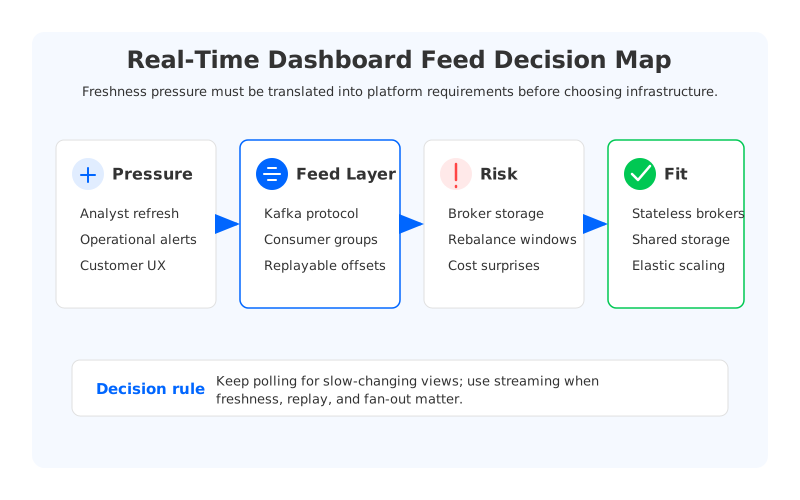
The catch is that Kafka removes one fragile layer only if the platform underneath it is designed for the same operating pressure as the application above it. Real-time dashboard feeds are read-heavy, fan-out-heavy, and bursty. They often mix low-latency user-visible paths with high-throughput ingestion paths. They also need replay after deploys, backfills after schema fixes, and controlled cutovers when the dashboard moves from polling to streaming.
2The Production Constraint Behind the Problem
A dashboard feed has a stricter contract than many internal pipelines because humans are watching it. A data warehouse report that is a few minutes late may annoy stakeholders; an incident dashboard that hides a customer-impacting error for a few minutes changes the response. That visibility changes how teams should define the system. The feed is not a convenience cache. It is a production serving path with its own latency budget, recovery objective, access policy, and rollback plan.
The latency budget has several parts. Producer applications must publish events quickly enough. The Kafka-compatible platform must accept, persist, replicate, and expose those events without creating broker-side bottlenecks. Stream processors must update derived state without unbounded lag. The serving layer must push updates to clients without creating retry storms. If any stage is treated as "probably fine," the dashboard freshness objective becomes a hope rather than an SLO.
Four questions separate a useful real-time feed from an accidental distributed system:
- What is the authoritative event boundary? The team needs a clear rule for what becomes an event, what remains a query against state, and how late or corrected data is represented.
- What does replay mean? Replaying offsets into a materialized view is powerful, but it must not duplicate notifications, corrupt counters, or violate user-visible ordering assumptions.
- Who owns freshness? Application teams may own the dashboard, but platform teams usually own broker capacity, network paths, retention, and observability.
- How does the system fail? A stale dashboard, a partial dashboard, and a blank dashboard create different operational responses. The architecture should make those states visible.
These questions are independent of vendor choice. They apply whether the cluster is self-managed, managed by a cloud provider, or delivered by a Kafka-compatible platform. The vendor decision comes later, after the team understands which layer is carrying which operational risk.
3Architecture Options and Trade-Offs
The simplest architecture keeps polling but moves expensive queries behind a cache or read model. This can be enough for dashboards where "near real time" means tens of seconds or minutes, the user count is bounded, and the source tables are not under stress. It is also a good transitional state: change-data capture or application events populate a serving table, while the frontend continues to fetch snapshots. The limitation is that the client experience still depends on intervals, cache invalidation, and query fan-out.
A stronger design makes Kafka the feed backbone. Producers write events into topics, processors maintain the dashboard state, and the frontend subscribes to a serving channel. Kafka consumer groups allow independent services to read the same events without coupling every dashboard to every producer. Offsets make recovery explicit: if a processor deploy fails, it can resume from a known position rather than asking the database to reconstruct time.
The third design adds lakehouse or analytical storage to the path. Operational dashboards still need low-latency serving state, but analytics teams may also want the same events in object storage, Iceberg tables, or a warehouse. Kafka Connect, CDC tools, and stream processors can all move data downstream, but each handoff adds ownership, monitoring, schema evolution, and recovery work.
| Architecture pattern | Good fit | Hidden cost |
|---|---|---|
| Polling plus cache | Low fan-out, relaxed freshness, bounded users | Cache invalidation and synchronized refresh bursts |
| Kafka feed plus serving state | User-visible freshness, replay, independent consumers | Broker capacity, lag management, client push infrastructure |
| Kafka plus lakehouse integration | Dashboards and analytics share event sources | Connector operations, schema governance, downstream consistency |
| Shared-storage Kafka-compatible platform | Elastic workloads and cloud cost control | Requires platform evaluation beyond API compatibility |
The platform question becomes sharper as workloads grow. Traditional Kafka's Shared Nothing architecture stores partition data on broker-local disks and relies on replication across brokers for durability and availability. That design is proven, but it makes storage part of the broker identity. Scaling, replacing, or rebalancing brokers can trigger data movement. For a dashboard workload, that operational work can compete with the same network and disk resources needed to keep feeds fresh.
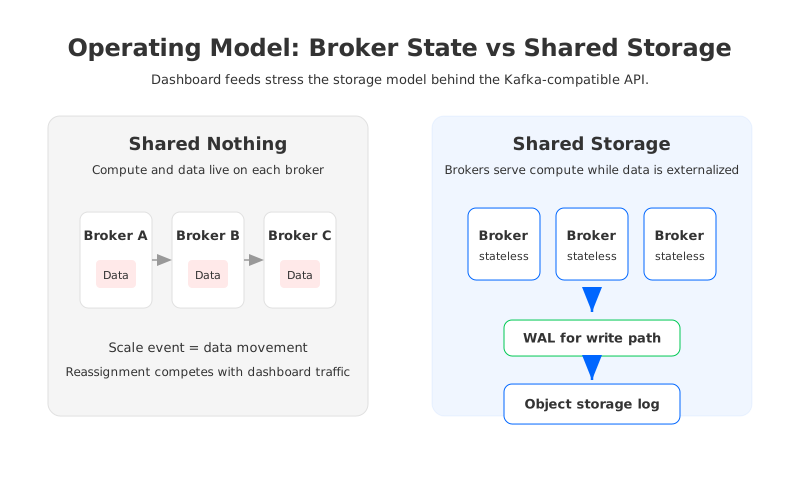
Tiered Storage can reduce pressure on local disks by moving older data to object storage, and it is useful for retention-heavy workloads. It does not automatically make the active broker path stateless. Platform teams still need to understand which data remains local, how reassignments behave, how consumers read remote segments, and how recovery changes under load. A dashboard feed cares about the hot path first; historical retention helps only after freshness is protected.
4Evaluation Checklist for Platform Teams
The right evaluation starts with compatibility but should not end there. Kafka API compatibility matters because dashboard feeds rarely live alone. They interact with existing producers, stream processors, schema registries, connectors, security policies, and deployment automation. A replacement that forces application rewrites may erase the value of moving away from polling in the first place.
Once compatibility is credible, the evaluation should move to operating behavior. Ask how the platform handles broker failure, scale-out, scale-in, partition movement, retention growth, and read fan-out. A useful test shows what happens while data is flowing, consumers are behind, a node disappears, and a dashboard still has users staring at it.
Cost deserves the same treatment. Kafka dashboard feeds generate cost through more than broker instances. Storage, replication, cross-zone traffic, connector compute, stream processing state, cache capacity, and egress to clients can all show up in different lines of the cloud bill. The architecture should make those paths visible before the team promises "real time" as a product feature.
Use this checklist before declaring the polling layer retired:
- Compatibility: existing Kafka clients, topic configurations, ACL patterns, schemas, and consumer group behavior should work with minimal application change.
- Freshness: lag should be measured from event production through dashboard rendering, not only at the broker or processor.
- Elasticity: expected traffic spikes should be handled without long data rebalancing windows or emergency overprovisioning.
- Governance: the feed should respect tenant, region, IAM, encryption, and audit boundaries.
- Migration: the polling path and streaming path should run side by side until correctness and latency are proven.
- Rollback: teams should know whether rollback means switching clients, replaying offsets, restoring serving state, or all of the above.
- Observability: producer errors, broker metrics, consumer lag, processor checkpoints, serving latency, and client delivery failures should be correlated.
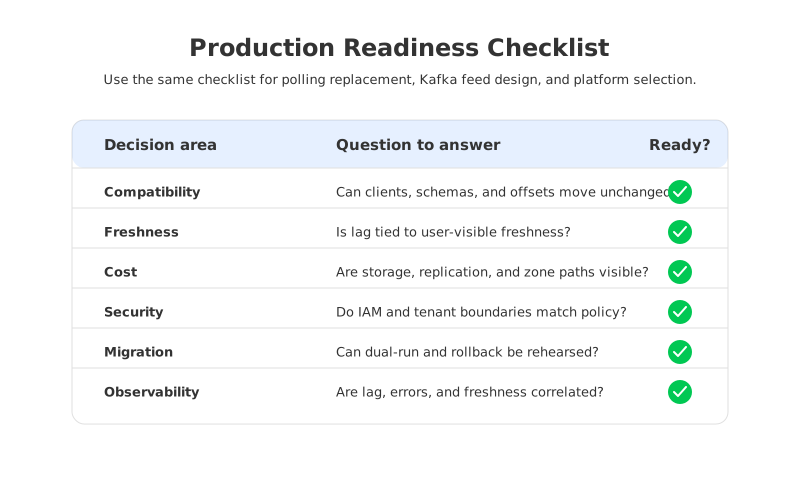
This checklist also prevents a common sequencing mistake. Teams sometimes build the WebSocket layer first because it is visible, then discover that the event model, schema policy, or broker operations are the real blockers. The better sequence is less glamorous: define event boundaries, prove replay, measure lag, then expose live updates.
5How AutoMQ Changes the Operating Model
If the evaluation points to Kafka compatibility but the operational concern is broker-local state, the architectural category to look at is Kafka-compatible streaming with shared storage. AutoMQ is one implementation of that category: it preserves Kafka protocol compatibility while replacing the traditional broker-local storage model with an object-storage-backed architecture.
The important shift is not cosmetic. In a Shared Storage architecture, brokers no longer have to be treated as the permanent owners of partition data. AutoMQ externalizes durable data to object storage and uses a WAL layer for the write path, which changes how scaling and recovery are managed. A broker can be added, removed, or replaced without the same assumption that large amounts of local partition data must follow it.
For dashboard feeds, that matters in three ways. First, it reduces the coupling between traffic spikes and storage movement. If a dashboard suddenly needs more feed capacity, the platform team wants to add serving capacity without a long broker-local data migration. Second, compute and storage can scale more independently, which fits workloads where retention and live fan-out grow at different rates. Third, cloud cost analysis becomes clearer because object storage, broker compute, and network paths are separate design dimensions.
AutoMQ also provides a bridge for teams that want dashboard feeds and analytical access to the same event stream. Its Table Topic capability writes streaming data into Iceberg-oriented table storage, which can reduce the need for a separate ETL chain in some analytics scenarios. That does not replace serving state for low-latency dashboards, but it can simplify the surrounding architecture when operations, product analytics, and data science need the same events.
The practical evaluation remains the same: test compatibility, failure behavior, freshness, cost, and migration. AutoMQ is most useful after the team has concluded that dashboard feeds need Kafka semantics but should not inherit broker-local storage as the next fragile layer.
6Migration Pattern: From Polling to Streaming Without a Big-Bang Cutover
The safest migration starts by observing the existing polling path rather than replacing it. Measure request rate, query latency, cache hit ratio, stale responses, and user-visible refresh delay. That baseline tells the team whether streaming is solving the right problem and gives product owners a concrete freshness target.
Next, introduce events behind the current dashboard. Producers publish the state changes that matter, and a consumer builds a read model that can be compared against the existing polling response. At this stage, users do not need to see the streaming path. The goal is to prove event completeness, ordering assumptions, schema behavior, and replay. If the read model cannot match the prior response under controlled conditions, pushing updates to browsers will only make the mismatch visible faster.
After correctness is proven, the serving layer can expose incremental updates. Many teams keep snapshot fetches for initial page load and use streaming updates for changes after the page is open. That hybrid model is often more robust than trying to deliver every piece of dashboard state through a live channel. It also gives a clean fallback: if the streaming channel is degraded, the application can show a freshness warning and temporarily rely on slower snapshot refreshes.
The final step is operational ownership. Document who owns topics, schemas, lag, checkpoints, serving state, client delivery, and incident response. Real-time dashboards cross boundaries by design; without explicit ownership, the first serious incident becomes an ownership argument.
7References
- Apache Kafka Documentation
- Apache Kafka KRaft Documentation
- Apache Kafka Tiered Storage Documentation
- AWS S3 Pricing
- Amazon S3 User Guide
- AutoMQ Architecture Overview
- AutoMQ Table Topic Overview
8FAQ
8.1Is Kafka required for every real-time dashboard feed?
No. Polling or cache-backed snapshots can still be the right answer for slow-changing dashboards, small user groups, and views where stale data has low impact. Kafka becomes more attractive when the dashboard needs replayable events, multiple independent consumers, consistent freshness tracking, and a clean way to decouple producers from serving views.
8.2Should the frontend connect directly to Kafka?
Usually no. A browser-facing dashboard normally talks to an application-owned serving layer through WebSockets, Server-Sent Events, GraphQL subscriptions, or normal HTTP snapshots. Kafka sits behind that layer as the durable feed and replay mechanism. This keeps credentials, authorization, backpressure, and client-specific delivery logic out of the broker layer.
8.3What metric matters most for dashboard freshness?
Consumer lag is necessary but not sufficient. The better metric is end-to-end freshness: event creation time to rendered dashboard update. That includes producer delay, broker persistence, consumer processing, serving-state updates, and client delivery.
8.4How does shared storage help real-time dashboard feeds?
Shared storage helps when the operational risk is broker-local state. If brokers can be scaled or replaced without moving large amounts of local partition data, platform teams have more room to respond to spikes and failures. The benefit is that elasticity is less likely to become a storage migration event.
8.5Where should teams start with AutoMQ?
Start with the architecture, not a slogan. Review the AutoMQ architecture overview, then test a representative dashboard feed with your real clients, schemas, retention policy, failure cases, and freshness SLO. That path gives the platform team evidence before changing the user-facing dashboard contract.


