
Table of Contents
Table of Contents
Data sovereignty used to be discussed after the data landed in a warehouse, lake, or archive. Kafka changes the timing. A stream may cross regions, service boundaries, private links, broker disks, connector workers, monitoring systems, and replay jobs before anyone calls it "stored data." For platform security teams, that means real time data sovereignty is not only a legal location question. It is an architecture question about where events move while the business is still reacting to them.
The hard part is that Kafka is designed for movement. Producers write continuously, consumers fetch at their own pace, offsets preserve replay, and partitions are replicated for availability. These strengths also create places where regional control can become ambiguous. A policy that says "customer data must stay in Region A" is too coarse unless the team can explain the broker storage model, replication path, network route, control plane, and evidence trail.
1Why Real Time Data Sovereignty Matters Now
Most sovereignty programs start with a simple question: where is the data? In batch systems, the answer often points to a database, bucket, table, or backup location. In Kafka, the answer must include data in motion and data retained for replay. A record can be written in milliseconds, consumed by several applications, retained for days, and replayed during an incident. If that record contains payment activity, identity context, health events, industrial telemetry, or public-sector data, the stream itself becomes regulated.
That is why "region selection" is only the first layer. A Kafka cluster deployed in the correct cloud region may still need answers for several control questions:
- Which account, VPC, subnet, or private environment contains the data plane?
- Which storage resources persist topic data, WAL data, snapshots, logs, and backups?
- Which services can move records into a different region through connectors, processors, or replication?
- Which operators, support processes, and automation systems can read or change the environment?
- Which logs prove that the intended network and storage paths were actually used?
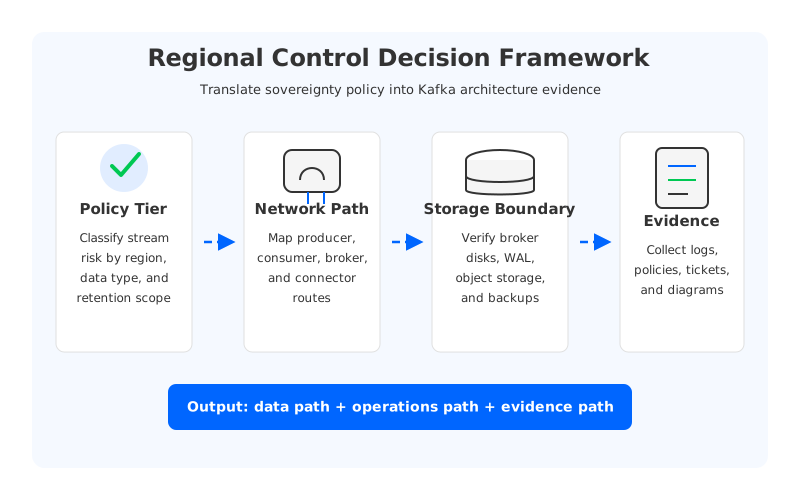
The useful shift is to design sovereignty as a control loop, not a label. A control loop has a declared policy, a technical boundary, continuous evidence, and an incident procedure. Kafka makes that loop more demanding because traffic is continuous and replayable. The architecture has to make the boundary visible before a reviewer asks for it.
2The Production Constraints Behind the Search
Traditional Apache Kafka runs with a shared-nothing storage model. Each broker owns local log segments for the partitions it hosts, and durability is achieved through replication across brokers. That design is proven and widely understood. It also means that data placement is tied to broker placement, replica placement, reassignment, and disk capacity. When a broker is replaced or partitions are rebalanced, the platform may move stored data as part of normal operations.
For regional control, that has two implications. First, capacity and locality are coupled: the team cannot scale broker compute without thinking about the durable partition data attached to it. Second, evidence is spread across Kafka metadata, broker storage, cloud disks, network paths, and operational logs. None of that is impossible to manage, but it raises the burden for teams that need a precise answer to "where did this stream live during normal operation and failure recovery?"
The constraints usually show up in four areas:
| Constraint | Why it matters for sovereignty | What to verify |
|---|---|---|
| Data plane boundary | Records are produced, stored, fetched, and replayed here | Region, account, VPC, subnet, endpoint, and broker placement |
| Storage ownership | Retained Kafka data is evidence-sensitive | Broker disks, remote tiers, object storage, WAL, snapshots, and backups |
| Operational control | Automation can change routes, access, and placement | Admin identities, support access, change logs, and break-glass paths |
| Scaling and recovery | Incidents can trigger movement across infrastructure | Reassignment, failover, restore, replay, and regional isolation plans |
This is also where cost and reliability intersect with governance. A platform can keep data in the right region but still require heavy overprovisioning, slow reassignment, or manual evidence gathering. A regional design that cannot scale under load may push teams into emergency changes that weaken the very controls the design was meant to protect.
3Architecture Patterns Teams Usually Compare
Teams evaluating real time data sovereignty for Kafka usually compare three broad patterns. The first is self-managed Kafka inside a controlled region. It gives the infrastructure team direct ownership, but the team also owns broker storage operations, patching, monitoring, partition placement, and incident recovery. This can satisfy strict controls, but it is rarely a light path.
The second pattern is managed Kafka as a service in an approved region with private networking and documented provider controls. This can reduce operational burden, and it may satisfy many residency programs when the provider boundary is acceptable. The important question is not whether the service has private connectivity. The question is whether the organization's policy allows the data plane and storage layer to sit inside that provider-operated service boundary.
The third pattern is a bring-your-own-cloud or private deployment model where the Kafka-compatible data plane runs in the customer's cloud account, VPC, or private environment. This can make evidence easier to produce because storage policies, IAM, key management, route tables, flow logs, and resource ownership live closer to the customer's governance system. It also creates shared responsibility. The customer has more control, and therefore more design work.
No pattern wins by default. The right choice depends on the workload's risk tier, the operating model, and the proof the organization needs to produce. A marketing event stream and a regulated transaction stream may both use Kafka clients, but they may need different deployment boundaries.
4Designing the Regional Control Model
A practical sovereignty design starts by drawing two paths: the steady-state data path and the operational access path. The steady-state path shows producer writes, broker handling, WAL or disk writes, durable storage, consumer fetches, connectors, processors, and observability exports. The operational path shows cluster creation, scaling, upgrades, emergency support, credential rotation, and configuration changes. Mixing those paths in one diagram is the fastest way to hide risk.
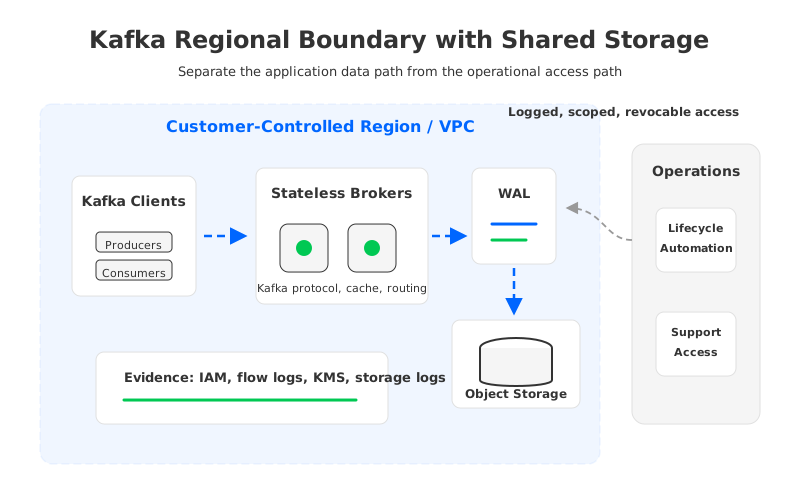
The steady-state path should answer where records go during normal operation. If a workload is bound to one jurisdiction, the diagram should show the exact region, cloud account, VPC, storage service, and endpoints involved. It should also show what does not happen: no cross-region replication, no public internet client path, no connector egress to unapproved destinations, or no vendor-side data plane if that is part of the requirement.
The operational path should answer who can change the system. This is where many sovereignty reviews become uncomfortable, because automation can be more powerful than application access. A deployment can keep records in-region while still allowing broad administrative actions from a remote control system. That may be acceptable if permissions are scoped, logged, and contractually governed. It is not acceptable if the team cannot describe it.
For Kafka, the design should be specific about several mechanisms:
- Replication and reassignment: Understand whether durability depends on broker-to-broker replicas, remote storage, object storage, or a combination. Then document how scaling and recovery affect data placement.
- Retention and replay: Treat retained event logs as regulated storage, not temporary transit. Replay can expose old records long after the original business event occurred.
- Connectors and stream processors: Include downstream services in the sovereignty model. A Kafka cluster can be in the right region while a sink connector moves the same records elsewhere.
- Telemetry and logs: Separate operational metrics from application records, and decide whether logs can contain payload fragments, keys, schema names, or sensitive identifiers.
- Key and identity model: Kafka ACLs, cloud IAM, Kubernetes service accounts, KMS policies, and support identities all need one ownership story.
The result should be an architecture decision record that a security reviewer can read without becoming a Kafka storage expert. Good sovereignty design puts each layer in a place where evidence can be collected.
5Where AutoMQ Changes the Operating Model
Once the evaluation reaches storage ownership and scaling behavior, the broker-local storage model becomes the center of the discussion. If durable log data is bound to brokers, regional control must account for broker disks, replica movement, and capacity planning. If durable log data can live in customer-controlled shared storage while brokers act more like stateless compute, the control model changes.
AutoMQ fits this second category as a Kafka-compatible cloud-native streaming platform. It preserves Kafka protocol compatibility for clients while replacing the traditional broker-local log storage layer with S3Stream, a shared streaming storage layer built around WAL storage and S3-compatible object storage. In AutoMQ's architecture, data is durably written to WAL and uploaded to object storage, while brokers can be treated more like compute and cache nodes than long-term owners of partition data.
That architecture matters for sovereignty for three reasons. First, the durable storage boundary can align with customer-controlled object storage in the selected region or private environment. Second, scaling broker compute no longer needs to mean large-scale durable partition data movement. Third, the evidence package can be expressed in cloud-native terms: object storage location, IAM policy, encryption setting, network endpoint, audit log, and environment boundary.
In AutoMQ Cloud BYOC, the environment model places the control plane system and data plane system in the user-defined network environment, while the data plane supports private network access. The public documentation also describes BYOC resources as belonging to the user's cloud account, with user authorization required for maintenance. That gives regulated teams a concrete boundary to review instead of a generic "managed Kafka" claim.
This does not make AutoMQ, or any Kafka platform, an automatic compliance answer. A real deployment still needs scoped permissions, private routing, encryption configuration, support-access governance, object storage controls, observability design, and tested incident procedures. The difference is architectural: a shared-storage Kafka-compatible platform can let the team keep the application contract familiar while making the storage and data-plane boundary easier to align with regional policy.
6Evaluation Checklist for Platform Teams
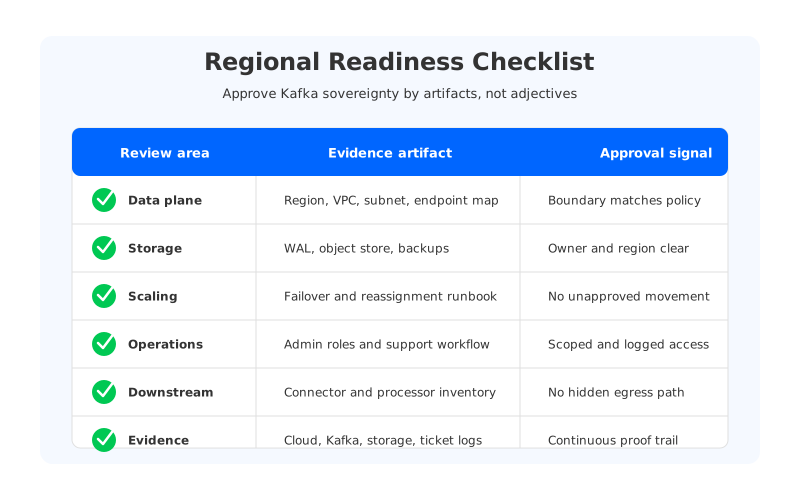
Before choosing a Kafka architecture for regional control, ask for evidence rather than adjectives. "Secure," "private," and "regional" are too vague to approve a streaming platform. The checklist below turns the review into artifacts.
| Review question | Evidence to collect | Decision signal |
|---|---|---|
| Where is the data plane? | Region, account, VPC, subnet, endpoint, and cluster topology | Approve only when the boundary matches workload policy |
| Where is durable stream data stored? | Broker storage, WAL, object storage, snapshots, and backup configuration | Prefer models that make ownership and location explicit |
| How does scaling affect placement? | Reassignment procedure, failover behavior, and recovery runbook | Avoid designs that require emergency data movement outside policy |
| Who can operate the platform? | Admin roles, vendor permissions, support workflow, and audit logs | Require scoped, logged, revocable operational access |
| What can move records downstream? | Connector inventory, processing jobs, replication links, and sink regions | Treat adjacent services as part of the sovereignty boundary |
| How is evidence retained? | Cloud audit logs, Kafka audit events, flow logs, storage logs, and ticket history | Make evidence collection continuous, not manual after the fact |
This table should be owned jointly by platform engineering, security, cloud infrastructure, and compliance. If one group owns Kafka and another owns cloud governance, regional control will fail at the boundary between them. The goal is not to slow the platform down. The goal is to make a fast platform explainable.
7Decision Table
Use self-managed Kafka when the organization already has mature Kafka operations, the workload requires direct infrastructure control, and the team can produce evidence across broker storage, replication, network routing, and operational access. This path gives strong control but places more responsibility on the customer.
Use a managed Kafka service when provider-operated reliability and ecosystem coverage matter more than customer-cloud ownership, and when the provider's region, networking, encryption, audit, and contractual controls satisfy the workload's policy. This path can be efficient, but the service boundary must be acceptable.
Use a Kafka-compatible BYOC or private architecture when the workload needs Kafka compatibility, customer-controlled infrastructure, and a clearer storage or data-plane boundary. This path is especially relevant when real time data sovereignty depends on cloud account ownership, private networking, regional object storage, and customer-native audit evidence. AutoMQ is worth evaluating in that category when the team wants the Kafka API without keeping durable stream storage tied to broker-local disks.
The search for real time data sovereignty usually begins with a region name. It should end with a data path, an operational path, and an evidence path. If those paths are clear, the platform decision becomes less mysterious.
If you are evaluating Kafka-compatible regional control and want to test how shared storage, BYOC boundaries, and customer-controlled object storage affect your architecture, review the AutoMQ documentation or talk to the AutoMQ team with one representative regulated workload: contact AutoMQ.
8References
- Apache Kafka documentation: replication design
- Apache Kafka documentation: security
- Apache Kafka protocol guide
- AWS PrivateLink documentation
- AWS S3 encryption documentation
- AutoMQ architecture overview
- AutoMQ S3Stream shared streaming storage
- AutoMQ compatibility with Apache Kafka
- AutoMQ Cloud BYOC environment overview
- AutoMQ data encryption at rest
9FAQ
9.1Is data sovereignty the same as data residency?
No. Data residency usually focuses on where data is stored or processed geographically. Data sovereignty also considers which laws, owners, operators, and control boundaries apply. For Kafka, both concepts must include data in motion, retained logs, replay, connectors, and operational access.
9.2Does placing Kafka in one region solve real time data sovereignty?
Region placement is necessary for many workloads, but it is not enough by itself. Teams also need to verify the data plane, storage ownership, network path, connector destinations, administrative permissions, and audit evidence.
9.3Why does Kafka storage architecture matter for regional control?
Kafka's storage model determines where retained event logs live and how scaling or recovery affects data placement. Broker-local storage ties durable data to broker disks and replica movement. Shared storage can separate durable data location from broker compute placement, which can make regional evidence easier to express.
9.4Is BYOC Kafka automatically compliant?
No. BYOC is a deployment model, not a compliance certificate. It can help align the data plane and storage path with customer-controlled cloud resources, but compliance depends on configuration, contracts, operating procedures, logging, access control, and customer obligations.
9.5When should AutoMQ be evaluated for data sovereignty?
Evaluate AutoMQ when the team needs Kafka compatibility and wants the durable stream storage, private network path, and operational evidence to align with a customer-controlled cloud or private environment. It is most relevant when broker-local storage and slow data movement make regional control harder to prove.


