
Table of Contents
Table of Contents
Teams searching for real time document processing kafka usually have a specific pain, not a theoretical interest in streaming. PDFs arrive from customers, invoices land in shared mailboxes, insurance forms are scanned, medical records move through approval workflows, and legal packets appear in object storage before anyone has extracted the fields that downstream systems need. The business wants those documents searchable, classified, routed, and audited while the workflow is still active.
That pressure changes the architecture discussion. Kafka is useful here, but not because the document body should be pushed through Kafka as a large binary payload. Kafka is useful because document processing is a chain of state changes: uploaded, validated, extracted, enriched, indexed, reviewed, corrected, and retained. The durable event log keeps those state changes ordered, replayable, and observable while object storage holds the bulky file body.
The tricky part is production behavior. Document workloads are uneven. A quiet hour can be followed by a bulk upload, a failed OCR provider can trigger retries, and a model upgrade can require reprocessing historical files. If the streaming platform cannot handle backfill, lag, retention, and governance without turning recovery into a broker sizing project, the pipeline works in a demo and becomes fragile in operations.
1Why Real-Time Document Processing Needs An Event Spine
A document pipeline looks simple when drawn as upload, extract, and index. Production systems rarely stay that tidy. A single document can spawn multiple tasks: virus scanning, checksum validation, text extraction, table extraction, entity recognition, classification, PII detection, embedding generation, human review, and downstream notification. Some tasks can run in parallel; others must wait for a previous result. Some tasks are idempotent; others call external systems that need careful retry logic.
Kafka fits this shape because it gives each stage a durable, ordered stream of work. Producers publish lifecycle events. Consumers join groups, commit offsets, and resume from known positions after failure. Teams can add another consumer for analytics, audit, or vector indexing without changing ingestion. When an extraction model changes, the team can replay selected events instead of searching application logs and reconstructing intent by hand.
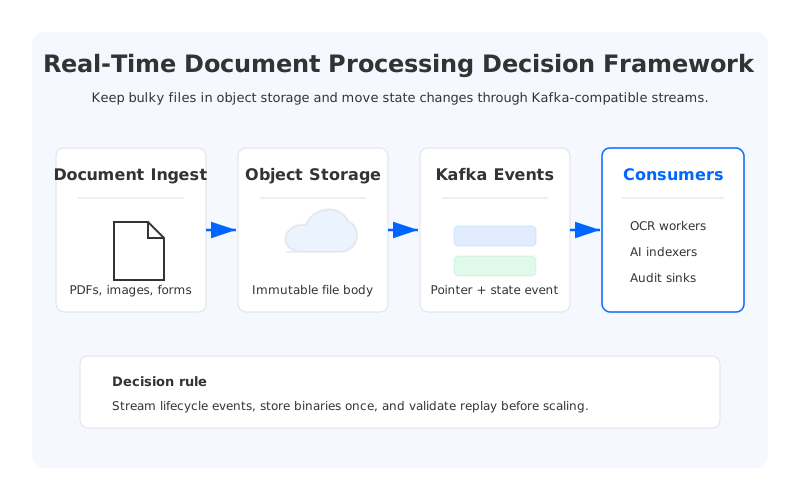
The design pattern is close to the claim-check pattern: the event carries metadata and a pointer, while the large document stays in object storage. A typical event includes the storage URI, document ID, content hash, tenant ID, schema version, classification hints, upload timestamp, and processing state. The event should not carry PDF bytes. That keeps Kafka focused on coordination, ordering, fan-out, and replay, while object storage handles durable binary storage.
2The Production Constraints Behind The Search
The first version of a document pipeline often fails for reasons that look unrelated. One team sees consumer lag during imports. Another discovers that retries create duplicate index entries. A third realizes that audit requirements apply to intermediate extraction results, not only to the final searchable document. These are not edge cases; they are the real workload.
Four constraints deserve attention before platform teams debate products:
- Backpressure. OCR, parsing, embedding, and malware scanning are slower than writing an object to storage. Kafka absorbs uneven work, but the topic design and consumer concurrency must prevent a slow stage from blocking every other stage.
- Replay. Reprocessing is a core requirement, not a disaster scenario. Teams replay documents after schema changes, model upgrades, policy changes, and data quality fixes. The storage and streaming layers must support replay without starving fresh uploads.
- Idempotency. At-least-once delivery is common in distributed processing. Workers need deterministic document IDs, content hashes, task IDs, and sink-side deduplication so retry behavior does not corrupt search indexes or case-management systems.
- Governance. Documents often contain sensitive data. The architecture has to define where file bodies, extracted text, embeddings, metadata, audit events, keys, and logs live. Access control cannot be left to a downstream application team after launch.
These constraints interact. If replay is slow, teams increase consumer capacity. If capacity is hard to add because brokers are disk-bound, the team shortens retention. If retention is short, audit and reprocessing become weaker. The pipeline then starts optimizing around infrastructure limits instead of business correctness.
3Keep Files In Object Storage, Stream State Changes
Putting document bodies directly into Kafka is tempting because it makes the first prototype look straightforward. The upload service has one output path, and every consumer receives everything it needs. That convenience has a cost: large messages increase broker storage pressure, network movement, retention overhead, and consumer memory risk. It also makes access control less precise because every consumer that receives the event may see content it does not need.
A better contract separates the file body from the processing state. Object storage becomes the system of record for binaries and large derived artifacts. Kafka carries the state transitions and references. The extraction worker reads the object, writes extracted text or structured output to the right store, and emits another event. The embedding worker consumes the extraction event, writes vectors to the index, and emits its own status. Audit consumers track the same lifecycle without touching the original file unless policy allows it.
This event contract should be explicit. A document lifecycle topic might use keys based on tenant and document ID so related state changes preserve useful ordering. Events should include schema version, producer name, trace ID, storage pointer, content hash, processing state, and retry context. Dead-letter topics should preserve enough detail for repair without exposing sensitive payloads to a broad audience.
The result is not less architecture; it is clearer architecture. Kafka handles coordination and history. Object storage handles bulk durability. Specialized stores handle search, vectors, extracted tables, or records. The document pipeline becomes a set of contracts instead of a queue of opaque files.
4Where Traditional Kafka Architecture Gets Stressed
Apache Kafka's Shared Nothing architecture has served many production workloads well. Brokers own local log segments, partitions are assigned to brokers, and replication across brokers provides durability. For steady event streams with predictable retention, that design is familiar and reliable when the team has the operational discipline to run it.
Document processing creates a different stress profile. Backfills are common because a parser changes, an AI model improves, or an audit team asks for historical enrichment. Retention can grow because the event history needs to explain how a document moved through each state. Consumer fan-out can grow because search, analytics, compliance, notification, and AI indexing teams all want the same lifecycle stream.
When durable log storage is tightly coupled to broker-local disks, those needs become infrastructure planning problems. Adding capacity may involve partition movement. Replacing a broker can involve replica catch-up. Expanding retention increases the amount of broker-attached storage the fleet must carry. Kafka tiered storage can reduce pressure from older segments, but architects still need to evaluate how hot reads, local resources, and backfill traffic behave under their actual workload.
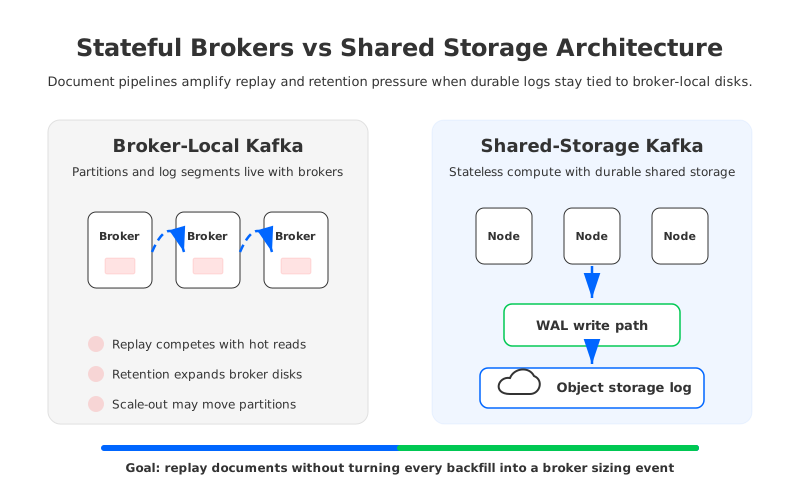
The point is not that traditional Kafka is wrong for document processing. It is that the storage model becomes part of correctness and economics. If replay and retention are central to the workflow, platform teams should evaluate whether broker-local storage is the right place to carry that pressure.
5Architecture Patterns Teams Usually Compare
Most teams do not choose between Kafka and no Kafka. They compare several ways to keep Kafka semantics while changing the operational model around storage, ownership, and elasticity.
| Pattern | What works well | What to validate |
|---|---|---|
| Self-managed Kafka | Maximum operational control and mature ecosystem behavior | Broker disk growth, partition movement, upgrade process, and incident response during replay |
| Managed Kafka service | Reduced day-to-day cluster administration | Data boundary, pricing dimensions, throughput limits, private networking, and migration exit path |
| Kafka with tiered storage | Better economics for colder retained segments | Hot-path behavior, backfill impact, object-store request patterns, and operational maturity |
| Kafka-compatible shared storage | Durable data decoupled from broker-local disks | WAL design, object-storage behavior, client compatibility, metadata path, and failure recovery |
This comparison should be workload-driven. A light document notification stream may run well on an existing Kafka estate. A regulated AI document platform with long retention, repeated reprocessing, and customer-controlled storage boundaries may need a different operating model. The decision should follow evidence from replay tests, governance review, and cost modeling, not a generic feature matrix.
6Evaluation Checklist For Platform Teams
A production review should test the pipeline as it will fail, not as it looks in a diagram. Run the same architecture under normal uploads, large imports, failed extraction workers, duplicate events, schema evolution, and historical replay. The point is to learn where the system bends before customers and auditors do.
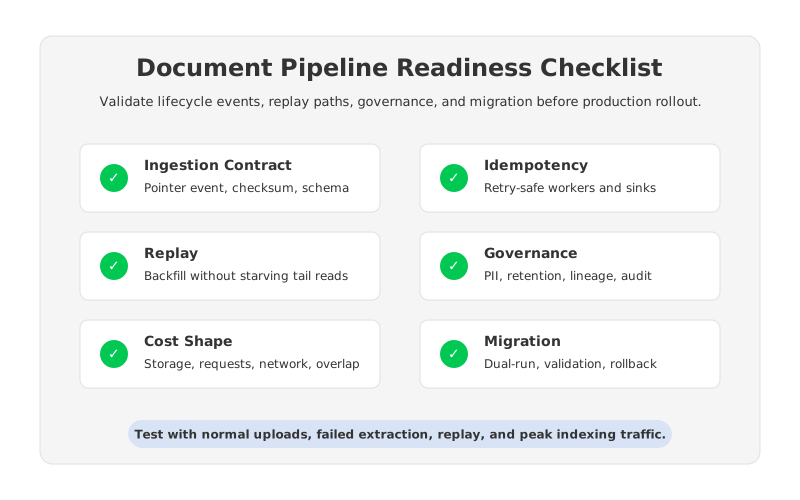
Use this checklist as a baseline:
- Ingestion contract. Define the event schema, document ID strategy, object pointer format, checksum, tenant boundary, and schema evolution policy. The contract should be stable enough for independent teams to consume.
- Idempotency. Prove that workers can retry without creating duplicate extracted text, duplicate vectors, duplicate notifications, or inconsistent approval states.
- Replay behavior. Measure catch-up while fresh uploads continue. A pipeline that can replay history only during maintenance windows is not a real-time pipeline.
- Governance. Map file bodies, extracted text, embeddings, metadata, logs, and audit events. Define which systems can read each artifact and how deletion or retention policies propagate.
- Cost shape. Model compute, broker or service cost, object storage, request volume, network transfer, search or vector index cost, and migration overlap. Document pipelines often move cost from one line item to another.
- Migration and rollback. Plan dual-running, offset handling, validation, consumer cutover, and rollback. The pipeline should have a reversible path before it becomes the source of truth for document state.
The strongest signal is replay under live traffic. If the architecture can process fresh uploads, recover from a failed worker, and replay older documents without a special incident process, it is closer to production readiness.
7Where AutoMQ Changes The Operating Model
Once the evaluation reaches storage-coupled scaling, replay cost, and governance boundaries, AutoMQ becomes relevant as a Kafka-compatible, cloud-native streaming platform built around shared object storage. The Kafka-facing contract stays familiar to producers and consumers, while the durable stream storage model changes from broker-local disks to shared storage with a WAL in the write path.
That shift matters for document processing because the durable event history can grow independently from broker-local disk planning. Brokers are more stateless, durable data is placed in object storage, and the WAL absorbs fresh writes before data is flushed. Platform teams still need to validate compatibility, WAL selection, cache behavior, object-store request patterns, and failure recovery. The benefit is that replay, retention, and compute elasticity become architecture-level capabilities rather than repeated broker sizing exercises.
AutoMQ's BYOC and software deployment options are also relevant for document workloads that carry sensitive content. If documents, extracted text, and event metadata must remain inside a customer-controlled cloud boundary, the deployment model is part of the security architecture. For teams building AI document processing, that boundary can matter as much as throughput because embeddings and extracted text may be more sensitive than the original file name suggests.
AutoMQ should not be introduced as a shortcut around design discipline. The same event contract, idempotency, schema governance, and replay tests still apply. It belongs on the shortlist when the team wants Kafka compatibility, object-storage-backed durability, stateless broker operations, and a deployment boundary that fits internal governance requirements.
8A Practical Decision Table
The right decision depends on the dominant constraint. The mistake is asking for a universal answer before naming the workload's actual pressure point.
| If your main constraint is... | Prefer this direction | Why |
|---|---|---|
| Existing Kafka runs well and document volume is predictable | Improve the current Kafka estate | Better topic design, retention policy, and worker idempotency may solve the immediate problem. |
| The team wants operations offload more than architectural change | Evaluate managed Kafka services | Managed services can reduce direct cluster work, but review data boundary and pricing carefully. |
| Replay, retention, and backfill dominate the workload | Evaluate Shared Storage architecture | Decoupling durable storage from broker-local disks can make replay and elasticity easier to operate. |
| Documents and derived AI artifacts must stay in your cloud boundary | Evaluate BYOC or self-controlled deployment | Governance needs a clear answer for where payloads, metadata, keys, and support access live. |
| Migration risk is the blocker | Prioritize Kafka compatibility and rollback design | The platform is useful only if producers, consumers, offsets, and runbooks survive the transition. |
For most teams, the next step is a focused proof of concept rather than a broad platform bake-off. Pick one real document flow, preserve the file sizes and failure modes, and run fresh ingestion plus historical replay at the same time. If broker storage, backfill, or governance boundaries become the limiting factor, evaluate whether AutoMQ's Shared Storage architecture is a better fit for the next stage. Start with the AutoMQ Kafka compatibility overview and map the checklist above to your own pipeline.
9References
- Apache Kafka Documentation
- AWS Prescriptive Guidance: Claim-check pattern
- AWS Documentation: Processing Documents Asynchronously with Amazon Textract
- AWS Documentation: Amazon S3 Event Notifications
- AutoMQ Documentation: What is AutoMQ?
- AutoMQ: Built on Kafka
10FAQ
10.1Should Kafka store the document file itself?
Usually no. Kafka should carry lifecycle events, metadata, and object-storage pointers, while object storage holds the binary file and large derived artifacts. This keeps the event log focused on ordering, fan-out, replay, and coordination.
10.2What events should a document processing pipeline publish?
Common events include uploaded, validated, extraction requested, extraction completed, classification completed, enrichment completed, indexed, review requested, approved, rejected, corrected, archived, and deletion requested. The exact states should match the business workflow rather than a generic processing template.
10.3How do you prevent duplicate processing?
Use deterministic document IDs, content hashes, task IDs, idempotent workers, and sink-side deduplication. Kafka offsets are necessary for progress tracking, but they do not replace application-level idempotency when workers call OCR services, vector indexes, or case-management systems.
10.4Where does object storage fit with Kafka?
Object storage holds the document body and large outputs such as extracted text, normalized tables, or enriched artifacts. Kafka carries where those artifacts live, what state they are in, and which consumers should act next.
10.5When should AutoMQ be evaluated for document pipelines?
Evaluate AutoMQ when Kafka compatibility matters but broker-local storage, replay cost, long retention, elastic scaling, or data-boundary requirements are becoming architectural constraints. It is most relevant when the team wants shared object-storage-backed stream storage while preserving familiar Kafka client behavior.


