
Table of Contents
Table of Contents
Teams search for real time fraud scoring kafka when the fraud model has become part of a live decision path. A card payment, account login, ad click, wallet withdrawal, or marketplace order arrives, and the business wants a risk decision while the user is still in the session. The model needs fresh signals, but it also needs context: prior attempts, device changes, merchant history, chargeback patterns, velocity windows, and the downstream outcome of earlier decisions.
That context is where many architectures get uncomfortable. A scoring service can call feature stores and databases directly, but those calls add latency, create coupling, and make replay difficult after the model or feature logic changes. A batch pipeline can provide historical aggregates, but it does not explain what happened in the last few seconds of user activity. Kafka-compatible streaming sits between those extremes because it can carry the live event stream and preserve enough history for stateful processors, audit trails, and rebuilds.
The hard part is deciding what kind of Kafka-compatible infrastructure can support fraud scoring after launch. Once the workload is tied to revenue protection and user experience, platform questions become product questions: how much context can be retained, how quickly can processors recover, how expensive is multi-AZ durability, and who owns the security boundary around sensitive risk data?
1Why teams search for real time fraud scoring kafka
Fraud scoring is a control-loop problem. The system observes behavior, updates context, scores the next action, records the decision, and later uses confirmed outcomes to improve the model. Kafka fits naturally because the event log becomes the shared timeline for multiple consumers: online scoring, feature computation, case management, customer support, analytics, model training, and compliance review. Each consumer can progress at its own offset while reading the same ordered facts.
The search query usually hides a production concern rather than a library choice. A prototype can publish PaymentAttempted events and consume them in a stream processor. A production platform has to decide how partitions are keyed, how long events are retained, how consumer lag is interpreted, how state is rebuilt, how failed records are handled, and how a migration can happen without losing scoring continuity.
Three questions tend to separate a useful architecture from a demo:
- Does the stream preserve enough context to explain a decision after the fact? Fraud systems need more than a current score. They need durable evidence for why the score changed.
- Can stateful processors recover without blocking live scoring? Replay is a normal operating task after feature changes, processor bugs, and model refreshes.
- Does the platform cost model survive retention, read fanout, and multi-AZ durability? Fraud events may be smaller than telemetry, but they are often sensitive, highly connected, and reused by many teams.
Those questions are not purely application-level. They depend on the event backbone. If the Kafka-compatible platform treats storage, compute, networking, and recovery as one bundled capacity problem, fraud scoring inherits that coupling.
2The production constraint behind the problem
A real-time fraud scoring system has a sharper latency budget than many analytical pipelines, but latency is not the whole constraint. The platform must keep current context fresh enough for online decisions and durable enough for investigation. If a scoring processor falls behind, the system may still be "up" while making decisions from stale context. If a replay competes with live traffic, a routine feature rebuild can become an availability incident.
Traditional Kafka follows a shared nothing model: each broker owns local storage, and durability depends on replicas spread across brokers. This design is proven and widely understood, but it binds operational work to data placement. Broker replacement, partition reassignment, storage growth, and rebalancing are not only compute operations; they involve moving or catching up data. For fraud scoring, that matters because the same cluster may handle live scoring events, replay traffic, model-feature rebuilds, connector exports, and audit reads.
The constraint becomes visible during stress windows. A payment retry storm increases write rate. A model rollback requires replaying event history. A fraud investigation triggers ad hoc reads. A downstream connector slows down and builds lag. Together, they test whether the platform can isolate hot-path scoring from retained history and recovery work.
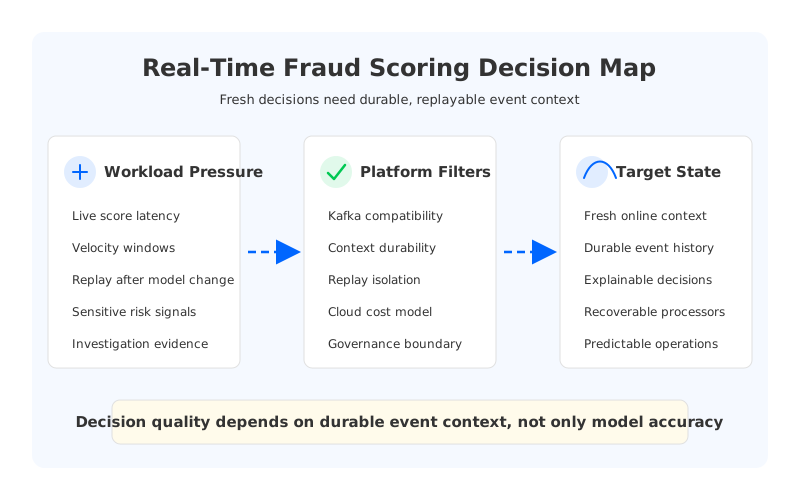
The safest architecture treats the stream as durable event context, not only a transport. That means partition keys, retention, state snapshots, offset discipline, schema evolution, access controls, and cloud cost are part of the scoring design. The model may be the visible component, but the event context determines whether the model can be trusted during failure, replay, and migration.
3Architecture options and trade-offs
Most teams evaluate three broad platform options. Self-managed Kafka gives maximum control, but the team owns broker sizing, storage, rebalancing, upgrades, security hardening, and incident response. Managed Kafka reduces some operational work, but buyers still need to understand service limits, networking charges, configuration boundaries, and migration paths. Kafka-compatible cloud-native systems ask a different question: can the platform preserve Kafka semantics while changing the storage ownership model underneath?
For fraud scoring, the key trade-off is where durable context lives. In a broker-local storage model, retained events are tied to broker disks and replica placement. In a shared storage model, brokers can act more like compute nodes while durable stream data is stored in a shared object-storage layer with a write-ahead log for the hot path. The second model does not remove the need for careful latency testing, but it changes recovery and scaling from "move broker-owned data" toward "restore service capacity above shared durable data."
The distinction matters most when live scoring and replay happen together. Stateful stream processors such as Apache Flink use checkpoints and state to recover computation, but they still rely on the source stream for input history. Kafka consumers depend on group membership, committed offsets, and fetch behavior. A platform that makes retained data expensive or operationally heavy will shape every one of those systems.
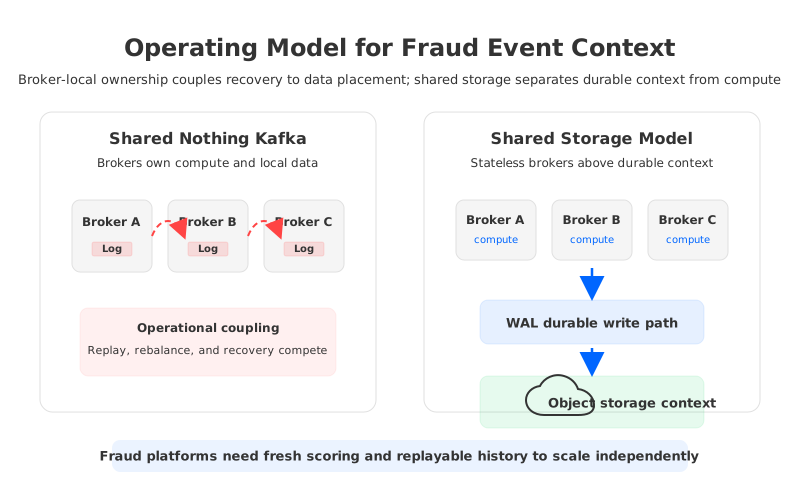
A neutral evaluation should include both application semantics and platform mechanics:
| Decision area | What to check | Why it matters for fraud scoring |
|---|---|---|
| Kafka compatibility | Producer, consumer, admin, transaction, security, and connector behavior | Scoring services and stream processors should not be rewritten during an infrastructure change |
| Context durability | Where acknowledged events become durable and how long they can be retained | Investigations, feature rebuilds, and model audits depend on replayable event history |
| Latency isolation | How live writes, reads, replay, and connector lag affect each other | A replay should not silently age the context used for online decisions |
| Scaling model | Whether compute and storage can scale independently | Traffic spikes and retention growth stress different parts of the system |
| Network cost | Cross-AZ replication paths, private endpoints, and cloud data processing charges | Multi-AZ fraud systems can turn networking into a major operating line |
| Governance | IAM, VPC boundary, encryption, audit logs, and topic-level access | Fraud data often contains sensitive behavioral and financial signals |
This table keeps the discussion away from vendor slogans. The practical question is whether the platform can keep the scoring loop fresh, explainable, recoverable, and affordable under the conditions that actually break systems.
4Evaluation checklist for platform teams
Start with the scoring timeline. Every event that can affect a risk decision needs a stable contract: key, schema, ordering expectation, timestamp semantics, retention rule, and ownership. Kafka preserves ordering within a partition, so the key decision defines which context can be updated deterministically without cross-partition coordination. For payment scoring, that key may be account ID, payment instrument, merchant, or a composite domain key; for ad-click fraud, it may be publisher, campaign, user, device, or IP-derived identity.
Next, separate online scoring from asynchronous learning. The online path should use a bounded set of features with a known freshness target. The offline path can consume the same events for training, backtesting, and investigation, but it should not disrupt live scoring when a warehouse sink slows down or a training export backfills data. Consumer groups make this separation possible, but the platform still needs lag visibility and capacity controls.
State recovery is the third gate. If a stream processor rebuilds velocity windows or device reputation from Kafka, the team must know how much history is needed, how fast it can be read, and whether the rebuild affects current traffic. Offsets, checkpoints, and dead-letter handling should be tested together because a clean Kafka offset does not guarantee correct business state after partial writes to an external store.
Cost review should happen before the architecture is approved. A fraud workload can look small in write throughput and still become costly because of long retention, broad fanout, cross-AZ durability, private connectivity, and repeated replays. Model which cost line grows with each workload dimension instead of treating "Kafka cost" as one number.
Security review is equally concrete. Fraud topics can expose payment behavior, account compromise indicators, device fingerprints, or merchant risk signals. The platform must support least-privilege access, private networking, encryption, auditability, and clear operational ownership. BYOC or software deployment can be attractive when the data plane and cloud resources must remain inside the team's own account boundary.
5How AutoMQ changes the operating model
After the neutral checklist exposes the storage and recovery constraints, AutoMQ becomes relevant as a Kafka-compatible streaming platform built around shared storage and stateless brokers. AutoMQ keeps the Kafka protocol surface familiar while replacing broker-local persistent storage with an object-storage-backed architecture and a WAL layer for durable writes. For fraud scoring, the question is whether this storage model gives platform teams better levers for retained context, replay, scaling, and recovery.
In a shared nothing Kafka cluster, broker compute and broker-owned data move together. That coupling is manageable for many workloads, but it creates friction when a fraud platform needs elastic compute for hot scoring, retained history for investigations, and replay headroom for feature rebuilds. In AutoMQ's shared storage architecture, durable stream data is designed to live outside individual brokers. Brokers can be added, removed, or replaced with less dependence on moving long-lived local replicas.
That changes the operating model in four ways. Retention planning can focus more directly on object storage rather than broker disk sizing. Broker recovery can focus on restoring serving capacity above shared durable data. Replay-heavy workflows can be planned as read pressure against retained context. Deployment boundaries such as AutoMQ BYOC or software deployment can help teams keep the data plane within customer-controlled cloud accounts when governance requires it.
AutoMQ also documents zero cross-AZ traffic designs for supported deployments. That is relevant because fraud scoring commonly runs across availability zones, and traditional replica movement can make network cost part of the durability model. The exact impact depends on cloud provider, region, endpoint design, retention, and read fanout, so validate it with real workload assumptions.
The important caveat is that Kafka compatibility still needs workload-specific validation. A fraud platform should test its actual client versions, security settings, producer acknowledgements, transactional assumptions, consumer groups, stream processor checkpoints, connector behavior, observability, failure drills, and rollback path. Compatibility reduces migration risk; it does not replace production proof.
6Migration and readiness scorecard
A fraud-scoring migration should be staged around decision safety. Inventory topics, schemas, keys, ACLs, producers, consumers, stream processors, connectors, retention settings, dashboards, and alert rules. Then classify each consumer by decision impact. Online scoring and feature computation deserve stricter cutover gates than offline analytics.
The rollback plan must define where truth lives at every point. If producers move first, old consumers need a bridge. If consumers move first, offsets and duplicate handling need proof. If stream processors are rebuilt from copied topics, output stores must be validated against known decisions before the target path becomes authoritative. The migration is complete only when business-level scoring signals, not only broker metrics, match the expected state.
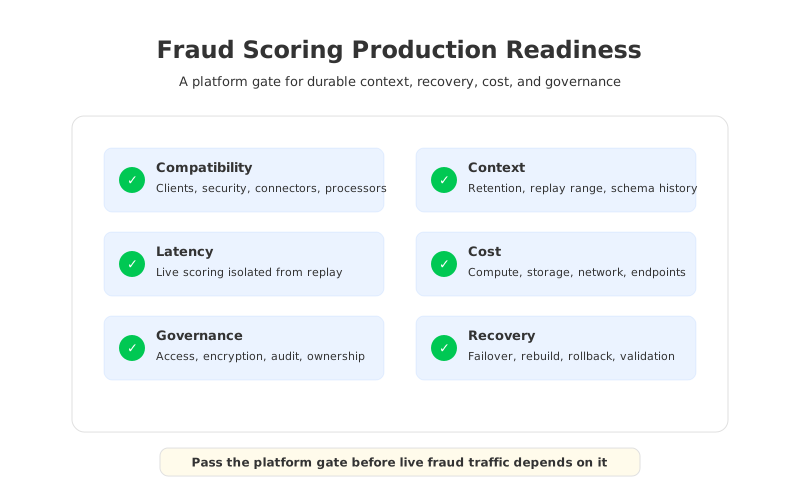
Use the scorecard as a production gate:
- Compatibility: real producers, consumers, admin tools, security settings, connectors, and stream processors pass workload tests.
- Context: retention, replay range, schema history, and decision evidence are sufficient for investigation and model review.
- Latency: live scoring, replay, backfill, and connector lag are tested as separate failure modes.
- Cost: compute, storage, cross-AZ traffic, private connectivity, and object storage requests are modeled by workload dimension.
- Governance: access control, encryption, audit logging, deployment boundary, and data ownership are approved before cutover.
- Recovery: failover, offset reset, state rebuild, rollback, and business-level validation are rehearsed.
The output should be a short list of risks that can be tested, not a generic architecture approval. Real-time fraud scoring depends on fresh context, but production trust comes from durable context: the ability to replay, explain, govern, and recover the event history behind a decision.
If your team is evaluating Kafka-compatible infrastructure for fraud scoring and wants to understand how shared storage changes the operating model, start with the AutoMQ architecture overview and run the checklist against your own scoring path: explore AutoMQ for Kafka-compatible fraud scoring.
7References
- Apache Kafka Documentation: https://kafka.apache.org/documentation/
- Apache Kafka Consumer Groups and Offsets: https://kafka.apache.org/documentation/#intro_consumers
- Apache Kafka Message Delivery Semantics and Transactions: https://kafka.apache.org/documentation/#semantics
- Apache Kafka Connect Documentation: https://kafka.apache.org/documentation/#connect
- Apache Flink Stateful Stream Processing: https://nightlies.apache.org/flink/flink-docs-stable/docs/concepts/stateful-stream-processing/
- AWS S3 Pricing: https://aws.amazon.com/s3/pricing/
- AWS PrivateLink Pricing: https://aws.amazon.com/privatelink/pricing/
- AutoMQ Kafka Compatibility: https://docs.automq.com/automq/what-is-automq/compatibility-with-apache-kafka?utm_source=blog&utm_medium=reference&utm_campaign=RPB-0157
- AutoMQ Shared Storage Architecture: https://docs.automq.com/automq/what-is-automq/difference-with-apache-kafka?utm_source=blog&utm_medium=reference&utm_campaign=RPB-0157
- AutoMQ Migration Overview: https://docs.automq.com/automq-cloud/migrate-to-automq/overview?utm_source=blog&utm_medium=reference&utm_campaign=RPB-0157
- AutoMQ Zero Cross-AZ Traffic Overview: https://docs.automq.com/automq-cloud/eliminate-inter-zone-traffics/overview?utm_source=blog&utm_medium=reference&utm_campaign=RPB-0157
8FAQ
8.1Is Kafka a good fit for real-time fraud scoring?
Kafka can be a strong fit when fraud scoring needs ordered event context, independent consumers, replay, and integration with stream processors. The fit depends on the event contract and operating discipline. Teams still need stable partition keys, schema governance, lag monitoring, state recovery, and a clear plan for failed records.
8.2How much history should a fraud-scoring stream retain?
The answer depends on the decision window, investigation requirements, model rebuild process, and compliance policy. A velocity feature may need a short window, while audit and training workflows may need longer retained history. Treat retention as an architecture decision because it affects storage, replay, cost, and governance.
8.3What is the biggest platform risk in real-time fraud scoring?
The biggest risk is stale or incomplete context that looks like a valid score. A processor can be running while lagging, a feature store can be available while missing recent events, and a replay can rebuild state incorrectly if offsets and side effects are not coordinated. Observability should include business-level scoring freshness, not only broker health.
8.4How does shared storage help Kafka-compatible fraud workloads?
Shared storage separates durable event history from broker-local disks. That can make broker replacement, retained-data operations, and compute scaling less dependent on moving local broker replicas. For fraud workloads, the main benefit is an operating model with more independent levers for live scoring, replay, retention, and recovery.


