
Table of Contents
Table of Contents
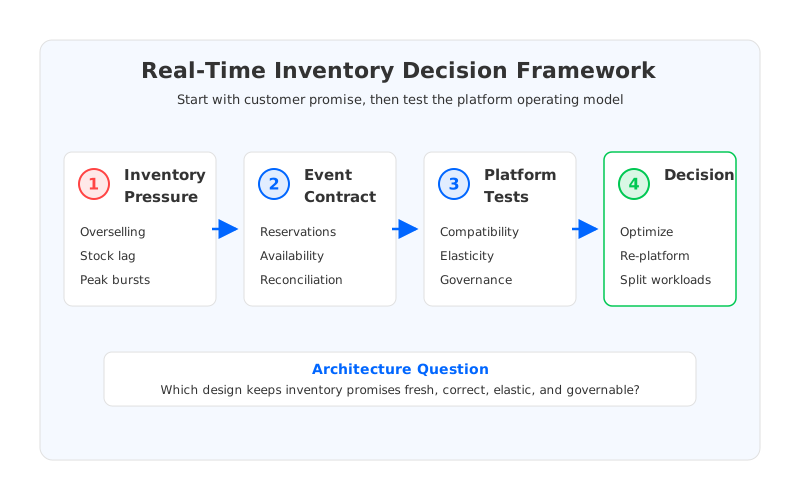
Retail teams usually search for real time inventory kafka after inventory accuracy has become customer visible. The website says an item is available, checkout accepts the order, the warehouse system disagrees, and customer support inherits the damage. The technical issue may look like replication lag or an undersized Kafka cluster, but the business issue is sharper: every channel is making promises against inventory state that keeps changing.
Kafka can be a strong backbone because inventory updates are event-shaped. Stock receipt, reservation, payment authorization, pick confirmation, cancellation, return, replenishment, and safety-stock adjustment all have time, order, ownership, and downstream consumers. The hard part is building an architecture where product pages, checkout, stores, fulfillment, analytics, and AI workflows can consume fresh signals without turning the streaming platform into a fragile dependency.
1Why Real-Time Inventory Kafka Matters In Retail
Inventory is one of the few data domains where stale information can become a failed transaction within minutes. A pricing update can be corrected later; a delayed catalog enrichment may reduce conversion; an inaccurate inventory promise can create overselling, split shipments, store associate confusion, and customer churn. The pressure grows when retailers operate across e-commerce, stores, warehouses, marketplaces, logistics providers, and recommendation systems.
The search intent behind real time inventory kafka architecture is therefore not "how do I stream data faster?" It is "how do I keep multiple systems aligned when inventory is both operational state and analytical signal?" A batch feed from the warehouse management system may still be useful for reconciliation, but it cannot be the only source for customer-facing availability when carts, reservations, cancellations, and substitutions happen continuously.
Kafka's core model helps because records are retained in ordered partitions, and different applications can read the same event history independently through consumer groups and offsets. A checkout service can care about reservation decisions, a search indexer can update availability facets, a fulfillment optimizer can recalculate allocation, and an analytics sink can retain history. None of those consumers should steal progress from the others.
A retail inventory platform is not a single queue feeding a single worker. It is a shared event log for many systems reasoning from the same business changes.
2The Production Constraints Behind Inventory Streams
Inventory workloads stress streaming systems in ways that are easy to underestimate during a pilot. The event rate may be moderate on a normal weekday and then spike during a promotion, seasonal launch, weather event, or marketplace synchronization window. Consumer fan-out also grows over time. A stream that begins with stock updates may later feed search, personalization, fraud checks, store pickup, replenishment planning, customer notification, finance reconciliation, and AI feature pipelines.
Four constraints decide whether the architecture holds up.
- Freshness: Product pages and checkout flows need low-lag availability signals, especially for limited stock and fast-moving SKUs. Freshness should be measured at the business decision point, not only at the broker.
- Correctness: A reservation, release, or shipment confirmation may have irreversible business meaning. Idempotency, ordering, deduplication, and replay behavior must be designed before peak traffic arrives.
- Elasticity: Capacity should adapt to campaign and seasonality patterns without turning every scale event into storage rebalancing work.
- Governance: Inventory data connects to pricing, customer promise, supplier performance, and store operations. Topic ownership, schemas, access controls, audit evidence, and retention policies cannot be afterthoughts.
These constraints are connected. A team can lower lag by overprovisioning brokers, but that may increase cost. It can reduce cost by shortening retention, but that may weaken replay and reconciliation. Architecture is the work of choosing which tradeoff is acceptable and which one is inherited from an old operating model.
3Model Inventory As Business Events, Not Tables In Motion
A common mistake is to mirror database tables into Kafka and call the result real-time inventory. Change data capture can be useful, but table-level events rarely express the business contract downstream systems need. A row update may tell you that a number changed. It may not say whether the change came from a reservation, damaged item, delayed shipment, store transfer, substitution, or fraud hold.
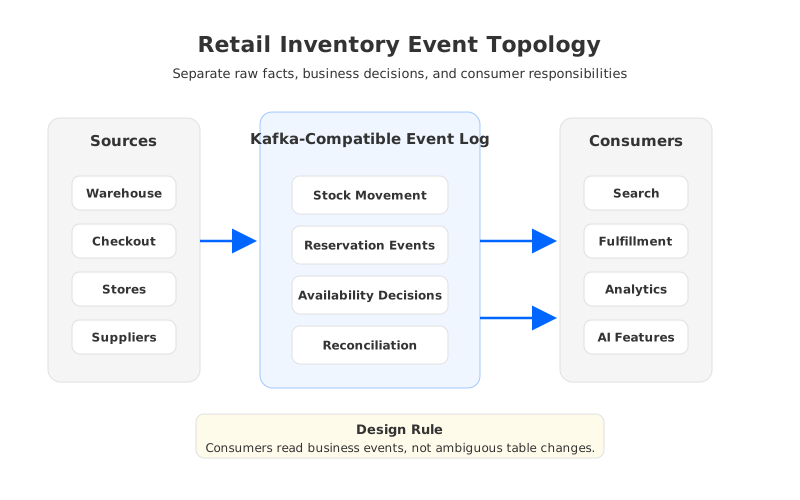
A better event model separates facts from decisions:
| Event Type | Example | Why It Matters |
|---|---|---|
| Stock movement | Received, transferred, returned, damaged | Updates physical or logical quantity |
| Reservation | Cart reserved, reservation expired, order confirmed | Protects customer promise while checkout completes |
| Availability decision | Sellable, hidden, backorderable, store-pickup eligible | Converts raw stock into channel-specific promise |
| Reconciliation | Count adjustment, warehouse correction, supplier variance | Keeps event-derived state aligned with source-of-record checks |
| Audit event | Manual override, policy change, hold release | Explains why inventory changed and who approved it |
This model changes topic design. Raw stock movement may be keyed by SKU plus location when local ordering matters. Reservations may be keyed by order or cart when checkout correctness matters. Availability decisions may be keyed by SKU, location, and channel when search and product pages consume them. Reconciliation events may use a separate retention class because they are operational evidence, not only live state.
The platform team should define which stream is authoritative for each downstream decision. A search index may consume availability decisions, a replenishment model may consume reconciled inventory and demand signals, and a customer notification service may consume order-confirmed events. The more precise the contract, the less likely every consumer invents its own interpretation of "available."
4Architecture Patterns Teams Usually Compare
Most retail platforms do not choose between "Kafka" and "not Kafka" in the abstract. They compare several patterns that each solve part of the problem.
Point-to-point APIs fit request/response checks, especially when checkout needs a synchronous answer. They are weaker as the shared distribution mechanism because every new consumer adds another integration path.
Batch replication still matters for reconciliation, planning, and finance. It is usually the wrong primary mechanism for customer-facing availability because the delay is built into the model.
Traditional Kafka gives the organization a mature event log with strong ecosystem support. Producers, consumers, stream processors, connectors, schema tools, and observability patterns are well understood. Apache Kafka's consumer group and offset model also maps well to retail fan-out: each application can process at its own pace while preserving replay.
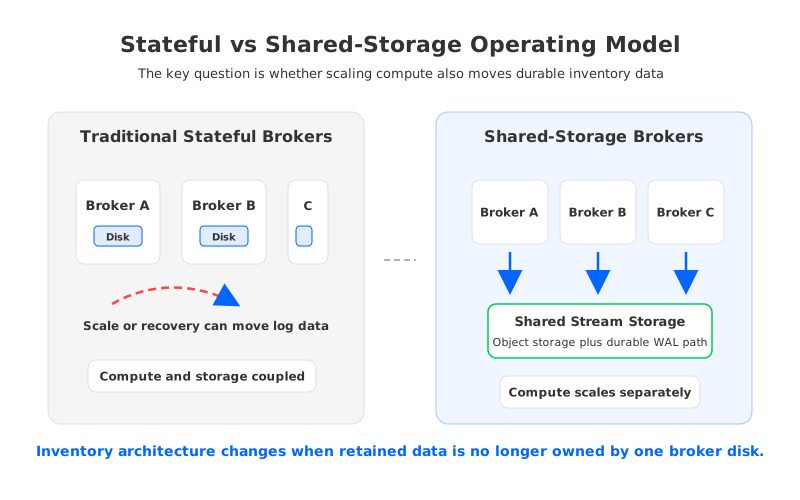
The operational constraint is Kafka's classic shared-nothing storage model. Brokers own local log data. Replication protects availability, but it also multiplies storage and network traffic. Scaling a stateful cluster can involve partition reassignment, data movement, leadership changes, and capacity planning around compute and disks. That becomes harder when retail demand swings sharply and retained inventory history keeps growing.
Kafka tiered storage can reduce pressure on local disks by moving older log segments to remote storage. That helps retention, but it does not make brokers fully stateless. Hot data, leadership, metadata operations, and local storage responsibilities still shape the operating model.
5The Evaluation Checklist For Platform Teams
The most useful evaluation starts with workload evidence, not vendor labels. Pick a few representative inventory flows: a high-volume stock update stream, a checkout reservation stream, a channel availability stream, and a reconciliation stream. Then test the platform against the failure modes that would hurt the business.
| Evaluation Area | What To Verify | Evidence To Collect |
|---|---|---|
| Kafka compatibility | Producer configs, consumer groups, offsets, transactions, headers, compaction, admin APIs | Client matrix, staging tests, config diff |
| Ordering and idempotency | Partition keys, duplicate handling, replay safety, reservation expiry | Failure drills, replay logs, downstream idempotency proof |
| Elasticity | Broker add/remove, partition expansion, peak ingestion, consumer replay | Lag curves, rebalance duration, data movement volume |
| Retention economics | Hot path, historical replay, object storage, local disk, networking | Cost model by topic class and retention window |
| Governance | ACLs, identities, schema ownership, encryption, audit logs, residency | Policy review, access diff, audit sample |
| Migration and rollback | Topic mapping, offset continuity, connector state, cutover windows | Runbook, rollback test, owner signoff |
This table is intentionally practical. A platform can look excellent on a generic throughput benchmark and still fail a checkout-reservation workflow if consumer replay produces duplicate holds. Another platform can offer attractive storage economics and still be a poor fit if the client features you rely on are not compatible. Retail inventory architecture rewards boring proof.
The same discipline applies to cost. Publishable models should use current official cloud pricing for the selected region and deployment model. The stable architectural lesson is that retained bytes, replica traffic, cross-zone movement, and operational labor often matter more than headline broker instance prices.
6Where Shared Storage Changes The Operating Model
The turning point is whether durable stream data must live on broker-local disks. In a shared-nothing Kafka cluster, storage ownership, broker lifecycle, and partition placement are tightly coupled. When a broker is replaced or the cluster scales, the platform has to reason about local log data as well as compute. That coupling is why capacity planning can feel like a storage problem even when the business asks for elastic inventory events.
Shared-storage Kafka-compatible architectures change that premise. Brokers still serve Kafka protocol traffic, but durable data lives in shared storage, with a write-ahead log layer used for the immediate durable write path. Scaling compute becomes less tied to moving partition data between broker disks. Retained history can use object storage economics. Broker replacement can become less storage-bound because persistent data is not owned by one server.
AutoMQ fits into this evaluation as a Kafka-compatible, cloud-native shared-storage option rather than as a reason to skip the evaluation. Its documentation describes compatibility with Apache Kafka clients, stateless broker design, S3-compatible object storage for stream data, WAL options for durable writes, and deployment models where the data plane can run in the customer's cloud account. For retail platforms, that is relevant when teams want to preserve Kafka APIs while changing the cost and elasticity model underneath.
The practical questions remain workload-specific:
- Can existing producers, consumers, connectors, and stream processors run with today's protocol features?
- Does the chosen WAL and storage configuration meet the latency and durability needs of checkout, reservation, and availability decisions?
- How does the platform behave when brokers are added, removed, or failed during a promotion-level traffic spike?
- What proves that inventory history and replay remain inside the required governance boundary?
- How would the team migrate topics, offsets, schemas, and rollback procedures without confusing downstream owners?
Those questions keep the discussion architectural. AutoMQ may be a strong candidate when traditional Kafka operations are constrained by local disks, partition movement, and retained-history cost. It still has to pass the same production tests as any streaming platform.
7Decision Table: Optimize, Re-Platform, Or Split
Retail inventory systems often need a mixed architecture. Synchronous APIs can protect checkout decisions. Kafka-compatible streams can distribute event history. Stream processors can materialize current availability. Object storage and lakehouse tables can retain long-term analytical history. The decision is not which tool wins everywhere, but which responsibility belongs where.
| Current Pressure | Better First Move | Why |
|---|---|---|
| Product pages lag behind warehouse updates | Improve event modeling and consumer lag visibility | The issue may be topology and ownership, not broker capacity |
| Checkout creates duplicate or stale reservations | Tighten idempotency, ordering, and reservation-state design | Correctness must be fixed before platform migration |
| Campaign peaks trigger repeated broker scaling work | Evaluate cloud-native or shared-storage Kafka-compatible options | Elasticity is limited when compute and local storage scale together |
| Retention cost blocks replay and reconciliation | Separate retention classes and test shared-storage economics | Inventory history has different value windows by event type |
| Governance reviews slow every new consumer | Standardize topic ownership, schemas, ACLs, and audit evidence | Platform sharing requires visible policy, not informal trust |
| Migration risk is the main blocker | Start with a narrow topic slice and reversible cutover plan | A small verified path beats a broad untested migration |
The architecture should end where the search began: customer-facing inventory promises. If the platform cannot explain which event changed availability, which consumer saw it, which decision used it, and how to replay or correct it, "real time" is mostly a slogan. Start with the event contract, test the operating model, and evaluate shared-storage options when the evidence shows that broker-local storage is shaping decisions more than the business should accept.
For teams exploring that path, review AutoMQ's Kafka-compatible architecture and compare it with your own inventory event classes, retention needs, and migration constraints: AutoMQ architecture documentation.
8References
- Apache Kafka Documentation
- Apache Kafka Consumer Position
- Apache Kafka Transactions
- Apache Kafka KRaft
- Apache Kafka Tiered Storage
- Amazon S3 Strong Consistency
- AWS Data Transfer Pricing
- AutoMQ Architecture Overview
- AutoMQ Kafka Compatibility
9FAQ
9.1What is real-time inventory Kafka architecture?
Real-time inventory Kafka architecture publishes stock movements, reservations, availability decisions, reconciliation events, and audit records to Kafka-compatible streams. Multiple applications can consume the same inventory history independently while preserving ordering, replay, and evidence.
9.2Is Kafka a good fit for retail inventory systems?
Kafka is often a good fit when checkout, search, warehouse operations, stores, analytics, notifications, and AI workflows need independent access to inventory events. It still requires careful event modeling, partition keys, idempotency, schema governance, retention classes, and failure testing.
9.3How should retailers choose partition keys for inventory topics?
Partition keys should match the ordering boundary of the business decision. SKU plus location is common for stock availability, while order ID or cart ID may fit reservations. Teams should test for hot partitions during promotions.
9.4How is Kafka tiered storage different from shared-storage Kafka?
Kafka tiered storage moves older log segments to remote storage while brokers retain local storage responsibilities. Shared-storage Kafka-compatible architectures move durable stream storage toward shared object storage and make brokers more stateless. The practical difference is how much scaling and recovery depend on broker-local data movement.
9.5Where does AutoMQ fit in a retail inventory platform?
AutoMQ fits as a Kafka-compatible shared-storage option for teams that want to preserve Kafka clients while changing the storage and elasticity model. Retail teams should evaluate it with the same evidence they would use for any platform: client compatibility, reservation correctness, latency, failure behavior, governance boundaries, and migration safety.


