
Table of Contents
Table of Contents
Inventory accuracy fails in small gaps. A store sells the last unit while an online checkout still shows stock. A warehouse receives a pallet, but allocation logic keeps routing orders to a farther facility. A supplier delay lands in the planning system after the replenishment job has already made yesterday's decision. These are not database problems in isolation. They are signal timing problems, and that is why teams search for real time inventory signals kafka when batch synchronization stops matching the pace of the supply chain.
Kafka is a natural fit for this search intent because inventory movement is already event-shaped. Sales, returns, cycle counts, shipment scans, purchase order updates, and reservation changes all have producers, consumers, ordering concerns, and replay requirements. The harder question is whether the streaming layer can stay boring when traffic is seasonal, stores are distributed, connectors are fragile, and cost pressure keeps increasing.
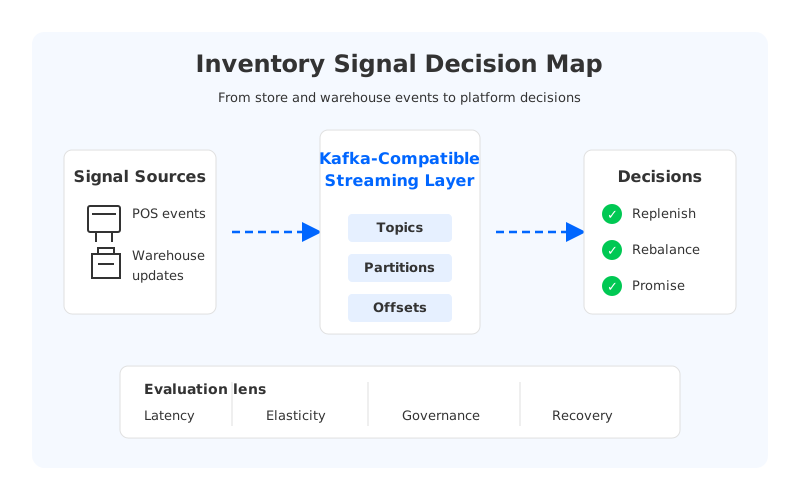
The right platform decision starts with the inventory signal, not the broker. If a signal changes what a customer can buy, where an order is routed, or whether safety stock is triggered, then the stream is part of the supply chain control plane. That control plane needs low-latency ingestion, durable replay, predictable governance, and a cost model that does not punish every peak week with emergency capacity planning.
1Why teams search for real time inventory signals kafka
Inventory data used to move in comfortable batches because many downstream decisions moved in batches. Planning systems could wait for nightly extracts. Store replenishment could tolerate a delay. Reporting systems could reconcile after the fact. Omnichannel retail, marketplace fulfillment, and tighter supplier networks changed the tolerance window. The business no longer asks for a cleaner report tomorrow; it asks whether the next order can be promised now.
The search phrase real time inventory signals kafka usually hides several technical requirements at once:
- The team wants to capture every inventory-changing event without forcing every application to call every other application directly.
- The order-management system needs a reliable stream of stock availability, reservations, exceptions, and fulfillment state.
- Analytics teams want the same signal history for forecasting, anomaly detection, and service-level review.
- Platform teams need a standard integration path that can support warehouses, stores, ecommerce, ERP, and data warehouse sinks without a custom pipeline for each pair.
This is where Kafka's core model remains useful. Topics decouple producers and consumers. Consumer groups let multiple application replicas share work while preserving offset-based progress. Retention and replay make it possible to rebuild downstream state when logic changes or a consumer falls behind. Kafka Connect can move data between Kafka and external systems without every team writing the same ingestion and sink code.
The complication is that supply-chain workloads rarely grow smoothly. Promotions, holidays, supplier disruptions, weather events, and regional incidents create uneven pressure. A topic that is quiet most of the week can become operationally important for a few hours. If the streaming platform needs days of capacity planning or risky rebalancing before it can absorb the next peak, the event-driven design has moved the bottleneck rather than removed it.
2The production constraint behind the problem
The most important inventory signals are small, frequent, and stateful. A single sale event may be tiny, but the effect of processing it late can be expensive: oversold inventory, split shipments, manual exception handling, or inaccurate demand signals. The infrastructure team therefore has to design for both throughput and decision freshness. Raw write capacity is not enough if consumer lag, connector delays, or broker maintenance introduce unpredictable stalls.
Traditional Kafka deployments also bind several concerns together. Brokers handle protocol work, partition leadership, replication, local log storage, fetch serving, and operational recovery. This shared-nothing architecture is proven and widely understood, but it makes storage locality part of many operational actions. When teams add brokers, change partition placement, expand disks, or recover from a failure, data movement can become the slow and expensive part of the workflow.
For inventory use cases, that coupling shows up in familiar places. Retention grows because teams want replay for audit and model features. Partition counts grow because more facilities, channels, and product domains produce independent streams. Consumer groups grow because availability, fraud checks, forecasting, search indexing, and customer notification systems all want the same signals. Each of these is reasonable on its own. Together they turn the Kafka cluster into a persistent operational surface, not a transport detail.
The cloud adds another constraint: the cost of moving data is visible. Broker-to-broker replication, cross-zone produce and consume paths, catch-up reads, and data warehouse sinks can all create network and storage charges depending on deployment topology. A platform team can tune some of this with rack awareness, placement strategy, and client configuration, but the bill still reflects the architecture. If every inventory event is copied through multiple local disks and network paths before it becomes durable and consumable, the cost model follows that path.
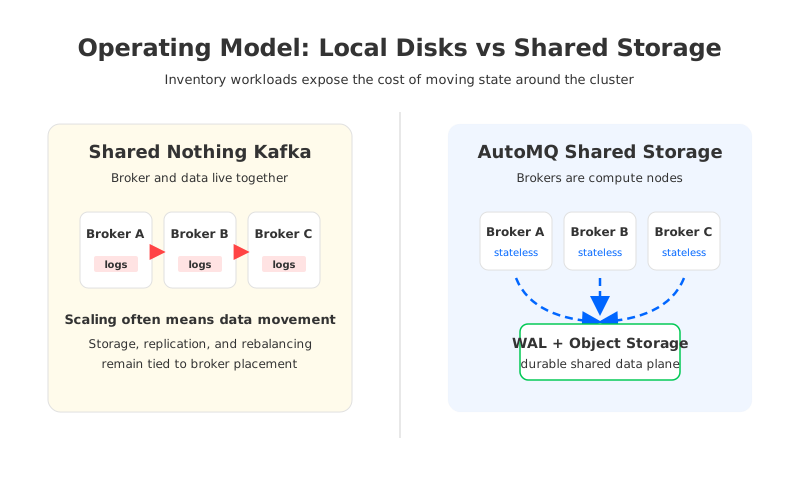
This does not make shared-nothing Kafka wrong. It means the team should evaluate it against the actual operating model of inventory signals. A small centralized cluster with predictable load is different from a multi-region retail platform with bursty store traffic and long retention. The same Kafka API can sit on very different storage and recovery designs, and those designs matter once the stream becomes a production dependency.
3Architecture options and trade-offs
An inventory streaming architecture usually lands in one of four patterns. The names matter less than the trade-offs behind them.
| Pattern | What it optimizes for | Where it becomes painful |
|---|---|---|
| Batch extracts into a warehouse | Simplicity and reporting consistency | Late operational decisions and duplicated point-to-point jobs |
| Application database polling | Low initial integration cost | Missed changes, high source load, weak replay semantics |
| Traditional Kafka on local disks | Mature ecosystem, strong event model, broad client support | Capacity planning, data movement, retention cost, operational burden |
| Kafka-compatible shared storage | Kafka API continuity with cloud-native storage behavior | Requires careful validation of latency, deployment model, and compatibility needs |
The evaluation should start with the decisions the stream must support. If inventory events feed a customer-facing availability service, the platform has to protect freshness during broker maintenance and consumer recovery. If the stream feeds forecasting and allocation, the platform needs durable history and clean replay. If the stream feeds data warehouse tables, connector operations and schema evolution matter as much as broker throughput.
There is also a governance layer that teams often postpone until the first incident. Inventory events can expose commercial sensitivity: product velocity, regional demand, supplier constraints, and fulfillment weaknesses. A platform design should account for authentication, authorization, encryption, auditability, network boundaries, and ownership of cloud resources. For regulated or data-sovereignty-sensitive environments, a managed service that moves data outside the customer's account may create a different risk profile than a customer-controlled deployment.
The most useful architecture review is therefore a decision matrix, not a feature race. Ask whether the platform can preserve Kafka semantics where applications depend on them. Ask how it scales during seasonal demand. Ask what happens when a connector falls behind for hours. Ask whether long retention increases broker disk pressure or mostly shifts to object storage. Ask how quickly a team can add capacity without moving large volumes of local log data.
4Evaluation checklist for platform teams
A practical checklist keeps the conversation grounded. It also prevents the common mistake of treating "real time" as a single latency number. Inventory freshness is a pipeline property: producer behavior, broker durability, partitioning, consumer groups, sink connectors, and downstream state stores all contribute to the final decision time.
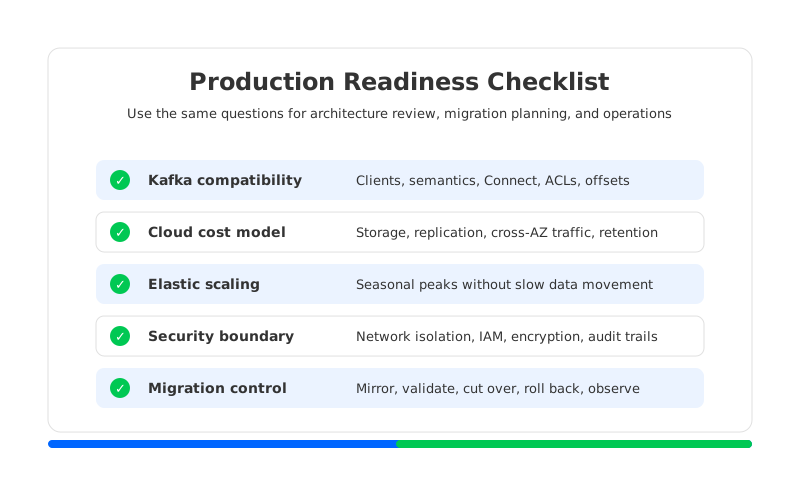
Use these questions in an architecture review before the platform becomes hard to change:
- Compatibility: Can existing Kafka clients, serializers, ACL expectations, topic configurations, offset behavior, and Connect workloads move without application rewrites?
- Cost model: Which parts of the design create storage, compute, API, and cross-zone network charges as event volume and retention grow?
- Elasticity: Can the cluster add and remove capacity around seasonal peaks without long partition reassignment windows or manual data placement work?
- Recovery: How does the platform recover from broker failure, connector failure, consumer lag, bad deployments, and corrupted downstream state?
- Governance: Who owns the cloud account boundary, encryption keys, network paths, identity policies, audit logs, and operational runbooks?
- Migration: Can the team mirror traffic, validate consumer behavior, compare lag, cut over gradually, and roll back without losing replay history?
- Observability: Do SREs have lag, throughput, request latency, connector status, broker health, storage growth, and cost signals in one operational view?
The answers will vary by organization. A global retailer may care most about multi-AZ network cost and peak elasticity. A manufacturer may care more about factory network isolation and delayed connectivity. A marketplace may care about exactly how reservations, cancellations, and refunds are ordered across services. The value of the checklist is that it makes those priorities explicit before the team debates broker counts or instance types.
5How AutoMQ changes the operating model
Once the checklist points to storage coupling, the architecture question becomes more specific: can the platform keep Kafka-compatible behavior while reducing the amount of broker-local state that operators must move, rebalance, and overprovision? AutoMQ fits into that category: a Kafka-compatible streaming platform that reworks Kafka's storage layer around shared storage, with brokers acting more like stateless compute nodes than long-lived owners of local log data.
In AutoMQ's architecture, stream data is durably written through a WAL layer and then stored in object storage as the shared data plane. The important shift is not "object storage is lower cost" by itself. The shift is that broker lifecycle and durable data ownership become less entangled. Capacity changes, broker replacement, and partition reassignment can be approached as compute operations instead of large local-disk relocation projects.
For real-time inventory signals, that changes several day-two concerns. A platform team can think about seasonal elasticity without assuming every capacity event will trigger heavy data movement. Long retention can be planned around object storage rather than broker-local disks alone. Recovery design can focus on restoring service against shared durable data instead of treating each broker's local disk as a unique recovery boundary. The Kafka API remains the contract for applications, while the storage layer better matches how cloud infrastructure is priced and operated.
AutoMQ also gives teams a way to keep deployment boundaries under their control. For buyers that need data to stay in their own cloud accounts, BYOC and software deployment models can be important evaluation points. For cost-sensitive multi-AZ environments, AutoMQ documentation describes configurations that can avoid producer, consumer, and server-side replica replication cross-AZ traffic under stated topology constraints. Those constraints matter; the point is not to assume magic routing, but to evaluate whether the architecture gives the team a controllable path.
This is the natural place for AutoMQ in the decision process. The platform should appear after the team has identified the operating-model problem: Kafka-compatible applications need durable event streams, but the cloud cost and scaling model should not be dominated by broker-local storage. If that is your inventory platform's problem, shared storage is a different way to draw the boundary between event processing and durable data.
6A migration path that reduces regret
The safest migration plan treats inventory streams as business controls, not technical plumbing. Start with one bounded domain such as store stock adjustments, warehouse receipts, or reservation events. Mirror the existing data path into the target Kafka-compatible platform and keep consumers in observe mode until lag, ordering assumptions, schema handling, and connector behavior are understood. The first goal is to prove that the target operating model preserves the semantics your applications already rely on.
Good migration plans also include rollback before they include celebration. Keep source systems authoritative until consumers have demonstrated stable behavior across peak and failure windows. Track replay time, connector restart behavior, consumer group stability, and downstream state reconciliation. If the target architecture is shared storage, validate the operational claims that motivated the move: faster capacity changes, less data movement during reassignment, more predictable retention growth, and clearer cloud cost attribution.
By the time the team moves critical inventory decisions, the debate should no longer be theoretical. You should know which topics carry customer-facing decisions, which consumers can tolerate delay, which sinks require strict ordering, and which workloads exist mostly for analytics replay. That map becomes the basis for production SLOs. It also helps avoid over-engineering every topic to the highest standard when only a subset of inventory signals directly affects order promising.
Real-time inventory is not a dashboard feature. It is a promise that the next operational decision sees the latest meaningful signal. Kafka gives teams a strong event foundation, but the infrastructure underneath determines how costly and operable that foundation becomes at supply-chain scale. If your team is evaluating a Kafka-compatible shared storage model for this workload, the AutoMQ overview is a useful next step: review the architecture and deployment model.
7References
- Apache Kafka Documentation
- Apache Kafka Consumer Groups and Offsets
- Apache Kafka Connect
- Apache Kafka KRaft
- AWS S3 Storage Classes
- AutoMQ Overview
- AutoMQ Compatibility with Apache Kafka
- AutoMQ Shared Storage Architecture
- AutoMQ WAL Storage
- AutoMQ Cross-AZ Traffic Configuration
8FAQ
8.1Is Kafka required for real-time inventory signals?
Kafka is one possible event backbone, and it is often a strong fit when multiple systems need the same ordered, durable, replayable inventory events. The decision depends on how many producers and consumers exist, how much replay is needed, and whether the team already standardizes on Kafka clients and operations.
8.2What inventory events should be streamed first?
Start with events that change customer-facing or operational decisions: sales, returns, reservations, stock adjustments, shipment scans, receiving confirmations, and fulfillment exceptions. Reporting-only events can follow once the team has proven producer quality, consumer lag targets, schema practices, and rollback procedures.
8.3How should teams partition inventory topics?
Partitioning should reflect ordering needs and load distribution. Many teams consider keys such as SKU, facility, order, or reservation entity, but the right key depends on which events must be processed in order. A poor key can create hot partitions or break the ordering assumptions of downstream services.
8.4Where does AutoMQ fit in an inventory streaming architecture?
AutoMQ fits when teams want Kafka-compatible APIs with a cloud-native shared storage operating model. It is most relevant when broker-local storage, slow data movement, cross-zone traffic, or retention growth make traditional Kafka operations difficult to scale economically.
8.5Does shared storage remove the need for Kafka operations?
No. Teams still need topic governance, client configuration, schema discipline, consumer lag monitoring, connector operations, security controls, and incident response. Shared storage changes the storage and broker lifecycle model; it does not remove the need for platform engineering.


