
Table of Contents
Table of Contents
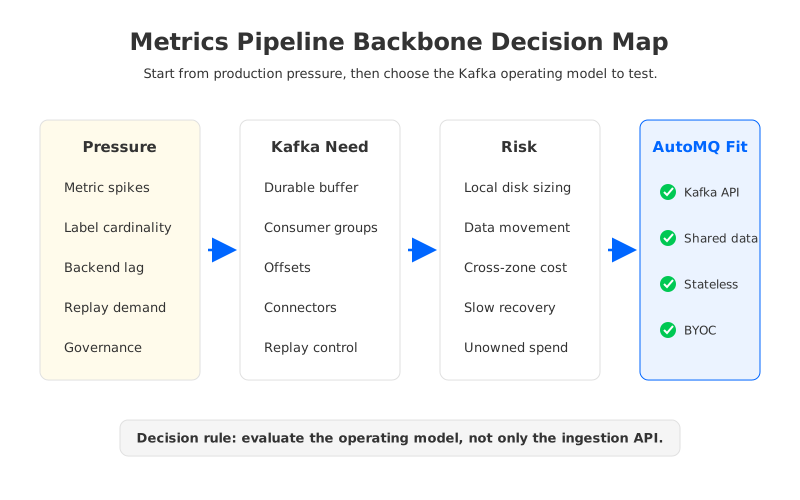
Teams search for observability metrics pipeline kafka when the metrics path has stopped feeling like background plumbing. The symptoms are familiar: collectors retry during a backend incident, dashboards lag behind the systems they describe, one service adds high-cardinality labels, and the platform team suddenly has to explain whether the pipeline is dropping signal or buffering it. Kafka looks attractive because it offers durable ingestion, independent consumers, offsets, and replay. The harder question is whether the Kafka layer has the right operating model for metrics that arrive constantly, spike during incidents, and feed several downstream systems with different failure behavior.
Metrics are not the same workload as logs or traces. A log pipeline often fights payload volume. A trace pipeline often fights sampling policy and span explosion. A metrics pipeline fights continuity and cardinality: small records, steady arrival, strict alerting expectations, and the risk that one label decision creates far more series than the storage and query path expected. When Kafka becomes the backbone for that pipeline, the design decision is no longer "Can Kafka move metrics?" It is "Can the streaming layer preserve real-time control when collection, retention, fan-out, and governance all change at different speeds?"
1Why Teams Search for Observability Metrics Pipeline Kafka
The search usually starts after a direct collection path has shown its limits. Agents and OpenTelemetry collectors can batch, retry, transform, and export, but they do not always provide a durable coordination point between producers and backends. If the metrics backend is throttled, collectors may accumulate local pressure. If a routing rule changes, service owners may need redeployments. If a compliance or platform team wants a second consumer for audit, capacity planning shifts from one destination to a shared data flow.
Kafka changes the shape of that problem. Producers publish to topics. Consumer groups read independently. Offsets give each downstream system a concrete recovery point. Kafka Connect and stream processing tools can bridge data into storage, alerting, billing, security, and analytics systems. That model is useful because a metrics pipeline rarely has one customer. The SRE team cares about alert freshness, application teams care about debugging, FinOps cares about usage attribution, and security may care about environment-level signals.
The design trap is treating Kafka as a neutral pipe. A metrics pipeline has several behaviors that need explicit ownership:
- Cardinality control: labels, dimensions, and tenant metadata determine how many series downstream systems must store and query.
- Alert path freshness: some metrics feed paging workflows, where lag is not only a reporting problem.
- Fan-out discipline: the same metric stream may feed alerting, forecasting, chargeback, anomaly detection, and long-term analysis.
- Replay boundaries: reprocessing metrics is useful, but replay can also duplicate alerts or distort derived aggregates.
- Data governance: metrics may carry service names, customer segment labels, deployment metadata, or infrastructure identifiers that deserve access control.
Kafka gives the pipeline a stronger coordination layer, but it also makes the streaming backbone part of the reliability surface. That is the right trade for many teams, provided they evaluate the broker architecture instead of stopping at API compatibility.
2The Production Constraint Behind the Problem
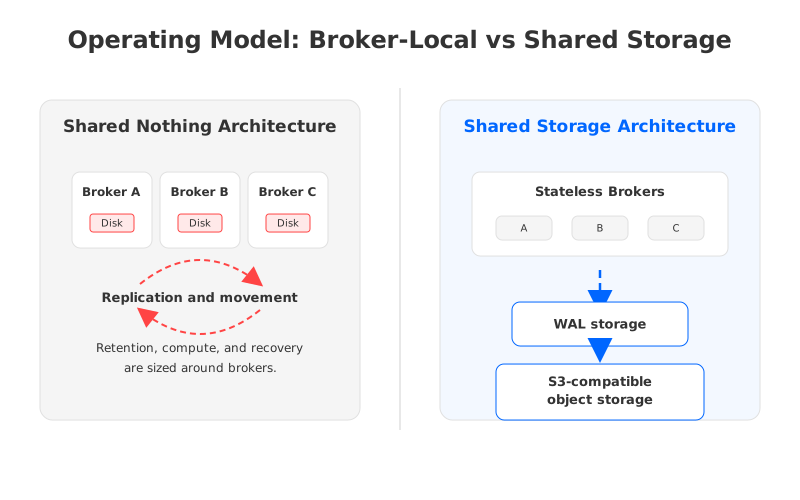
Metrics pipelines expose a specific mismatch in traditional Kafka operations. Apache Kafka's default architecture is built around brokers that own partitions, keep log segments on local or attached storage, and replicate data for durability. This Shared Nothing architecture is proven, understandable, and still a strong fit for many workloads. The constraint appears when metrics retention, broker compute, read fan-out, and recovery behavior need to scale independently.
A metrics spike often needs more ingestion and consumer capacity, not a permanent increase in retained local disk. A compliance requirement may need longer replay, not more broker CPU. A backend migration may need dual consumers and careful offset tracking, not a full cluster expansion. When brokers hold the durable state locally, those requirements become entangled. Capacity plans start to include extra disks for retained metrics, extra brokers for burst headroom, and wider maintenance windows for partition movement.
Tiered Storage can help with retention pressure by moving older log segments to remote storage. It is an important option to evaluate, especially for teams that want to reduce local storage pressure while preserving the familiar Kafka operating model. The distinction is that Tiered Storage does not make brokers stateless. Hot data, partition ownership, replica placement, and broker recovery still require careful design. For metrics pipelines, that distinction matters because the real-time path and the replay path are both production paths, but they do not have the same capacity profile.
3Architecture Options and Trade-Offs
The useful evaluation starts by naming the operating model instead of naming vendors. A direct collector-to-backend path has low moving parts, but it gives the platform team less durable control during backend failures. A traditional Kafka backbone gives durable buffering and consumer isolation, but it can bind storage, compute, and recovery work to broker-local state. A Kafka-compatible shared-storage backbone keeps the Kafka contract while changing where durable data lives.
That choice should be grounded in failure modes:
| Architecture pattern | Strong fit | Trade-off to test |
|---|---|---|
| Collector direct to backend | Simple metrics paths with one main destination and short retry windows | Backend throttling and routing changes can push complexity into collectors |
| Traditional Kafka backbone | Teams that need durable fan-out, replay, and mature Kafka operations | Broker-local storage can shape retention, scaling, and recovery decisions |
| Kafka with Tiered Storage | Teams that want to reduce older-segment pressure while keeping the stateful broker model | Hot path sizing, local storage, and recovery behavior still need planning |
| Kafka-compatible shared storage | Workloads where replay, burst capacity, and elastic operations are constrained by broker-local data | Requires validation of latency profile, storage backend, and operational tooling |
No row is a universal winner. A small platform with predictable metrics volume may be better served by a simpler topology and strict label governance. A large platform with several downstream consumers may need Kafka because the coordination value outweighs the extra layer. A replay-heavy platform may need to ask whether broker-local storage has become the reason every retention decision turns into a cluster sizing discussion.
4Evaluation Checklist for Platform Teams
A useful architecture review for a metrics pipeline looks more like an incident drill than a feature checklist. Start with the moments when the pipeline matters most: a backend is unavailable, a rollout produces noisy metrics, an alerting consumer falls behind, or an audit team asks for a replay window. Then map each moment to the streaming layer's responsibilities.
Use this checklist before choosing or changing the backbone:
- Compatibility: Can existing producers, collectors, processors, Kafka clients, Consumer groups, and connectors work without rewriting application code?
- Freshness objective: Which topics feed alerting, and what lag budget turns a delayed metric into an incident?
- Cardinality policy: Where are high-cardinality labels normalized, rejected, aggregated, or routed to a lower-priority path?
- Retention model: Which metrics need hot replay, which need long-term archive, and which should be aggregated before retention?
- Consumer isolation: Can a slow forecasting job fall behind without weakening alert delivery or operational dashboards?
- Recovery behavior: What happens to offsets, duplicate writes, and derived aggregates during replay or backend migration?
- Deployment boundary: Which components run inside the team's cloud account, VPC, Kubernetes cluster, or private environment?
- Cost ownership: Can the platform attribute storage, network, and consumer load to teams or metric classes?
The answers often change the ranking. A platform that looks throughput-heavy at first may actually be governance-heavy after the cardinality review. Another platform may discover that its biggest risk is not ingest speed, but the operational cost of keeping enough broker-local storage around for rare replay events. The checklist turns "Kafka for metrics" into a set of testable platform contracts.
5How AutoMQ Changes the Operating Model
Once the neutral review shows that broker-local durable state is the limiting constraint, a shared-storage Kafka-compatible architecture becomes worth testing. AutoMQ is one implementation of that approach: it preserves Kafka protocol compatibility while using Shared Storage architecture, stateless brokers, WAL (Write-Ahead Log) storage, and S3-compatible object storage as the durable layer.
The important change is not that metrics become easier by architecture alone. Cardinality limits, topic ownership, alert SLOs, and replay procedures still belong to the platform team. The change is that broker compute and durable storage no longer have to be sized as one rigid capacity block. Brokers can focus on Kafka request handling, leadership, caching, and serving active traffic, while durable data is kept in shared object storage. For a metrics pipeline, that means a burst, a longer replay window, and a compute scaling event can be evaluated as related but separable decisions.
AutoMQ's deployment models also matter for teams with strict boundaries. AutoMQ BYOC runs in the customer's cloud account and VPC, while AutoMQ Software is designed for customer-operated private environments. That lets platform teams evaluate Kafka compatibility and Shared Storage architecture without treating the metrics stream as a vendor-hosted data path. The operational review should still include IAM, network routing, encryption, observability export, backup expectations, and the exact WAL type selected for the workload.
The migration path deserves the same seriousness. Metrics pipelines often feed alert rules, service-level objectives, cost dashboards, and operational automation. A backbone migration should run dual paths where needed, verify Consumer group progress, compare derived metrics, and define rollback before the final cutover. AutoMQ Kafka Linking can help with migration scenarios that need byte-level copying and Consumer group progress synchronization, but the platform team still owns semantic validation: a metric replay is useful only when the downstream interpretation remains correct.
6Readiness Scorecard
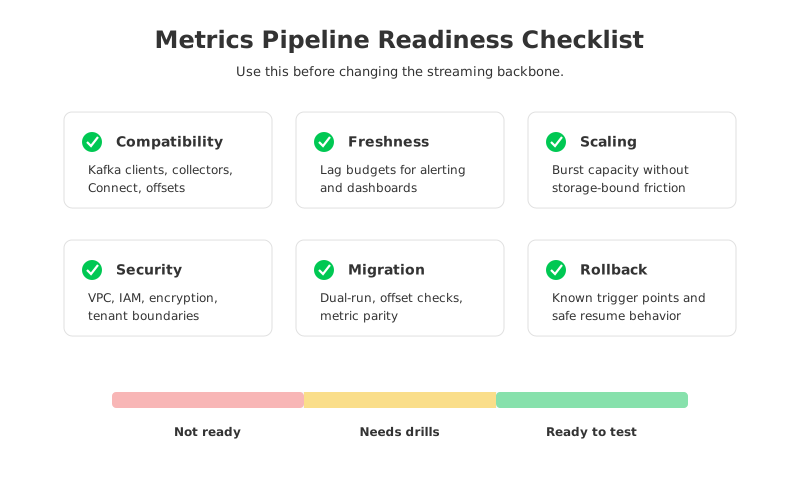
A practical readiness scorecard should separate architecture fit from migration readiness. Architecture fit asks whether the current Kafka model is shaping decisions in a way the team can no longer defend. Migration readiness asks whether the team can change the backbone without weakening alerting, dashboards, or governance.
| Review area | Ready signal | Warning signal |
|---|---|---|
| Kafka contract | Producers and consumers use standard Kafka APIs and documented client behavior | Hidden client assumptions or unsupported protocol features are unknown |
| Metrics semantics | Alerting, aggregation, and replay rules are documented by topic class | Replay can duplicate alerts or rewrite derived aggregates without review |
| Storage model | Retention and replay needs are separated from active broker compute needs | Local disk sizing dominates every capacity decision |
| Operations | Scaling, recovery, and failover drills are tested with metric consumers attached | Tests stop at broker health and ignore downstream lag |
| Governance | Labels, tenants, and sensitive metadata have ownership rules | Cardinality problems are discovered from backend bills or paging noise |
| Migration | Dual-run, offset verification, and rollback criteria are defined | Cutover depends on a maintenance window with unclear metric parity checks |
Back to the original search query: the strongest metrics pipeline is not the one with the longest list of integrations. It is the one whose streaming backbone makes failure, replay, growth, and ownership explicit. Kafka can provide that backbone, but the broker architecture determines how much operational friction sits behind every retention and scaling decision. If your metrics path has reached that point, evaluate AutoMQ with real topics, real Consumer groups, and real replay drills rather than a synthetic hello-world test. You can start from the AutoMQ deployment path and validate the architecture against the scorecard above.
7FAQ
7.1Is Kafka a good fit for observability metrics pipelines?
Kafka is a good fit when the pipeline needs durable buffering, independent consumers, replay, and controlled fan-out. It is less useful as a replacement for metrics governance. Teams still need label policy, alert freshness targets, retention classes, and ownership rules.
7.2Should metrics, logs, and traces share the same Kafka backbone?
They can share a platform, but they should not be treated as one identical workload. Metrics usually need stricter freshness and cardinality control, logs often need volume filtering and redaction, and traces often need sampling decisions. Topic design should reflect those differences.
7.3Does Tiered Storage solve the metrics retention problem?
Tiered Storage can reduce pressure from older log segments, but it does not make brokers stateless. Teams still need to size and operate the hot path, local storage, replica placement, and recovery behavior. For replay-heavy metrics workloads, that distinction should be tested directly.
7.4Where does AutoMQ fit in the architecture?
AutoMQ fits after the team has validated that Kafka compatibility is required and broker-local durable state is limiting elasticity, retention, or operational recovery. It changes the storage model underneath the Kafka protocol rather than asking applications to adopt a different streaming API.
7.5What should a proof of concept include?
A useful proof of concept should include existing producers or collectors, realistic Consumer groups, alerting consumers, replay tests, backend throttling behavior, security configuration, migration rollback, and operational drills. A bootstrap connection test is not enough for a production metrics pipeline.
8References
- Apache Kafka Documentation
- Apache Kafka Connect Documentation
- Apache Kafka KRaft Documentation
- Apache Kafka Tiered Storage Documentation
- OpenTelemetry Collector Documentation
- OpenTelemetry Metrics Specification
- AutoMQ Architecture Overview
- AutoMQ S3Stream Shared Streaming Storage
- AutoMQ Kafka Linking Documentation


