
Table of Contents
Table of Contents
Searches for payment authorization streams kafka usually come from a team that already has Kafka in the architecture and has reached the uncomfortable part of the design. The question is no longer whether payment events can be written to a topic. The real question is whether the streaming backbone can carry authorization decisions, fraud signals, ledger updates, audit records, and downstream notifications without turning every peak, failover, and schema change into a production incident. Payment authorization is a narrow workflow, but it exposes almost every hard boundary in a streaming platform.
That is why this topic deserves a platform-level answer instead of a pattern catalog. Kafka gives teams a durable log, ordered partitions, consumer groups, offsets, producer retries, transactions, and a broad connector ecosystem. Payment workloads add a harder demand: the platform must preserve the contract under pressure, when traffic is uneven, consumers fall behind, and the business cannot pause authorizations while brokers rebalance.
The useful thesis is simple: payment authorization streams need a Kafka-compatible interface, but the operating model behind that interface determines how much risk, cost, and recovery work the team inherits.
1Why Teams Search for payment authorization streams kafka
A payment authorization stream is not one topic with one consumer. It is a chain of time-sensitive facts that may include authorization requests, approval or decline decisions, risk scores, card network responses, merchant context, customer notifications, reconciliation records, and compliance evidence. Some records participate in the decision path. Others feed analytics, fraud tuning, observability, or audit storage. Treating all of them as the same stream is a fast way to hide important service-level differences.
The first design decision is therefore to separate the workflow by risk, not by team ownership. An inline decision topic may require tight latency objectives and conservative dependency choices. A ledger projection may require strict ordering and replay discipline. An audit topic may care more about retention, access control, and immutable history than single-digit millisecond produce latency. A fraud feature stream may tolerate short delays if it gives analysts a complete replay window.
For platform teams, Kafka is attractive because it can keep these flows connected without forcing every application to call every other application directly. Producers publish facts. Consumers choose their own pace. Consumer groups coordinate partition ownership and commit offsets, which makes parallel processing and recovery manageable. Kafka Connect can move data between Kafka and external systems, while transactions and idempotent producers help applications reason about retries and atomic writes. Those are good building blocks, but they do not remove the need to design the infrastructure envelope around them.
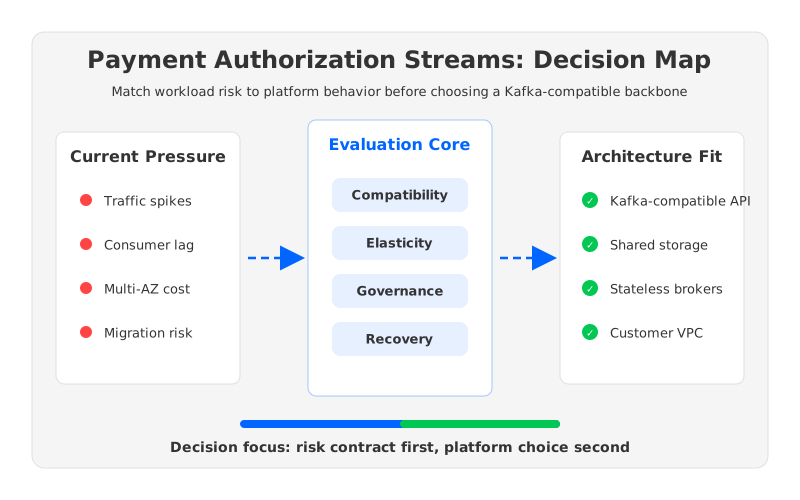
The decision map matters because the same Kafka API can sit on very different infrastructure. A broker cluster sized for average traffic may behave well in normal hours and still become fragile during a card-program launch, payday spike, marketplace promotion, or regional incident. A cluster sized for every possible spike may be stable but wasteful. A cluster that relies on slow partition movement during scale-out may be both expensive and hard to recover.
2The Production Constraint Behind the Problem
Traditional Kafka uses a Shared Nothing architecture: each broker owns local storage, and partitions are replicated between brokers for durability and availability. That design was reasonable for the data center era, where local disks were the natural persistence layer and east-west replication did not show up as a separate cloud bill. In cloud environments, the same design binds capacity, data placement, and recovery to broker-local storage.
That binding affects payment authorization streams in several ways:
- Capacity has to be reserved before the spike. If storage and compute scale together, adding brokers after traffic rises may still require partition reassignment and data movement before the added capacity is useful.
- Recovery competes with the workload. When a broker fails or a topic is rebalanced, replication and catch-up traffic can consume the same network, disk, and CPU budget that payment traffic needs.
- Cross-AZ replication becomes a cost and topology decision. Multi-AZ durability is necessary for regulated financial systems, but broker-to-broker replication across Availability Zones can make the storage design visible in the network line item.
- Retention increases blast radius. Longer replay windows are useful for audit, fraud review, and reconciliation, yet local-retention-heavy clusters often require more broker storage and more careful rebalance planning.
None of these points means Kafka is the wrong abstraction. They mean the storage model behind Kafka determines the cost of operating that abstraction. Payment teams often discover this during a scaling exercise: the application logic is ready, the topic model is reasonable, and the client configuration is defensible, but the cluster still asks operators to move large amounts of data before it can adapt.
3Architecture Options and Trade-Offs
The first option is to run traditional Kafka with disciplined capacity management. This can work well when the organization has mature SRE practices, predictable growth, clear topic ownership, and a budget model that accepts overprovisioning for critical paths. The advantage is familiarity: existing tooling, known failure modes, and a large talent pool. The trade-off is that platform teams must keep storage placement, replica movement, broker sizing, and retention policy under constant review.
The second option is managed Kafka. It can reduce day-to-day operational burden, especially for teams that do not want to own upgrades, patching, and baseline monitoring. The evaluation should still look beyond the word "managed." Payment workloads need clear answers about client compatibility, network isolation, access control, audit integration, scaling behavior, quota policy, region strategy, and what happens during broker maintenance. A managed control plane does not automatically change the data movement properties of the underlying architecture.
The third option is a Kafka-compatible cloud-native streaming platform that separates compute from storage. In this model, the platform keeps Kafka protocol semantics for clients while changing how durable data is stored and how brokers scale. The key question becomes whether the platform can preserve the operational contract payment teams care about: predictable failover, controlled latency, replay, governance boundaries, and migration safety.
| Evaluation area | Why it matters for payment authorization streams | What to ask before choosing |
|---|---|---|
| Kafka compatibility | Payment systems often depend on existing producers, consumers, serializers, transactions, and offset behavior. | Which Kafka client versions and APIs are supported, and what tests prove compatibility? |
| Elasticity | Authorization traffic can be bursty, and peak provisioning is costly. | Does scale-out require large data movement before capacity helps? |
| Storage model | Retention and replay are business requirements, not afterthoughts. | Are durable records tied to broker-local disks or stored in a shared storage layer? |
| Network topology | Multi-AZ deployment affects both resilience and cost. | Which paths cross AZ boundaries during produce, replication, catch-up, and failover? |
| Governance | Payment data needs identity, authorization, auditability, and schema discipline. | Can the team enforce access control, separate duties, and track change history? |
| Migration risk | Authorization streams cannot accept vague cutover plans. | Can offsets, producer writes, and rollback be controlled during migration? |
This table is deliberately neutral. It prevents a common mistake: choosing a platform from a feature list while leaving the highest-risk operational questions unanswered. Payment authorization is too important for that. The right design has to make normal operations boring and abnormal operations explicit.
4Evaluation Checklist for Platform Teams
Start with the contract before drawing the architecture. Define which topics are in the authorization path, which topics are derived, which records are replayable, which consumers may lag, and which operations require human approval. A topic that triggers an approval decision should not inherit the same retention, scaling, and rollback policy as a stream used for offline model training.
A practical readiness review should cover seven areas:
- Compatibility: Verify producer, consumer, admin, transaction, and offset-management behavior against the client versions you run in production. Include serializers, schema validation, and operational tools in the test.
- Latency envelope: Separate inline authorization topics from near-real-time analytics or audit topics. Set targets by workflow tier instead of applying one global number.
- Failure recovery: Test broker failure, consumer group rebalance, controller failover, object storage or disk throttling, and downstream sink outages. Measure application-visible behavior, not only broker metrics.
- Cost model: Account for compute, storage, retention, cross-AZ traffic, connector capacity, monitoring, and peak headroom. Avoid treating broker count as the full cost model.
- Governance: Confirm encryption, identity boundaries, ACLs, schema controls, audit logs, and environment separation. Payment metadata can be sensitive even when message payloads are encrypted.
- Migration plan: Preserve offsets, partition ordering assumptions, producer routing, and rollback paths. Test a non-critical stream first, then promote the pattern.
- Observability: Track end-to-end latency, produce error rates, consumer lag, commit behavior, storage latency, rebalance events, and connector health in one operational view.
The checklist also gives teams a cleaner way to discuss trade-offs with application owners. Instead of saying "the cluster is safe," the platform team can say which contracts have been tested and which contracts remain workload-specific. That distinction matters when a payment service and a reporting service share the same streaming backbone but have different failure tolerance.
5How AutoMQ Changes the Operating Model
Once the evaluation points to a need for Kafka compatibility plus a different storage model, AutoMQ becomes relevant as a Kafka-compatible cloud-native streaming platform built around Shared Storage architecture. AutoMQ keeps the Kafka protocol and client ecosystem while moving durable stream data from broker-local disks to S3-compatible object storage through S3Stream. Brokers become stateless in the persistence sense: they handle Kafka requests, leadership, caching, and scheduling, while durable data lives in shared storage.
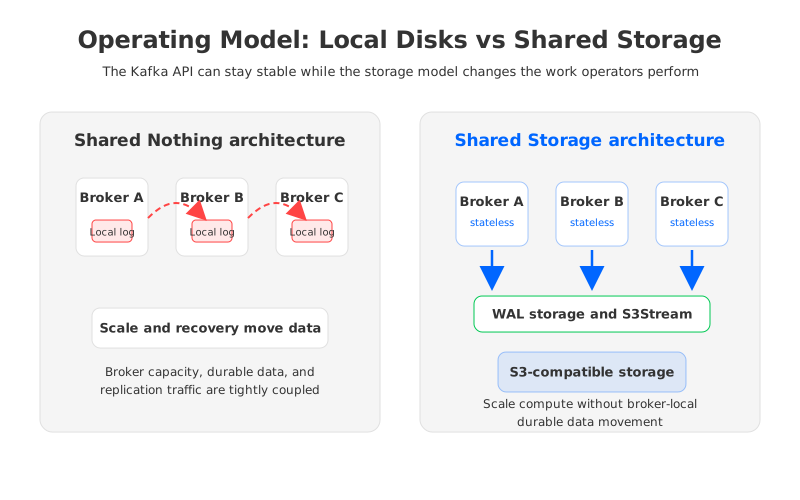
This changes the operational shape of a payment streaming platform. Adding or replacing brokers is less about copying partition data and more about changing ownership, routing, and cache locality. Partition reassignment can complete without the same broker-to-broker bulk data movement that defines traditional local-disk Kafka operations. For a workload with bursty authorization traffic and long-lived audit or reconciliation retention, that separation gives the platform team a better lever: scale compute for traffic, use shared object storage for durability and replay, and avoid coupling every storage decision to broker count.
The WAL (Write-Ahead Log) layer is the detail that keeps this from becoming a simplistic "write everything directly to object storage" story. AutoMQ uses WAL storage for durable write acknowledgement and recovery, then stores stream data in S3 storage as the primary durable layer. Different deployment choices can use different WAL types, so production evaluation should match the WAL to the latency and fault-domain needs of the workload. That is especially important for payment authorization streams, where inline decision topics may have a tighter write path than audit, analytics, or model-feedback streams.
AutoMQ BYOC also changes the deployment boundary. In BYOC (Bring Your Own Cloud), the control plane and data plane run in the customer's cloud account and VPC, so business data remains inside the customer's environment. For regulated payment teams, this boundary can be as important as raw platform mechanics. The streaming backbone has to fit existing network controls, IAM review, private connectivity, monitoring, and audit processes.
Migration is the last piece of the operating model. AutoMQ Kafka Linking is designed for migrations from Apache Kafka and other Kafka-compatible sources, with byte-level message synchronization and consumer group progress synchronization. Payment teams should still phase migration by workload tier. Start with a bounded derived stream, prove producer routing and consumer progress, then move closer to the authorization path once rollback behavior is understood.
6Readiness Scorecard
Use this scorecard before putting payment authorization streams on any Kafka-compatible platform. It is not a vendor scoring sheet; it is a way to surface assumptions while they are still inexpensive to change.
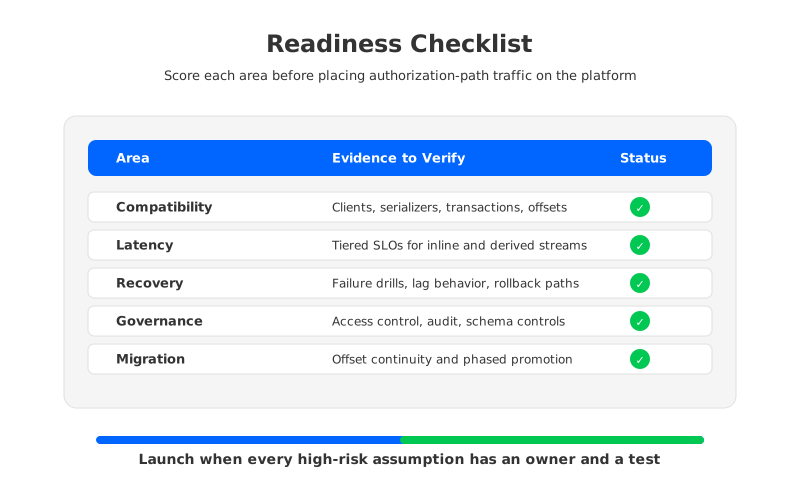
| Score | Meaning | Action |
|---|---|---|
| 1 | The area is documented, tested, and owned. | Keep it in the launch checklist and monitor it after release. |
| 2 | The area is partly tested or depends on manual operations. | Add a failure drill, runbook, or automated control before rollout. |
| 3 | The area is unclear, untested, or owned by nobody. | Do not place authorization-path traffic on the platform until this is resolved. |
The most useful result is not the total score. It is the set of disagreements. If application engineers rate migration risk as low and SREs rate it as high, the team has found the next test to run. If security rates governance as unresolved, the architecture discussion should pause before anyone argues about throughput.
7FAQ
7.1Is Kafka a good fit for payment authorization streams?
Kafka can be a strong fit when the workflow benefits from durable ordered events, replay, consumer fanout, and decoupled services. The fit depends on the latency tier, idempotency model, recovery plan, and governance controls around the authorization path.
7.2Do payment authorization streams require exactly-once semantics?
They require a clear business idempotency and recovery model. Kafka transactions and idempotent producers can help with transport-level guarantees, but payment correctness usually also depends on domain keys, ledger rules, and downstream side-effect control.
7.3Should every payment event use the same topic design?
No. Authorization decisions, ledger projections, audit records, fraud features, and analytics feeds usually have different latency, retention, and replay needs. Model the workflow first, then assign Kafka topics and service-level objectives.
7.4Where does AutoMQ fit in the architecture?
AutoMQ fits when teams want Kafka-compatible clients and operations with a Shared Storage architecture. It is most relevant when local-disk broker operations, cross-AZ traffic, retention growth, or migration risk have become platform constraints.
7.5What is the safest migration path?
Start with a derived or non-critical payment stream, verify offset behavior and rollback, then move toward authorization-path topics in phases. Treat migration as a production workflow, not a one-time data copy.
Payment authorization streams start as an application architecture question, but they become a streaming-platform question the moment traffic spikes, consumers lag, or recovery has to be proven. If your team is evaluating a Kafka-compatible backbone for that path, review AutoMQ BYOC deployment options and test the operating model against your own authorization, audit, and migration contracts.


