
Table of Contents
Table of Contents
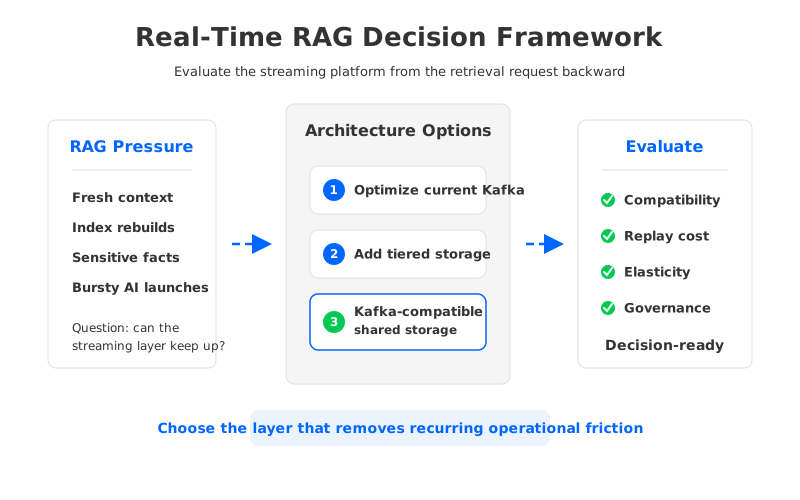
Teams search for real time rag kafka when batch refreshes start to leak into user experience. A support copilot cites yesterday's customer status. A fraud analyst sees a generated explanation that missed a transaction event from the last few minutes. A sales assistant retrieves account facts from a vector index that is technically correct, but stale enough to be operationally wrong. Retrieval-augmented generation makes model output depend on the freshness, lineage, and governance of upstream data, so the streaming layer becomes part of the AI system rather than a background integration detail.
Kafka is a natural place to start because many enterprises already use it as the durable event backbone for customer activity, operational telemetry, CDC, payments, order status, and product usage streams. The harder question is not whether Kafka can feed a real-time RAG pipeline. It is whether the Kafka-compatible streaming platform can keep up with the operating model AI teams are asking for: low-latency ingestion, bursty embedding workloads, replay for re-indexing, governance for sensitive records, and predictable cloud cost while the number of AI use cases keeps changing.
1Why real time rag kafka matters in production
RAG moves knowledge retrieval from a static document lookup into the request path of an AI product. That changes the failure mode. In a traditional analytics dashboard, a delayed batch job may mean a stakeholder waits for the next refresh. In an AI assistant, stale retrieval can be turned into confident prose and handed directly to a customer, employee, or automated workflow. The data platform is now responsible for freshness and trust at the same time.
Most production RAG systems have at least four data paths:
- Fact ingestion from source systems such as databases, SaaS applications, logs, tickets, product events, and billing records. CDC and event streams are common because the upstream state changes continuously.
- Transformation and enrichment that normalizes records, filters sensitive fields, chunks documents, joins metadata, and prepares payloads for embedding.
- Embedding and indexing into a vector database, search service, feature store, or lakehouse table used by retrieval.
- Replay and correction when an embedding model changes, a prompt requires different metadata, a governance rule removes records, or a downstream index falls behind.
Kafka-compatible streaming gives these paths a shared contract: ordered partitions, offsets, consumer groups, retention, replay, and a mature client ecosystem. Those mechanics are useful because real-time RAG is not only about low latency. It is also about being able to answer, "Which version of this fact reached the index, which consumer processed it, and can we replay from a known offset without rewriting every producer?"
2The production constraints behind the architecture
The early prototype of a real-time AI data pipeline often looks straightforward: publish source events to Kafka, consume them with a stream processor, call an embedding service, and write vectors to an index. The production version is less tidy because each stage has a different scaling pattern. Source events may arrive steadily, but embedding workloads can spike after a document import, model migration, or index rebuild. Retrieval traffic may be read-heavy during business hours while indexing catches up in the background.
That mismatch exposes constraints that platform teams should evaluate before choosing a streaming architecture:
| Constraint | Why it matters for real-time RAG | What to evaluate |
|---|---|---|
| Freshness | Retrieved context can become part of user-visible model output. | End-to-end lag, consumer lag, retry policy, and index update latency. |
| Replay | Teams reprocess data when chunking, metadata, embedding models, or policies change. | Retention cost, catch-up read performance, and offset-based recovery. |
| Elasticity | AI workloads are bursty and often product-driven rather than capacity-plan driven. | Broker scaling time, partition movement, and autoscaling operations. |
| Governance | RAG commonly touches customer, employee, or regulated data. | Data residency, access boundaries, auditability, and deletion workflows. |
| Cost | Long retention and replay can make storage and network traffic dominate. | Broker disk, cross-AZ traffic, object storage, and operational labor. |
This table is deliberately vendor-neutral. A platform that wins a benchmark but fails governance is not production-ready. A platform that keeps data fresh but requires days of manual rebalance work after every capacity change is also fragile. RAG workloads make these trade-offs visible because they combine streaming, storage, machine learning, search, and compliance into one path.
3Architecture patterns teams usually compare
The default Kafka architecture is a shared-nothing model: brokers own local log storage, partitions are replicated across brokers, and durability comes from in-sync replicas. This design is proven and well understood. It also means storage, replication, and compute capacity are tightly coupled. When a broker is added, removed, or overloaded, partition reassignment can involve moving substantial data. When retention grows for replay, broker storage grows. When replicas span availability zones, replication traffic becomes part of the cloud bill.
Tiered storage reduces part of this pressure by moving older log segments to object storage. It can be a practical improvement for long retention, but the hot path still depends on broker-local primary storage. For real-time RAG, that distinction matters: a team may need both fast tailing reads for fresh context and efficient catch-up reads for re-indexing. If the architecture still treats local broker storage as the primary source of truth for active data, scaling and rebalancing remain tied to data movement.
Kafka-compatible shared storage changes the operating model more deeply. In this pattern, brokers continue to speak Kafka protocol and preserve Kafka semantics, but durable stream data is placed in shared storage rather than being permanently bound to broker-local disks. Brokers become closer to stateless compute nodes that handle protocol requests, caching, leadership, and traffic scheduling. The platform still needs a low-latency write path, typically through a write-ahead log, but the durable data plane is no longer shaped by every broker's attached disk.
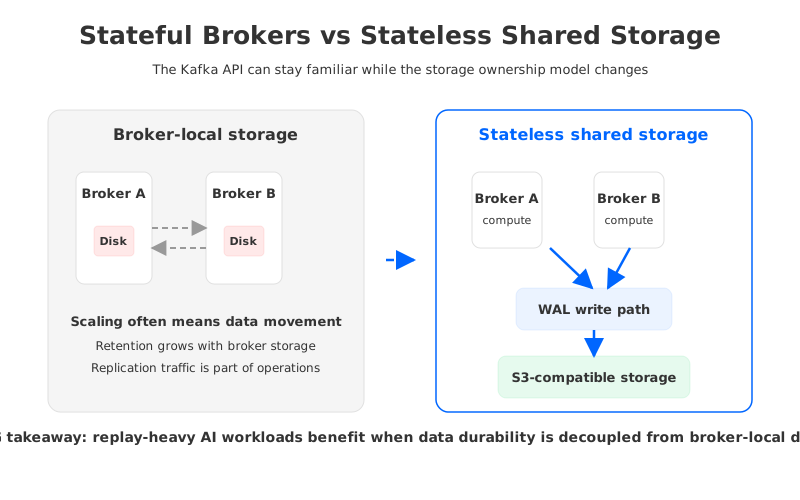
The practical difference is not semantic novelty; it is operational leverage. If producers, consumers, Kafka Connect jobs, stream processors, and AI indexing workers can keep using Kafka-compatible APIs, the migration surface remains manageable. Meanwhile, the infrastructure team gains a storage model that is better aligned with cloud elasticity and long-lived replay data.
4Evaluation checklist for platform teams
A strong real-time RAG platform should be evaluated from the retrieval request backward. Ask what has to be true for a generated answer to use the right context, at the right time, under the right policy. That lens produces a more useful checklist than comparing streaming platforms only by peak throughput.
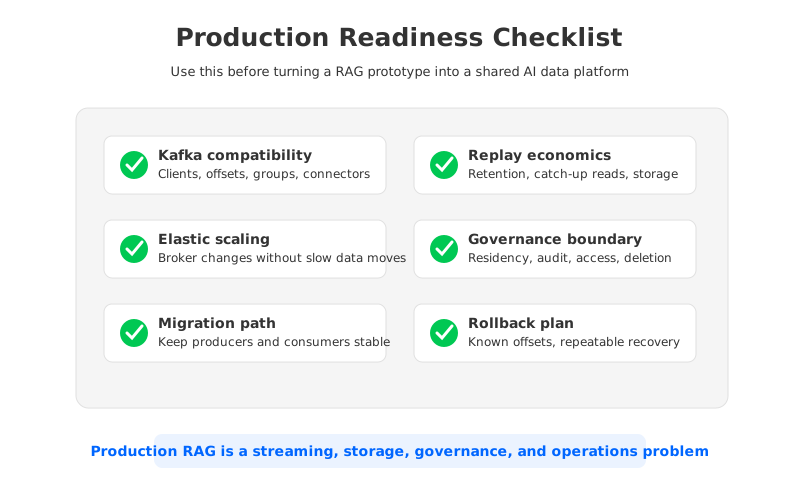
Start with compatibility. Kafka compatibility should cover client behavior, topic and partition semantics, offsets, consumer groups, idempotent producers, transactions where needed, Kafka Connect, and observability conventions. A partial compatibility layer may be enough for a greenfield prototype, but RAG pipelines usually sit between existing systems and AI products that are still changing. Rewriting producers and consumers is rarely the highest-value engineering project.
Then examine retention and replay. RAG systems often need to rebuild indexes after changing chunking rules, embedding models, or metadata schemas. Replay is easy to say and expensive to operate. The streaming platform should make it clear how long data can be retained, how catch-up reads affect live traffic, and how storage cost scales when multiple AI teams retain similar event streams for different indexes.
Governance deserves equal weight. A real-time AI data pipeline can move sensitive facts faster than a batch pipeline, which is useful only if access control, audit logs, residency boundaries, and deletion workflows move with it. For regulated or customer-sensitive use cases, a BYOC or customer-controlled deployment boundary can be more than a procurement preference. It may determine whether the architecture is approvable.
Finally, test elasticity as an operational scenario, not a diagram. Add an embedding workload. Rebuild an index. Increase retention. Simulate a broker failure. Roll a version. Watch what happens to partition movement, consumer lag, cloud network traffic, and human intervention. The result tells you more than a static feature checklist.
5Where AutoMQ changes the operating model
Once the evaluation frame is clear, AutoMQ enters as a specific architecture option rather than a generic product claim. AutoMQ is a Kafka-compatible, cloud-native streaming platform that replaces Kafka's broker-local storage layer with S3Stream, a shared streaming storage architecture built on WAL storage and S3-compatible object storage. The goal is to keep the Kafka protocol and ecosystem path familiar while changing the storage and elasticity model underneath.
For real-time RAG pipelines, that distinction maps to several concrete operating concerns:
- Kafka-compatible integration path. Existing Kafka clients, producers, consumers, Kafka Connect integrations, and stream processing jobs can remain the design center. This matters when AI teams need to consume enterprise event streams without forcing every upstream team into a different protocol.
- Shared Storage architecture for replay-heavy workloads. S3-compatible object storage becomes the primary durable data repository, while WAL storage accelerates writes and recovery. That makes long retention and re-indexing a storage-design question rather than a broker-disk expansion project.
- Stateless brokers for elastic operations. Because durable data is not permanently tied to broker-local disks, partition reassignment and traffic balancing are less dominated by data copying. This is relevant when embedding jobs, index rebuilds, or product launches create short-lived capacity pressure.
- Customer-controlled deployment boundaries. AutoMQ BYOC and AutoMQ Software are designed for environments where customers need control over the cloud account, VPC, storage, and operational boundary. For RAG on sensitive enterprise data, that control can simplify security review.
The key is not that every RAG workload needs a replacement streaming platform on day one. If a team's Kafka cluster already has adequate retention, predictable scaling, clear governance, and acceptable cost, tuning may be enough. AutoMQ becomes more interesting when the AI roadmap turns replay, elasticity, and cloud storage economics into recurring constraints rather than occasional incidents.
6Decision table: optimize, redesign, or evaluate AutoMQ
The most useful decision is often not "Kafka or not Kafka." It is which layer should change first. A team building its first RAG prototype may only need topic hygiene, consumer-lag monitoring, and a reliable indexing worker. A team running many RAG products across customer, support, security, and operations data may need a platform architecture that treats freshness, replay, and governance as first-class design goals.
| Situation | Best next move | Why |
|---|---|---|
| One small RAG pipeline with low retention and stable traffic | Optimize the existing Kafka deployment. | Keep scope tight; focus on lag, retries, schema quality, and index correctness. |
| Multiple RAG pipelines competing for retention and replay capacity | Redesign the streaming storage model. | Broker-local disk and reassignment work may become recurring bottlenecks. |
| Sensitive enterprise data with strict residency or account-boundary requirements | Evaluate a customer-controlled deployment model. | Governance and procurement can block otherwise sound architectures. |
| Frequent index rebuilds, embedding model changes, or bursty AI launches | Evaluate Kafka-compatible shared storage. | Elastic brokers and object-storage-backed retention better match replay-heavy AI workloads. |
| Existing Kafka ecosystem is deeply embedded | Prefer Kafka-compatible migration paths. | Avoid rewriting producers, consumers, connectors, and operations tooling at the same time. |
Real-time RAG turns streaming into a product reliability problem. The question is no longer whether events can be delivered to an index. The question is whether the platform can keep retrieved context fresh, replayable, governed, and cost-effective as AI workloads grow from one demo to many production systems. If your current Kafka architecture is starting to make that harder, explore AutoMQ as a Kafka-compatible path toward shared storage and more elastic operations.
7References
- Apache Kafka Documentation
- Apache Kafka Consumer Groups and Offsets
- Apache Kafka Transactions
- AutoMQ Architecture Overview
- AutoMQ S3Stream: Shared Streaming Storage
- AutoMQ Continuous Self-Balancing
- Amazon S3 FAQs
8FAQ
8.1Is Kafka a good fit for real-time RAG pipelines?
Kafka is a strong fit when the RAG pipeline depends on continuously changing enterprise facts, CDC streams, operational events, or auditability. It provides ordered partitions, offsets, consumer groups, replay, and a mature ecosystem. The main question is whether the specific Kafka deployment can handle the retention, replay, scaling, and governance requirements of production AI workloads.
8.2What is the biggest architecture risk in real-time RAG on Kafka?
The biggest risk is treating RAG as only an indexing problem. Indexing is one stage. The harder platform problem is keeping source events fresh, replayable, governed, and observable while embedding services, vector stores, and AI products change independently.
8.3Do real-time RAG pipelines need exactly-once processing?
Some stages benefit from idempotent writes or transactional guarantees, especially when updates must not be duplicated in downstream state. Many RAG indexing paths can also work with at-least-once delivery if the index writer is idempotent and records carry stable keys. The right answer depends on how deletes, updates, and reprocessing are modeled.
8.4How does shared storage help RAG workloads?
Shared Storage architecture can reduce the operational coupling between broker compute capacity and durable stream data. For RAG workloads that need long retention, frequent replay, and bursty indexing, that separation can make scaling and re-indexing less dependent on moving large amounts of broker-local data.
8.5When should a team evaluate AutoMQ for RAG?
Evaluate AutoMQ when existing Kafka operations are constrained by broker storage, slow partition reassignment, cross-AZ replication cost, replay-heavy AI workloads, or customer-controlled deployment requirements. It is most relevant when Kafka compatibility remains important but the operating model of traditional broker-local storage is becoming the bottleneck.


