
Table of Contents
Table of Contents
Searches for real time ad bidding signals kafka usually come from a very practical place: an advertising team already has event streams, but the streams are starting to behave like a product risk instead of a data pipeline. Bid requests, impression events, click signals, device context, inventory quality, campaign pacing, fraud scores, and conversion feedback all need to move while the auction is still worth acting on. If the streaming backbone adds operational drag, the bidding model does not fail dramatically; it becomes slightly late, slightly stale, and slightly harder to trust.
Apache Kafka is a common fit for this problem because the application boundary is naturally event-shaped. Producers publish signal updates, stream processors enrich or score those updates, and consumers feed bidders, feature stores, attribution systems, or analytical sinks. The hard part is not drawing that architecture on a whiteboard. The hard part is keeping it predictable when campaign traffic changes by region, a large advertiser shifts budget, a fraud rule creates a hot partition key, or an analytics consumer falls behind during peak demand.
Ad bidding exposes an uncomfortable truth about streaming infrastructure: throughput, latency, durability, and operating cost are coupled. You can overprovision brokers to protect latency, retain more data for replay, or add replicas for durability, but each choice changes cost and recovery behavior. The architecture decision is therefore not only "Can Kafka handle the events?" It is "Can the team operate Kafka-like semantics without turning every traffic change into a storage and balancing project?"
1Why teams search for real time ad bidding signals kafka
Real-time bidding systems have several event classes with different tolerance for delay. Auction-time features need freshness because they affect bid price or eligibility. Conversion and attribution events can arrive later, but they must preserve ordering, offsets, and replayability for model training and billing reconciliation. Governance signals, such as consent, geography, and policy flags, need strong operational discipline because a stale value can create compliance exposure rather than a mere ranking error.
That mix pushes teams toward a backbone with durable topics, consumer groups, independent producers and consumers, replay, and established client behavior. Apache Kafka documents these primitives clearly: a topic is partitioned, consumers coordinate through consumer groups, offsets track read progress, and transactional or idempotent producers can be used when the application needs stronger write guarantees. For ad bidding teams, those are not academic concepts. They are how a pacing service, model feature service, fraud detector, and reporting job share the same event stream without becoming one large, tightly coupled application.
The search intent usually appears when the first implementation has already worked. Early pipelines often survive because traffic is modest, retention is short, and the team can manually rebalance a cluster during a maintenance window. The next phase is less forgiving. More campaigns add partitions, more models add consumers, and longer audit windows add retained data. What used to be a Kafka deployment becomes a platform contract for revenue-facing applications.
2The production constraint behind the problem
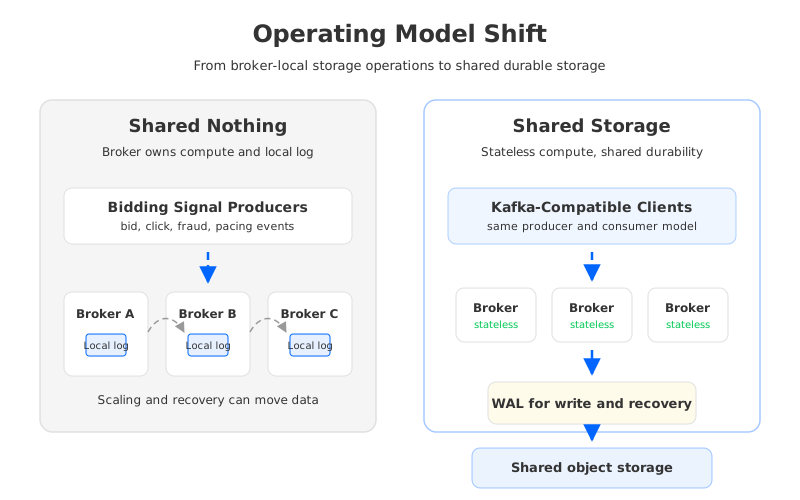
Traditional Kafka uses a Shared Nothing architecture: each broker owns local storage, and partitions are assigned to brokers. Durability and availability are achieved by replicating partition data across brokers. That design has served many teams well, especially when local disks were the natural storage substrate and the operational model was built around stable broker capacity. In cloud environments, the same design can turn capacity changes into data movement.
The pressure shows up in four places:
- Broker-local storage becomes a scaling unit. Adding brokers helps only after partitions and their data are reassigned. Removing brokers requires care because data has to move away from the retiring nodes.
- Replication becomes network traffic. In a multi-Availability Zone design, durability and availability can imply cross-zone writes, and cloud providers charge for some data transfer paths. AWS documents data transfer pricing separately from compute and storage, which is why the bill often surprises teams that modeled only broker instance cost.
- Retention changes the operational footprint. Longer replay windows help debugging, attribution, and model correction, but retained bytes stay attached to the storage design.
- Hot partitions create local stress. A campaign, geography, or partner can skew traffic. Consumer lag and broker disk pressure then become a shared incident across applications that otherwise look independent.
Kafka features such as KRaft, Kafka Connect, transactions, consumer groups, and Tiered Storage improve important parts of the platform. KRaft removes ZooKeeper from the metadata path, Kafka Connect standardizes integration, and Tiered Storage moves older log segments to remote storage while local storage remains part of the active log path. These tools do not erase the platform question: when the workload changes quickly, how much work is caused by data being physically tied to brokers?
3Architecture options and trade-offs
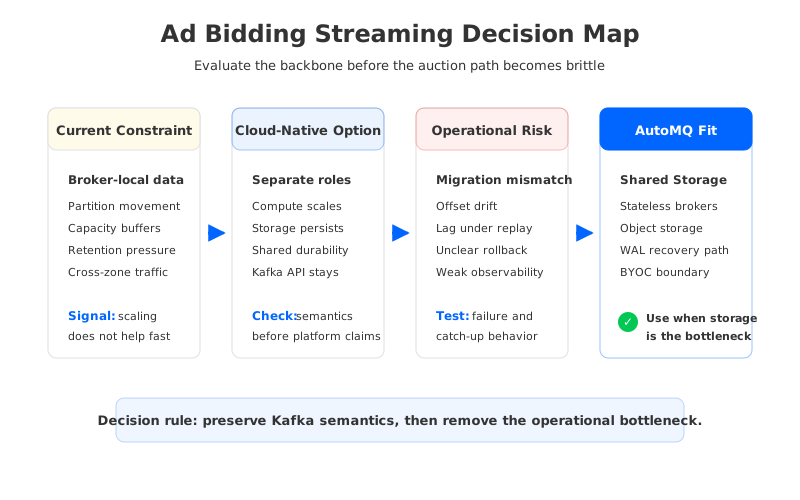
There are three common ways to respond when real-time ad bidding signals outgrow the first Kafka footprint. The first is to keep the existing Shared Nothing cluster and improve operational practice: stronger partition design, better rack awareness, more disciplined quotas, careful consumer lag monitoring, and scheduled reassignment. This is often the least disruptive path, and it can be the right answer when traffic is predictable and the team already has mature Kafka operations.
The second option is Kafka with remote storage for historical data. This can reduce long-retention pressure and make catch-up reads less dependent on local disk capacity. The trade-off is architectural clarity: Tiered Storage changes where older segments live, but it does not make brokers fully stateless. Platform teams still need to reason about the active local log, hot data, broker replacement, and storage tiers.
The third option is a Kafka-compatible platform built around separation of compute and storage. Brokers keep Kafka protocol responsibilities, but durable data is no longer fundamentally broker-local. The point is to make storage shared so compute capacity can follow traffic without copying large amounts of partition data between brokers.
The decision is easiest to make when the team separates application semantics from infrastructure mechanics:
| Evaluation area | What to ask | Why it matters for bidding signals |
|---|---|---|
| Kafka compatibility | Can existing producers, consumers, offsets, and operational tools keep working? | Migration risk is unacceptable if bidders and reporting jobs need code rewrites at the same time. |
| Elasticity | Does scale-out require data movement, metadata changes, or both? | Auction traffic can shift faster than storage rebalancing plans. |
| Cost model | Are compute, storage, replication traffic, and retention independently controllable? | Ad workloads often combine bursty ingest with long replay and audit requirements. |
| Recovery | What happens when a broker, zone, or node group fails? | Revenue-facing systems need predictable failover behavior, not heroic repair steps. |
| Governance | Can tenant, region, and data boundary requirements be enforced without duplicating pipelines? | Consent, geography, and policy signals are part of the bidding decision. |
| Migration | Can the team mirror data, validate offsets, and roll back? | A platform migration should not change auction semantics. |
This checklist is deliberately vendor-neutral. A team may decide that its current Kafka architecture is healthy and that better partition hygiene is enough. Another team may find that storage movement, cross-zone traffic, and manual balancing are becoming the dominant work. The useful question is not whether a platform is "Kafka-compatible" in a broad marketing sense. The useful question is where the operational bottleneck moves under load.
4Evaluation checklist for platform teams
A production review should start with the workload, not the product catalog. Map the bidding signal path from producer to final consumer and mark where the business depends on freshness. Auction-time enrichment, frequency capping, fraud scoring, and budget pacing usually deserve tighter latency and lag controls than offline attribution. Training data export and replay may tolerate more delay, but they need retention, lineage, and offset discipline.
Then test the operational model against realistic stress. What happens when one partner doubles request volume in a single region? What happens when a consumer group pauses for an hour and catches up during peak traffic? What happens when a broker is replaced, a node pool is resized, or a campaign launch creates a hot partition? The answers reveal whether the bottleneck is client code, processing logic, broker compute, local storage, cloud networking, or governance.
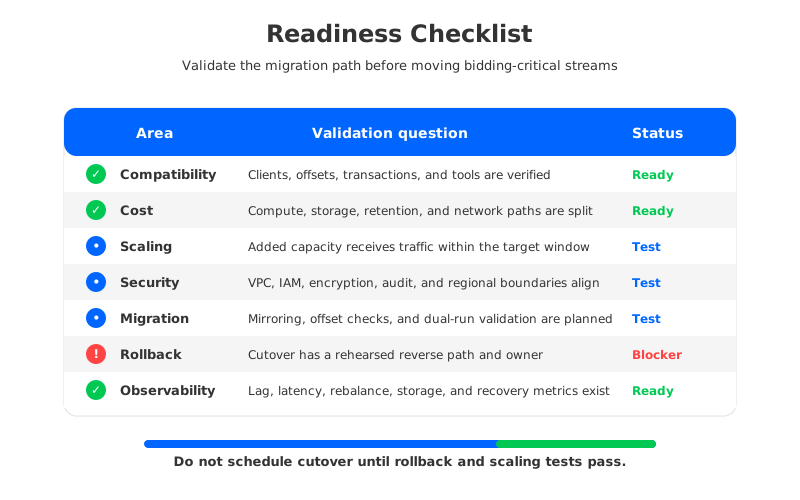
For many teams, the most revealing review artifact is a readiness scorecard:
- Compatibility: Validate client versions, serializers, security settings, consumer group behavior, offset handling, and transaction usage.
- Cost: Break down compute, storage, cross-zone data transfer, retained bytes, remote storage requests, observability, and operational time.
- Scaling: Measure how long it takes to add capacity and when the added capacity actually receives traffic.
- Security: Confirm encryption, network boundaries, access control, audit logs, and regional data handling.
- Migration: Plan topic mirroring, offset validation, cutover, rollback, and dual-write avoidance.
- Observability: Track producer latency, consumer lag, broker saturation, rebalance events, storage pressure, and object storage behavior where applicable.
This review also prevents a common mistake: treating ad bidding as one stream. Some topics are latency-sensitive and short-lived. Some are retained for audit and replay. Some must flow into a data lake for training and reporting. A durable backbone should let those streams share a protocol without forcing every topic into the same cost and scaling profile.
5How AutoMQ changes the operating model
Once the evaluation points to storage-bound operations, a Shared Storage architecture becomes a serious option. AutoMQ is a Kafka-compatible cloud-native streaming platform that keeps Kafka protocol semantics while replacing broker-local log storage with S3Stream, a storage layer backed by shared object storage and WAL (Write-Ahead Log) storage. The architectural shift is specific: AutoMQ Brokers handle Kafka protocol, routing, leadership, caching, and scheduling, while durable stream data lives in a shared durable layer rather than being permanently tied to broker disks.
That changes the day-two model. If brokers are stateless, scale-out is less about copying partition data and more about shifting ownership, metadata, and traffic. If object storage is the primary durable layer, retention and replay are less constrained by the size of broker-local disks. If WAL storage is used as a write buffer and recovery mechanism, the platform can acknowledge writes through a storage path designed for streaming while uploading data to object storage in the background. The exact WAL option matters: AutoMQ Open Source uses S3 WAL, while AutoMQ BYOC and AutoMQ Software can use additional WAL storage options depending on the deployment environment and workload requirements.
For ad bidding signals, the practical value is not a single benchmark number. The value is that the platform team can evaluate compute, storage, and network behavior separately. A bidder-facing topic may need strict latency monitoring. An attribution topic may need longer retention and catch-up reads. AutoMQ features such as Self-Balancing, Kafka Linking, and Table Topic fit into this model as operational tools for balancing traffic, preserving Kafka migration semantics, and connecting selected streams to Apache Iceberg tables.
The BYOC boundary is also relevant for advertising teams. In AutoMQ BYOC, the control plane and data plane run in the customer's cloud account and VPC, so customer message data remains within customer-controlled infrastructure. That gives platform, legal, and data governance teams a concrete deployment boundary to evaluate.
6Decision scorecard
Use this scorecard before a migration plan becomes a calendar commitment.
| Question | Green signal | Red signal |
|---|---|---|
| Are bidding-critical topics isolated from analytical catch-up traffic? | Different topics, quotas, and lag objectives are visible. | One cluster absorbs all traffic with little workload separation. |
| Can the team add compute without large storage movement? | Capacity becomes useful quickly after scale-out. | Reassignment dominates every scaling event. |
| Is the cost model explainable? | Compute, storage, retention, and network paths are tracked separately. | The largest bill items are discovered after traffic spikes. |
| Is migration reversible? | Offsets, mirroring, validation, and rollback are tested. | Cutover depends on a one-way maintenance window. |
| Are governance boundaries explicit? | Region, VPC, access control, and audit requirements are mapped. | Policy signals are treated as ordinary events without controls. |
The search that starts with real time ad bidding signals kafka usually ends with an architecture conversation. Kafka semantics are often the right foundation, but the backbone has to match the operating reality of bidding: traffic shifts quickly, stale signals have business cost, and retained data is still part of the system. If your team is evaluating how a Kafka-compatible Shared Storage architecture changes that model, talk with AutoMQ and compare it against your actual bidding signal path.
7FAQ
7.1Is Kafka a good fit for real-time ad bidding signals?
Kafka is often a strong fit because bidding signals are event streams with multiple independent consumers. The platform still needs careful partitioning, lag control, observability, and governance because freshness and replayability matter at the same time.
7.2What is the main Kafka architecture risk in ad bidding workloads?
The main risk is coupling rapid traffic changes to broker-local storage operations. When partitions, retained data, and replicas are tied to brokers, scaling and recovery can become slower than the business workload expects.
7.3Does Tiered Storage make Kafka brokers stateless?
No. Tiered Storage can move older log segments to remote storage, but the active log path and broker-local storage still matter. A Shared Storage architecture changes the model more deeply by making durable stream data shared rather than broker-local.
7.4When should a team evaluate AutoMQ for bidding signals?
Evaluate AutoMQ when Kafka compatibility is required but the current operating bottleneck is storage movement, capacity overprovisioning, cross-zone traffic, or slow balancing. The strongest signal is when scaling compute does not quickly translate into useful serving capacity.
7.5What should be validated before migration?
Validate client compatibility, security settings, topic configuration, consumer group behavior, offsets, mirroring, rollback, observability, and cost assumptions. A migration that changes auction semantics is not acceptable for revenue-facing bidding systems.


