
Table of Contents
Table of Contents
Teams rarely start with the phrase "real time table compaction Kafka" because they enjoy tuning compaction jobs. They search for it when a lakehouse pipeline is already under pressure. The dashboard is stale, the Iceberg or warehouse table has too many small files, the streaming job is spending more time coordinating writes than processing records, and the Kafka retention policy is either too short for replay or too long for the cloud bill.
That pressure is easy to misread. Table compaction looks like a downstream file-layout problem, so the first reaction is to tune the lakehouse writer or run larger rewrite jobs. Those changes matter, but they do not fix the root design question: what shape of stream history are you asking the table layer to absorb?
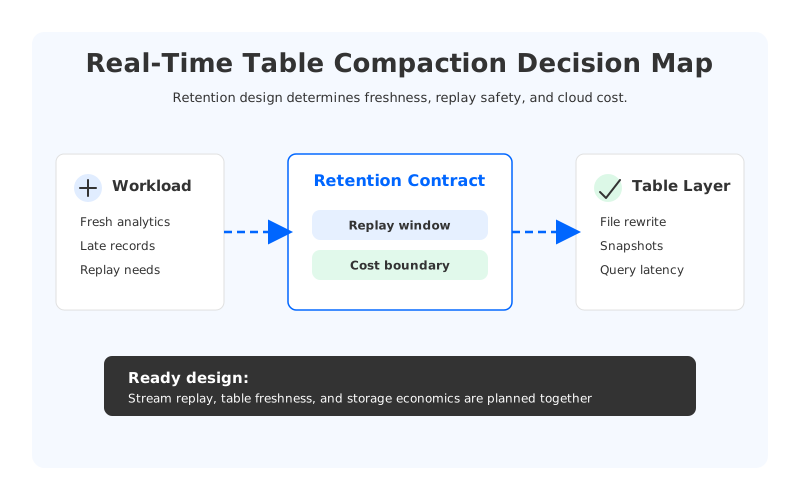
The useful starting point is not "which compaction engine should we use?" It is "what retention contract should exist between Kafka and the table?" That contract defines how long data remains replayable, how late records are handled, how much backfill capacity the platform must reserve, and whether storage growth is a predictable lakehouse cost or an unpleasant broker-local surprise.
1Why teams search for real time table compaction Kafka
Real-time table compaction sits at the intersection of three systems that were often designed by different teams. Kafka owns ordered streams and replay. A stream processing engine such as Flink or Spark Structured Streaming owns transformations, checkpoints, and output cadence. A table format such as Apache Iceberg owns snapshots, file metadata, partition evolution, and maintenance actions such as rewriting data files or expiring snapshots. Each system has a clean abstraction on its own; the hard part is the boundary between them.
The boundary gets stressed when a business turns "near real time" into an SLO. A fraud feature store cannot wait for a nightly optimize job. A customer analytics table cannot publish tens of thousands of tiny files every hour. An operations dashboard cannot lose the ability to replay the last day of events because a consumer group fell behind. Real-time compaction is the symptom of that combined requirement: fresh tables, bounded files, replayable streams, and cost that does not grow faster than traffic.
Kafka log compaction is part of the vocabulary, but it is not the same as lakehouse table compaction. Kafka compaction keeps the latest value for a record key within a topic log, subject to Kafka's cleanup policies. Table compaction rewrites table data files and metadata so query engines can scan fewer, larger files. Treating them as the same operation leads to bad designs: the stream may discard data the table still needs, while the table keeps reorganizing files created by an overly chatty sink.
The search phrase is therefore useful because it exposes a real architecture choice. You are not deciding whether compacted topics are good or bad. You are deciding where state belongs, how replay is bounded, and how much operational work each layer should carry.
2The lakehouse freshness constraint behind the workload
A real-time lakehouse pipeline usually wants four things at once: low ingest latency, efficient table files, replay for recovery, and predictable cloud cost. Retaining high-volume event streams on broker-local disks can turn a table-maintenance problem into a capacity-planning problem.
Those goals pull against each other. Shorter flush intervals improve freshness, but they create more files. Larger files improve query efficiency, but they increase the delay before data lands in a compact table layout. Longer Kafka retention improves recovery and backfill, but it consumes more storage and can slow broker operations if the cluster was sized around hot traffic rather than retained history. Pushing every knob toward "more" creates a pipeline that looks robust on paper and expensive in production.
The platform team needs a retention design that acknowledges two clocks:
- The stream clock measures how long events must remain readable in Kafka-compatible storage for replay, late processing, and migration safety.
- The table clock measures how quickly new data must become queryable and how often files can be rewritten without overwhelming metadata, object storage requests, or compute slots.
When those clocks are independent, teams can reason clearly. A table can publish small files quickly and compact them later if the stream remains replayable. A stream can retain a wider recovery window without forcing every byte to live on expensive broker-local storage.
3Stream retention is the first compaction variable
Retention is often configured after the pipeline design is already chosen. That is backward. Retention defines the failure window for the stream-to-table system, so it should be set before compaction cadence, file target size, or sink parallelism.
Three retention questions should be answered before implementation:
- What is the maximum time between an event entering Kafka and the table layer no longer needing the original record for correctness?
- What is the recovery window for a failed sink, a bad deployment, or a table rollback?
- What volume of historical data can the Kafka-compatible platform retain without turning broker scaling, partition reassignment, or cross-zone replication into the limiting factor?
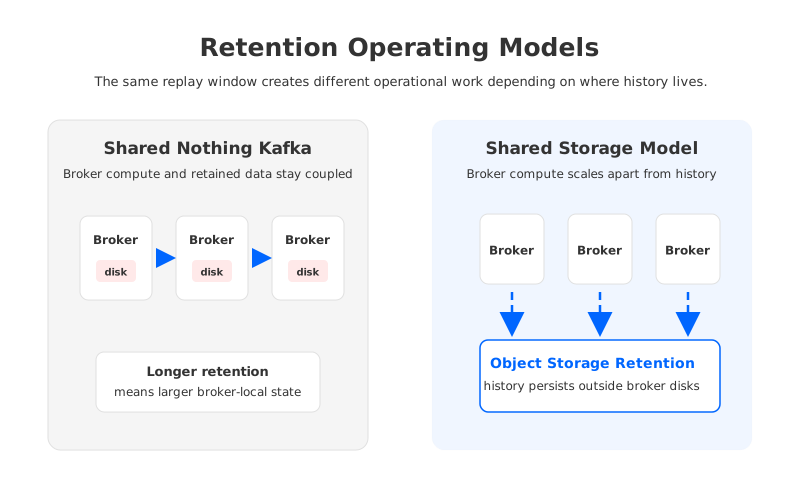
The last question is where traditional Kafka architecture can surprise teams. In a shared-nothing Kafka cluster, brokers store log segments on local or attached disks and replicate partitions across brokers for durability. Retention is therefore not only a policy value; it is also a broker storage, replication, and rebalancing commitment.
That does not make traditional Kafka wrong. It means the architecture is carrying two jobs: serving live traffic and retaining stream history. Real-time table compaction becomes easier when those jobs can be evaluated separately.
4Stream-to-table architecture options
Most production teams end up with one of four patterns. The right choice depends on the failure modes you are willing to operate.
| Pattern | Where compaction pressure lands | When it fits | Main operational risk |
|---|---|---|---|
| Kafka to batch table loads | Table compaction and scheduler | Lower freshness requirements, simple recovery | Stale tables and bursty maintenance jobs |
| Kafka to streaming sink | Sink cadence and table file layout | Fresh analytics with controlled file sizes | Many small files if flush policy is too aggressive |
| Kafka compacted topic plus table | Kafka key compaction and table maintenance | Upsert-heavy workloads with clear record keys | Losing intermediate changes needed for audit or replay |
| Kafka-compatible shared storage plus table topic | Stream retention and table ingestion share object-storage economics | High retention, elastic traffic, lakehouse-oriented operations | Requires validating compatibility and governance boundaries |
The table shows why no single compaction setting solves the problem. Append-only clickstream tables, upsert-heavy state tables, and CDC histories ask different things from Kafka retention and table maintenance. If your biggest risk is replay cost, the streaming platform architecture matters as much as the table engine.
The cleaner design is to define the data contract first. Decide which topics are append-only facts, which topics are keyed state updates, which transformations are allowed to drop intermediate records, and which tables must preserve auditability. Then choose compaction behavior for each layer. Kafka retention, Kafka cleanup policy, sink checkpointing, table partitioning, and table maintenance cadence should reinforce the same contract rather than fight each other.
5Evaluation checklist for platform teams
Platform teams need a checklist that reaches beyond the table writer. A real-time table pipeline will run for years, across traffic spikes, schema changes, cloud-region decisions, security reviews, and migration projects. A design that works in a proof of concept can become brittle when retention grows from hours to days or when a failed deployment requires a controlled replay.
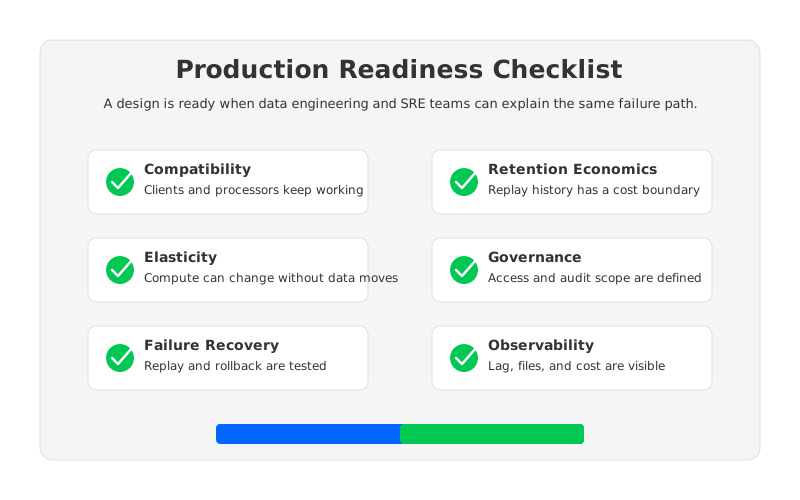
Use this evaluation frame before choosing the compaction strategy:
- Compatibility: Can existing Kafka clients, connectors, stream processors, and operational tools keep working? Changing the stream layer should not require rewriting every producer and consumer.
- Retention economics: Does extending replay history primarily consume low-cost shared storage, or does it force larger broker disks and slower data movement?
- Elasticity: Can the platform add or remove serving capacity without moving retained history as a prerequisite?
- Governance: Are table schemas, access boundaries, encryption, audit logs, and cloud account ownership compatible with the organization's policies?
- Failure recovery: Can the team recover from sink failure, bad data, table rollback, and Kafka cluster scaling without losing offsets or replay windows?
- Observability: Can engineers see consumer lag, sink checkpoints, table file counts, compaction backlog, object storage behavior, and cross-zone traffic in the same operational story?
This checklist also clarifies who owns what. Data engineers can tune file sizes and compaction cadence, but they cannot compensate for a stream platform that is too expensive to retain enough history. SREs can scale brokers, but they should not be the only defense against a table writer that creates unbounded small files.
6How AutoMQ changes the operating model
Once the evaluation frame is clear, AutoMQ becomes relevant as an architectural option rather than a product detour. AutoMQ is a Kafka-compatible streaming platform that separates broker compute from stream storage and uses shared object storage as the durable data layer. That matters for real-time table compaction because retention stops being tied as tightly to broker-local disk capacity.
In a shared storage model, brokers can focus more on serving traffic, while durable stream data is persisted through the storage layer designed for capacity and resilience. The operational effect is concrete: extending the replay window does not have to mean pre-provisioning the same amount of broker-local storage, and scaling broker compute does not have to begin with moving retained log segments between machines. For table pipelines, that creates room to design retention around recovery and freshness rather than around the most painful broker capacity edge case.
AutoMQ's Table Topic capability is especially relevant for lakehouse-oriented teams because it connects Kafka-compatible ingestion with table-oriented data lake output. The important point is not that a feature removes every maintenance task. The point is that a stream platform designed around shared storage can align the economics of retention, replay, and table ingestion more naturally than a platform where every retained byte lives inside the broker cluster's local storage plan.
There are still decisions to make. You need to validate Kafka client compatibility, table format expectations, cloud object storage configuration, access controls, network paths, and observability. A better storage model reduces unnecessary operational coupling; it does not remove the need for clear ownership.
The practical migration path is to start with one workload where retention and table freshness are both painful. Keep producers and consumers Kafka-compatible. Measure the current replay window, broker storage growth, file count, sink lag, and compaction backlog. Then compare that baseline with a design where stream retention is backed by shared storage and table ingestion is part of the same platform strategy.
7A production scorecard
Before you call a real-time table compaction design ready, give it a scorecard that a data engineer and an SRE can both sign. The goal is to make failure predictable.
| Area | Good answer | Warning sign |
|---|---|---|
| Replay window | Retention covers sink outages, bad deploys, and table rollback | Retention is set by leftover broker disk |
| File layout | Target file size and rewrite cadence match query patterns | Freshness creates endless small files |
| Offset safety | Consumer progress, checkpoints, and table commits are correlated | No one can explain recovery from a partial write |
| Cost boundary | Storage growth and serving capacity scale independently | More retention always means more broker headroom |
| Governance | Access, encryption, and audit scope are defined for stream and table | Table data moves outside approved cloud boundaries |
| Migration | Compatibility and rollback are tested with existing clients | The first test requires application rewrites |
Real-time systems fail in plain ways: a job stops, a table commit is wrong, a consumer falls behind, a cloud bill grows, or a team cannot replay enough data to recover. The architecture should make those events visible and recoverable.
8Closing thoughts
Real-time table compaction is not only a table maintenance problem. It is a retention design problem that shows up in the table layer because the table is where freshness, replay, file layout, and cost finally collide. Start by defining what the stream must remember, for how long, and at what operational cost. Then let the table compaction strategy follow from that contract.
If your team is evaluating Kafka-compatible infrastructure for lakehouse ingestion, review AutoMQ's Table Topic documentation and shared storage architecture as part of that assessment: Explore AutoMQ Table Topic. The most useful next step is not a generic benchmark; it is mapping one real pipeline's retention window, replay risk, and table freshness target onto an architecture that can operate them together.
9References
- Apache Kafka Documentation
- Apache Kafka Log Compaction
- Apache Kafka Topic Configuration: cleanup.policy
- Apache Iceberg Maintenance Documentation
- AutoMQ Table Topic Overview
- AutoMQ Shared Storage Architecture Overview
- AutoMQ Compatibility with Apache Kafka
10FAQ
10.1Is Kafka log compaction the same as table compaction?
No. Kafka log compaction keeps the latest value for a key in a topic log, while table compaction rewrites table data files and metadata for better query performance and maintenance. They can complement each other, but one does not replace the other.
10.2Should every real-time table pipeline use compacted Kafka topics?
No. Compacted topics fit keyed state-update workloads where retaining the latest value per key is acceptable. Append-only facts, audit streams, CDC streams, and event histories may need longer retention of intermediate records, so the cleanup policy should follow the data contract.
10.3What retention window should a Kafka-to-table pipeline use?
Start from recovery, not convenience. The retention window should cover downstream outages, bad deployments, table rollback, late-arriving data, and migration tests. After that, evaluate whether the streaming platform can retain that history at a predictable cost.
10.4Where does AutoMQ fit in this architecture?
AutoMQ fits when a team wants Kafka-compatible APIs with a shared storage operating model. For table pipelines, that can make stream retention, broker elasticity, and lakehouse ingestion easier to reason about because retained history is no longer tied as tightly to broker-local disks.
10.5Does shared storage remove the need for table maintenance?
No. Table formats still need maintenance policies such as file rewrite, snapshot expiration, and metadata cleanup. Shared storage changes the economics and operations of stream retention; table compaction still needs to be designed around query patterns and governance requirements.


