
Table of Contents
Table of Contents
Kafka rebalances are usually discussed as a consumer group behavior: a member joins, a member leaves, partitions move, polling pauses, and lag may rise. That description is accurate, but it is too narrow for production systems where a consumer group sits behind fraud scoring, payment authorization, inventory updates, observability alerts, or AI feature refresh. In those systems, a rebalance is not an isolated protocol event. It is a temporary reduction in the application's ability to keep up with time.
That is why rebalance impact analysis kafka is a useful search phrase. The operator is not asking what a rebalance is. They are asking how much damage a rebalance can cause, how to measure it before an incident, and whether their Kafka-compatible platform makes the problem smaller or larger. The answer depends on consumer configuration, workload shape, broker behavior, storage architecture, deployment topology, and the organization's ability to control changes during peak traffic.
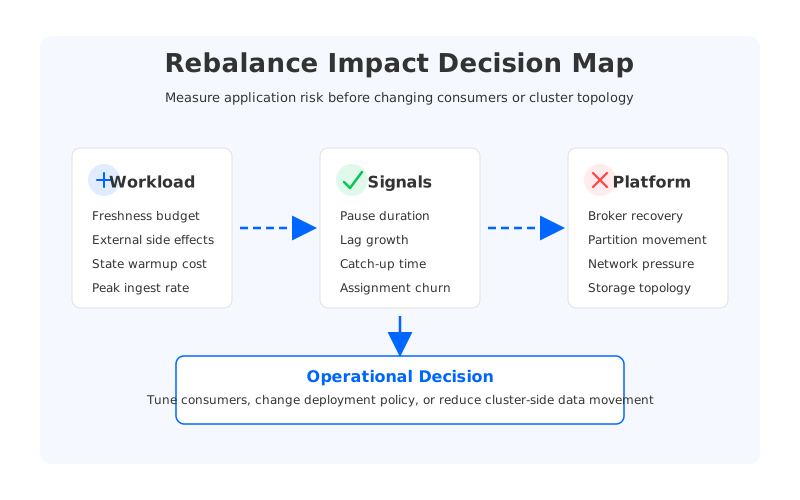
The practical way to analyze rebalance impact is to separate two questions that often get blended together. First, what happens inside the consumer group when assignment changes? Second, what happens in the broader platform when the cluster is scaling, recovering, moving partitions, or absorbing a workload spike at the same time? Many incidents start with the first question but become expensive because the second question was ignored.
1Why Rebalance Impact Matters More for Consumer-Critical Workloads
Apache Kafka's consumer group protocol coordinates partition ownership across group members. The consumer configuration reference documents the assignment strategy, session timeout, max poll interval, and related controls that determine how the group reacts when consumers join, leave, or appear unhealthy. These settings are not cosmetic. They define the boundary between a quick reassignment and a pause long enough to violate an application-level SLO.
The most sensitive workloads share a pattern: they convert consumer delay into a business consequence quickly. A log analytics pipeline may tolerate a few minutes of lag during maintenance. A fraud decision service might not. A CDC pipeline feeding a search index may survive a short catch-up period, while a trading risk pipeline may treat the same delay as data loss for practical purposes.
A useful impact analysis therefore starts with application semantics, not broker metrics. Ask what the consumer is protecting:
- Freshness-bound decisions. The workload becomes wrong when it reads old events, even if it eventually catches up.
- External side effects. The consumer writes to databases, calls APIs, sends notifications, or triggers workflows where retries must be idempotent.
- Coordinated processing. The application depends on ordering, partition affinity, local state, or transactional boundaries.
- Operational fan-out. One rebalance affects downstream services, dashboards, alerting, and on-call diagnosis at the same time.
Those categories change the risk model. A rebalance that looks harmless in broker dashboards can still be severe if a consumer loses warm state, reinitializes a cache, replays side-effecting records, or triggers downstream retry storms. The impact is not merely "lag increased"; it is "the application temporarily stopped making timely decisions."
2The Consumer-Side Mechanics You Need to Measure
A rebalance usually becomes visible through four signals: pause time, lag growth, duplicate processing risk, and state recovery cost. Pause time is the interval when a partition has no useful application progress. Lag growth measures how quickly the backlog accumulates during that pause. Duplicate processing risk appears when consumers reprocess records after ownership changes. State recovery cost appears when the new owner must rebuild local state, reload caches, or seek to committed offsets before it can resume useful work.
The configuration levers are well known, but the hard part is choosing them for the workload instead of copying defaults. A short session timeout detects failure quickly, but it can punish noisy networks and overloaded consumers. A long max poll interval gives slow processing more room, but it can hide stuck consumers for too long. Cooperative assignment can reduce the amount of partition movement, but it does not remove the need to test state handoff, shutdown hooks, and deployment behavior.
For an impact analysis, track these measurements during controlled events:
| Measurement | Why it matters | How to interpret it |
|---|---|---|
| Rebalance duration | Shows how long group coordination blocks useful work. | Compare p95 and worst case against the application freshness budget. |
| Lag accumulation rate | Shows how much backlog builds while consumers are paused. | Multiply by peak ingest rate, not average ingest rate. |
| Catch-up time | Shows how long the system remains degraded after the rebalance ends. | Include downstream write capacity and state warmup, not only Kafka fetch throughput. |
| Duplicate or replay rate | Shows whether side effects are protected. | Validate idempotency and transaction boundaries under ownership changes. |
| Assignment churn | Shows how many partitions moved. | A small membership event should not reshuffle the whole group. |
These measurements also expose a common trap. Teams tune the consumer until the lab rebalance looks clean, then production still suffers during broker maintenance or scaling. The consumer group did its job, but the platform changed the ground underneath it.
3The Platform Constraint Behind the Rebalance
In traditional Kafka, brokers own local partition data. That shared-nothing model is durable and battle-tested, but it couples placement, storage, replication, and recovery. When a broker is replaced, capacity is added, a hot partition is moved, or disks become imbalanced, the operational work often includes data movement. For consumer-critical workloads, that matters because platform maintenance can create exactly the instability that consumer teams are trying to avoid.
The platform impact shows up in several ways. Partition reassignment consumes broker, disk, and network capacity that consumers also need for catch-up reads. Broker replacement can change leadership and fetch locality. Cross-zone replication and follower fetching choices affect both cost and latency. Tiered storage may reduce long-term storage pressure, but the hot set and leader placement still require careful capacity planning. None of these are consumer group settings, yet they directly affect how painful a rebalance becomes.
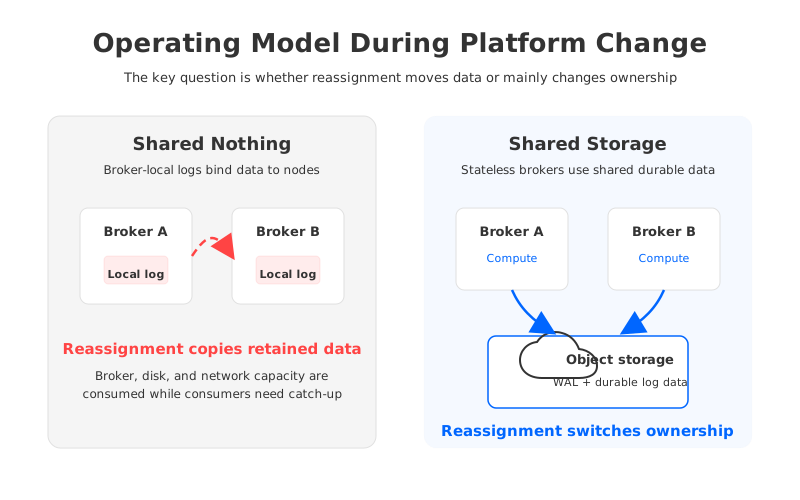
This is where architecture becomes part of rebalance analysis. A consumer group can be perfectly tuned and still fail its SLO if the cluster needs hours to drain, copy, or rebalance data during a capacity event. Conversely, a platform that can move ownership without moving large data sets reduces the blast radius of maintenance. The consumer application still needs correct commit behavior, but it is no longer fighting a cluster-level storage migration at the same time.
4A Decision Framework for Platform Teams
The most useful rebalance review is a joint review between application owners and platform owners. The application team knows the freshness budget and side effects. The platform team knows broker topology, storage layout, rolling upgrade behavior, and scaling paths. If those teams review different dashboards, they will reach different conclusions after the same incident.
Use a neutral scorecard before selecting tooling or changing architecture:
- Compatibility. Existing clients, Kafka Connect workers, stream processors, schemas, ACLs, and observability tooling should keep working. Rebalance fixes that require broad client rewrites usually move risk from the platform into every application team.
- Elasticity. The cluster should add, remove, or replace capacity without turning partition movement into a long-running data copy project.
- Cost visibility. Rebalance and recovery traffic should be visible in storage, compute, and cross-zone network bills. A design that hides operational traffic during normal operation can surprise finance teams during incidents.
- Failure recovery. A broker, node, zone, or consumer deployment failure should have a known recovery path with measured pause time and rollback behavior.
- Governance. Platform teams should know who can trigger deployments, scaling, partition movement, connector changes, and schema changes during protected windows.
- Observability. Dashboards should connect consumer lag, rebalance count, assignment churn, broker leadership changes, fetch latency, and storage recovery activity.
The important point is not to maximize every category. It is to identify the bottleneck that controls user impact. If the application's state restore dominates catch-up time, broker architecture will not solve that part. If partition reassignment saturates the cluster for hours, consumer tuning will not solve that part either. A good scorecard prevents both teams from optimizing the wrong layer.
5How Shared Storage Changes the Operating Model
After the neutral analysis, a different architecture question becomes natural: what if partition movement did not require moving most of the partition's historical data? AutoMQ is a Kafka-compatible cloud-native streaming system that keeps Kafka protocol and ecosystem compatibility while replacing broker-local log storage with S3Stream, a shared streaming storage layer backed by WAL storage and object storage.
That design changes the operational model around rebalancing. Brokers still serve Kafka clients and participate in Kafka semantics, but durable data is no longer primarily owned by broker-local disks. Object storage becomes the primary persistent layer, while WAL storage handles low-latency durable writes and recovery buffering. When partitions are reassigned, the system can transfer ownership and metadata after flushing the small amount of data that has not yet reached object storage, instead of copying the full retained log from one broker to another.
This distinction matters for consumer-critical workloads because it separates two kinds of movement. Consumer group rebalancing still assigns partitions to application instances. Cluster-side partition reassignment, capacity scaling, and broker replacement become less dependent on bulk local-data migration. The result is not that rebalances disappear. The result is that platform operations are less likely to stack a storage-heavy maintenance event on top of a sensitive consumer group event.
AutoMQ's public architecture documentation describes this as Shared Storage architecture with stateless brokers, S3Stream, WAL storage, and object storage. Its partition reassignment documentation explains that reassignment can focus on uploading the temporary WAL-resident data and switching partition ownership. For a platform team, the value is operational: scaling and recovery become scheduling problems more than data-copy problems.
There is still engineering work to do. You still need to validate client compatibility, group assignment behavior, offset management, transactions if used, connector behavior, and failure drills. Shared storage reduces one major source of cluster-side drag; it does not excuse weak consumer design. The strongest result comes when application-level rebalance hygiene and platform-level elasticity reinforce each other.
6Production Readiness Checklist
A rebalance impact analysis should end in a runbook, not a slide. The runbook should define what is safe, what is risky, and what evidence is required before changing consumer deployments or cluster topology. The checklist below is intentionally concrete because vague readiness language tends to fail during incidents.
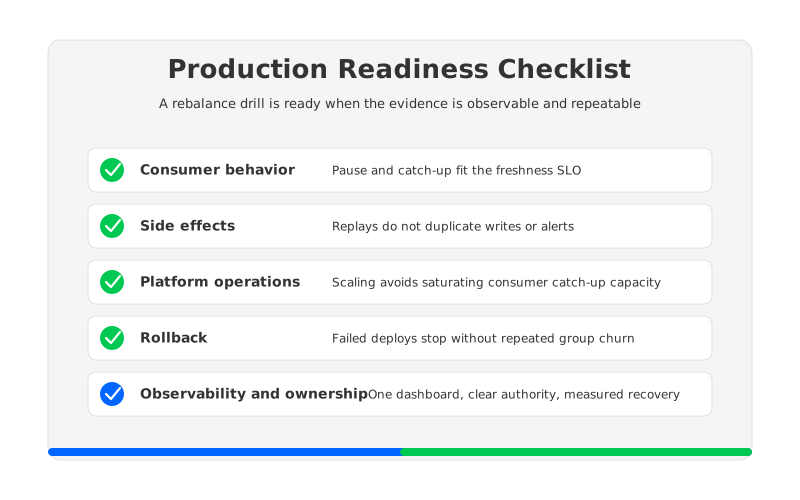
Start with controlled tests. Trigger a rolling consumer deployment during peak-like traffic. Kill one consumer instance without graceful shutdown. Add a new consumer instance. Restart a broker or simulate a broker replacement in a non-production environment that mirrors storage and network topology. For each test, record rebalance duration, maximum lag, catch-up time, duplicate processing behavior, downstream saturation, and operator actions.
Then convert the results into policy. Some workloads should use protected deployment windows. Some should pin maximum concurrent consumer restarts. Some should require cooperative assignment. Some should move state out of process-local caches. Some should set a hard alert when assignment churn exceeds a normal threshold. Platform teams should do the same for broker operations: define when partition movement is allowed, which workloads are protected, and how scaling automation is observed.
The final artifact can be simple:
| Readiness area | Pass condition |
|---|---|
| Consumer behavior | Rebalance duration and catch-up time fit the freshness SLO under peak-like traffic. |
| Side effects | Replays do not create duplicate external writes or inconsistent state. |
| Platform operations | Scaling, broker replacement, and partition reassignment do not saturate resources needed by consumers. |
| Rollback | A failed deployment can be stopped without triggering repeated full-group churn. |
| Observability | One dashboard correlates consumer, broker, storage, and network signals. |
| Ownership | Application and platform owners know who can pause, roll back, or continue an operation. |
This kind of checklist turns rebalance analysis from a Kafka tuning exercise into a production engineering practice. It also gives technical buyers a sharper way to evaluate Kafka-compatible platforms. The question is not only "does it support the Kafka API?" It is "what happens to consumer-critical workloads when the platform is changing under load?"
If your team is evaluating whether shared storage and stateless brokers can reduce the operational drag around Kafka scaling and recovery, review AutoMQ's Kafka-compatible architecture and deployment model here: Explore AutoMQ built on Apache Kafka.
7References
- Apache Kafka documentation: consumer configuration, including partition assignment strategy.
- Apache Kafka documentation: session timeout and max poll interval consumer settings.
- AutoMQ documentation: Architecture overview.
- AutoMQ documentation: Compatibility with Apache Kafka.
- AutoMQ documentation: S3Stream shared streaming storage.
- AutoMQ documentation: Partition reassignment in seconds.
- AutoMQ documentation: Eliminate inter-zone traffic.
8FAQ
8.1Is a Kafka rebalance always bad?
No. Rebalancing is a normal part of consumer group coordination. It becomes risky when pause time, assignment churn, state restoration, or replay behavior exceeds the workload's freshness and correctness budget.
8.2Which Kafka consumer settings matter most for rebalance impact?
The most common starting points are assignment strategy, session timeout, heartbeat behavior, max poll interval, and offset commit strategy. The right values depend on processing time, failure detection needs, deployment behavior, and whether the application can tolerate duplicate processing.
8.3Can shared storage eliminate consumer group rebalances?
No. Shared storage changes the broker and partition operating model; it does not remove consumer group coordination. Its value is reducing cluster-side data movement during scaling, broker replacement, and partition reassignment so platform operations are less likely to amplify consumer-side disruption.
8.4What should be tested before changing a critical consumer group?
Test rolling deployments, ungraceful consumer loss, scale-out, scale-in, broker maintenance, downstream throttling, and rollback. Measure rebalance duration, peak lag, catch-up time, duplicate processing, state warmup, and operator actions.
8.5How should technical buyers compare Kafka-compatible platforms for this problem?
Compare protocol compatibility, operational elasticity, partition movement behavior, storage architecture, observability, cross-zone traffic controls, migration path, and rollback options. The winning platform is the one that keeps consumer-critical workloads predictable while the cluster changes under real load.


