
Table of Contents
Table of Contents
If you searched for redpanda agentic data plane, redpanda pivot, or the more anxious version, is Redpanda dead, you are probably not asking whether a vendor changed a homepage headline. You are asking a more expensive question: should a Kafka-facing infrastructure decision still assume Redpanda is primarily a Kafka alternative, or should it now be evaluated as a broader AI data platform?
That question is reasonable. Redpanda's current public messaging leads with the Agentic Data Plane, enterprise agents, governance, explainability, MCP, and AI Gateway. At the same time, Redpanda's documentation still describes Kafka compatibility, BYOC clusters, and self-managed Redpanda as a Kafka-compatible streaming platform. The product did not disappear. The center of gravity changed.
For platform teams, positioning is not a marketing footnote. It affects roadmap gravity, feature prioritization, pricing packaging, support expertise, ecosystem fit, and the shape of future migration risk. A streaming platform can be technically solid and still become a strategic mismatch if your team needs stable Kafka semantics while the vendor is increasingly optimizing for agent governance and AI infrastructure.
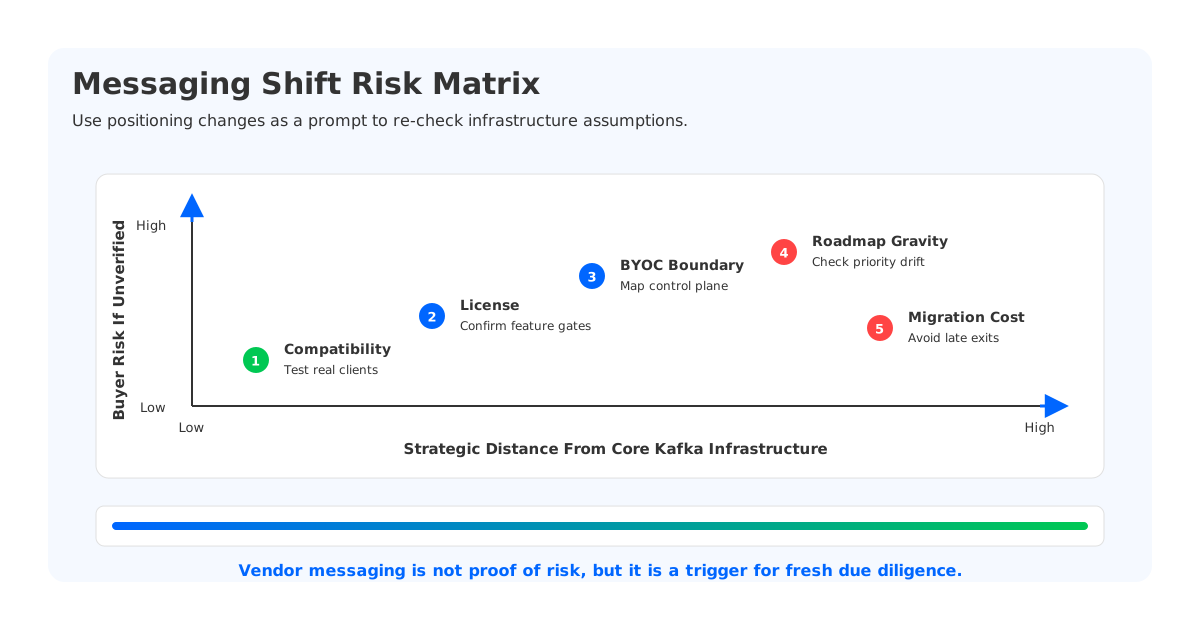
The right response is not panic. Redpanda can still be a good fit for teams that have validated its Kafka API compatibility, like its operational model, and want its AI-facing platform direction. The mistake is treating the old evaluation memo as current forever. A platform decision made around "faster Kafka without JVMs" should be re-opened when the vendor's primary story becomes "governed infrastructure for enterprise agents."
1What Changed in Redpanda's Positioning
Redpanda has long been known in the Kafka ecosystem as a Kafka API-compatible streaming platform implemented outside Apache Kafka's JVM broker architecture. That pitch had a clean infrastructure buyer logic: keep the Kafka client surface, remove ZooKeeper and the JVM, and operate a different broker implementation. Whether a team agreed with every benchmark claim or not, the category was clear.
Redpanda's current homepage now opens with Agentic Data Plane language. Its product framing emphasizes agent governance, agent identity, auditability, model and cloud flexibility, MCP, A2A, Postgres, and AI Gateway. Redpanda's docs also have a dedicated Agentic Data Plane area, with a notable constraint: the Agentic Data Plane is listed as supported only on BYOC clusters running on AWS with Redpanda version 25.3+ and is in limited availability at the time of writing.
That does not erase the streaming platform. Redpanda's data streaming pages still describe Kafka API compatibility, and its client compatibility docs state compatibility with Apache Kafka versions 0.11 and later, subject to documented exceptions.
The more useful interpretation is this:
| Evaluation Area | What Has Not Changed | What Needs Fresh Review |
|---|---|---|
| Kafka-facing workloads | Redpanda still documents Kafka API compatibility and Kafka client support. | Check the exact APIs, clients, connectors, transactions, security controls, and admin workflows your workload needs. |
| Deployment model | Redpanda still offers cloud and self-managed paths. | BYOC security boundaries, control-plane dependency, and customer access restrictions deserve a fresh architecture review. |
| Licensing | Redpanda still publishes Community and Enterprise licensing details. | Source-available BSL and enterprise-license features should be checked against your internal open-source and commercial-use policies. |
| Roadmap | Streaming remains part of the platform. | AI governance may attract more roadmap attention than core Kafka replacement use cases. |
| Exit risk | Kafka clients may reduce application migration friction. | Kafka API compatibility is not the same thing as Apache Kafka operational equivalence. |
Infrastructure teams often evaluate a platform for one job and then inherit the vendor's next job. If your job is "operate Kafka-compatible streaming infrastructure for the next five years," the vendor's strategic narrative is part of the technical due diligence.
2Why Kafka Users Should Care About a Vendor Pivot
Kafka infrastructure is sticky because it is rarely only a broker. It is producers, consumers, schemas, Connect pipelines, ACLs, quotas, monitoring, incident playbooks, compliance controls, and a few strange client behaviors that everyone forgot about until the migration test failed. A platform that says "Kafka API-compatible" reduces one kind of migration risk, but it does not remove the broader operational contract.
That is why product positioning matters more for Kafka than it does for a small developer tool. When a vendor's priority changes, the consequences show up in places that do not look like marketing:
- Compatibility depth: Common Kafka clients can work while edge cases remain in admin APIs, transactions, quotas, rebalancing, security, or tooling.
- Packaging and licensing: Features that look peripheral during a pilot, such as audit logging, tiered storage, RBAC, or enterprise connectors, may become mandatory later.
- Support muscle: A support organization optimized for agentic AI may not allocate the same depth to Kafka migration or broker-level tuning.
- Roadmap allocation: Engineering focus follows the strategic story. If the story moves toward agents, Kafka infrastructure features may still improve, but they compete with a larger product agenda.
- Procurement risk: A platform bought as a Kafka alternative may renew as an AI governance platform with different commercial packaging and different internal stakeholders.
None of these points prove that Redpanda is the wrong choice. They prove that "we evaluated it two years ago" is not enough. Kafka is usually a foundation layer. Foundation layers deserve current evidence.
3Is Redpanda Still Kafka Compatible?
Redpanda's official documentation still says Redpanda is compatible with Apache Kafka versions 0.11 and later, with exceptions documented by Redpanda. So the answer to the narrow question is yes: Kafka compatibility remains a published part of Redpanda's product.
The buyer-grade question is narrower: compatible with what you run? Test the parts of Kafka that are easy to assume and painful to debug later, including producer and consumer behavior, Kafka Connect, Schema Registry expectations, TLS/SASL/ACL/RBAC controls, admin workflows, upgrades, disaster recovery, broker metrics, and consumer-lag monitoring. Compatibility work is supposed to be boring before production. If the proof-of-concept only runs a Java producer and consumer through a happy path, it has not answered the platform question.
4The Licensing Question Is Not Academic
Redpanda's self-managed documentation describes Community Edition as free and source-available under the Redpanda Business Source License, with conversion to Apache 2.0 four years after each code merge. It also describes Enterprise Edition features under the Redpanda Community License, unlocked by a license key. Those are not unusual commercial open-source mechanics, but they are not the same as an Apache 2.0 project.
The practical issue is not ideology. It is decision rights. Some companies are comfortable with BSL-style source-available licenses. Others have policies that distinguish sharply between OSI-style permissive open source and source-available commercial licenses. Some platform teams also care about whether they can offer an internal shared streaming service, modify code for their own environment, or maintain an emergency fork if commercial terms change.
If Redpanda is already in production, this creates a checklist:
| Question | Why It Matters |
|---|---|
| Which edition are you actually using? | Enterprise-only features can quietly become part of the production dependency chain. |
| Are any production-critical features license-gated? | Audit logging, data balancing, RBAC, tiered storage, and connector features may affect compliance or operations. |
| Does BSL fit your internal policy? | Source-available is not the same review category as Apache 2.0 in many companies. |
| Does procurement understand the AI platform direction? | Renewals may be evaluated by different stakeholders if the product category shifts. |
This is where AutoMQ's positioning is intentionally different. AutoMQ is Apache 2.0 open source, built around Kafka compatibility and cloud-native object storage rather than an AI governance suite. That does not mean every Redpanda user should migrate. It means strict open-source, cloud-control, or Kafka-roadmap requirements should be compared directly.
5BYOC: Same Acronym, Different Control Boundary
BYOC is one of the most overloaded terms in cloud infrastructure. It can mean "the data plane runs in your account," "the vendor agent has managed access to your account," "the control plane stays outside," or "the control plane is deployed inside your VPC." Two products can both say BYOC and have very different security reviews.
Redpanda's BYOC documentation says clusters deploy in the customer's cloud environment and customer data remains in the data plane. It also describes a Redpanda-managed control plane and a cloud agent that provisions infrastructure, applies cluster specifications, and manages resources under least-privilege IAM permissions. The same docs state that Redpanda Cloud does not support customer access or modifications to internal data plane resources, which Redpanda frames as part of maintaining its SLA.
For many buyers, that is a reasonable managed-service trade-off. For regulated teams that want stronger operational autonomy, it raises questions about vendor access, break-glass procedures, maintenance authorization, and how much of the control surface is truly inside the customer's boundary.
AutoMQ's BYOC environment takes a stricter residency posture. AutoMQ documentation states that the underlying resources belong to the user's cloud account under the VPC, and that both the environment console/control plane and Kafka service/data plane are deployed in the user-defined network environment. It also states that maintenance requires user authorization.
Redpanda BYOC may be attractive if you want managed operations and accept the vendor-managed control plane model. AutoMQ BYOC becomes more relevant if your requirement is Kafka compatibility plus customer-resident control plane, customer-resident data plane, and object-storage economics.
6Stable Kafka-Compatible Alternatives
If the Redpanda strategy shift makes you uneasy, the next move is not automatically "migrate away." Define what stability means for your team. Stable can mean "closest to upstream Apache Kafka," "least commercial lock-in," "lowest operational burden," or "same Kafka API but a cloud-native storage model." Those are different shortlists.
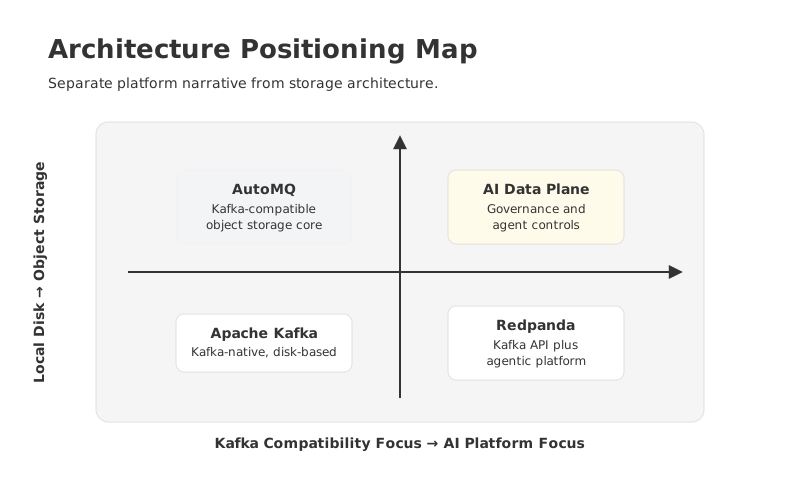
A practical shortlist usually has three lanes:
- Managed or self-managed Apache Kafka: Amazon MSK, Aiven for Apache Kafka, Confluent Platform, or self-managed Kafka reduce semantic uncertainty because the core broker is Apache Kafka.
- Kafka API-compatible broker alternatives: Redpanda can fit when teams want the Kafka client surface with a different implementation and have validated compatibility.
- Kafka-compatible cloud-native storage redesigns: AutoMQ fits when the team wants Kafka compatibility but wants to change cost and elasticity by moving storage to object storage.
AutoMQ's argument is not "AI is bad" or "every platform should ignore agents." The argument is narrower: if your core problem is Kafka infrastructure, cost, elasticity, cloud-account control, and compatibility, you may want a platform whose roadmap is centered on exactly that problem. AutoMQ keeps the Kafka-facing API surface while replacing the storage layer with object storage such as S3, GCS, or Azure Blob. Its public docs describe Kafka API compatibility, seconds-level elasticity, and storage-compute separation. Its public GitHub repository is Apache 2.0 licensed.
Production evidence matters because object-storage-native Kafka can sound like a nice diagram until someone asks whether it survives real traffic. AutoMQ publishes customer references including Poizon's observability use case at 40 GiB/s peak throughput with about 50% cost reduction via elastic scaling and 85% cost reduction on cold data through S3 tiering. AutoMQ's GitHub README also links public customer stories from Grab, Tencent Cloud EMR, LG U+, Geely, Bambu Lab, Honda, Avia Games, JD.com, iQIYI, miHoYo, FunPlus, and Hungry Studio.
7Questions to Ask Before Committing to Redpanda
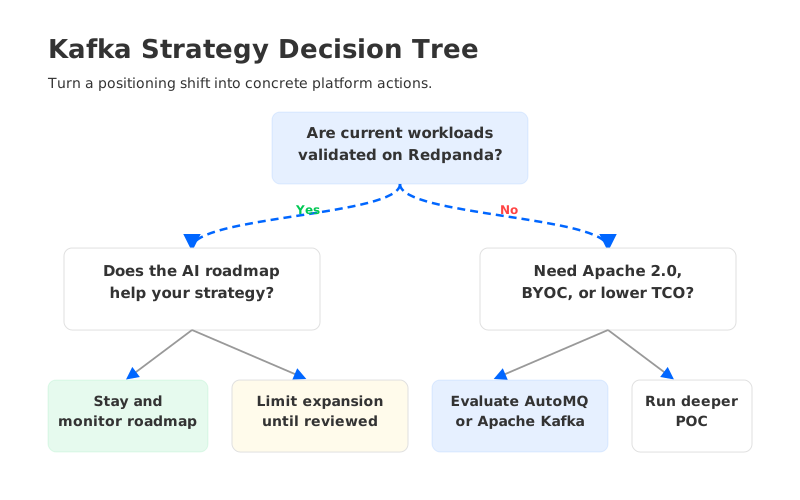
The most useful evaluation memo is a living risk register, not a one-time product scorecard. If you are already using Redpanda, the same questions help decide whether to stay the course, limit expansion, or run a parallel evaluation.
Ask seven questions in writing: what role Redpanda should play, which Kafka semantics you depend on, which production features are license-gated, what your exit path would be, who owns the cloud boundary, what roadmap evidence you need, and which workload shape would break your assumptions. High fan-out, long retention, strict latency, high partition counts, heavy compaction, observability peaks, and multi-region patterns can stress platforms differently.
The point is not to make Redpanda fail the checklist. The point is to make every answer concrete enough to guide a platform decision.
8Where AutoMQ Fits If You Need a Redpanda Alternative
AutoMQ is most relevant when your Redpanda concern is not "we dislike the product" but "we need a more stable Kafka-infrastructure thesis." That thesis has three parts: preserve Kafka compatibility, redesign storage around cloud object storage, and keep deployment control aligned with enterprise security boundaries.
The architecture difference is important. Traditional Kafka and Kafka-like systems usually bind compute, serving, and local storage together. Brokers become stateful units, so scaling, recovery, and rebalancing become data-movement problems. AutoMQ separates compute from storage: brokers become closer to elastic compute, while object storage provides durable shared storage.
That model is not free of trade-offs. You still need to test latency, workload shape, connector behavior, operational tooling, and failure recovery. But the architectural upside is real for workloads where retention, elasticity, and cloud storage cost dominate the economics.
AutoMQ should be on the shortlist when these statements sound familiar:
- You need Kafka API compatibility but do not want a roadmap centered on AI governance.
- You want Apache 2.0 openness rather than source-available or proprietary core licensing.
- You want BYOC with both control plane and data plane in your cloud environment.
- You want object-storage economics for retention-heavy or bursty workloads.
- You want to reduce the operational weight of broker-local storage, disk planning, and partition reassignment.
This is not a universal replacement claim. If your Redpanda deployment is working, your licensing model is approved, your workloads are validated, and the AI platform direction is useful, staying may be right. If your evaluation keeps returning to Kafka compatibility, open-source policy, cloud boundary, and infrastructure cost, AutoMQ deserves a real proof-of-concept.
9Decision Checklist
Use this checklist before renewing, expanding, or replacing Redpanda:
| Decision Signal | Stay With Redpanda | Re-evaluate or Add AutoMQ to the Shortlist |
|---|---|---|
| Strategic fit | You want both Kafka-compatible streaming and Redpanda's agentic AI platform direction. | You mainly need Kafka infrastructure and the AI platform direction creates uncertainty. |
| Compatibility | Your real clients, connectors, admin workflows, and failure tests pass. | Compatibility was assumed from a small producer/consumer test. |
| Licensing | BSL/RCL terms and enterprise feature dependencies are approved. | Apache 2.0 openness or emergency forkability is a hard requirement. |
| BYOC boundary | A vendor-managed control plane and agent model are acceptable. | Control plane and data plane must live inside your cloud network. |
| Cost structure | Local-disk or Redpanda storage economics fit your retention and traffic profile. | Object-storage economics and stateless brokers would materially change cost or elasticity. |
| Roadmap | Redpanda's AI governance roadmap helps your platform strategy. | You want a narrower Kafka-compatible streaming roadmap. |
The cleanest answer may be a staged strategy. Keep stable Redpanda workloads where the fit is proven. Run a controlled AutoMQ proof-of-concept where storage cost, retention, burst elasticity, or open-source policy are the pain points. Compare migration risk with measured workload behavior, not vendor adjectives.
10FAQ
10.1Is Redpanda dead?
No. Redpanda continues to publish product pages and documentation for Kafka-compatible streaming, Redpanda Cloud, BYOC, and self-managed deployments. The real question is not whether Redpanda exists; it is whether its current strategic direction still matches your Kafka infrastructure requirements.
10.2Is Redpanda still Kafka compatible?
Redpanda's official docs state compatibility with Apache Kafka versions 0.11 and later, with documented exceptions. Treat that as a starting point, not a substitute for testing. Validate your actual clients, connectors, admin workflows, security model, transactions, observability, and failure scenarios.
10.3What is Redpanda Agentic Data Plane?
Redpanda describes Agentic Data Plane as infrastructure for building, deploying, and governing AI agents, including governance, transcripts, MCP, AI Gateway, access control, and auditability. Redpanda docs currently describe it as limited availability and supported only on BYOC clusters running on AWS with Redpanda version 25.3+.
10.4Does Redpanda's AI pivot mean Kafka users should migrate?
Not automatically. A pivot changes evaluation questions; it does not invalidate working systems. Migrate only if the product direction, licensing, compatibility evidence, cost model, or deployment boundary no longer fits your requirements.
10.5What is a good Redpanda alternative for Kafka users?
It depends on what you want to preserve. If you want the closest Apache Kafka semantics, evaluate Apache Kafka, MSK, Aiven for Apache Kafka, or Confluent Platform. If you want Kafka compatibility with object-storage economics, Apache 2.0 openness, and BYOC data/control residency, evaluate AutoMQ.
10.6How is AutoMQ different from Redpanda?
Redpanda is a Kafka API-compatible platform with its own broker implementation and a growing Agentic Data Plane strategy. AutoMQ is a Kafka-compatible, Apache 2.0 open-source streaming platform that replaces Kafka's local storage layer with object storage and uses stateless brokers for cloud-native elasticity.
10.7Should I move from Redpanda to AutoMQ?
Run a proof-of-concept before deciding. AutoMQ is worth testing if your pain points are Kafka infrastructure cost, retention, elastic scaling, open-source policy, or BYOC control boundaries. If Redpanda is already validated and its roadmap supports your AI and streaming strategy, migration may not be worth the operational change.


