
Table of Contents
Table of Contents
A Redpanda alternative evaluation should not start with a vendor ranking. It should start with the workload, Kafka surface area, and operational events that make the current platform hard to live with. If the team jumps straight to "Redpanda versus X," the loudest demo usually wins. The better process: write down required evidence, then run the same tests against each option.
Redpanda can be a strong fit for teams that want a Kafka API-compatible streaming engine with a broker-centric performance model, documented Kafka client compatibility, cloud deployment options, and tiered storage for offloading log segments. The platform question is narrower: does another architecture, commercial model, or data-control boundary fit your next 2-3 years better?
That is where alternatives become meaningfully different. Apache Kafka or Amazon MSK keep the familiar Kafka operational model. Confluent Cloud adds a managed Kafka ecosystem. WarpStream moves durable data into object storage behind stateless agents. AutoMQ belongs in the same evaluation as a Kafka-compatible shared-storage option: it keeps Kafka protocol semantics, uses stateless brokers, stores durable data through S3Stream and object storage, and supports BYOC deployment for teams that want cloud-account control.
1How to Use This Checklist
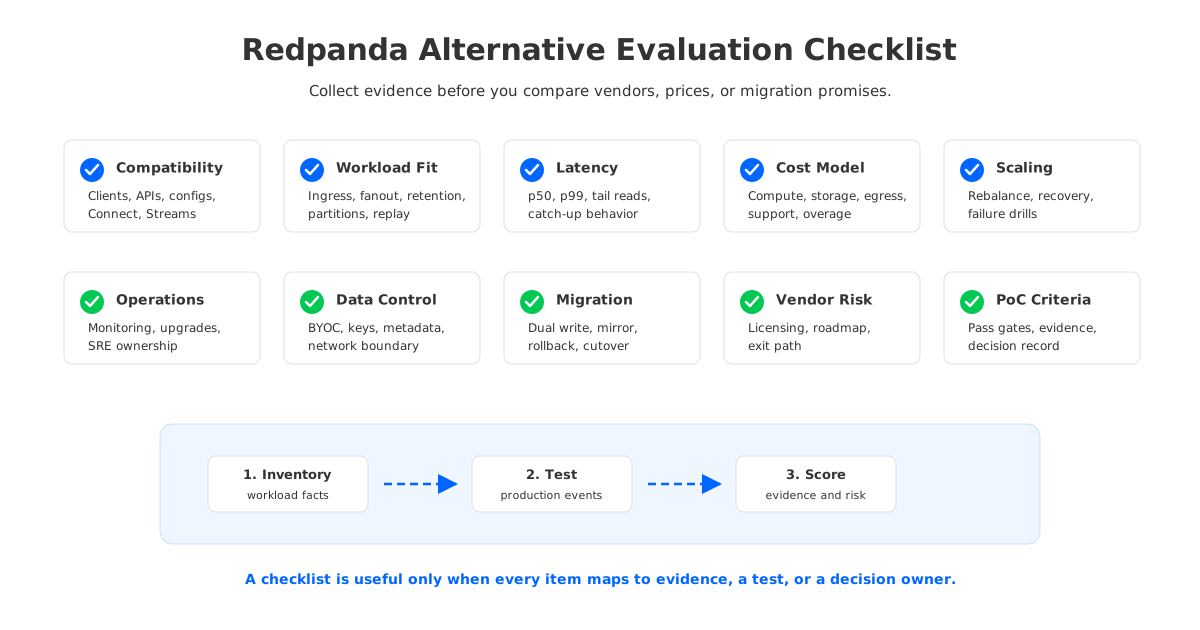
Use this as a decision worksheet, not a generic feature matrix. For each candidate, assign an owner, collect the artifact, run the test, and record a decision. A vendor answer that cannot be tied to documentation, a benchmark, a contract term, or a PoC result is a risk item.
Keep the candidate set small enough to test properly: Redpanda as the baseline, one managed Kafka service, one object-storage-first option, and one Kafka-compatible shared-storage option such as AutoMQ.
| Evaluation area | Required output | Decision owner |
|---|---|---|
| Compatibility | Client, API, config, and ecosystem test matrix | Platform engineering |
| Workload profile | Traffic, retention, fanout, replay, and partition inventory | Data platform + app owners |
| Latency | p50, p95, p99, catch-up, and failure-mode benchmark | SRE + performance engineering |
| Cost model | 12-month and growth-case TCO with source links | FinOps + platform engineering |
| Scaling and recovery | Scale-out, scale-in, rebalance, broker failure, AZ impairment tests | SRE |
| Operations | Monitoring, upgrades, support path, runbooks, alert ownership | Platform operations |
| Data control | Data path, metadata path, IAM, keys, telemetry, support access | Security + cloud platform |
| Migration | Replication, offset validation, cutover, rollback, freeze window | Migration owner |
| Vendor risk | Contract, SLA, roadmap, license, export path, renewal exposure | Architecture review + procurement |
| PoC criteria | Pass/fail gates and decision record | Evaluation sponsor |
2Compatibility Checklist
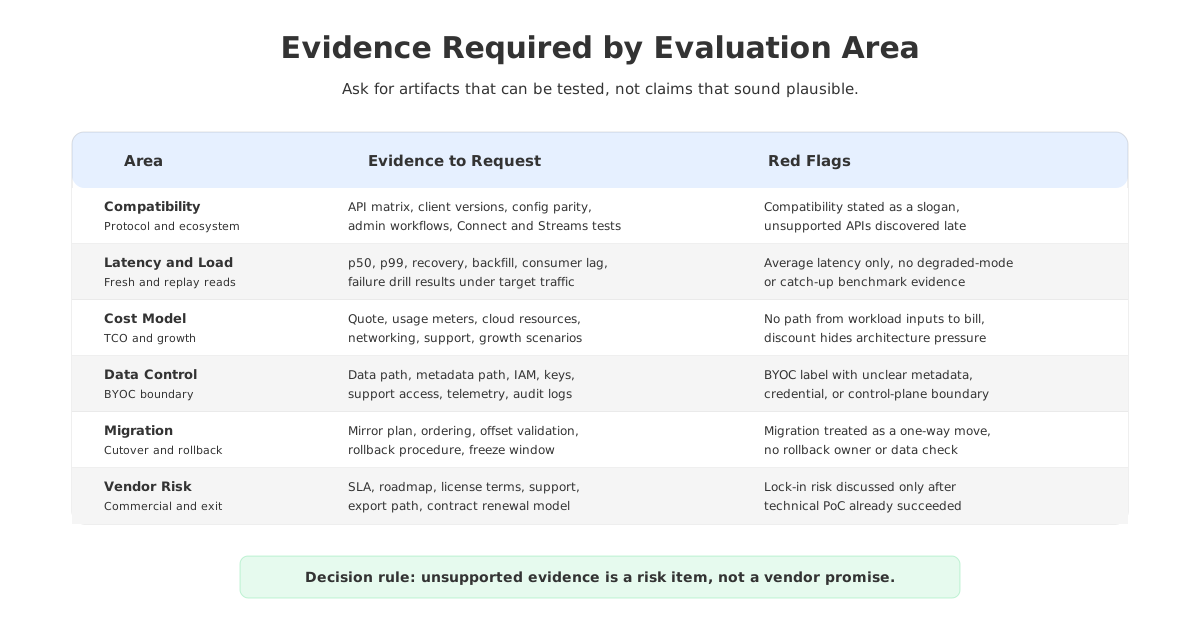
"Kafka-compatible" is a starting point, not a conclusion. Redpanda documents compatibility for Kafka clients developed for Apache Kafka 0.11 or later, with documented limitations and feature notes. Apache Kafka itself defines a much larger operational surface: producers, consumers, transactions, idempotence, ACLs, quotas, topic configuration, consumer groups, admin APIs, Kafka Connect, Kafka Streams, and observability integrations.
Ask every candidate for a compatibility matrix that maps your actual estate, not an abstract Kafka checklist:
- Client versions and languages: Java, Go, Python, Node.js, C/C++, librdkafka, and any vendor-specific wrappers. Include TLS, SASL, idempotent producer, transactions, compression, and batching settings.
- Protocol and admin APIs: topic creation, partition expansion, ACLs, consumer group reset, offset inspection, quotas, config changes, and broker metadata behavior.
- Ecosystem components: Kafka Connect source and sink connectors, Kafka Streams applications, schema registry workflows, MirrorMaker 2 or Cluster Linking, stream processors, and monitoring agents.
- Operational assumptions: scripts that call
kafka-topics,kafka-configs,kafka-consumer-groups, JMX exporters, or broker-specific metrics.
The red flag is vague compatibility language. A platform can pass produce and consume tests while failing an admin workflow that your incident process depends on.
3Workload Profile Checklist
Many failed evaluations use the wrong workload. A demo cluster with one topic, one producer, and one consumer cannot tell you how the platform behaves during replay, scaling, or broker replacement.
Capture these inputs before you ask for architecture opinions:
- Traffic shape: peak and average ingress, egress fanout, message size distribution, compression ratio, producer batch settings, and busiest-hour patterns.
- Topic shape: topic count, partition count, replication settings, compaction, delete retention, tombstone behavior, and hot partitions.
- Read behavior: tailing reads, catch-up reads, replay jobs, analytics exports, long-idle consumers, and recovery time objectives.
- Growth and seasonality: expected 12-month growth, campaign spikes, batch windows, region expansion, and non-production environments.
- Failure events: broker loss, storage impairment, AZ impairment, retry storms, consumer lag, and migration overlap.
This is where Redpanda, Kafka/MSK, Confluent, WarpStream, and AutoMQ separate. Broker-centric systems keep hot data close to serving nodes; shared-storage systems change the scaling, recovery, and object-storage assumptions that the PoC must test.
4Latency Checklist
Latency claims are often true under the conditions that produced them. Find out whether those conditions match production. Do not accept one average number. Measure p50, p95, p99, and max under steady traffic, burst traffic, consumer lag, replay, upgrade, and failure recovery.
Define at least four latency scenarios:
| Scenario | What to measure | Why it matters |
|---|---|---|
| Hot tailing | Produce-to-consume p50 and p99 for fresh records | Validates user-facing streams and online services |
| Catch-up | Throughput and p99 while consumers replay retained data | Validates recovery, backfill, and incident workflows |
| Failure mode | Latency during broker, node, AZ, or storage impairment | Exposes architecture behavior under stress |
| Migration overlap | Latency while mirroring, dual writing, or validating offsets | Prevents a clean PoC from hiding cutover risk |
Redpanda's local hot path may be attractive for latency-sensitive streams. AutoMQ, WarpStream, Kafka/MSK, and Confluent still need tests that include replication, object storage, managed-service limits, cache behavior, and broker replacement. The right result is the number that survives your cost, recovery, and data-control constraints.
5Cost Model Checklist
Cost evaluation should be workload-based. Redpanda Cloud, Confluent Cloud, Amazon MSK, WarpStream, and AutoMQ expose different meters, so comparing a unit price without mapping the workload is noise.
Build one worksheet with the same inputs for every candidate:
- Platform charges: subscription, usage meters, cluster hours, partitions, storage, ingress, egress, compute, support, and minimum commitments.
- Cloud charges: instances, block storage, object storage, API operations, load balancers, private networking, cross-AZ or cross-region traffic, observability, and backups.
- Operational charges: SRE ownership, upgrades, incident response, migration overlap, validation, and non-production environments.
- Growth cases: current, committed growth, stress growth, and failure/replay scenarios.
Discounts can change the final number, but they do not change the cost slope. If retention, fanout, or peak headroom grows faster than platform budget, architecture matters more than the quote. Shared-storage and object-storage-first options may change storage and recovery economics; broker-centric options may preserve lower hot-path latency with more local capacity coupling.
6Scaling and Recovery Checklist
Scaling is not "can I add capacity?" The useful question is what has to move when capacity changes. Broker-centric systems connect partition placement, local state, and broker capacity; shared-storage systems shift the test toward metadata, object storage, WAL, cache warm-up, and control-plane coordination.
Run these drills with production-shaped traffic:
- Add capacity under peak load and record time to rebalance.
- Remove capacity and watch for data movement, leadership movement, cache effects, and user-visible latency.
- Terminate a broker or serving node and measure recovery time, data availability, and client errors.
- Run high-lag replay while scaling the serving layer.
- Validate partition expansion, hot-partition mitigation, and quotas.
The red flag is a scaling story that only discusses steady-state scale-out. Real platforms also scale down, replace failed nodes, recover from lag, and absorb uneven topics.
7Operations Checklist
Operations are where elegant architectures become daily work. A managed service may reduce operational scope, but it does not eliminate ownership. BYOC may improve visibility and control, but it increases the importance of IAM, networking, cloud quotas, and runbooks.
Evidence to request:
- Monitoring: SLO dashboards, broker or agent metrics, storage metrics, consumer lag, request latency, error codes, cloud metrics, and alert examples.
- Upgrade process: version policy, maintenance windows, rollback path, compatibility notes, and change authority.
- Incident process: support SLA, escalation path, diagnostic access, log collection, and known failure modes.
- Production operations: topic lifecycle, ACLs, quotas, certificate rotation, key rotation, network changes, and capacity forecasting.
For Redpanda, review streaming engine operations and Redpanda Cloud responsibility boundaries. For MSK and Confluent, review managed-service limits and support boundaries. For WarpStream and AutoMQ, review how stateless serving layers interact with object storage, metadata, and customer cloud resources.
8Data Control and BYOC Checklist
BYOC is not one thing. It can mean customer-owned data-plane infrastructure, networking, storage, keys, or some combination of these with a provider-managed control plane. The security review should draw the data path and metadata path separately.
Ask every vendor to answer these questions in writing:
- Where are Kafka records stored, and who controls the storage account or bucket?
- What metadata leaves the customer account, and can it contain topic names, offsets, file names, schemas, principals, or operational details?
- Which identities can access brokers, agents, object storage, logs, metrics, keys, and control APIs?
- How are support sessions authorized, audited, and revoked?
- What happens if the vendor control plane is impaired?
- How are backups, deletion, retention, and legal hold handled?
Redpanda Cloud, WarpStream, and AutoMQ use different BYOC boundaries. Draw them as architecture diagrams instead of summarizing them as "supports BYOC."
9Migration Checklist
Migration is where compatibility claims become operational facts. A Redpanda replacement project has to move producers, consumers, offsets, topic configuration, ACLs, monitoring, and runbooks.
Use this migration checklist:
- Inventory: topics, partitions, configs, ACLs, schemas, clients, consumer groups, connectors, and retention classes.
- Replication plan: source-to-target replication method, ordering expectations, data validation, lag targets, and backpressure behavior.
- Offset strategy: consumer group offset translation, validation, freeze window, and rollback behavior.
- Cutover plan: producer migration, consumer migration, DNS or bootstrap changes, monitoring, and stakeholder sign-off.
- Rollback plan: rollback time limit, data divergence handling, ownership, and cleanup.
The red flag is a migration plan with a forward path but no rollback path. Another red flag is treating offset migration as an implementation detail.
10Vendor Risk Checklist
Vendor risk is not only procurement's problem. It affects architecture because it determines how reversible your decision is.
Review these areas before the PoC is declared successful:
- Commercial model: commitment, renewal, overage terms, support tier, marketplace dependency, and price protection.
- License and ecosystem: client compatibility, open-source components, service restrictions, and portable tooling.
- Roadmap dependency: features needed for your workload and alternatives if delivery slips.
- Exit path: data export, topic recreation, offset, schema, connector migration, and termination support.
- Organizational fit: whether SRE, security, FinOps, and application teams can operate within the model.
This is also where AutoMQ should be evaluated without turning the article into an AutoMQ pitch. If the concern is data control, elastic recovery, or reducing broker-local storage coupling while keeping Kafka compatibility, AutoMQ is a reasonable candidate to test.
11PoC Criteria Checklist
A PoC should fail fast when a candidate does not fit. Write the pass/fail gates before the vendor workshop.
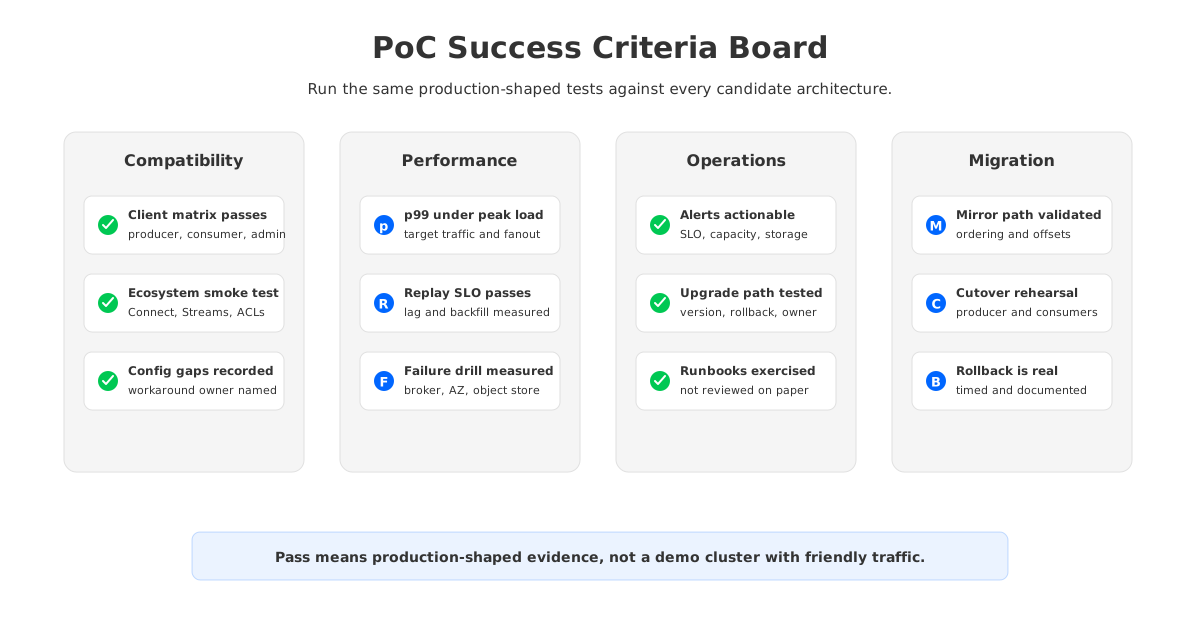
Minimum PoC gates:
- Compatibility gate: critical clients, admin workflows, security settings, connectors, stream processors, and monitoring agents pass or have accepted workarounds.
- Performance gate: p99 latency, replay throughput, and failure behavior meet targets under production-shaped traffic.
- Cost gate: current and growth-case TCO is traceable to documented meters, quote terms, and cloud assumptions.
- Operations gate: monitoring, alerting, upgrade, rollback, incident, and support workflows are exercised by the owning team.
- Data-control gate: security approves data path, metadata path, IAM, keys, telemetry, support access, and deletion behavior.
- Migration gate: cutover and rollback are rehearsed, with offset and data validation documented.
Document the result as a decision record: what passed, what failed, what was waived, and who accepted the risk.
12AutoMQ Evaluation Notes
AutoMQ should appear in a Redpanda alternative evaluation when the team wants Kafka compatibility but is questioning the cost and operational consequences of broker-local durable storage. Its public documentation describes a shared-storage architecture based on S3Stream, object storage, and stateless brokers.
Evaluate AutoMQ with the same checklist:
- Validate Kafka clients, admin tooling, Kafka Connect, Kafka Streams, schema workflows, ACLs, and observability.
- Test WAL-backed write latency, tailing reads, catch-up reads, object storage behavior, and broker replacement.
- Model BYOC cloud resources, object storage, networking, support, telemetry, and operational ownership.
- Review data and control boundaries for the specific deployment model.
- Rehearse migration from the current Redpanda or Kafka-compatible estate.
The architecture may be attractive when retention, replay, elastic recovery, or data-control requirements dominate the roadmap. It still has to prove itself against your workload. To compare it with your Redpanda assumptions, talk to the AutoMQ team.
13References
- Redpanda Kafka client compatibility
- Redpanda Tiered Storage documentation
- Redpanda Cloud billing documentation
- Redpanda Cloud deployment options
- Redpanda Cloud BYOC architecture
- Redpanda pricing page
- Apache Kafka official documentation
- Confluent Cloud cluster types
- Amazon MSK provisioned throughput documentation
- WarpStream billing documentation
- AutoMQ architecture overview
- AutoMQ S3Stream shared storage overview
- AutoMQ Cloud overview
- AutoMQ GitHub repository
- AutoMQ pricing calculator
14FAQ
14.1What should a Redpanda alternative checklist include?
It should include Kafka compatibility, workload profile, latency, cost model, scaling and recovery, operations, data control, migration, vendor risk, and PoC criteria. Each item should map to evidence: official documentation, a quote, a reproducible test, a runbook, or a decision record.
14.2Is Redpanda compatible with Kafka clients?
Redpanda documents compatibility with Kafka clients developed for Apache Kafka 0.11 or later, with documented exceptions and feature notes. Platform teams should still test their own clients, admin APIs, connectors, stream processors, security settings, and operational scripts.
14.3Which Redpanda alternatives should platform teams evaluate?
Common alternatives include Apache Kafka, Amazon MSK, Confluent Cloud, WarpStream, and AutoMQ. The right short list depends on whether the team is optimizing for managed operations, Kafka ecosystem breadth, object-storage economics, shared-storage architecture, BYOC control, or low-latency broker-centric performance.
14.4How should cost be compared across Redpanda alternatives?
Use one workload model for every candidate: ingress, egress, retention, partitions, read fanout, replay frequency, peak-to-average ratio, cloud region, availability-zone strategy, support terms, and growth assumptions. Then map those inputs to each vendor's documented billing meters and surrounding cloud costs.
14.5When should AutoMQ be included in the evaluation?
Include AutoMQ when the team wants Kafka compatibility but is evaluating shared storage, stateless brokers, object-storage-backed durability, BYOC deployment, or a different cloud cost curve. It should be tested with the same compatibility, latency, recovery, operations, data-control, and migration gates as every other candidate.


